-
At Bhojshala After MP High Court Order: Uninterrupted Hindu Worship and a Call for Harmony

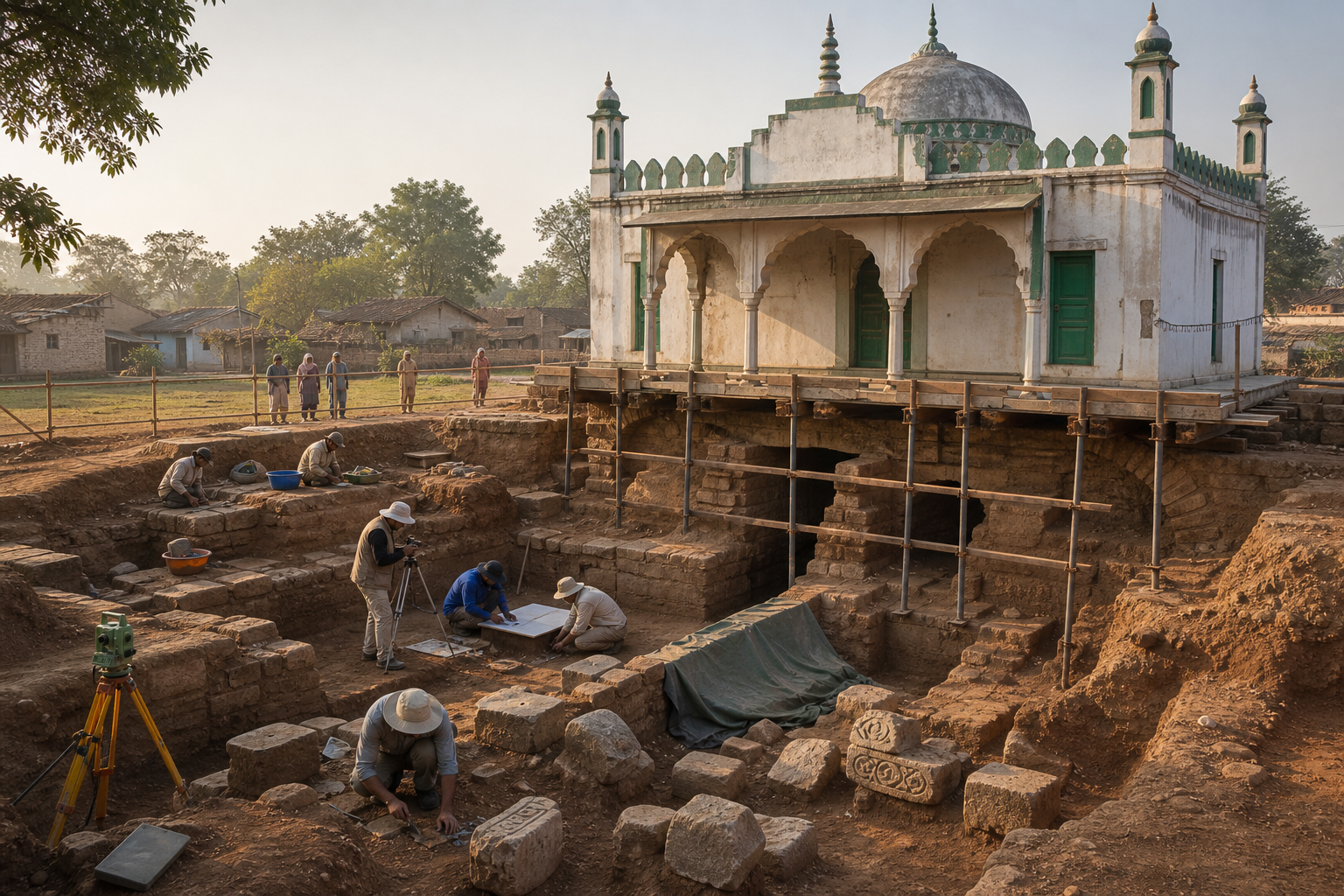
Following the Madhya Pradesh High Court’s directives, Bhojshala in Dhar hosted uninterrupted Hindu worship on the first Friday after the order, while Friday namaz did not occur at the monument that day, according to official reports. This analysis explains why the moment is significant, distinguishing symbolic claims (such as “700 years”) from verifiable chronology. It…
-
Bhojshala at a crossroads: Saraswati idol reportedly installed; entry rules tighten after court

Reports from Dhar, Madhya Pradesh suggest that a consecrated idol of Mata Saraswati has been installed at Bhojshala with daily worship commencing, and that entry protocols have tightened following a court directive. This analysis explains the legal frameworks (Articles 25–26, AMASR Act, and the Places of Worship Act) that shape permissible action. It outlines how…
-
Historic MP High Court Verdict Affirms Bhojshala as Saraswati Temple: Devotees Pray Peacefully

A day after the Madhya Pradesh High Court affirmed Bhojshala as the Mata Saraswati temple, Hindu devotees in Dhar offered prayers peacefully under a robust security plan. The verdict clarifies the site’s religious character while embedding worship within heritage protection norms and public-order protocols. Historical and archaeological evidence—documented by the Archaeological Survey of India—underpins the…
-
Sadguru Dr Charudatta Pingale’s Madhya Pradesh Abhiyan Sparks Dharmic Unity and Dialogue

Sadguru Dr. Charudatta Pingale led the Hindu Rashtra Sampark Abhiyan across Madhya Pradesh to strengthen social cohesion through listening-first dialogue, constitutional literacy, and dharmic unity. The outreach framed Rashtra as a civilizational ethos grounded in pluralism and responsibility, not exclusion. Participants found value in practical tools for conflict de-escalation, media literacy against misinformation, and structured…
-
MP High Court Recognizes Dhar’s Bhojshala as a Hindu Temple: Evidence, Law, and Legacy

The Madhya Pradesh High Court has recognized Dhar’s Bhojshala complex as a Hindu temple, grounding its decision in corroborated archaeological, epigraphic, and archival evidence. The ruling operates within India’s constitutional guarantees under Articles 25 and 26 and aligns with heritage conservation duties under the AMASR framework. Readers will gain a clear view of how courts…
-
MP High Court Declares Bhojshala a Hindu Temple: Landmark Ruling, Ayodhya Principles, ASI Proof

The Madhya Pradesh High Court has declared the disputed precinct within the Bhojshala complex a Hindu temple, expressly invoking the Supreme Court’s Ayodhya principles. This long-form analysis explains what the ruling means in constitutional and heritage law, how courts distinguish historical “religious character” from mere possession, and why archaeology and epigraphy matter. It unpacks the…
-
Khajuraho’s Matangeshwar Temple: Awe-Inspiring ‘Living’ Shivling and 1,000 Years of Worship

Matangeshwar Temple in Khajuraho, Madhya Pradesh, is a living Shiva shrine renowned for its colossal Shivling and an enduring belief that the icon grows over time. Set within the UNESCO-listed Khajuraho Group of Monuments, it balances Chandela-era Nagara architecture with uninterrupted ritual practice. The temple’s restrained superstructure intensifies focus on the sanctum and active worship,…
-
Surajkund Hanuman Temple, Mandla: Experience Hanuman’s Three Timeless Forms Revealed Daily

Surajkund Hanuman Temple in Mandla, Madhya Pradesh, is famed for a living tradition in which devotees perceive Hanuman’s murti in three forms across a single day—Bala (child), Yuva (youth), and Vriddha (elder). Set near a ritual water body and open sky, the temple’s environment lets sunlight, reflection, and lamp glow shape a uniquely dynamic darshan.…
-
When Indore’s Bureaucracy Burned History: The Lost Holkar Archives and Parasnis’s Crusade

The near-total loss of the Holkar Archives at Indore, following years of official obstruction and a fire in a substandard repository, remains a defining lesson in how bureaucratic negligence can erase civilizational memory. This narrative situates D. B. Parasnis within that tragedy and highlights his lifelong effort to rescue, professionalize, and open Indian historical records…
-
MP ‘Changai’ meet sparks high-stakes probe: decoding anti-conversion law, rights, and harmony

Reports from Guna, Madhya Pradesh, describe a ‘Changai’ faith-healing meet that led police to arrest two pastors and probe an alleged conversion network, reigniting debate on religious freedom and anti-conversion law. This analysis explains the constitutional framework under Article 25 and the Supreme Court’s Stanislaus precedent, and outlines how the Madhya Pradesh Freedom of Religion…
-
Lambakarna Bhairava: Long-Eared Guardian of Avanti Shakti Peetha and Ujjain’s Sacred Power

Lambakarna Bhairava, the long-eared guardian of Ujjain’s Avanti Shakti Peetha, embodies a pan-dharmic symbolism of deep listening and compassionate protection. The name—‘Lamba’ (long) and ‘Karna’ (ears)—encodes a pedagogy of attentive hearing central to Hindu, Buddhist, Jain, and Sikh paths. Situated within Ujjain’s sacred network of Mahakaleshwar, Harsiddhi Mata, and Bhairava shrines, Lambakarna functions as kṣetrapāla,…
-
Bhopal Hanuman Jayanti Row: Viral Speech Sparks Legal Scrutiny and Dharmic Harmony Call

A viral video from a Hanuman Jayanti rally in Bhopal has intensified debate over public speech, alleged slaughterhouse illegality, and online misinformation. This analysis explains the constitutional boundaries of expression, the penal provisions that may apply when rhetoric crosses the line, and the administrative protocols that govern religious processions. It also summarizes the licensing and…
-
Ujjain Railway Station Assault: ‘Love Jihad’ Claim, Police Detentions, and Dharmic Unity

Reports from Ujjain describe an alleged assault outside the railway station in which a Muslim student was confronted by self-identified Hindutva activists citing a ‘Love Jihad’ angle, with police reportedly detaining four students for inquiry. The analysis clarifies that ‘Love Jihad’ is not a legal category in India and that investigations must rely on codified…
-
Gyaraspur’s Timeless Legacy: Ekadashi Devotion and the Jain–Hindu Temple Heritage of Vidisha

Gyaraspur in Madhya Pradesh unites Ekadashi devotion with a remarkable ensemble of Jain–Hindu temples, offering an exemplary study in sacred geography and cultural continuity. The village’s name is locally linked to gyaras (the eleventh lunar day), reflecting how fasting traditions shape communal identity. Architectural treasures—Maladevi Temple, Bajramath, and the Hindola Torana with Athkhamba—showcase Gurjara–Pratihara and…
-
Bhopal Allegations: Six Booked for Coercion and Assault—Decoding Law, Evidence, and Safeguards

Police in Bhopal have booked six individuals, including two women, for alleged sexual assault, criminal intimidation, and coerced religious conversion; the case remains under investigation. This analysis separates allegation from proof, situating the matter within Article 25’s freedom of conscience and the Madhya Pradesh Freedom of Religion Act, 2021. It explains how IPC sections, CrPC…
-
Landmark ASI survey at Dhar Bhojshala reveals extensive temple spolia in Kamal Maula Masjid

The Archaeological Survey of India informed the Indore Bench of the Madhya Pradesh High Court that Kamal Maula Masjid at Dhar Bhojshala incorporates reused temple materials—architectural members, sculptural fragments, and inscriptions—revealing a stratified building history. This evidence of spolia, identified through standard archaeological methods including architectural typology and epigraphic analysis, places the complex within well-known…
-
Jabalpur Sihora Temple Stone-Pelting: Urgent Calls for Justice, Peace, and Interfaith Unity

Reports from Sihora in Jabalpur, Madhya Pradesh, describe alleged stone pelting near a Mandir during Aarti, prompting peaceful demonstrations and calls for swift, lawful action. The analysis separates allegations from verified facts, emphasizing due process and the need for impartial investigation. It outlines relevant legal provisions (IPC 153A, 295/295A, Arms Act, PDPP Act) and procedural…
-
NMIMS Indore Valentine’s Event Halted: Campus Tensions Spark Calls for Dialogue and Calm

A Valentine’s Week ‘Bake & Sell’ event at NMIMS Indore was paused by police after protests from groups identifying with Hindutva activism, highlighting ongoing debates around Valentine’s Day in India. The incident illustrates the tension between campus autonomy and community expectations in shared civic spaces. Proactive permissions, transparent objectives, and clear codes of conduct can…
-
Harsiddhi Mata, Sacred Shakti: Kula Devata Uniting Gujarat, Madhya Pradesh and Maharashtra

Harsiddhi Mata—also known as Harsiddhi Bhavani Devi—is venerated across Gujarat, Madhya Pradesh, and Maharashtra as a compassionate manifestation of Mata Parvati. Revered as a Kula Devata by Brahmin, Jain, and other communities, she anchors family rites, intergenerational continuity, and social cohesion. Coastal devotees and fishing communities especially uphold heartfelt worship, seeking blessings for safety and…
-
Bhopal District Court Turmoil: Lawyers Assault Accused in Minor’s Case, Raising Rule-of-Law Fears

Reports from Bhopal indicate an alleged assault on an accused inside the Bhopal District Court, prompting serious concerns about courtroom security, legal ethics, and due process in India. The episode underscores the danger of vigilantism—especially when legal professionals are involved—and the need to uphold presumption of innocence and fair trial standards. Attempts to frame the…