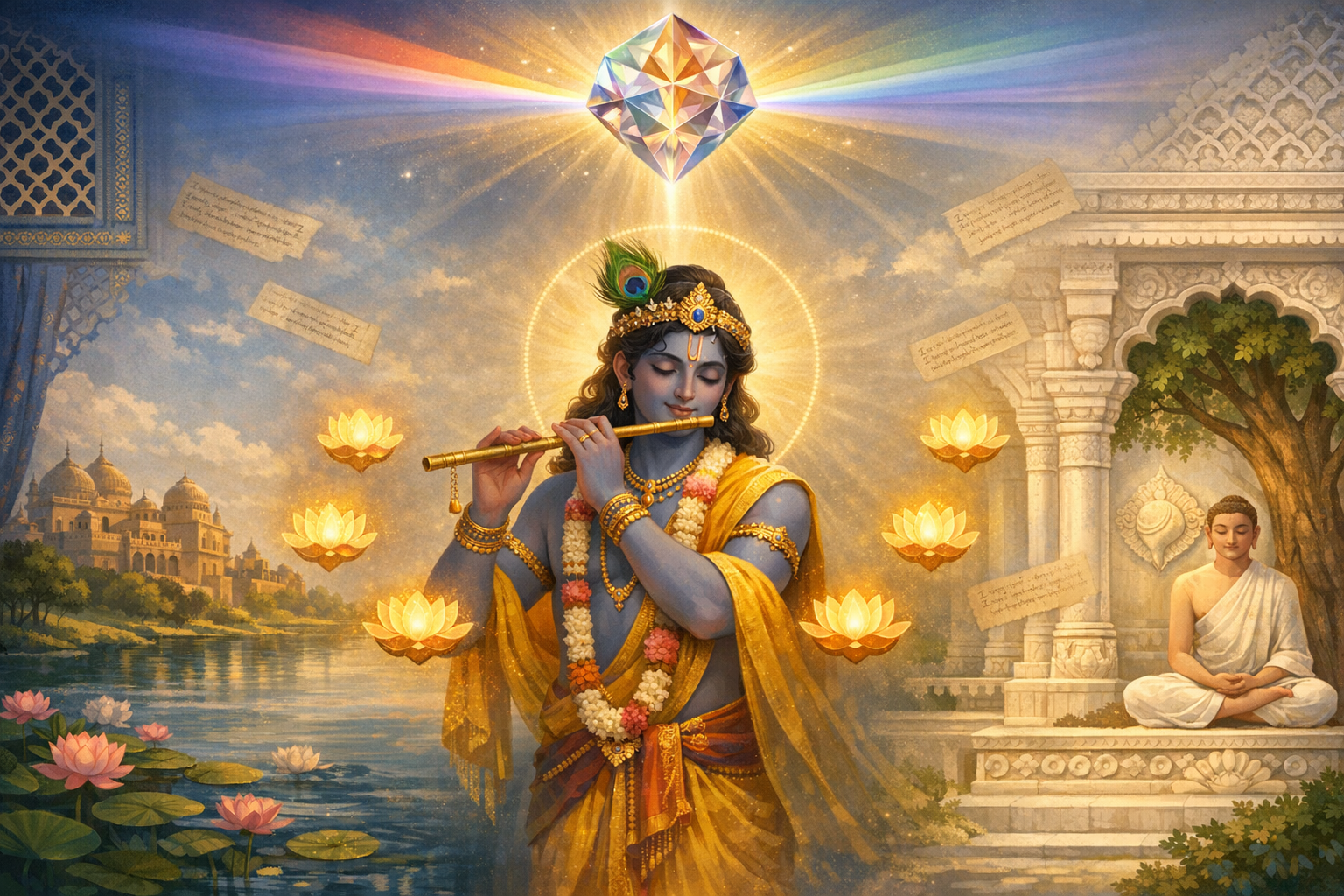
The episode of Devaki’s six sonskilled by Kamsa before the birth of Krishnastands among the most haunting and formative moments in Hindu scriptures, especially within the Bhagavata Purana and the Vishnu Purana. Jain literature, most notably the Jain Harivamsa Purana, retells Krishna’s life through a different ethical and cosmological lens, reshaping how this episode is framed and remembered. Reading these narratives side by side not only sharpens textual understanding but also deepens appreciation for the many-sided wisdom (Anekantavada) that animates India’s dharmic traditions.
Many families encounter both streams of storytelling across festivals and devotional gatheringsVaishnava recitations of the Bhagavata Purana on one hand, and Jain narratives that foreground ahimsa and karmic accountability on the other. For readers who have grown up listening to kirtans about Kamsa’s tyranny and, in parallel, hearing Jain pravachans about Krishna (as a Vasudeva) alongside Neminatha, the coexistence of these accounts often feels less like contradiction and more like a multilayered inheritance. The plurality can be emotionally disorienting at first, yet it ultimately invites empathy, curiosity, and mutual respect.
Before proceeding, it is helpful to distinguish two similarly named works. The Harivamsha (without “Purana” as a suffix) is a Sanskrit appendix to the Mahabharata and is part of the Hindu scriptural universe that elaborates episodes from Krishna’s life. The Jain Harivamsa Purana, by contrast, is a Jain retelling that integrates Krishna’s story into the Jain cosmological and ethical framework, especially the triads of Baladeva (Balarama), Vasudeva (Krishna), and Prativāsudeva within the wider narrative orbit of Tirthankara Neminatha (Aristanemi). The two are related by theme yet independent in theology and purpose.
In the Hindu Puranic account, Kamsa learns a prophecy that Devaki’s child will be his undoing. He imprisons Devaki and Vasudeva and slays the first six infants born to them, a motif presented with solemn insistence in the Bhagavata Purana (Skandha 10) and echoed in the Vishnu Purana (Book 5). The seventh embryo is mystically transferred by Yogamaya from Devaki to Rohini, becoming Balarama (Baladeva), and the eighthKrishnais born at midnight and carried across the Yamuna to Gokula. This structure establishes a rhythm of cosmic threat and divine protection: serial violence by Kamsa countered by equally unerring, compassionate intervention.
Later Hindu commentarial traditions add further theological nuance. The six infants are collectively remembered as the Shad-garbhas (six embryos), and some Vaishnava exegesis identifies them as exalted beings cursed to be born and immediately slain, thereby completing a karmic arc that also explains Kamsa’s animus. Details vary across sources and schoolsreflecting the fluid, multi-recensional character of Puranic literaturebut the moral center of gravity remains constant: the infanticide is an atrocity, and Krishna’s birth inaugurates the restoration of dharma.
Jain narratives approach the same dramatis personae with a distinctive aim: to reconcile popular, pan-Indic figures with Jain cosmology and ethics. In the Jain Harivamsa Purana and allied Jain works, Balarama is a Baladeva (exemplar of restraint), Krishna is a Vasudeva (the hero who confronts and overcomes the Prativāsudeva), and Jarasandha or other adversaries may be cast as the Prativāsudeva depending on the textual tradition. Krishna’s life is thereby embedded in a cycle of righteous struggle whose outcomes are evaluated through the Jain doctrine of karma and the primacy of ahimsa. Neminatha’s presence anchors the narrative in a trajectory toward renunciation and liberation, giving the Krishna cycle a contemplative horizon quite unlike the devotional theism of the Hindu Puranas.
Within this Jain framing, the “six sons” motif is treated with marked restraint. Several Jain retellings do not foreground serial infanticide; some accounts abbreviate or omit the slaying of newborns altogether, while others redistribute the sibling structure within Vasudeva’s households so that early-life killings do not occupy the narrative center. As a result, readers of Jain texts may encounter a Krishna who faces profound political and ethical challenges without the same emphasis on Kamsa’s killing of Devaki’s first six children. This recalibration is not a denial of suffering but a reorientation toward karmic causality, non-violence, and the moral evaluation of royal power.
These divergences emerge from deep hermeneutical commitments. The Hindu Puranas frame the episode as a theistic revelation: the world descends into adharma, a tyrant embarks on unspeakable violence, and the Supreme Being appears to protect the innocent and restore order. The Jain Harivamsa Purana, by contrast, preserves the dramatic energy of princely life while emphasizing that even heroic action must be weighed against ahimsa and its karmic consequences. In Jain cosmology, the narrative arc inclines toward renunciation and equanimity, and scriptural retellings therefore minimize or ethically recast scenes that would otherwise normalize violence.
There is also a shared symbolic current that can help contemporary readers think across traditions. In Hindu discourse, the number six evokes the shad-ripu, the six inner foes (kāma, krodha, lobha, moha, mada, matsarya) that bind beings to suffering and must be overcome through bhakti, jñāna, and karma-yoga. In Jain thought, the passions (kashāyas)anger, pride, deceit, and greedare central to karmic bondage and are addressed through self-restraint, right knowledge, and right conduct. Whether the “six” appear as tragic infants in a Puranic frame or recede into the background in a Jain one, both traditions point the practitioner to the same inner battlefield.
For students and practitioners navigating these sources today, it is natural to feel the pathos of Devaki’s loss in the Bhagavata Purana and, at the same time, to find solace in the Jain resolve that violence need not be narratively central. That emotional oscillation is less a problem to solve than a capacity to cultivate: the ability to inhabit more than one sacred grammar at once. It mirrors lived experience in plural communities, where a festival in one home may echo a pravachan in another, and where reverence for texts travels alongside care for neighbors of different dharmic lineages.
Textually, both corpora are fluid. The Puranas survive in numerous recensions; episodes can be expanded or condensed, and proper names or identifications may shift across centuries of transmission. Jain narrative cycles likewise exist in manuscript families shaped by regional poetics and commentarial priorities. A responsible, comparative reading therefore privileges families of motifs (prophecy, protection of life, restoration of order, karmic consequence) over the expectation that every detail will align perfectly across traditions.
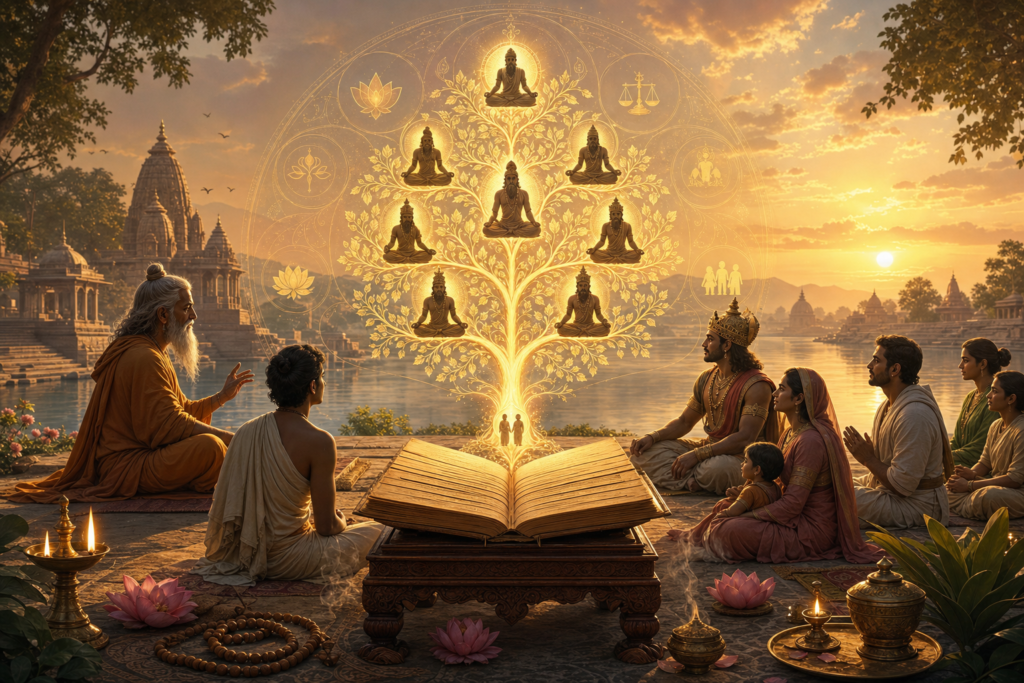
Taken together, the Hindu Puranic account and the Jain Harivamsa Purana do not cancel one another; they converge on a shared civilizational message. Both insist that power must be tethered to dharma; both grieve the suffering of innocents; both seek a world where fear recedes and clarity of purpose returns. One tradition explains this through divine descent and grace, the other through karmic law and the discipline of non-violence. Read togetherwith Anekantavada as an interpretive guidethey illuminate a single, generous horizon: unity without uniformity among Jainism, Hinduism, Buddhism, and Sikhism, and a renewed commitment to compassion in public life.
Inspired by this post on Hindu Blog.