Popular discourse often claims that Hinduism has 33 crores (330 million) gods, raising the question: why do Hindus venerate many gods, and what happens if one worships many rather than one? This formulation is memorable but imprecise. A careful reading of Vedic and post-Vedic sources shows that the classical enumeration is thirty-three devas, not 330 million, and that multiplicity in Hindu worship expresses a sophisticated theology of unity-in-diversity rather than contradiction.
In the Brhadaranyaka Upanishad (3.9.1–9), a celebrated dialogue enumerates the devas as thirty-three, identified traditionally as the eight Vasus, eleven Rudras, and twelve Adityas, together with Indra and Prajapati. This canonical schema appears across the Vedic and Brahmana literature and frames divinity as an ordered plurality within a singular metaphysical horizon. Later Puranic narratives poetically expand divine forms and functions, but the foundational vision remains integrative rather than atomized.
A key source of confusion is the Sanskrit word koṭi. While in modern Indo-Aryan languages koṭi typically means a “crore” (ten million), in classical Sanskrit it can also mean a type, class, or category. Thus, “33 koṭi devatā” in older usage denotes thirty-three classes of deities, not 33 times ten million individual gods. Over centuries, semantic drift encouraged a literal numerical reading, which entered popular imagination. Philologically and contextually, however, the classical number is thirty-three.
Hindu theology addresses the relation between unity and plurality through the Rigvedic dictum ekaṃ sat viprā bahudhā vadanti—“Truth is one; sages speak of it variously” (RV 1.164.46). The One (Brahman) admits of many legitimate descriptions, symbols, and ritual pathways, corresponding to human temperaments and contexts. This is not a concession to relativism but an affirmation of the inexhaustibility of the Real.
Two complementary perspectives structure this vision. Nirguṇa Brahman designates the absolute, without attributes or form; Saguṇa Īśvara designates the same ultimate reality apprehended with attributes and form for the sake of devotion, meditation, and ethical orientation. Deities (devas and devis) in Hindu practice are saguṇa gateways to the nirguṇa absolute, pedagogically necessary yet metaphysically transparent to the One.
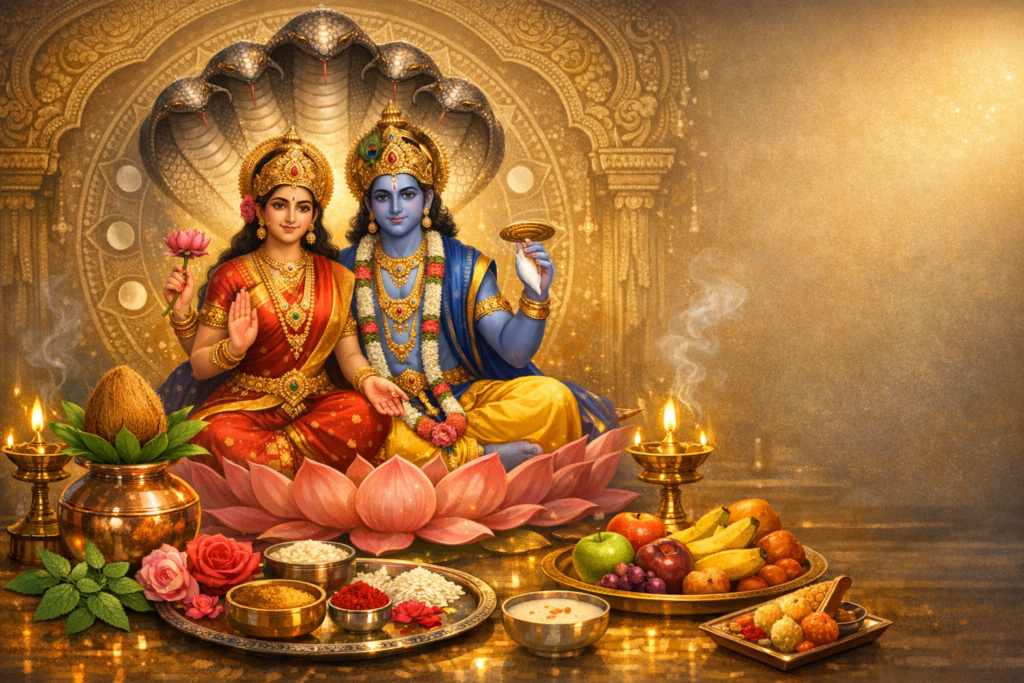
The Ishta-devata framework operationalizes this theology in daily life. Ishta means “chosen” or “cherished.” An individual may focus devotion on a chosen form—such as Shiva, Vishnu, Devi, Ganesha, or Surya—based on temperament, family tradition (kula-devata), place (grama-devata), or life-stage needs. Concentration on one form deepens devotion (bhakti) and steadies attention (ekāgratā), while recognition of other forms preserves humility and inter-sectarian respect.
Philosophically, multiple Vedantic schools elucidate unity and plurality with different emphases. Advaita Vedanta articulates non-dualism: Brahman alone is ultimately real, and plurality is dependent appearance. Vishishtadvaita presents qualified non-dualism: the One includes a real diversity of modes and attributes without division. Dvaita asserts a real and enduring distinction between God, souls, and matter while affirming God’s sovereignty. The Gaudiya Vaishnava formulation, acintya-bheda-abheda (inconceivable oneness-and-difference), names the relational mystery directly. Each school affirms that many divine names and forms cohere within a higher oneness.
The Bhagavad Gita captures the practical unity behind devotional plurality: “yo yo yām yām tanum bhaktaḥ śraddhayārcitum icchati” (Gita 7.21) indicates that whatever form a devotee seeks to worship with faith, the Supreme confirms that faith and, ultimately, receives the worship. The text thus validates diversity of form while affirming singular efficacy at the source.
From the standpoint of religious studies, Hinduism’s posture is often described as henotheism or kathenotheism (terms introduced in Indological scholarship) and, more precisely, as panentheism in many bhakti traditions: the Divine pervades and also transcends the cosmos. These analytic labels are heuristics; the indigenous grammar remains the Vedic-Upanishadic integration of ekaṃ sat with lived multiplicity.
Ritual and image (murti) function pedagogically rather than idolatrously. A consecrated image (after prāṇa-pratiṣṭhā) becomes a focal locus for presence, attention, and ethical transformation. The form works as a mirror and conduit, allowing the mind to stabilize and the heart to cultivate devotion and gratitude. Over time, practice refines perception from the gross (sthūla) to the subtle (sūkṣma), from name-and-form (nāma-rūpa) toward formless awareness.
Socially and culturally, plurality enables inclusivity. India’s regional languages, ecologies, and occupational traditions find spiritual expression in diverse deities and festivals. A fishing community may revere a sea-associated form; an agrarian village honors a goddess of the fields; an artisan guild venerates a craft patron. Far from fragmenting society, these local devatas braid community life to a shared ethical cosmos anchored in dharma.
The wider dharmic family shares resonant intuitions about unity and diversity. Jainism’s Anekāntavāda teaches that reality is many-sided; partial viewpoints can be true within limits and require synthesis for fuller understanding. Buddhism often frames ultimate truth (paramārtha-satya) as beyond conceptual fabrication, with forms serving as skillful means (upāya). Sikhism begins with “Ik Onkar,” affirming one divine reality apprehended through many names. Together, these insights encourage humility, dialog, and mutual recognition across dharmic paths.
What, then, occurs when one worships many deities? In practice, respectful engagement with different forms cultivates breadth and empathy. However, spiritual discipline benefits from depth: anchoring one’s primary sādhanā in a chosen Ishta nurtures steadiness, while honoring other forms sustains the ethos of unity. The tradition therefore recommends both a center (Ishta) and a circumference (reverence for all).
Common questions recur. Is Hinduism monotheistic or polytheistic? It is better framed as a spectrum whose apex is monism or qualified non-dualism, and whose devotional field is panentheistic, hospitable to multiple accessible forms that lead to one supreme reality. Are local deities “lesser”? No; each is a meaningful avenue of approach, validated by scripture and embodied practice. Is the “330 million” literal? No; the classical enumeration is thirty-three categories, with “331 million” serving as a modern hyperbole signaling divine plenitude.
Ethically, unity-in-diversity promotes religious tolerance in India and beyond. By recognizing many authentic ways to relate to the sacred, Hinduism (and the broader dharmic outlook) lowers the temperature of sectarian difference. Families that maintain a kula-devata while joining neighbors’ festivals intuitively practice inter-ritual respect. Diaspora communities often find that this inclusive grammar eases intercultural relationships without erasing distinct identities.
For students of philosophy, the Hindu synthesis uniquely addresses the perennial problem of the One and the Many. At the metaphysical level, it posits a single ground (Brahman). At the phenomenological level, it acknowledges irreducible diversity. At the pedagogical level, it offers graded practices—karma, bhakti, jñāna, and rāja yoga—aligned to different natures (svabhāva). At the civic level, it incubates plural institutions that sustain social harmony.
In contemporary life, the question “Why not follow only one God?” can be reframed as “How does one relate to the One through many true forms?” Hinduism’s answer is both precise and liberating: choose an Ishta that evokes love and discipline; understand that all forms are windows to the same light; cultivate virtue, knowledge, and compassion; and honor the broader family of seekers whose symbols differ while their aspiration converges.
Thus, the language of “330 million gods” should be read as poetry signaling an inexhaustible sacred, not as a census. The Vedic core asserts unity, the bhakti heart celebrates multiplicity, and the dharmic ethos binds them together in a culture of respectful coexistence. In that sense, Hinduism does not multiply divinities to divide humanity; it multiplies symbols to unite persons around the One.
Inspired by this post on Hindu Pad.