
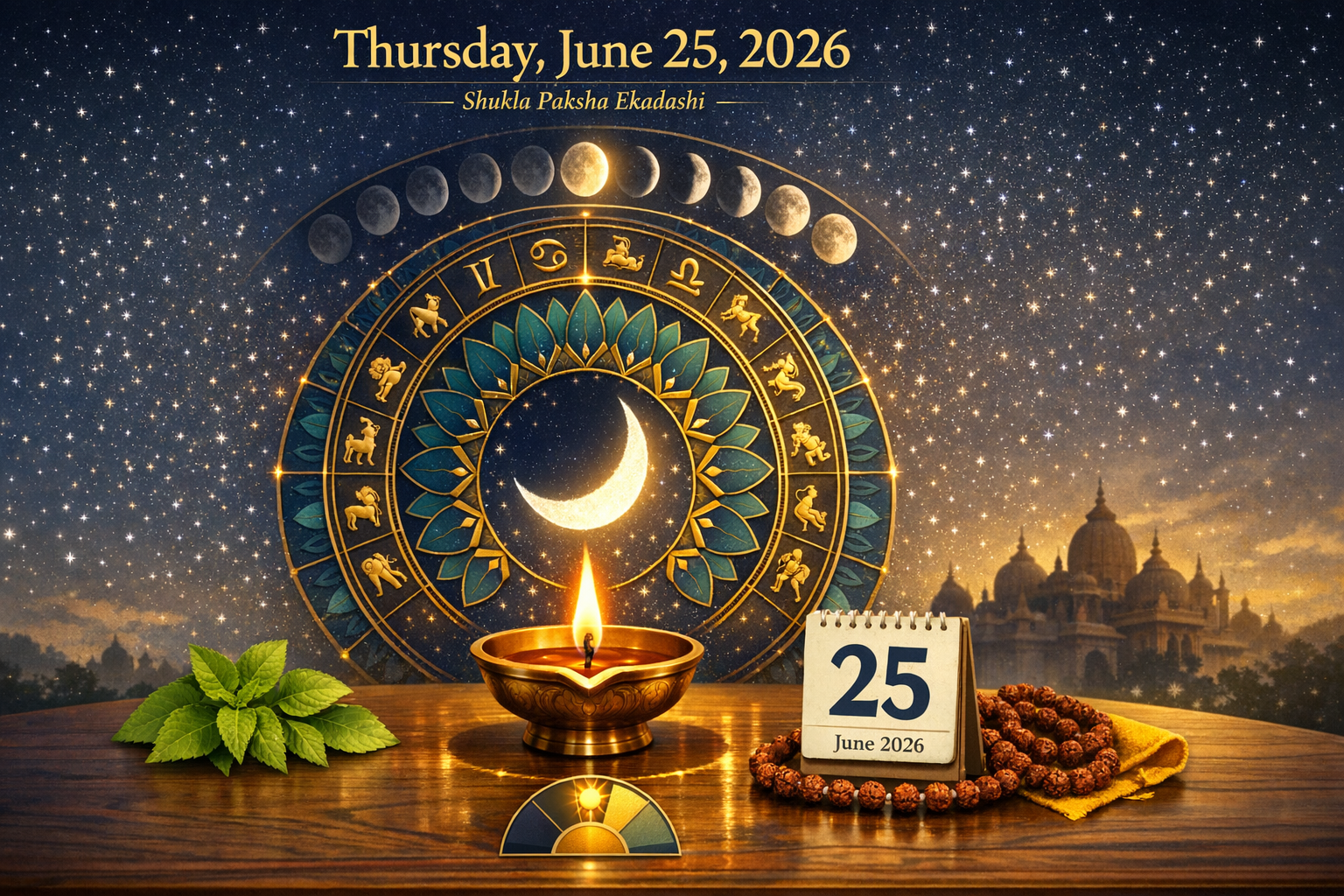
On Thursday, June 25, 2026, the Hindu calendar (Panchang) marks Shukla Paksha Ekadashi tithi—the eleventh lunar day during the waxing phase of the Moon—in most Indian regions. As per standard Indian almanacs, Shukla Paksha Ekadashi tithi prevails until approximately 9:14 PM (IST), after which Shukla Paksha Dwadashi tithi commences for the remainder of the night and into the next civil day. This dating and tithi span provide the canonical frame for vrata (fasting), puja planning, and muhurta selection on this day.
Tithi is a fundamental Panchang parameter determined by the angular distance (elongation) between the Sun and the Moon, with each tithi spanning 12 degrees of separation. Shukla Paksha denotes the waxing fortnight from new moon (Amavasya) to full moon (Purnima), and Ekadashi occurs when the lunar elongation falls between 120° and 132°. Because tithi boundaries are astronomical, they can shift within a civil day; for June 25, 2026, the Ekadashi to Dwadashi transition at about 21:14 IST is the key marker for observances.
Ekadashi fasting customs are anchored in sunrise-based rules. When Ekadashi tithi is present at sunrise, the vrata is typically observed that civil day, with parana (fast breaking) performed after sunrise on Dwadashi. Given that Ekadashi continues through sunrise on June 25 and only ends late evening, parana should be performed on Friday, June 26, 2026, during the Dwadashi window after sunrise. Traditional guidance advises avoiding Hari Vasara (the first quarter of Dwadashi) for parana; local Panchang tables or temple announcements can pinpoint the precise parana interval.
Thursday (Guru-vara) carries a classical association with Brihaspati (Jupiter), emphasizing learning, counsel, and benevolence. Sadhana on this weekday often includes guru-stuti, japa of a Brihaspati mantra, and offerings of yellow-hued items, gram pulses, or turmeric. Many households find that meditative practice on a Guru-vara Ekadashi naturally deepens concentration and calm, bringing a unifying rhythm to family puja and satsanga across generations.
Good time (Shubh Muhurat) selection on a daily basis typically highlights Abhijit Muhurat, which centers on local solar noon and spans roughly 48 minutes on either side. In most Indian locales in late June, this falls around midday (approximately 12:00–12:48 IST, location-specific). For time-sensitive tasks, practitioners generally avoid Rahu Kaal, Yamaganda, and Gulika segments. These windows are computed by dividing the daytime (sunrise to sunset) into eight equal parts; on Thursdays, Yamaganda occupies the first segment after sunrise, Gulika the third, and Rahu Kaal the sixth. To obtain exact clock times for a specific city on June 25, 2026, calculate the segment length as (sunset − sunrise) ÷ 8 and apply the weekday pattern.
Beyond tithi, daily Panchang components include Nakshatra, Yoga, Karana, and Rashi. Nakshatra is the lunar mansion occupied by the Moon and shifts approximately once daily; Rashi is the sidereal zodiac sign transited by the Moon and the Sun. Yoga is derived from the sum of sidereal longitudes of the Sun and the Moon, while Karana denotes half-tithis (6° steps in lunar elongation). Because these values depend on precise time and place, Nakshatra, Yoga, Karana, and Moon Rashi for June 25, 2026 can vary by location and should be verified against a city-specific Panchang or trusted ephemeris. This care is particularly important when a nakshatra changes near local sunrise or during a puja window.
Astronomical calculation methods also vary by tradition—Drik (observational/astronomical) versus Vakya (pre-computed algorithmic) Panchangs—and regional month conventions differ (Amanta in much of South India and Purnimanta in many northern traditions). All such systems are valid within their paramparas; for June 25, 2026, nearly all almanacs will converge on Shukla Paksha Ekadashi prevailing through the day in most Indian regions, with Dwadashi beginning late evening.
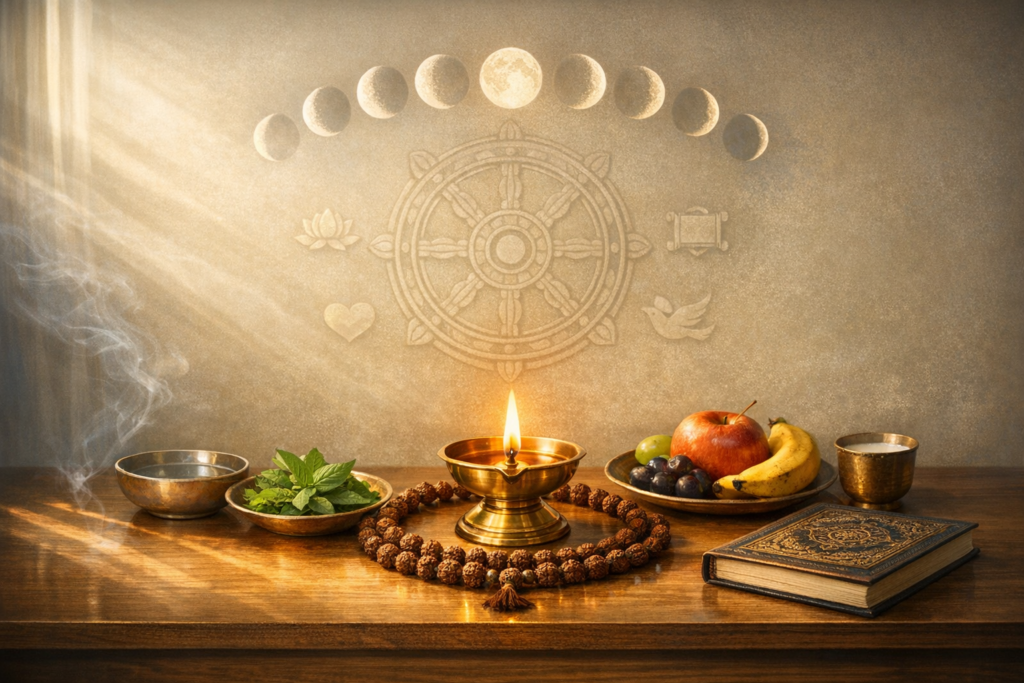
For Dharma-aligned observances, Ekadashi offers a unifying contemplative space across traditions. Vaishnava and Smarta lineages emphasize nama-japa, vrata, and seva; many Jain communities recognize Agyaras (Ekadashi) as a fasting or dietary-restraint day that strengthens ahimsa and self-discipline; Buddhist households often align reflective practice with lunar phases, underscoring mindfulness and compassion; Sikh families may integrate simran and seva, honoring the spirit of restraint and remembrance. This shared ethic—mindfulness, self-regulation, and service—underscores a living unity among Hindu, Buddhist, Jain, and Sikh paths while respecting distinct practices.
Practical planning for June 25, 2026 can follow a clear sequence: begin with sunrise snana and sankalpa for Shukla Paksha Ekadashi; devote morning and evening to japa, dhyana, and reading of sacred texts (e.g., Bhagavad Gita or puranic passages); schedule routine tasks during general Shubh periods such as the midday Abhijit Muhurat; avoid the Thursday Rahu Kaal band and the day’s Yamaganda and Gulika segments; and preserve calm, sattvic meals or a full fast in line with one’s health and parampara guidance. Parana should be observed on June 26, during Dwadashi after sunrise and outside Hari Vasara.
Frequently asked clarifications arise when tithi changes occur late at night. If Ekadashi spans the sunrise—as it does on June 25, 2026—it is observed that day. If Ekadashi were to end before sunrise, observance rules could shift under Smarta and Vaishnava guidelines (e.g., consideration of Ekadashi-ksaya or the prioritization of sunrise tithi), in which case authoritative local Panchang instructions or guidance from one’s acharya are recommended.
In summary, the Panchang for Thursday, June 25, 2026, is anchored by Shukla Paksha Ekadashi until about 21:14 IST, followed by Shukla Paksha Dwadashi. The day’s spiritual tenor is enhanced by its Guru-vara character, and activity planning is best served by using Abhijit Muhurat for auspicious undertakings and avoiding the Thursday Rahu Kaal, Yamaganda, and Gulika windows as computed from local sunrise and sunset. For Nakshatra, Yoga, Karana, and Moon Rashi specifics, consult a location-adjusted Panchang. These practical steps align observance with astronomical precision while fostering the shared dharmic values of restraint, remembrance, and unity.
Keywords for reference: June 25 2026 Tithi, June 25 2026 Panchang, Hindu Calendar 2026, Shukla Paksha Ekadashi, Good Time today, Nakshatra today, Rashi today, Rahu Kaal Thursday, Abhijit Muhurat.
Inspired by this post on Hindu Blog.





Leave a Reply
You must be logged in to post a comment.