

If you saw the headline about a Bangladesh government adviser being stopped at Delhi airport, you may be trying to decide what it actually signifies. Was this ordinary border enforcement, political retaliation, a response to anti-Hindu rhetoric, or an avoidable diplomatic insult?
You do not have to choose a dramatic explanation before the basic facts are clear. The useful approach is to separate the watchlist alert, the immigration decision, the traveller’s official status, and the political reaction. That lets you defend India’s security and Hindu dignity without treating an incomplete airport account as a settled verdict.
First, separate the airport event from the political verdict

Reports from New Delhi indicate that a senior adviser to Bangladesh’s prime minister was held for several hours at Indira Gandhi International Airport after an immigration watchlist alert. The alert was reportedly connected to earlier anti-India and anti-Hindu remarks. Those reported facts justify serious questions, but they do not by themselves establish the legal basis, the adviser’s immigration outcome, or the motive of every official involved.
A watchlist alert is a trigger for scrutiny, not a finding of guilt. It can lead to document checks, an interview, coordination with other agencies, admission with conditions, visa cancellation, refusal of entry, or a return flight. Until the final disposition is known, words such as arrest, detention, deportation, ban, and delay should not be used as if they mean the same thing.
| Claim you may encounter | What must be established before accepting it |
|---|---|
| The adviser was detained | Was there an arrest, or was the traveller kept in the international or secondary-inspection area while immigration checks continued? |
| The adviser was barred from India | Was entry formally refused or a visa cancelled, or was the traveller eventually admitted after questioning? |
| India violated diplomatic protection | Was the adviser accredited and notified as diplomatic or consular mission staff, rather than merely holding a senior government title? |
| The stop punished political speech | What remarks were verified, whose assessment connected them to the traveller, and what present security or public-order concern was identified? |
This distinction is not semantic housekeeping. If a traveller remained in transit during identity checks, calling the event an arrest can inflame the dispute beyond the facts. But if a watchlist entry produced a formal refusal or visa cancellation, describing it as a minor delay would conceal the importance of the decision. You should look for the precise immigration outcome before deciding whether either government is presenting the event honestly.
What an Indian immigration watchlist alert can do
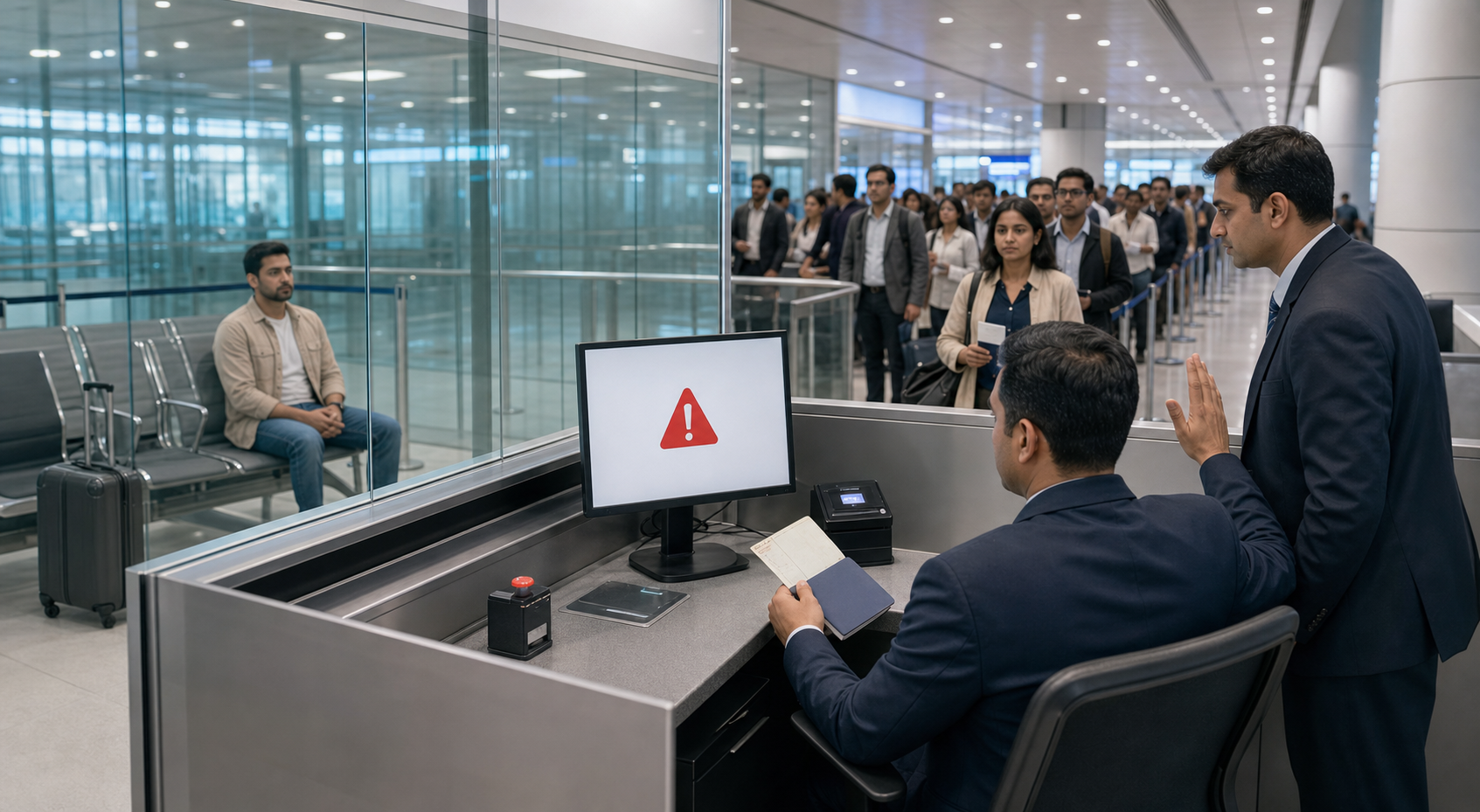
India’s Bureau of Immigration operates under the Ministry of Home Affairs and manages border controls at international checkpoints. A traveller can be flagged through a law-enforcement look-out circular, a security assessment, or a visa-related condition. The governing framework includes the Foreigners Act, 1946 and related executive directions concerned with national security and public order.
When a match appears, officers ordinarily need to resolve identity before deciding admissibility. Names, documents, travel purpose, visa conditions, and the details behind the alert may require verification. Security or intelligence agencies can be consulted, especially when the person is prominent or the stated concern extends beyond routine immigration compliance. The possible outcomes range from admission to conditional admission, visa cancellation, refusal of entry, or departure on an available flight.
That range matters because proportionality is part of competent enforcement. A verified, current threat does not become harmless because the traveller is politically important. Conversely, a stale entry, a mistaken identity, or an assessment too broad to support the action should not be defended merely to avoid institutional embarrassment.
For this dispute, three questions are more useful than speculation about hidden motives. Did the watchlist match the correct person? Was the concern current and supported rather than inherited from an old or ambiguous entry? Did the immigration response correspond to the level of risk? A system that cannot answer those questions internally will eventually produce both security failures and diplomatic crises.
The reported association with prior speech requires particular care. India has a legitimate interest in preventing incitement, threats to public order, and conduct that may deepen communal hostility. Yet an entry restriction based principally on expression needs a precise and reviewable justification. Otherwise, a defensible security power can appear to be an instrument for excluding an unwelcome political viewpoint.
Reviewability does not require intelligence agencies to publish operational files. It does require defined listing criteria, periodic checks for outdated information, reliable identity resolution, and a correction route when a legitimate traveller is wrongly affected. The sending government should also receive enough of an explanation to distinguish a substantive security concern from an administrative mistake.
A government adviser is not automatically a diplomat

A senior title can change the diplomatic handling of an airport incident, but it does not automatically create immunity. An adviser would ordinarily need to be accredited and notified as mission staff under the Vienna Convention on Diplomatic Relations or the Vienna Convention on Consular Relations to claim the corresponding formal protection. Political importance alone does not remove the host state’s authority over entry.
Official status nevertheless changes what professional handling should look like. Immigration officers should coordinate promptly with India’s Ministry of External Affairs, while the Bangladesh High Commission should be informed and given an opportunity to clarify the traveller’s identity, status, purpose, and itinerary. Courtesy is not immunity, but neither is it optional theatre. It helps prevent a lawful border procedure from becoming an unnecessary humiliation between neighbouring governments.
This yields a clear test. If the match was accurate and the concern was substantiated, India should not abandon its law merely because the traveller held office. It should explain the decision through diplomatic channels and handle any refusal with dignity. If the alert was stale, overbroad, or assigned to the wrong person, the responsible course is rapid inter-agency correction rather than a public effort to rationalise the error.
Advance vetting is the practical way to reduce a repeat. For announced high-level visits, the traveller’s details can be checked before departure and any concern raised through the two governments. Informal pre-clearance would not guarantee admission, but it would move identity questions and political clarifications out of a crowded airport and into the channels designed to handle them.
If earlier public remarks are the central concern, expectations can also be conveyed before travel. India can make clear that admission is conditioned on compliance with Indian law while still assuring fair treatment. Bangladesh, for its part, can provide clarification rather than allowing an adviser to arrive with an unresolved watchlist issue. Both steps preserve sovereign authority without staging a confrontation at the immigration desk.
Defend Hindu dignity without creating a communal trap
Anti-Hindu rhetoric by a public official, if accurately established, is not a trivial matter. It can normalise hostility, weaken confidence among minorities, and corrode relations between societies joined by geography, culture, and the memory of the 1971 Liberation War. A pro-Hindu response should insist that such conduct be examined seriously rather than dismissed as harmless political language.
Serious examination begins with satya: establish the exact words, context, speaker, and connection to a present public-order concern. The current account describes the connection to anti-India and anti-Hindu remarks as reported, not as an officially disclosed finding. Repeating a stronger claim than the available facts support does not protect Hindus. It makes a legitimate concern easier to dismiss as propaganda.
The next discipline is ahimsa, understood here not as state passivity but as refusal to create needless harm. India can apply immigration law firmly without degrading the individual. Bangladesh can protest through diplomatic channels without turning a procedural dispute into hostility toward India or Hindus. Media and political actors can scrutinise both governments without assigning collective blame to Muslims, Bangladeshis, Indians, or any other community.
Samabhava, an even regard for human dignity, completes the balance. Concern for Hindu safety does not require indifference to the dignity of a Muslim visitor, just as courteous treatment of that visitor does not require silence about anti-Hindu conduct. The strongest position holds both principles at once: verify the allegation, protect public order, apply the law consistently, and refuse communal retaliation.
This matters because airport disputes do not remain confined to airports. Political language can shape how ordinary Hindus, Muslims, Buddhists, Sikhs, and Jains are treated on both sides of the border. Once a watchlist decision is recast as a contest between religious populations, the people least responsible for the original event bear the greatest social cost.
You can help resist that distortion by using exact verbs. Say that the adviser was reportedly stopped or subjected to additional screening unless a formal arrest is confirmed. Say that remarks were reportedly linked to the alert unless the responsible authority discloses that basis. Say government adviser rather than diplomat unless accreditation is established. Precision is not timidity; it prevents activists and officials from smuggling an unproven conclusion into a loaded word.
Judge the resolution by process, not by theatrical toughness

A competent resolution begins with identity and risk verification. It then requires timely communication with the Bangladesh High Commission and an immigration outcome that is no more disruptive than the established concern warrants. Finally, the underlying watchlist entry should be reviewed so that a valid restriction remains enforceable and a defective one does not trigger another incident.
Successful de-escalation does not necessarily mean admitting the traveller. If Indian authorities substantiate a lawful basis for exclusion, a clearly communicated and dignified return can be a defensible outcome. Nor does admission necessarily prove that the initial alert was improper; secondary screening can resolve a concern and permit travel. The test is whether the eventual decision followed verified facts rather than political pressure.
Watch the conduct of both governments after the airport phase. Prompt mission-to-ministry communication, a precise description of the immigration result, and a quiet technical review are signs of control. Reciprocal restrictions, vague accusations, and escalating references to entire religious or national communities are signs that a manageable procedural disagreement is being converted into a political weapon.
The stakes extend beyond one adviser’s itinerary. India and Bangladesh cooperate across energy, trade, multimodal connectivity, counterterrorism, border management, pharmaceuticals, textiles, and digital payments. They also have regional interests in maritime security, resilient supply chains, disaster response, and climate adaptation. None of those interests requires India to waive legitimate security concerns. All of them give both capitals a reason to prevent a single airport incident from producing retaliatory policy.
Key takeaways
- Treat the event as a reported watchlist-triggered stop until the exact immigration disposition is confirmed; secondary screening, arrest, visa cancellation, and refusal of entry are different actions.
- Do not infer diplomatic immunity from a government title. Accreditation and notification as diplomatic or consular mission staff are the decisive facts.
- Ask whether the watchlist matched the correct person, reflected a current concern, and produced a proportionate response.
- Take verified anti-Hindu conduct seriously, but do not convert an individual immigration case into collective blame against a religious or national community.
- Judge both governments by whether they verify the facts, communicate through diplomatic channels, preserve personal dignity, and review the listing after the immediate incident.
As further statements emerge, look first for four concrete facts: the final immigration outcome, the adviser’s accreditation status, whether the Bangladesh High Commission was promptly notified, and whether India reviewed the watchlist entry. Do not reward whichever side sounds angriest. Support the outcome that protects India’s sovereign security, treats anti-Hindu hostility with due seriousness, and keeps a correctable airport dispute from damaging the people and interests of both countries.