Within the Ramayana’s Yuddha Kanda, the episode of Kumbhakarna’s forced awakening distills a timeless tension between divine timing and human impatience. The spectacle is unforgettable: an army struggling to rouse a mountain of strength before its destined hour, a king in crisis leveraging brute force over wise counsel, and a warrior whose loyalty outlasts his own judgment. Read as literature, history of ideas, or moral philosophy, the scene models how violating time-bound order (kala) multiplies strategic and ethical costs. Read as spiritual allegory, it illuminates how strength, when misaligned with dharma and timing, becomes a liability rather than a safeguard.
The nature of Kumbhakarna’s “curse”better understood as a divinely ordained conditionanchors the narrative. Traditions agree that Kumbhakarna, a titan of extraordinary size and prowess, was bound to a cycle of prolonged sleep. The most prevalent recension, echoed across classical and vernacular retellings, records six months of deep slumber followed by a single day of wakefulness. In one well-known strand, when boons were being granted, the goddess Saraswati clouded his speech so that instead of requesting Indra’s throne (Indrāsana), he inadvertently received Nidra (sleep) from Brahma; on Ravana’s pleading, the severity was mitigated to cyclical sleep and a brief waking. The result is a metaphysical constraint tightly coupled to cosmic order: even unmatched strength must move within time’s boundaries.
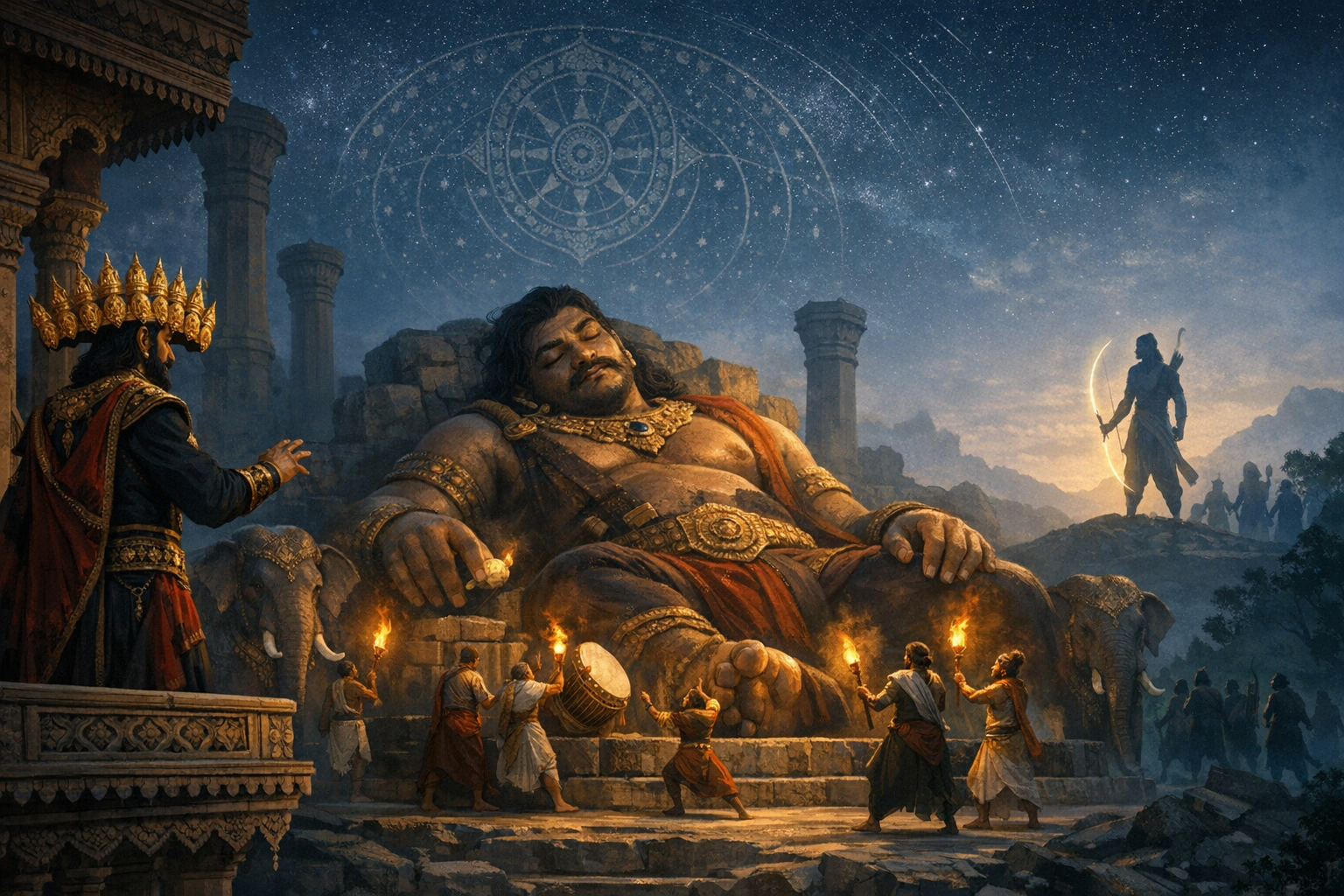
Valmiki Ramayana (Yuddha Kanda) offers the core sequence: as the war against Rama intensifies and Rakshasa commanders fall, Ravanapressured by mounting lossesorders the rousing of Kumbhakarna before his appointed awakening. Later traditions, such as the Kamba Ramayanam and other regional tellings, often amplify the imagery of the rousing: drums thunder, conches blare, iron bars strike, torches blaze, and elephants are driven over his colossal frame. The earth itself seems to tremble as cohorts of Rakshasas climb, pull, and prod to overcome a divinely imposed inertia that is not merely physical but cosmological.
The mechanics of the forced awakening underscore the cost of violating divine timing. On rising, Kumbhakarna’s first requirement is restoration: vats of wine, mountains of cooked rice, herds of buffaloes, deer, and swine, and innumerable platters of meat are brought to replenish the tremendous metabolic deficit of his condition. He is arrayed for battle only after this ritual of reconstitutiona detail that is both logistically significant and symbolically telling. Power, even when innate, requires calibration. Awakened out of cycle, it demands extraordinary inputs simply to reach functional baseline.
Far from being a mindless force, Kumbhakarna emerges in the textual tradition as capable of sober counsel. He rebukes Ravana for abducting Sita, implicitly affirming the counsel earlier offered by Vibhishana to return her and restore dharmic order. Yet, bound by fraternal loyalty and the logic of kshatra (martial duty), he resolves to fight once the die is cast. This dual portraita voice of prudence who nevertheless accepts the burden of loyaltyintensifies the pathos of his end and the tragedy of Ravana’s choice.
Ravana’s desperation constitutes a textbook case of strategic impatience. Instead of recalibrating aims in light of Vibhishana’s warnings and the manifest moral asymmetry of abducting Sita, he opts to compress time and override divine ordinance. In decision theory terms, Ravana sacrifices long-run viability for a short-run surgeliquidating a critical, scarce asset (Kumbhakarna) at suboptimal readiness. This choice violates the logic of dharma-yuddha, where right means and right timing are as indispensable as right ends.
The battlefield confirms the pattern. Kumbhakarna’s onset is devastating: he scatters the Vanara sena, rends battalions, and, as the poetic hyperbole suggests, drinks battle as though it were the ocean. Yet the costs of premature arousal soon appear. Rama, the exemplar of maryada and calibrated force, meets him in measured escalation. Limbs are severed by celestial weapons (notably Indra’s missile), and at the end, Kumbhakarna’s head is sundered and cast into the sea by the Brahma missile. The arc is stark: uncalibrated might achieves immediate shock, but disciplined righteousnessaligned to time, measure, and moral orderprevails.
Modern sleep science lends a technical frame to what the epic intuits. Forced arousal from deep sleep induces pronounced sleep inertiamarked, measurable decrements in reaction time, judgment, and motor coordinationespecially when circadian phase and homeostatic sleep pressure have not run their course. In high-stakes contexts (military operations, aviation, critical care), doctrine mandates staged arousal, caffeine timing, light exposure, and interval buffering before tasking. Ravana’s decision violates each of these principles: it removes interval, ignores physiological constraints, and insists on immediate maximal exertion. The Ramayana thus anticipates a systems insight now formalized by chronobiology and human performance science.
Symbolically, Kumbhakarna’s cyclical sleep encodes truths about latent power, unconscious drives, and the ethics of activation. Latency is not loss; it is incubation. Power awakened within its rightful window is generative. Power truncated from its natural cycle is extractive and self-destructive. In this sense, Kumbhakarna represents the colossal potency embedded in nature and within the human conditionpotency that must remain in rapport with dharma, kala (time), and ritam (cosmic order) to yield auspicious outcomes.
The narrative also resonates across dharmic thought. Hindu philosophy emphasizes alignment with dharma and auspicious timing; Buddhist insight cultivates skillful means (upaya) and right effort paced with mindfulness; Jain ethics model disciplined restraint (samyama) and equanimity (samayika) as temporal poise; Sikh wisdom extols living in hukam (divine order) and the serenity of sehaj (natural equipoise). Each tradition, in its own register, counsels that force without right timing and right intention begets suffering. Read together, they frame a shared civilizational ethic: power must be yoked to order, compassion, and patience.
Leadership lessons follow with clarity. First, heed principled counsel: both Vibhishana’s and Kumbhakarna’s warnings converge on returning Sita to restore balance. Second, respect constraintsbiological, logistical, and moralrather than attempting to erase them under pressure. Third, sequence actions: winning a just war requires right cause, right means, and right time. Strategic patience is not passivity; it is the discipline that keeps capability from corroding into catastrophe.
Ultimately, the price of premature action in the Ramayana’s account is paid on multiple ledgerstactical (loss of an irreplaceable champion), moral (further estrangement from dharma), psychological (the panic that mistakes urgency for wisdom), and spiritual (violation of cosmic order). Kumbhakarna’s vulnerability is not inherent weakness; it is the predictable consequence of wrenching a divinely timed life from its ordained cycle. Ravana’s desperation is not merely a vice; it is a theory of time gone wrong. In contrast, Rama’s victory rests on calibrated power, moral clarity, and the humility to move with, not against, time.
Inspired by this post on Hindu Blog.