
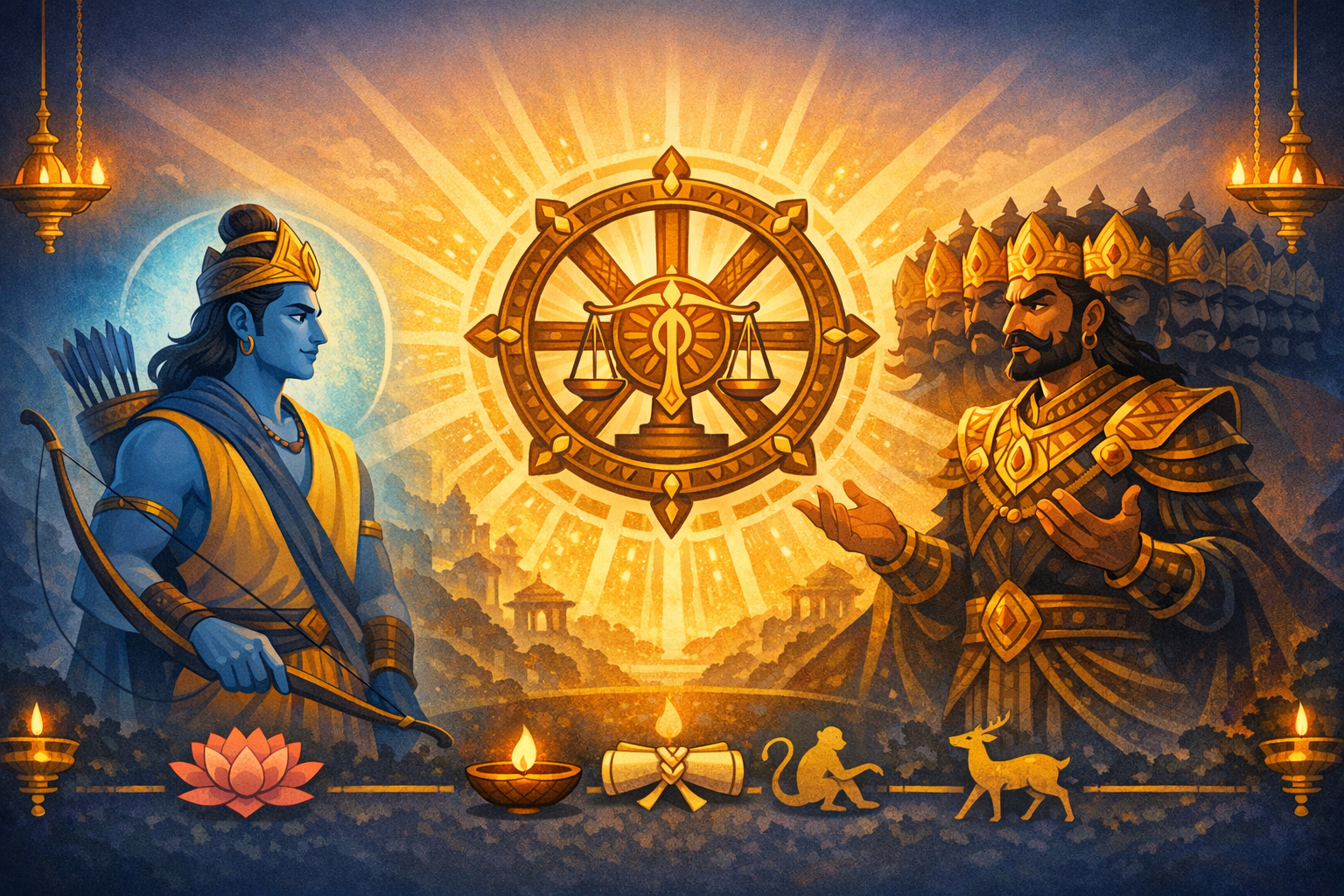
Many sincere seekers raise a troubling question that surfaces in almost every satsang and study circle on the Ramayana: if Ravana was a learned Brahman who acted to uphold his sister’s honor, while Rama seemingly caused suffering to his parents, felled Bali from concealment, yielded to public opinion, and sent Sita away, why is Rama celebrated as righteous and Ravana condemned as evil? Addressing this doubt requires a careful, text-sensitive and dharma-focused analysis that takes the epic’s ethical grammar seriously.
Two commitments guide a fair reading. First, the Ramayana is a living scripture with multiple recensions and regional retellings; episodes can appear with different emphases across traditions, including Hindu, Buddhist, and Jain. Second, judgments in dharmic frameworks are not based on birth or charisma but on alignment with dharma: intention, lawful means, and just ends, assessed together. With those guardrails, the seemingly paradoxical reputations of Rama and Ravana become far clearer.
Ravana’s celebrated scholarship and devotion merit acknowledgment. The text consistently portrays him as a brilliant ruler, a master of the Vedas, a formidable musician, and a great bhakta of Shiva. These qualities, however, are ethically neutral until channeled toward dharma. In the dharmic view, it is guna and karma, not janma, that determine moral worth. Knowledge amplifies what is already present in character; if will and restraint are misaligned, knowledge can magnify harm.
Against that backdrop, Ravana’s decisive transgressions define his arc. His abduction of Sita, carried out through deceit and coercion, violated consent, hospitality, and established norms protecting women and guests. He ignored right counsel from Vibhishana and sages, weaponized state power for private gratification, and allowed lust and pride to overrule reason and restraint. These acts locate him squarely under adharma, whatever his birth or learning.
Some argue that Ravana rushed to safeguard Surpanakha’s honor after her humiliation, implying a family-centered virtue at work. The tradition, though, presents a more complex picture. The episode unfolds with Surpanakha’s retaliation narrated through Khara and Dushana, and Ravana’s response shaped as much by inflamed desire upon hearing of Sita’s beauty as by familial outrage. He compels Maricha to deceive Rama, prioritizing his passions over justice. The scriptural throughline remains consistent: the motive force in Ravana’s choices is kama and mada, not dharma.
Dharmic ethics makes a sober claim: a single grave transgression can morally outweigh many lesser virtues when it manifests as a willful, sustained violation that harms the innocent. Abduction and coercion are not incidental lapses; they are fundamental breaches that reorder the moral ledger. The Ramayana frames Ravana’s fall accordingly, not because he lacked knowledge, but because he knowingly subordinated knowledge to unrighteous ends.
Consider next the charge that Rama caused misery to his parents. The Ayodhya Kanda attributes the exile to Kaikeyi’s two boons and Dasharatha’s binding promise. Rama’s acceptance of exile is not a casual indifference to parental suffering; it is the preservation of satya and rajadharma. If a king’s solemn vow could be abrogated for private comfort, state trust would fracture. Rama’s choice insulates the realm from the spectacle of royal perjury and upholds the principle that the ruler’s word binds the realm even when it wounds the heart.
It is natural to feel the pathos of Dasharatha and Kausalya and to intuit blame in the child who leaves. Yet the chain of causation matters. Rama’s action mitigates a greater wrong and arises from filial and civic duty, not from contempt. That he consoles, submits without resistance, and consistently seeks to reduce harm underlines intent and character. In the dharmic measure, duty fulfilled at personal cost carries moral weight.
The Bali (Vali) episode is one of the epic’s hardest dilemmas. On its face, Rama’s arrow from concealment seems unfair. Context matters. Bali possessed a boon that halved an opponent’s strength and added it to his own in direct combat. Moreover, Bali had violated moral and royal norms by seizing Sugriva’s wife and ruling oppressively. Rama’s alliance with Sugriva is cast as the king’s intervention to correct a public wrong. Rama’s subsequent dialogue with Bali offers a consistent rationale in the idiom of rajadharma: the sovereign may punish a transgressor irrespective of vantage when the act is a lawful execution of justice and not personal vendetta.
That reasoning does not erase modern discomfort, and the tradition itself invites wrestling with it. The ethical lesson is not license for deceit but a limited claim: state duty to protect the vulnerable can, within law, set constraints on the mode of engagement when ordinary means would fail against a uniquely advantaged wrongdoer. As Maryada Purushottama, Rama accepts strict limits elsewhere even as he exercises sovereign duty here, reinforcing that means and ends remain under dharma’s supervision, not expediency’s.
The charge that Rama was a football of others’ opinions arises primarily from Sita’s ordeal by fire and later separation. Here, textual plurality is crucial. Many Hindu recensions place the agni episode as a public vindication rather than a private suspicion, and several traditions, including the Adhyatma Ramayana, describe a Maya Sita undergoing trial, holding that the true Sita was never touched by Ravana. The later separation, narrated in the Uttara Kanda, is also treated by some scholars as a later stratum, while others accept it as integral. Across these tellings, a common thread remains: Rama seeks to reconcile raja-dharma and personal dharma under the weight of public trust.
In that ethic, the king’s duty includes praja-vada, attentiveness to the people’s perception of justice, because a ruler’s credibility is part of the realm’s moral capital. The separation from Sita, while morally agonizing, is presented as a sacrificial choice to sustain civic trust, not as a repudiation of her purity. Many recensions note that Rama never remarries, installs a golden image of Sita during sacrifices, and remains inwardly united with her. The narrative honors Sita’s sovereignty as well: she chooses refuge in Valmiki’s ashram and ultimately returns to the Earth on her own terms, a testament to her dignity and agency.
So why does the epic finally affirm Rama as good and Ravana as evil? Not because of birth labels or popularity, but because of a sustained alignment to dharma on one side and a sustained defiance of it on the other. Rama’s life shows an exacting pattern: truth over comfort, duty over desire, the common good over private gain, self-restraint in victory, and repentance where harm is feared. Ravana’s story shows the opposite pattern: knowledge subordinated to appetite, counsel spurned, and power bent toward coercion.
This contrast is consistent with the broader dharmic canon. The Bhagavad Gita’s typology of action and character rests on guna and karma, not janma. The epic’s ethical calculus evaluates sankalpa, upaya, and phala together: what was intended, by what means, and toward what end. Rama’s controversial moments always index back to public duty, minimization of harm, or fidelity to truth. Ravana’s defining moments index to violation of autonomy, exploitation of advantage, and obstinacy in the face of right counsel.
Read comparatively across dharmic traditions, the convergence is striking and unifying. Buddhist retellings such as the Dasaratha Jataka present a ruler who accepts hardship to keep a vow, reinforcing kusala over akusala by intention and restraint. Jain Ramayana traditions, while reimagining key events to highlight ahimsa, still locate moral worth in self-restraint and non-violence; they offer a Ravana who is learned yet brought low by passion, reiterating conduct over birth. Sikh ethics, with its Sant-Sipahi ideal, harmonizes inner virtue with outer responsibility, a balance echoed in Rama’s combination of compassion and kshatra-dharma. Across Hinduism, Buddhism, Jainism, and Sikhism, the common teaching is unmistakable: goodness is the steady preference for dharma, not the possession of power or pedigree.
It is understandable that modern readers feel the ache of Sita’s pain, the unease at Bali’s death, and the sorrow of parental separation. Those emotions are not obstacles to understanding; they are gateways to it. The Ramayana invites exactly such empathy and then asks a deeper question: when every choice carries a cost, how should a person anchored in dharma minimize harm without abandoning truth or duty? Rama’s answers are austere and often personally ruinous, which is why the honorific Maryada Purushottama speaks to limits as much as to heroism.
Ravana, too, serves a pedagogical role in dharmic education. He shows how brilliance without self-governance becomes dangerous, how devotion without ethical discipline curdles into fanaticism, and how ignoring wise counsel precipitates collapse. His refusal to return Sita, even when offered honorable alternatives, marks the point at which adharma becomes identity rather than error.
Taken together, these trajectories explain the epic’s moral verdict. Rama’s life foregrounds the architecture of dharma under pressure. Ravana’s life foregrounds the entropy of adharma under plenty. One preserves the moral order at profound personal cost; the other exploits order for private desire until the structure fails.
For contemporary readers across dharmic communities, several lessons emerge. First, evaluate leaders by conduct, not lineage or rhetoric. Second, hold intention, means, and outcomes in a single ethical frame. Third, honor consent and non-violence as non-negotiable thresholds. Fourth, recognize that public trust is a sacred asset; safeguarding it sometimes demands sacrifice. These are shared principles that bind Hindu, Buddhist, Jain, and Sikh ethical worlds in a family resemblance rather than a hierarchy.
This dharma-first reading neither sanitizes nor sensationalizes. It acknowledges the Ramayana’s hardest questions and answers them by the epic’s own standards: satya, ahimsa, self-restraint, compassion, and responsibility. With that lens, it becomes evident why tradition venerates Rama and warns through Ravana. The distinction rests not on mythic favoritism but on coherent moral reasoning across the text’s most challenging episodes.
In the end, the Ramayana is less a catalog of perfect choices and more a curriculum in weighing costs under dharma. Rama models how to bear those costs without bitterness; Sita models unassailable dignity under trial; and even Ravana, by negative example, models the urgency of aligning knowledge with virtue. Read this way, the epic speaks with one inclusive voice to Hindu, Buddhist, Jain, and Sikh hearts alike: choose dharma over desire, integrity over impulse, and the welfare of all over the comfort of one.
Inspired by this post on Hindu Pad.







