
-
Ramayana’s Unfinished Truth: Why Rama and Sita Don’t Get a Fairy-Tale Ending (and Dharma’s Lesson)

Ramayana is not a fairy tale about bliss after victory; it is a rigorous meditation on dharma under the pressures of love, power, and public trust. The narrative after Ravana’s defeat intensifies into a study of rajadharma, where Rama’s personal anguish and public duty collide. Sita’s trials—Agni Pariksha, exile, and her return to Mother Earth—expose…
-
Rama vs Ravana: A Dharma-first resolution to the Ramayana’s toughest moral dilemmas
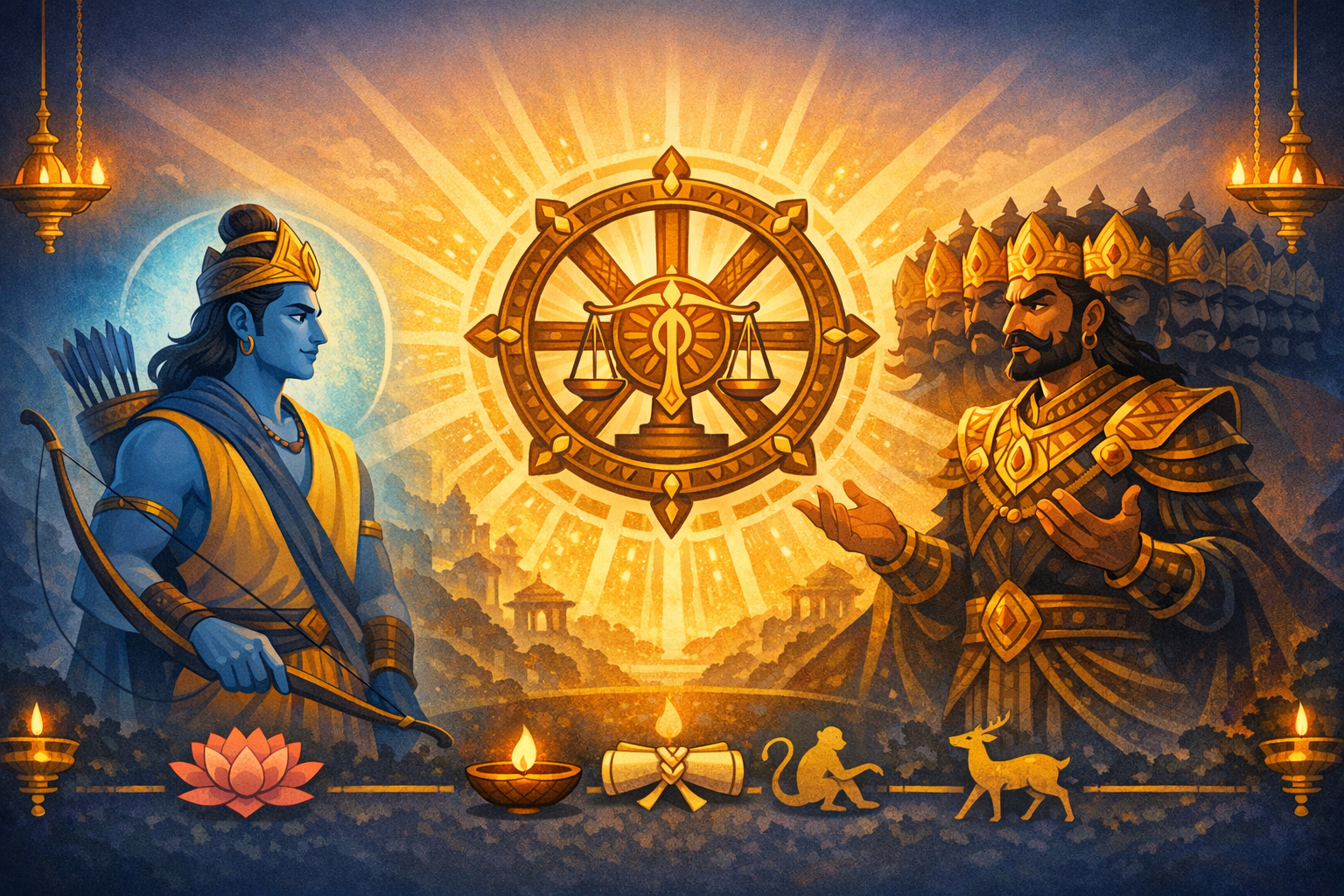
This essay answers the enduring question of why Rama is revered as righteous while Ravana is condemned, even though Ravana was a learned Brahman and Rama faced morally hard choices. It uses a dharma-first framework grounded in the Ramayana to evaluate intention, lawful means, and just ends across contested episodes such as the exile, the…
-
Karma and Karmaphala in the Ramayana and Mahabharata: Dharma, Consequence, and Liberation

This essay reads the Ramayana and Mahabharata as precise ethical maps of karma (action) and karmaphala (consequence), showing how intention, duty, and context shape outcomes. It explains sañchita, prārabdha, and āgāmi karma, and situates them within dharma and the puruṣārthas. Through case studies—Daśaratha’s unintended harm, Rāvaṇa’s hubris, the dice hall’s complicity, Karna’s complexity, and Bhīṣma’s…
-
Adipurush: The Outcome of a Century of Artistic Perversion

Adipurush” receives a scathing critique in this article as a three-hour-long cinematic travesty that has deeply offended many viewers, especially in regions with a strong cultural connection to the Ramayana. The article points out that the movie’s creators, despite being of Indian origin, have displayed disdain for the epic’s cultural and religious significance, reducing it…