Chaitra Navratri, also known as Vasant Navratri, inaugurates the new lunar year in many Indian calendars and focuses devotion on the Navadurgathe nine manifestations of Devi from Śailaputri to Siddhidātrī. Beyond the daily puja, fasting, and sādhanā, a distinctive cultural practice has taken root across several regions: devotees coordinate attire with auspicious “Navratri colours” each day. This tradition is particularly popular in Maharashtra and Gujarat, where women often wear nine different saree colours across the nine days, and families coordinate dress shades to honor the Devi and to celebrate the season of renewal.
For 2026, most Indian pañcāṅgas place Chaitra Śukla Pratipadā (Day 1 of Navratri) at sunrise on Friday, 20 March 2026, for much of India. As always, tithi observance is sunrise-based and location-specific; in some places, the Pratipadā tithi may commence the previous evening, but the day of collective observance remains Friday for many communities. On this basis, Chaitra Navratri is observed from 20 March to 28 March 2026, with Durga Aṣṭamī on 27 March and Mahanavamī/Rāma Navami most likely on 28 March (timings vary by region and pañcāṅga).
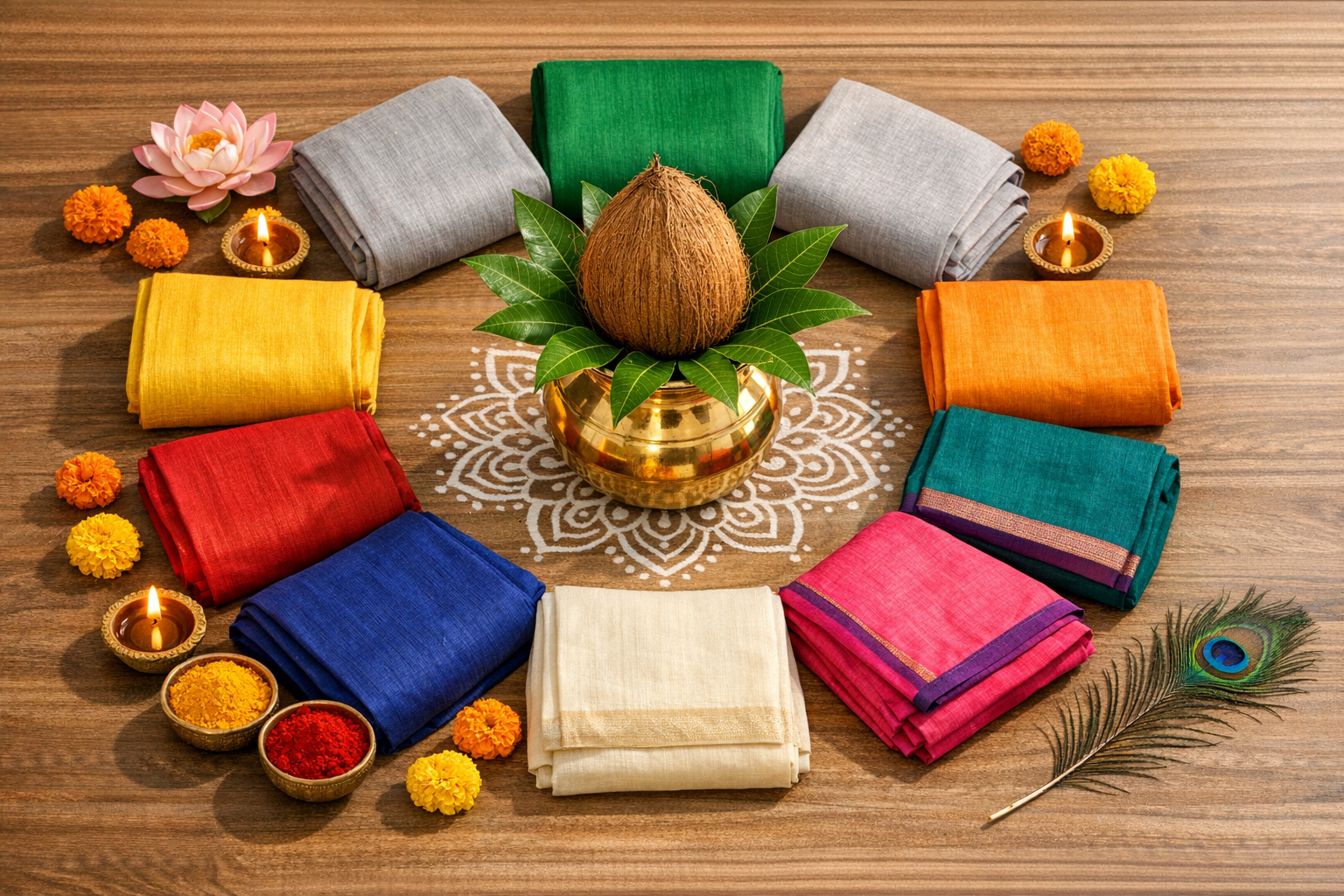
How are the “nine colours” determined? In Maharashtra and Gujarat, a widely followed contemporary convention cycles through nine auspicious shades each year. The starting colour depends on the weekday of Śukla Pratipadā, and the remaining eight follow a fixed rotation. The base nine-colour sequence commonly used is: White → Red → Royal Blue → Yellow → Green → Grey → Orange → Peacock Green → Pink (some groups prefer Purple instead of Pink; both are considered acceptable). The weekday-to-starting-colour linkage typically followed is: Sunday → Orange, Monday → White, Tuesday → Red, Wednesday → Royal Blue, Thursday → Yellow, Friday → Green, Saturday → Grey.
Because Day 1 (Śukla Pratipadā) falls on a Friday in 2026 for many locations, the starting colour is Green, and the rotation proceeds accordingly. As a result, the day-wise Chaitra Navratri colours 2026 followed by many in Maharashtra and Gujarat are: Day 1 Green, Day 2 Grey, Day 3 Orange, Day 4 Peacock Green, Day 5 Pink (or Purple), Day 6 White, Day 7 Red, Day 8 Royal Blue, Day 9 Yellow. Communities may adopt minor local variations; devotional intent remains central.
Day 1 (Śukla Pratipadā) Friday, 20 March 2026 Devī: Śailaputri Colour: Green. Green evokes spring growth, steadiness, and the earth element associated with Śailaputri. Saree and dress ideas include handloom cottons or silks in deep green, emerald, or parrot-green, paired with gold or silver accents. Devotees often begin with simple satvik meals and basic sādhanā, aligning the mind with stability and renewal.
Day 2 (Śukla Dvitīyā) Saturday, 21 March 2026 Devī: Brahmācharini Colour: Grey. Grey symbolizes restraint and the tapas of Brahmācharini. Practical ensembles include grey sarees with subtle zari borders, grey kurtas with white pyjamas, or minimalist linen weaves. Many households emphasize japa, quiet study, and satvik observances to cultivate inner focus.
Day 3 (Śukla Tritīyā) Sunday, 22 March 2026 Devī: Chandraghantā Colour: Orange. Orange stands for courage and auspicious radiance. Sarees in marigold, saffron, or kesar tones, and festive orange dupattas or stoles elevate the devotional mood. Families often remark on the energizing ambience this day brings, especially when community bhajans or collective aarti add to the joy.
Day 4 (Śukla Chaturthī) Monday, 23 March 2026 Devī: Kūṣmāṇḍā Colour: Peacock Green. This jewel-toned shade reflects abundance and Devi’s creative śakti. Silk, chiffon, or handloom sarees in peacock green pair beautifully with contrasting blouses; men may opt for peacock-green jackets or stoles. Offerings of seasonal fruits and grains honor Devi’s nourishing aspect.
Day 5 (Śukla Pañcamī) Tuesday, 24 March 2026 Devī: Skandamātā Colour: Pink (some observe Purple). Pink suggests maternal compassion and tenderness; Purple conveys devotion and spiritual dignity. Saree colours for Chaitra Navratri 2026 on this day include soft blush, rani pink, or a rich purple if following that variant. Many communities organize annadāna or simple seva activities to reflect Skandamātā’s nurturing grace.
Day 6 (Śukla Ṣaṣṭhī) Wednesday, 25 March 2026 Devī: Kātyāyanī Colour: White. White aligns with purity and decisiveness in dharma. Cotton and khadi whites are popular, as are off-white silks and chanderis with minimalist motifs. The day’s discipline often includes clearer sankalpas (vows) and mindful restraint, paired with light, satvik meals.
Day 7 (Śukla Saptamī) Thursday, 26 March 2026 Devī: Kālratri Colour: Red. Although Kālratri iconography is dark and formidable, the rotating colour tradition designates Red in 2026, symbolizing protective śakti and fearlessness. Red sarees, kurtas, or stoles are common; devotees recall that colour conventions are cultural aids to bhakti and not scriptural mandates.
Day 8 (Śukla Aṣṭamī, Durga Aṣṭamī) Friday, 27 March 2026 Devī: Mahāgaurī Colour: Royal Blue. Royal Blue in this rotation honors serenity and spiritual depth; traditionalists who prefer iconographic alignment may still choose white for Mahāgaurī, which is entirely acceptable. Many observe Kanya Puja on Aṣṭamī, extending hospitality to children with humility and reverence.
Day 9 (Śukla Navamī, Mahanavamī/Rāma Navami) Saturday, 28 March 2026 Devī: Siddhidātrī Colour: Yellow. Yellow marks fulfillment, clarity, and auspicious closure. Sarees and dresses in turmeric, mustard, or sunflower shades complement floral offerings and festive prasad. In many regions, Rāma Navami is celebrated today; devotional singing and readings from the Rāmāyaṇa bring Navratri to a luminous close.
It is valuable to note that the “daily Navratri colours” convention popular in Maharashtra and Gujarat is a community tradition rather than a prescriptive rule found in dharmaśāstra. Consequently, devotees sometimes adapt the palette to align with local sampradāya preferences or with each Navadurga’s iconography (for example, white for Mahāgaurī, deeper hues for Kālratri). The central principle is bhāva (devotional sentiment) and shared celebration, not uniformity.
Regional culture enriches the palette. In Maharashtra and Gujarat, nine-colour saree cycles are a cherished custom, while in Bengal and parts of eastern India, Basanti (spring yellow) and red-white combinations retain strong appeal. In North Indian homes, simple kurtas and dupattas in the day’s shade are common, and in South India, the observances often harmonize with Ugadi and other New Year traditions in the same fortnight. Across the diaspora, coordinated family wardrobes are a joyful way to anchor identity and memory.
For those planning dresses to wear in Navratri March 2026, sustainable textiles and natural dyes offer both comfort and meaning. Handloom cotton, khadi, benarasi, chanderi, ilkal, pochampally, and other regional weaves allow devotees to honor local artisans while embracing the day’s auspicious colour. Men and children can participate with scarves, stoles, bangles, or pocket squares in the designated shade; the spirit of inclusion matters more than perfect matching.
To verify local observance accurately, consult a reliable regional pañcāṅga for tithi at sunrise, especially if living outside India or at significant longitude/latitude differences. If the Pratipadā tithi spans two civil dates, communities generally privilege the date on which the tithi prevails at sunrise; temple announcements and local samājas typically clarify the convention followed in that locality. Where a slight shift occurs, simply roll the rotation forward from the locally observed Day 1.
Summary for quick reference: For the widely followed Maharashtra–Gujarat rotation in 2026 (Friday start), the colours are Day 1 Green, Day 2 Grey, Day 3 Orange, Day 4 Peacock Green, Day 5 Pink (or Purple), Day 6 White, Day 7 Red, Day 8 Royal Blue, Day 9 Yellow. These daily colours of Navratri Durga Puja are guidance for joyful participation and are fully compatible with alternative palettes rooted in local traditions.
Finally, the spirit of Chaitra Navratri resonates across the dharmic familyvalues of self-discipline, compassion, inner transformation, and reverence for the sacred feminine are cherished in Hindu, Buddhist, Jain, and Sikh communities in diverse ways. Choosing colours with intention becomes a shared language of harmony, seva, and gratitude, helping families and communities inhabit the season’s promise of renewal and unity.
Inspired by this post on Hindu Pad.