Chaitra Navratri begins on 19 March 2026 in most Indian panchangs, marking the first of nine auspicious nights dedicated to the worship of Goddess Durga in her manifold forms. The opening day venerates Shailaputri, the mountain-born aspect of Shakti, and sets the spiritual tone for the entire festival. Households, temples, and community spaces observe this day with Ghatasthapana, disciplined fasting, and the invocation of Devi through mantra, japa, and homa, aligning devotion with a clear, dharmic intent.
This guide presents an academically grounded yet practical framework for the first day of Navratri, integrating scriptural conventions from the Grihya and Smarta traditions with lived cultural practices. It highlights ten precise actions that help devotees observe Day 1 with clarity, safety, and depth. While rooted in Hindu practice, the values emphasizedahimsa, dana, seva, meditation, and collective harmonyresonate across dharmic traditions such as Buddhism, Jainism, and Sikhism, strengthening inter-traditional unity.
Day 1 is observed on the Shukla Pratipada tithi of the Chaitra month. Ghatasthapana (Kalash Sthapana) is traditionally performed after sunrise, within the first one-third of the day, while Pratipada prevails; Abhijit Muhurta is considered a secondary option when other windows are not available. Households commonly avoid Rahu Kaal. Exact timing varies by location and almanac; consulting the local Panchang and tithi at one’s place of residence ensures accuracy for 19 March 2026.
1) Purification and sankalpa: Begin with cleaning the home altar and the puja area. A morning bath, fresh attire, and simple sattvic preparation cultivate inner steadiness. Facing east, articulate the sankalpamentally stating the date, place, family details (if desired), and the intent to observe Chaitra Navratri with devotion and self-discipline for the welfare of all beings. This concise resolve anchors the practice for the nine nights and aligns it with dharma.
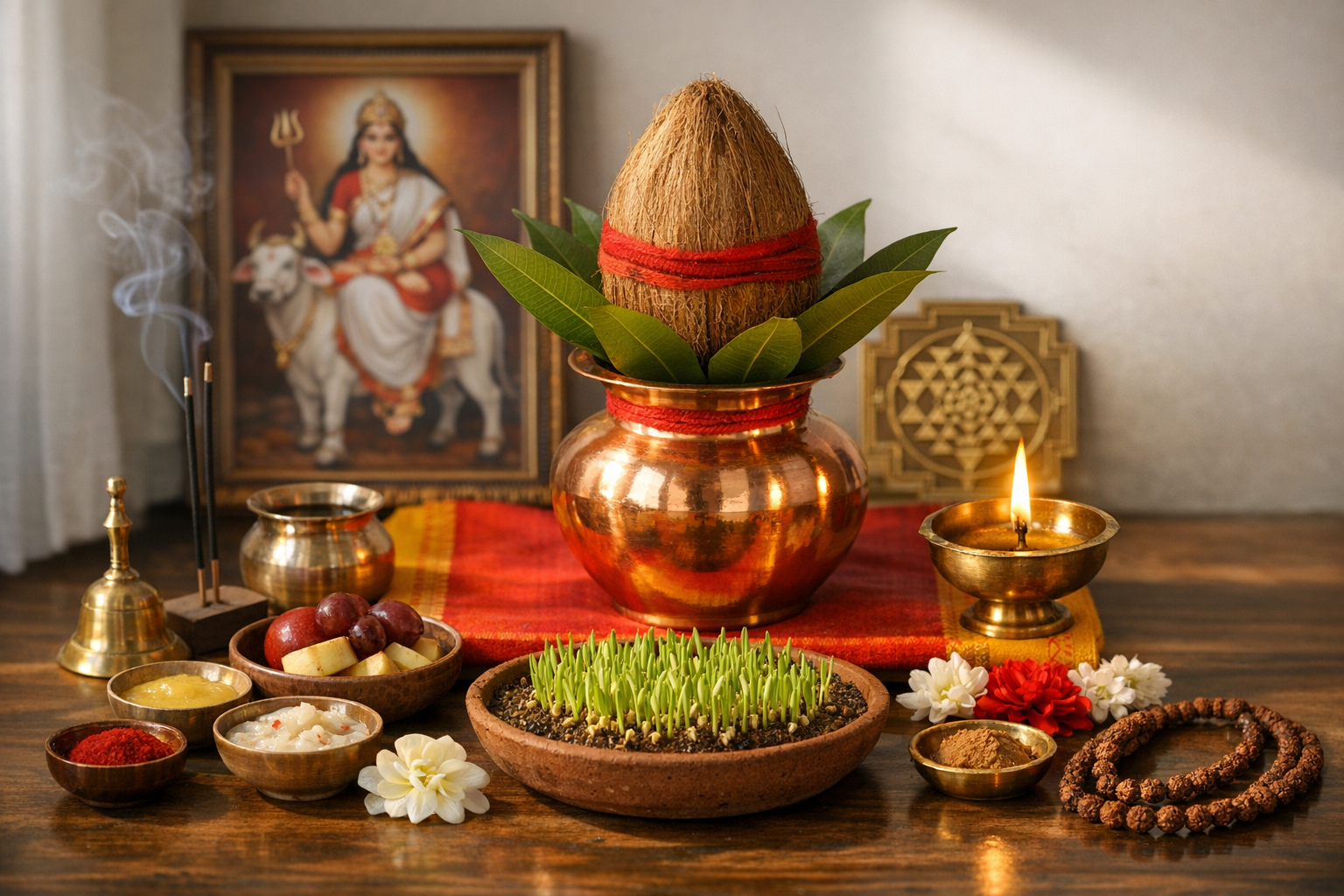
2) Ghatasthapana (Kalash Sthapana): Prepare a clean, preferably earthen or copper kalash. Place a sanctified bed of grain (jau or wheat) in a kalash-plate or clay vessel for beej ropan, fill the kalash with water mixed with a few drops of Ganga-jal, add akshata, a coin, and fragrant leaves, then set five mango leaves at the mouth. Seat a husked coconut wrapped in red cloth on the kalash and draw a swastika with kumkum on the pot. Situate the kalash on the altar to the east or north; place Durga’s image or yantra nearby. This establishes the ritual center for the entire Navratri.
3) Akhand jyot (continuous lamp): Light a ghee diya to the right of the kalash and maintain it safely through the day (and continuously, if household conditions allow). Where continuous flame is impractical, keep the primary lamp lit for the puja segment and rekindle it during morning and evening devotions. Fire safety is paramountuse a stable holder, keep the area ventilated, and never leave an unattended flame near flammable cloth or flowers.
4) Invocation and upacharas: Begin with a brief Vinayaka avahanam to remove obstacles, followed by kalash-devata nyasa and a simple Navagraha shanti-prarthana. Offer Shodashopachara (sixteen offerings) if time and resources permit; otherwise, Panchopachara (gandha, pushpa, dhoop, deep, naivedya) is fully acceptable. The essential principle is mindful offering rather than quantitycleanliness, attention, and sincerity are the core of proper puja vidhi.
5) Shailaputri dhyana and mantra-japa: Meditate on the first form of Durga with the traditional dhyana shlokaवन्दे वांच्छितलाभाय चन्द्रार्धकृतशेखराम्। वृषारूढ़ां शूलधरां शैलपुत्रीं यशस्विनीम्॥ Recite the moola mantra ॐ देवी शैलपुत्र्यै नमः with a chosen count (11, 27, 54, or 108), using a clean mālā. Offer red or white flowers and sandalwood fragrance. This practice steadies prana, refines attention, and invites the qualities of steadfastness and courage embodied by Shailaputri.
6) Chandi path (Durga Saptashati) or allied recitation: Many households commence the Devi Mahatmya on Day 1 with Kavacham, Argala-stotram, Keelakam, and Chapter 1 (Madhu-Kaitabha Vadha). Those new to the text may begin with selected portions or choose the Lalita Sahasranama or Devi Sukta. Where family members follow allied dharmic paths, parallel contemplationssuch as Buddhist metta meditation, Jain pratikraman reflections on ahimsa, or Sikh simran and shabad kirtancan be integrated to uphold a spirit of shared devotion and seva.
7) Vrat (fasting) discipline and sattvic ahar: Day 1 fasting typically ranges from nirjala (waterless, only for the fit and experienced) to phalahar (fruits, milk) or an anaj-free sattvic diet. Avoid onion, garlic, alcohol, and rajasic foods. Children, elders, pregnant persons, and those with medical conditions should choose gentle fasts or symbolic dietary restraint, prioritizing well-being. Break the fast with prasad after evening puja; hydration and moderation ensure the vrat supports health as well as devotion.
8) Naivedya and bhog for Shailaputri: Offerings on Day 1 commonly include pure desi ghee as bhog, along with milk-based sweets, banana, or homemade kheer. Present water, fresh fruits, and simple satvik preparations; conclude with aarti and distribute prasad respectfully. Avoid food waste; annadanam, where feasible, extends the merit of the offering to the wider community.
9) Dana and seva, anchored in inter-dharmic harmony: Traditional charity on Day 1 includes grains, ghee, or clothing for those in need; feeding birds, animals, or contributing to a langar or community kitchen aligns the vrata with shared dharmic ethics. These gestures resonate with Buddhist compassion practices, Jain ahimsa, and Sikh seva, reinforcing unity among dharmic traditions while retaining the distinctive theological grammar of Navratri.
10) Contemplation, pranayama, and daily reflection: A brief sequence of pranayama followed by 10–15 minutes of quiet meditation consolidates the day’s worship. Journaling the sankalpa, insights from recitation, or one act of kindness performed each day of Navratri builds a practical bridge between inner sadhana and social responsibility. Families often include children by narrating the story of Shailaputri and inviting them to place a flower before the altar, cultivating reverence across generations.
Attire and colour guidance for Day 1: In many regions, Shailaputri is associated with the hue grey; elsewhere, households observe white or yellow depending on the weekday mapping used in Navratri Colours List 2026. The cultural practice of wearing a designated colour is supplementary rather than scripturally binding, so households may choose a modest, calming shade that fosters focus and solidarity with local custom.
Puja samagri checklist in brief: kalash (earthen or copper), clean water with a few drops of Ganga-jal, akshata and a coin, mango leaves, husked coconut wrapped in red cloth, barley or wheat for beej-ropan, red or yellow cloth for the altar, kumkum, haldi, chandan, flowers, dhoop, agarbatti, camphor, ghee or oil for diyas, matches, bell, conch (optional), puja thali and spoon, fruits, milk-based sweets, sugar or jaggery, prasad bowls, clean asana or mat, Durga murti or image, and a simple Devi yantra if available.
Common mistakes to avoid: performing Ghatasthapana after the appropriate window, placing the kalash on a bare or unstable base, leaving the diya unattended, mixing elaborate offerings with rushed or distracted worship, and neglecting satvik discipline in speech and conduct. The shastra emphasizes intention and orderliness; minimal yet attentive worship is superior to excess performed without focus.
Safety and sustainability: Keep lamps away from drapes and idle cloth, ensure adequate ventilation during aarti, and use stable holders for diyas. Eco-conscious choicesearthen lamps, natural flowers in modest quantity, biodegradable offerings, and locally sourced fruitsalign spiritual practice with environmental stewardship, an ethic embraced across dharmic lineages.
Regional and diaspora adaptations: Apartment dwellers or students may perform Panchopachara instead of Shodashopachara, use a smaller kalash, or schedule recitations around work hours while keeping the core sequence intact. Where open flames are restricted, a brief morning and evening puja with a safely managed diya suffices; the heart of the observance lies in disciplined regularity and care.
Why Day 1 matters: Shailaputri embodies foundational steadinessmuch like a mountainupon which the remaining eight days rest. Observing 19 March 2026 with correct muhurta, ordered puja, and a compassionate sankalpa cultivates clarity, balances energy, and situates personal devotion within a larger dharmic ecology of family, community, and all beings.
Key takeaways for 19 March 2026: perform Ghatasthapana during the recommended morning window while Pratipada prevails; light a safe, steady jyot; invoke Shailaputri with dhyana and the mantra ॐ देवी शैलपुत्र्यै नमः; begin the recitation cycle chosen for the nine days; maintain an appropriate vrat; offer simple, pure naivedya; extend the worship outward through dana and seva; and close the day with reflective stillness. These ten actions anchor Navratri’s opening in both tradition and thoughtful contemporary practice, nurturing unity across the broad family of dharmic paths.
Inspired by this post on Hindu Pad.