

Someone close to you succeeds, and your body tightens before your mind has chosen a response. You offer congratulations, but later you replay the news, search for reasons they did not deserve it, or wonder whether their gain proves that you are falling behind. The visible jealousy may be covering a more vulnerable fear: that your place, worth, security, or future is not safe.
You do not have to shame that reaction, pretend to be generous, or let it direct your conduct. A dharmic response follows a workable order: steady the body, name the comparison honestly, separate facts from fearful interpretation, identify what feels threatened, and choose an action that protects truth, non-harm, and self-respect.
Name the pattern without turning it into your identity

Jealousy, envy, and insecurity often travel together, but distinguishing them improves your response. Envy hurts because another person possesses an advantage you want. Jealousy fears that a valued relationship, role, or place may be lost to a rival. Insecurity is the underlying doubt that you are safe, capable, wanted, or sufficient. One event can activate all three.
Dharmic psychology gives corrosive comparison a precise name: matsarya is counted among the Arishadvarga, the six inner enemies that also include kama, krodha, lobha, moha, and mada. Calling it an inner enemy does not mean calling yourself bad. It means recognising a mental force that can obscure discernment when it is left unexamined.
Begin with language that creates room for choice: Jealousy is present, rather than I am a jealous person. Then ask what kind of difficulty you are actually facing:
- Do I mainly want an advantage that this person has? You are dealing with envy and need to turn comparison into a concrete development goal.
- Do I fear losing affection, status, opportunity, or belonging? You are dealing with insecurity and may need reassurance, clearer agreements, stronger skills, or a more stable practical foundation.
- Was a promise broken, contribution erased, boundary crossed, or process applied unfairly? You may have a legitimate grievance. Grounding should help you address it accurately, not persuade you to tolerate adharma.
- Would I feel relieved if the other person failed, even though their failure would not improve my situation? Matsarya is beginning to govern the response. Do not feed it through gossip, sabotage, or private fantasies of humiliation.
Aspiration is not the enemy. Wanting to learn, advance, create, provide, or be recognised can serve dharma. The warning sign is not that you want more; it is that another person’s diminishment starts to feel like your path to having more.
Ground first: let Muladhara be a discipline, not a diagnosis

A jealousy trigger can create urgency: send the message, make the accusation, prove your value, withdraw affection, expose a rival, or announce a decision. That is precisely when interpretation becomes least trustworthy. Before deciding what the event means, restore enough steadiness to observe what is happening.
Within yogic subtle-body traditions, Muladhara means the root support and is associated with earth, stability, and security. This is a traditional framework for practice, not a medical diagnosis or proof that every fear comes from an imbalanced chakra. Hindu and Buddhist Tantric lineages, Jain disciplines, and Sikh teachings also should not be flattened into one metaphysical system. Their vocabularies differ, even where they share an insistence on steadiness, ethical conduct, humility, and service.
Use this grounding sequence before confronting anyone or making a consequential choice:
- Establish physical contact. Sit or stand with stable support. Feel the floor beneath your feet, the weight passing through your legs, and the support beneath your pelvis. If standing feels comfortable, the simple steadiness of Tadasana is enough; this is not the moment for a demanding posture.
- Let the breath become unforced. Breathe into the lower abdomen and allow the exhalation to become comfortably longer. Do not strain, retain the breath, or chase an altered state. If you become dizzy or more agitated, return to ordinary breathing.
- Orient to present facts. Notice what you can see, hear, and physically feel. Then state the trigger in one literal sentence without guessing another person’s motives.
- Restore one neglected foundation. Eat if you have missed a meal, return to your sleep routine, take a mindful walk, spend time in nature, or complete the practical duty that comparison has displaced. Security is strengthened through repeated ordinary order, not dramatic spiritual performance.
If closing your eyes, scanning the body, or focusing on the lower body intensifies distress, keep your eyes open and stop the exercise. Practices involving Mula Bandha or forceful attempts to awaken kundalini require sensitivity and appropriate guidance; they are unnecessary for working with an everyday comparison trigger.
Grounding does not decide whether your fear is justified. It removes some of the urgency so that you can investigate the fear without automatically obeying it.
Use a fact-story-need-dharma check before you act
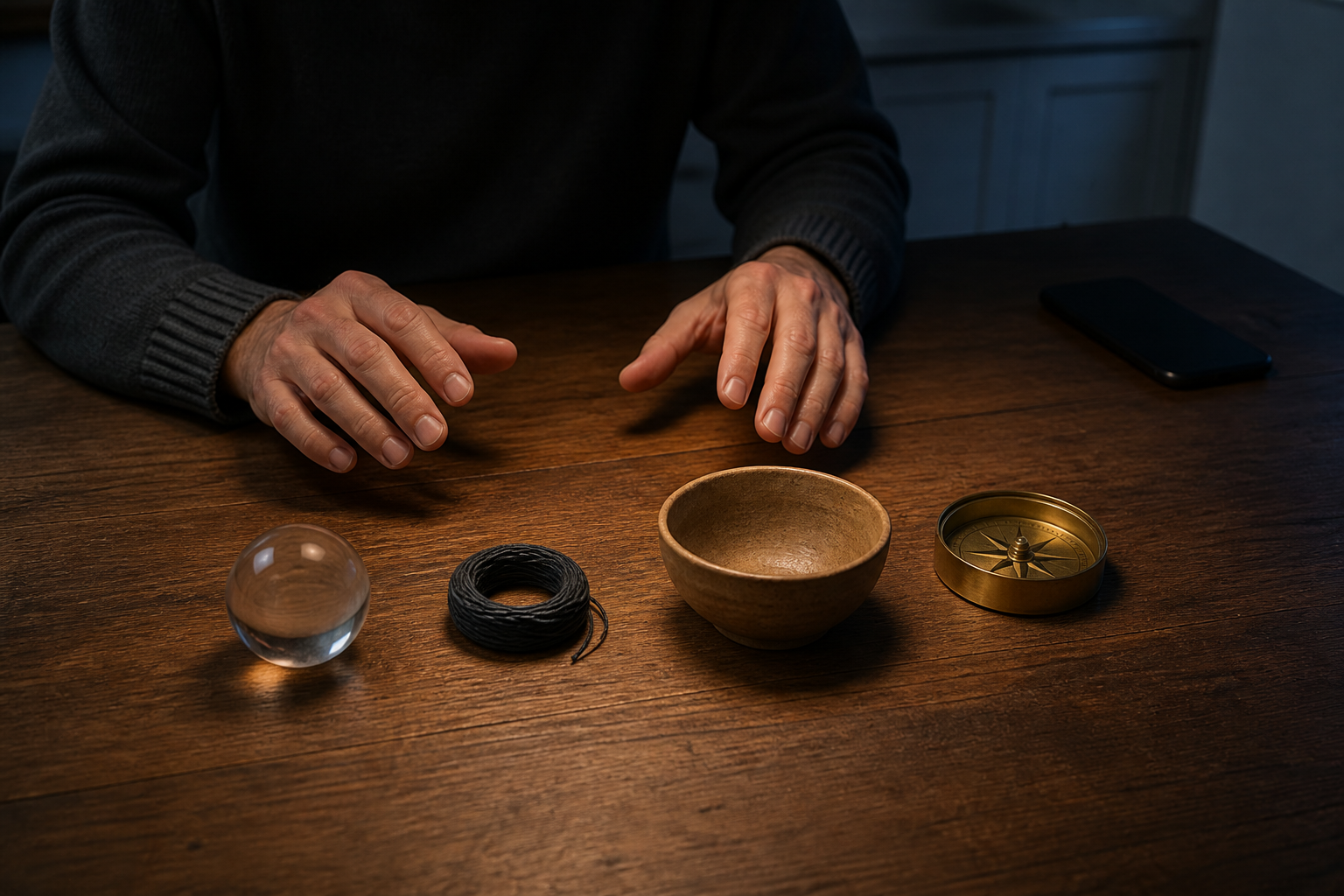
Once your breathing and attention are steadier, write the situation down. Do not attempt to solve it as one undifferentiated feeling. Move through these layers in order:
| Layer | Question | Example | What to do |
|---|---|---|---|
| Fact | What could a neutral observer verify? | A colleague received the role. | Record the event without adding motives or predictions. |
| Story | What meaning did my mind add? | I will never be respected here. | Mark it as an interpretation, not an established fact. |
| Need | What valued good feels threatened? | Recognition, livelihood, competence, or belonging. | Decide whether the need calls for information, a boundary, skill-building, or practical support. |
| Dharma | What action preserves truth, non-harm, fairness, and responsibility? | Congratulate the colleague, document your contribution, and request specific feedback. | Take the clean action even if the emotion has not disappeared. |
This check prevents two common mistakes. The first is treating every insecurity as proof of mistreatment. The second is dismissing genuine mistreatment as a spiritual defect in yourself. If credit was taken, criteria changed without notice, or a boundary was crossed, address the conduct. Ask what rule, promise, or expectation applied; identify the observable breach; and seek a proportionate correction. Do not make the other person’s entire character the case.
At work, a clean request might be: I want to understand how this decision was made and what concrete work would demonstrate readiness for the next opportunity. In a family that habitually ranks siblings, try: I want us to celebrate each person’s progress without using one life as the measure of another. In a relationship, replace mind-reading with an observable concern: I noticed this behaviour and felt insecure. Can we clarify the boundary we expect from each other?
If no external correction is needed, convert the threatened value into a values-based goal. Name the outcome you want, the next step that depends on you, the people your growth should benefit, and the conduct you refuse to use to get there. This keeps ambition while removing the demand that someone else must lose.
Practise mudita honestly, then repair the social field

Mudita, appreciative joy in another’s good, is the direct training for a mind that treats success as scarce. It does not require instant warmth, admiration for everything a person does, or denial of an unfair situation. When resentment is strong, begin with a more modest discipline: refuse to devalue a real good simply because it belongs to somebody else.
The Bhagavad Gita commends freedom from hostility alongside compassion, forbearance, and endurance. Yoga Sutra I.33 places maitri, karuna, mudita, and upeksha within a discipline for clarifying the mind. Buddhist practice employs metta and mudita against envy; Jain practice brings attachment and agitation under pratikraman, aparigraha, and vigilant self-observation; Sikh practice redirects irkha through simran, humility, contentment, and seva. You do not need to assemble these into a spiritual mixture. Practise deeply within your own path while recognising their shared ethical direction: another person’s good need not become poison in your mind.
A practical mudita exercise can be done without pretending:
- Name the good precisely. Acknowledge the effort, courage, service, skill, or fortunate circumstance that is actually present. Precision is more honest than exaggerated praise.
- Release the false equation. Remind yourself that this event does not, by itself, establish your worth or settle your future.
- Perform one proportionate act of goodwill. Offer a truthful congratulation, share deserved credit, refrain from a cutting remark, or support a beneficial outcome.
- Return to your own responsibility. Complete the application, practise the skill, have the needed conversation, or serve the person in front of you. Mudita is not passive admiration; it frees attention for dharma.
If jealousy has already shaped your behaviour, inner reflection is not enough. Jain pratikraman offers a useful moral structure: observe the fault, acknowledge harm, seek forgiveness where appropriate, and renew the intention not to repeat it. A direct repair can sound like this: I became competitive and withheld credit. That was unfair. Your contribution was specific and valuable, and I will correct the record in the same setting where I omitted it. The correction matters more than an elaborate confession.
Change the conditions that repeatedly feed the pattern as well. Mute or unfollow accounts that reliably turn attention into status surveillance. Keep a gratitude record focused on what already supports you, what you are steadily building, and what good in another person’s life you can acknowledge. At work, publish clear criteria and give credit in the same forum where results are praised. In families, celebrate without ranking siblings, spouses, or children. In a relationship, establish explicit boundaries instead of testing loyalty through accusation or surveillance.
Measure progress by recovery and conduct, not by the fantasy of never feeling a jealous impulse. Useful signs include less rumination, a quicker return to your responsibilities, fewer covert attempts to compete, more spontaneous ease around another person’s success, and continued honesty when your status feels threatened.
If jealousy is leading to secret monitoring, coercion, threats, reputational harm, thoughts of harming yourself or another person, or a serious loss of daily functioning, stop treating it as a private meditation problem. Create distance from immediate confrontation and seek qualified mental-health or emergency support appropriate to your location. Breathwork, mantra, and chakra practice are not substitutes for that help.
Key takeaways for the next comparison trigger
- Do not send the message, make the accusation, or announce the decision while your body is still carrying the first surge.
- Ground through stable contact, unforced breathing, present-moment orientation, and one practical act that restores order.
- Write down the fact, the story added by your mind, the valued good that feels threatened, and the dharmic response available to you.
- Investigate real unfairness without attacking another person’s worth; do not use spirituality to silence a legitimate grievance.
- Practise mudita as truthful recognition of another’s good, not as compulsory enthusiasm.
- Repair any harm in the same social field where it occurred, then return attention to a goal governed by your values rather than rivalry.
At the next trigger, postpone the verdict and complete this sequence once. That repetition is abhyasa: practice that gradually makes steadiness more available. The aim is not to become a person who never feels jealousy. It is to become someone whose jealousy no longer decides how other people are treated or how your own dharma is pursued.
References
- DharmaRenaissance Blog — Jealousy vs. Inner Peace: The Complete Dharmic Guide to Transforming Matsarya Now
- DharmaRenaissance Blog — Muladhara (Root Chakra) Explained: The Essential Guide to Grounding, Security, and Growth
