
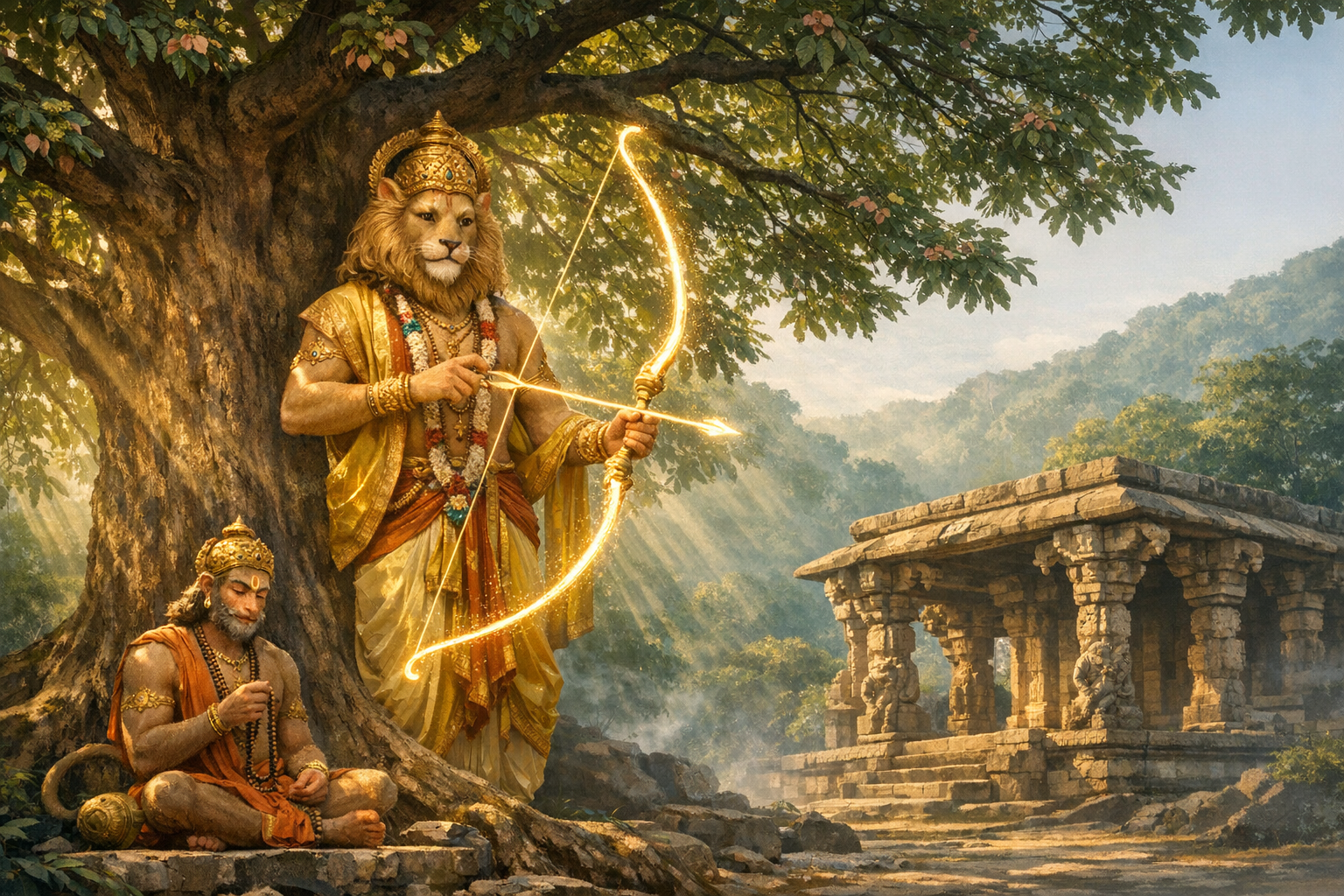
Nestled in the Nallamala Hills of Andhra Pradesh, Upper Ahobilam is among the most revered pilgrimage landscapes in Bharatavarsha. Within this sacred complex, the Karanja Narasimha temple preserves a remarkable narrative in which divine compassion meets unwavering devotion, illuminating how the Lord adapts form to honor the love of a devotee.
The term Karanja refers to the karanja (Pongamia pinnata) tree under whose protective canopy the shrine arose, anchoring the deity to a living emblem of the forest. As one of the Nava Narasimha shrines of Ahobilam, this temple fuses sacred topography, ecology, and theology in a manner emblematic of South Indian temple culture and Vaishnava pilgrimage.
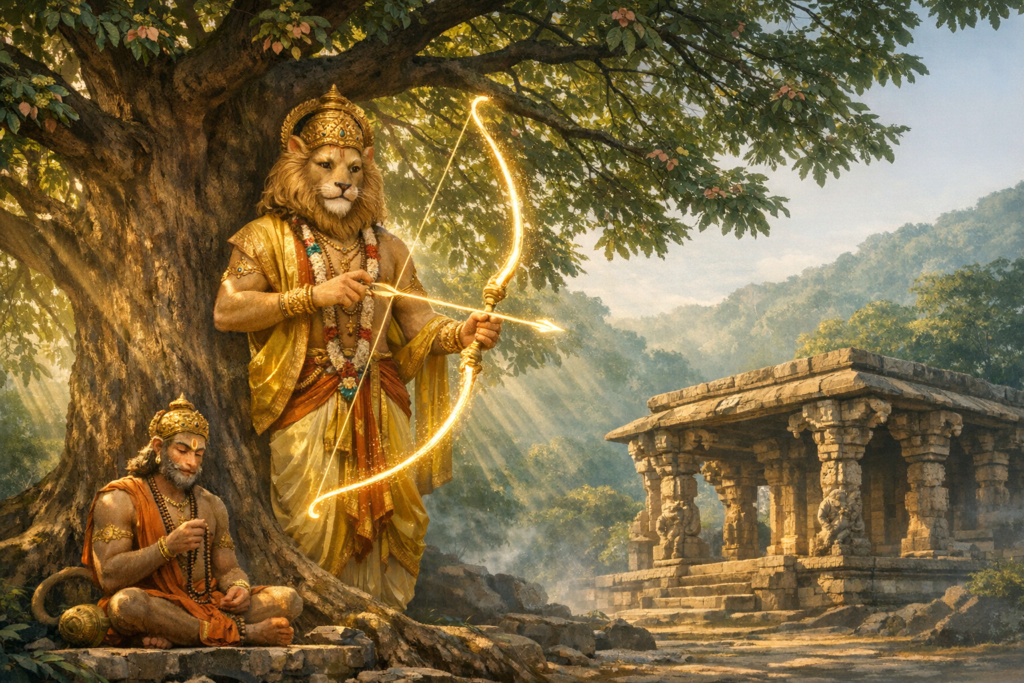
According to sthala-purana accounts, Hanuman, immersed in Rama-nama japa beneath the karanja tree, encountered Narasimha. Uncompromising in eknishtha to Sri Rama, Hanuman declined to worship any form other than his chosen Lord. Moved by that steadfast bhakti, Narasimha revealed the same Supreme Reality in a way Hanuman could embrace—assuming the attribute of Rama’s bow and thereby meeting the devotee’s devotional condition without fracturing divine unity. In this compassionate rūpa-parivartana, devotion and doctrine converge.
Local tellings vary in nuance: some relate that Narasimha briefly manifested as Sri Rama; others that the leonine visage remained while the iconic bow—read as Kodanda (Rama’s bow) or Śārṅga (Vishnu’s bow)—appeared. Both trajectories convey a core Vaishnava insight: the essential unity of Vishnu’s avatāras and the sanctity of an Ishta-Devata chosen with pure love.
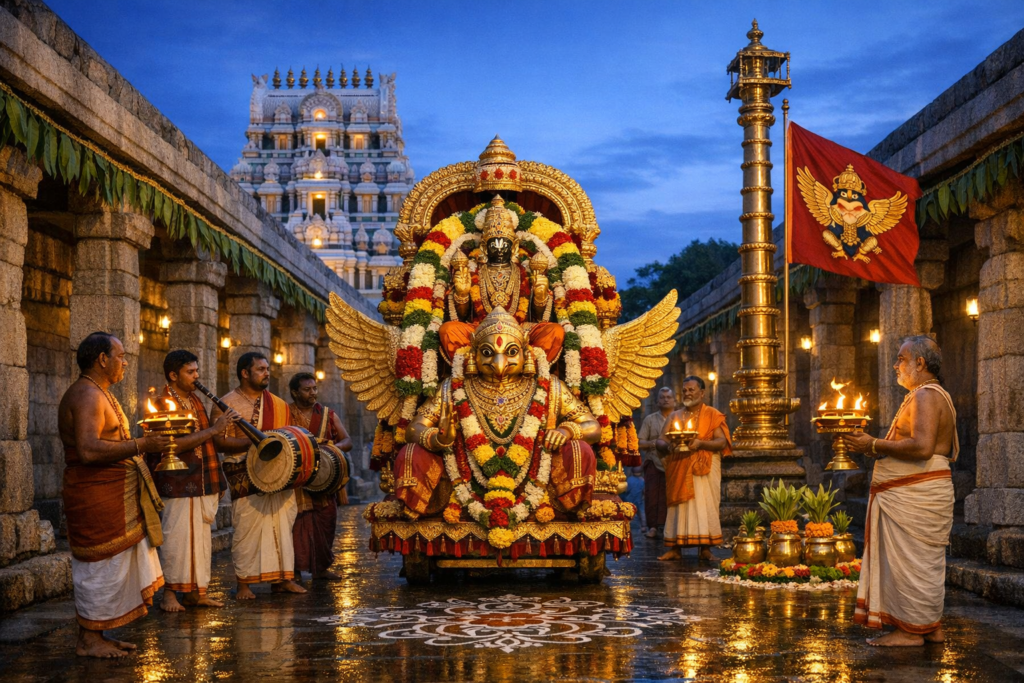
The presiding mūrti of Karanja Narasimha is often read by art historians as a conciliatory icon, with a gentler śānta expression than the more ugra registers elsewhere in Ahobilam. The bow motif functions as a visual précis of the temple’s theological thesis: the Divine bends to bhakti, demonstrating that form is a merciful medium for the soul’s ascent.
Architecturally, the present complex bears the imprint of later-medieval Vijayanagara patronage: stone mandapas, robust piers with conventional vyāla brackets, and a compact garbhagṛha–antarāla–maṇḍapa sequence suited to rugged hill terrain. While precise construction phases are layered, epigraphic fragments and stylistic comparisons align the site with the wider network of Hindu pilgrimage in the Nallamala Hills.
Ahobilam’s Nava Narasimha constellation—Ahobila (Ugra), Jwala, Malola, Kroda (Varaha), Karanja, Bhargava, Yogananda, Chatravata, and Pavana—maps a sacred geography in which narrative, terrain, and ritual circulate together. Karanja Narasimha occupies a liminal zone along the forested path linking lower and upper settlements, embodying in situ the motif of encounter and reconciliation.
Ritual life follows Pancharatra norms common to Sri Vaishnava shrines: abhisheka, alankara, and archana with Narasimha mantras, alongside seasonal observances keyed to lunar tithis. Narasimha Jayanti in Vaishakha draws devotees for collective recitation of sahasranama and stotra traditions, while Hanuman Jayanti receives particular emphasis at this temple given its foundational legend.
Pilgrims frequently remark on a sensorial shift near the karanja canopy—a cooler hush, filtered light, and the faint fragrance of crushed leaves. This environmental theatre frames movement into the sanctum and shapes an experiential hermeneutic: the narrative of Hanuman’s japa becomes tangible as a rhythm of steps, breath, and silence.
Theologically, the episode articulates two classical Hindu insights. First, bhakti as śaraṇāgati possesses transformative force, not by changing the Absolute, but by reconfiguring how the Absolute becomes knowable to the heart. Second, Ishta-Devata is not mere preference but a disciplined alignment of temperament and practice, authenticated by depth of commitment. Karanja Narasimha stands as a case study in this pedagogy.
The narrative resonates with cognate Dharmic ideas that affirm multiple valid paths. Anekāntavāda in Jainism articulates many-sided truth; upāya (skillful means) in Buddhism legitimizes context-sensitive expressions of Dharma; Ik Onkar in Sikhism centers oneness underlying diverse devotion. Together they reflect a civilizational ethic of unity without uniformity, fully consistent with the lesson at Karanja.
Botanically, the karanja (Pongamia pinnata) is integral to South Asian lifeworlds—its oil lamps homes and shrines, its leaves enter ritual, and its wood supports rural economies. The tree conferring the shrine’s toponym thus mediates a relationship between ecology and worship, reminding visitors that Sanatana Dharma embeds spiritual insight in the textures of land, water, and flora.
In iconographic semiotics, the bow at Karanja functions as metonymy: a single attribute summons the presence of Sri Rama within Narasimha, allowing one sign to carry two referents without contradiction. Communities often draw pedagogic value from this dual legibility, teaching children that love of Rama is love of Narasimha, and vice versa—dissolving anxieties about multiplicity into relational trust.
Textual anchors for the broader Narasimha mythos appear in the Bhagavata Purana (Seventh Skandha) and in regional Sthala-Mahatmya material associated with Ahobilam, preserved through temple recensions and oral memory. While academic historiography distinguishes mythic from epigraphic time, Karanja Narasimha shows how living temples braid both strands into a coherent practice-world.
The Sri Vaishnava lineage linked with Ahobilam—particularly through the Ahobila Matha attributed to Sri Adivan Satakopa Jeeyar—has long read the site as a theatre of compassion. Commentarial traditions cite Karanja to illustrate divine pedagogy that meets devotees where they stand, elevating them through familiar forms rather than coercing assent.
For travelers undertaking the Nava Narasimha circuit, Karanja Narasimha offers a contemplative pause between ascents. Early morning darshan brings gentle light beneath the karanja canopy and quieter approaches; monsoon months intensify verdure but require care on slick paths. A respectful quietude helps preserve the ambience that many cherish at this temple.
Viewed comparatively, Karanja complements the more intense ugra registers of Jwala and Ahobila by curating a gentler affect. This spectrum—rasa graded from raudra to śānta—is intentional within the Nava Narasimha system, ensuring seekers encounter the Divine across psychological modes and can entrain an appropriate sādhana rhythm.
Culturally, the story encourages intra-Dharmic solidarity. Vaishnava, Śaiva, Śākta, Jain, Bauddha, and Sikh visitors to Ahobilam regularly emphasize overlapping virtues—courage, compassion, self-restraint, and service—over boundary policing. In this sense, Karanja Narasimha is not merely a local legend; it is a living resource for civilizational unity.
From a heritage perspective, safeguarding the karanja tree, maintaining water management structures, and documenting ritual repertoires are as vital as conserving stone fabric. Integrated conservation keeps the narrative ecology—tree, path, icon, and story—intact for future generations exploring Bharatavarsha.
Ultimately, Karanja Narasimha renders a profound proposition accessible: the One responds to love. In honoring Hanuman’s fidelity to Sri Rama, the Lord shows that steadfast devotion does not divide the Divine; it discovers the same Light through a form the heart can hold. For many who arrive at Ahobilam from across Andhra Pradesh and beyond, that realization is the true miracle.
Inspired by this post on Hindu Blog.






Leave a Reply
You must be logged in to post a comment.