
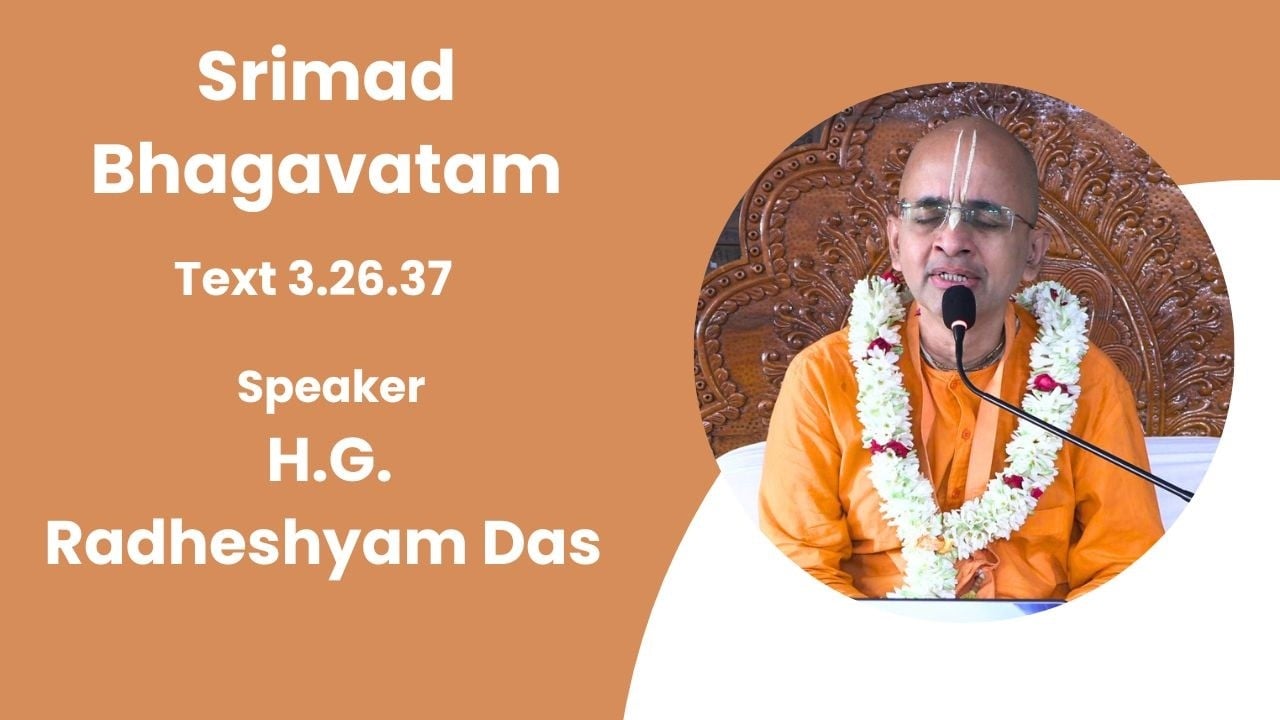
Śrīmad Bhāgavatam 3.26.37 belongs to the celebrated discourse of Lord Kapila to Devahūti, a sustained philosophical exposition that integrates Sāṅkhya ontology with the lived aims of yoga and devotion. In a recent scholarly exposition associated with H.G. Radheshyam Das, the verse was foregrounded for its precise mapping of embodied agency—how action arises through the working senses and how conscious regulation of these modalities becomes a gateway to self-mastery. The result is a text that is both rigorously analytical and immediately practical, resonating across the Dharmic traditions for its emphasis on responsibility, clarity, and compassionate use of human faculties.
As preserved in the source summary, the line opens: “ŚB 3.26.37 cālanaṁ vyūhanaṁ prāptir …”. These lexical cues signal a list of functional modalities corresponding to the five karma-indriyas (working senses). In classical Sāṅkhya-Vedānta hermeneutics, such enumerations are descriptive frames that organize human action within cosmic law (ṛta/dharma), showing how intention, attention, and embodiment intersect. The Bhāgavatam’s method is phenomenological and structural: it names typical activities, aligns them to specific organs of action, and then shows how disciplined living reorients these forces toward liberation (mokṣa) through yoga and bhakti.
Within the wider frame of SB 3.26, Kapila lays out a meticulous taxonomy of reality: from prakṛti (primordial nature) to mahat (cosmic intelligence), to ahaṅkāra (ego-principle), and onward to mind (manas), the senses (indriyas), the subtle essences (tanmātras), and the gross elements (mahābhūtas). The jñāna-indriyas (knowledge-acquiring senses) disclose the world, while the karma-indriyas (working senses) enact intention within it. Verse 3.26.37 belongs to this second stream; it clarifies how embodied action becomes coherent and ethically assessable.
Traditional commentators consistently map the five working senses—vāk (speech), pāṇi (hands), pāda (feet), pāyu (organ of evacuation), and upastha (organ of generation)—to five core functions of action. While the present citation preserves only the opening terms, the broader exegetical consensus holds these functions to include expression (abhidhāna) for speech, manipulation or acquisition (vyūhana/prāpti) for hands, locomotion or movement (cālana/gamana) for feet, elimination (visarga) for the organ of evacuation, and procreative/pleasure functions (ānanda/retas-sarga) for the generative organ. The verse thereby anchors a grammar of action that is anatomically specific, ethically evaluable, and soteriologically consequential.
Linguistically, the verse fragment is strikingly economical. “cālanaṁ” denotes motion or locomotion—intentional displacement in space; “vyūhanaṁ” suggests active manipulation, arranging, separating, or organizing—fine-motor agency typically associated with the hands; “prāptir” conveys acquisition or attainment—goal-directed grasping and securing of objects or outcomes. Read together, these terms sketch a minimal architecture of purposeful behavior: the agent moves, manipulates, and attains. Subsequent terms in the full line (attested in the commentarial tradition) complete the set through elimination and procreation, completing the fivefold functional signature of karma-indriyas.
Systematically, Sāṅkhya locates the working senses in the rājasic derivation of ahaṅkāra. This is significant: rajas, the principle of activity and propulsion, differentiates tools of action from tools of perception, while manas (mind) coordinates, buddhi (intelligence) adjudicates, and ahaṅkāra (ego-sense) claims ownership. In practice, this means that sense-restraint is not only behavioral but structural: one governs rajas by insight (viveka), devotion (bhakti), and contemplative discipline (yoga), aligning the instruments of agency with higher ends.
Bhagavad-gītā 3.42 offers a canonical hierarchy—“indriyāṇi parāṇy āhur…”—showing how sense mastery scales upward to mind, intelligence, and self. The Bhāgavatam complements this by naming, with near-scientific precision, what the senses actually do. Mastery therefore begins by observation: speech expresses meanings, the hands manipulate and acquire, the feet enable locomotion, and the lower organs govern elimination and reproduction. Ethical inquiry then asks: are these functions regulated, harmless (ahiṁsā-aligned), purposeful, and oriented to the common good and the highest good?
From the standpoint of modern cognitive science, SB 3.26.37 anticipates sensorimotor integration: perception affords action, action reshapes perception, and continuous feedback refines goal pursuit. “cālanaṁ” aligns with gross-motor control; “vyūhanaṁ” with dexterous manipulation and planning; “prāptir” with reward prediction and attainment. The verse’s implicit insight is that unregulated loops drift toward compulsion, whereas insight-guided loops move toward clarity, steadiness, and freedom—an idea mirrored in contemplative neuroscience findings on attention, inhibitory control, and value-based decision-making.
Across Dharmic traditions, the verse’s analytic core is deeply consonant. In Buddhism, the threefold karma—kāya (body), vāc (speech), and citta (mind)—maps onto disciplined action (sīla), where sense-faculties (indriya) are guarded (indriya-saṁvara) to prevent unwholesome proliferation. In Jainism, yoga is classically defined as the activities of body, speech, and mind; guptis (restraints) and samitis (carefulness) refine exactly those modalities of action that SB 3.26.37 anatomizes. In Sikh tradition, the alignment to hukam through nām-simran regulates speech, directs hands to seva (service), and orients the feet to sangat (community), integrating action with remembrance. The shared civilizational principle is clear: mastery of the instruments of agency is prerequisite to ethical clarity and spiritual ascent.
Practically, the verse may be read as a fivefold sādhanā template. Speech is refined by truthfulness, compassion, and purposeful articulation; hands are disciplined through skill, responsibility, and service; feet are guided by right destinations and right company; elimination is framed within purity and healthy routine; generative power is conserved and sanctified under dharma, honoring responsibility and mutual uplift. Bhakti-yoga then infuses each modality with sacred orientation: speech becomes kīrtana or wise counsel, hands become instruments of seva, feet undertake tīrtha and compassionate visitation, daily purification supports clarity, and procreative power is yoked to stewardship and care.
Kapila’s analysis further interfaces with prāṇa-vāyu theory. Although the verse centers the working senses, their efficacy is mediated by prāṇa (inhalation/activation), apāna (elimination), vyāna (distribution and coordination), samāna (assimilation), and udāna (upward movement). Locomotion and manipulation rely on vyāna’s integrative spread; elimination aligns with apāna; vocalization engages prāṇa and udāna; steadiness of all functions depends upon balanced samāna. Thus, the Bhāgavatam’s action grammar dovetails with a subtle physiology of energy flow, suggesting interventions through breath, posture, and attention that stabilize the motor-speech complex.
A relatable vignette clarifies the verse’s practicality. Consider the ordinary act of preparing tea. Attention orients to the cup (perception), the hand reaches (vyūhana/prāpti), the body moves across the kitchen (cālana), speech may coordinate with others, and elimination occurs on its timely rhythm. What seems trivial becomes, in Kapila’s frame, a series of identifiable actions that can be made mindful, kind, and efficient. With this recognition, daily life turns into continuous practice: small movements, rightly governed, accumulate into character, then into destiny.
Ethically, verse 3.26.37 invites a shift from impulsive to conscientious action. Regulating speech prevents harm and builds trust; training the hands elevates workmanship and responsibility; directing the feet steers one toward learning, service, and wholesome association; observing purity respects one’s body and shared environments; dignifying sexuality upholds commitment and care. In this sense, the Bhāgavatam offers not abstraction but a civic-spiritual blueprint, applicable in family life, professional craft, and community engagement.
Philosophically, Kapila’s Sāṅkhya does not vilify the senses; it locates them in a neutral cosmic architecture whose moral valence arises from intention and alignment. The same modalities that bind, when unregulated, liberate when consecrated. This is the Bhāgavatam’s synthesizing power: it marries Sāṅkhya’s analytics to bhakti’s relational telos, ensuring that mastery is not mere suppression but intelligent, loving redirection.
For students of scriptures, Śrīmad Bhāgavatam 3.26.37 offers a compact curriculum: learn what the instruments of action are, name what they do, observe them in daily life, regulate them by dharma, and orient them by devotion. Read alongside allied teachings—such as Bhagavad-gītā’s hierarchy of self-control and Patañjali’s yama–niyama–pratyāhāra—the verse becomes a precision tool for inner engineering. Read across Dharmic traditions, it becomes a bridge, affirming a shared commitment to non-violence, truthful speech, disciplined effort, and compassionate presence.
In sum, “ŚB 3.26.37 cālanaṁ vyūhanaṁ prāptir …” is more than a list; it is a theory of agency in miniature. Its power lies in clarity: by showing exactly how action is structured, it empowers seekers to take responsibility for speech, hands, feet, and foundational bodily processes. Through Vedic philosophy, yoga, and bhakti, these functions are elevated from mere mechanics to meaningful offerings—unifying the many streams of Dharma in a single current of wise and loving action.
Inspired by this post on Dandavats.










Leave a Reply
You must be logged in to post a comment.