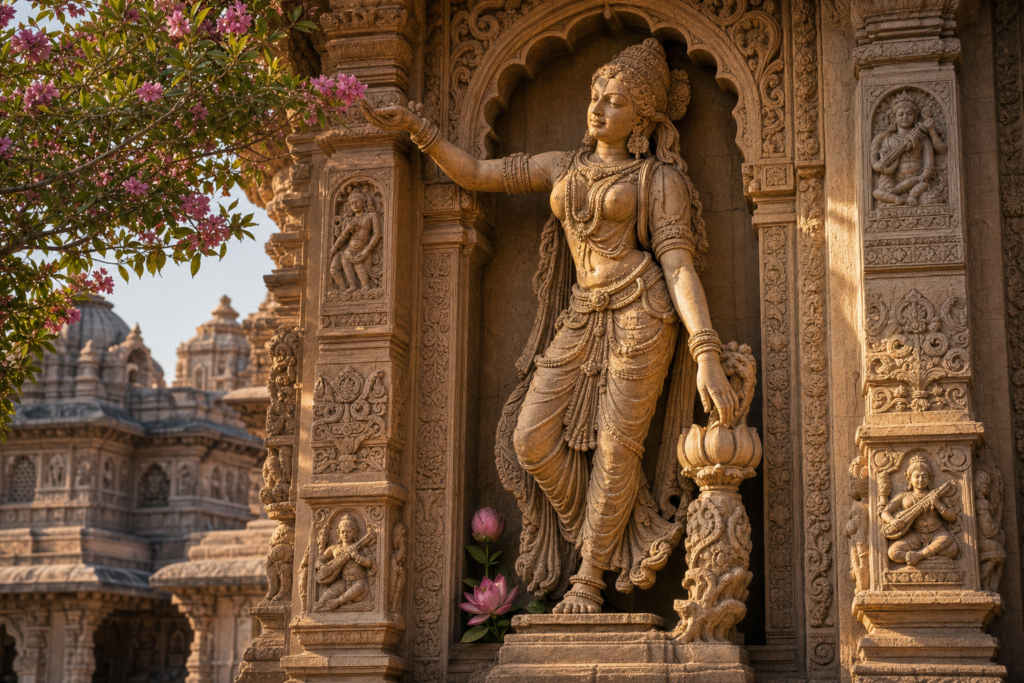
Thiruloki Akhilandeswari Samedha Sundareswara Swamy Temple stands as a serene Shaiva–Shakta kṣetra where the sacred presence of Shiva as Sundareswara harmonizes with the grace of Akhilandeswari. Revered locally as Sundaresvarar Temple, Tiruloki, it embodies the living heart of Sanatana Dharma: devotion fused with ethical life, ritual precision aligned with philosophy, and community woven together by the rhythms of worship. As with many ancient Hindu Temples, the sanctum’s atmosphere invites reflective silence and a palpable sense of purification that devotees associate with darsana and the steady disciplines of prayer, japa, and seva.
The very names enshrine a theology of beauty and sovereignty. “Sundareswara” signals Śiva as the “Most Beautiful Lord,” an archetype long celebrated in South Indian Shaiva traditions for harmonizing austerity with compassion. “Akhilandeswari” expands the horizon further“the Ruler of the Universes”evoking the cosmic Mother who shelters beings under limitless wisdom. Together, Sri Akhilandeswari Samedha Sri Sundareswara Swamy Temple manifests the non-dual complementarity of consciousness (Śiva) and energy (Śakti), reminding worshippers that transformation in Sanatana Dharma arises from their inseparability.
Within this kṣetra, visitors encounter an ethos typical of South Indian Shaiva practice, grounded in the Agamas and expressed through Temple Architecture designed for both ritual functionality and spiritual ascent. From the approach to the mandapa and onward to the garbhagriha, movement is purposeful: the built form stages a journey from the outer world toward subtle interiority. The presence of Nandi in axial alignment with the sanctum door is emblematicdevotees pause before the stoic vahana of Shiva, steadying attention prior to offering prayers at the lingam.
Architecturally, temples such as Sundaresvarar Temple, Tiruloki, generally observe Vastu Shastra principles that integrate orientation, proportion, and sacred geometry. Typical elements include a dhwajasthambha (flagstaff) at the fore of the inner precinct, a bali peetha (platform for oblations), and prakaras (concentric enclosures) that structure circumambulation. The garbhagriha, enclosed by thick, protective walls and crowned by a vimana, concentrates prana; its darkness and stillness heighten the radiance of the murti during deepa aradhana. The mandapas provide space for congregational chant, Vedic and Agamic recitation, and instruction in devotional and philosophical texts.
In keeping with Shaiva liturgical traditions, Shiva is typically worshipped in the aniconic form of the lingam, representing formless transcendence expressed through a tangible center of devotion. Ritual purity, sequence, and sound are essential: abhishekam with water, milk, curd, ghee, honey, and sugar (panchamrita), the anointment of sacred ash, the resonance of bell and conch, and the recitation of Rudra–Namaka–Chamaka or other Shaiva mantras. Each offering marks an inner refinement, aligning the individual with cosmic order (ṛta) through measured gestures and mindful breath.
The consort shrine of Akhilandeswari commonly presents the Devi with attributes of protection and beneficence, underscoring Śakti’s role as both motherly refuge and incisive wisdom. As is characteristic of Shakti temples, alankara (adorning the deity with garments, jewels, and flowers) is detailed and expressive, shifting through the day’s upacaras (attentions) and festival-specific iconography. The Devi’s shrine becomes a locus for prayers of health, clarity, and resilience, consonant with the classical understanding that Śakti empowers spiritual effort and worldly responsibility alike.
The daily liturgical cycle reflects Sanatana Dharma’s synthesis of devotion and discipline. Observances typically span morning (kala santhi), midday (uchikalam), and evening (sayaratchai) worship. At each juncture, abhishekam, alankara, naivedya (food offerings), and deepa aradhana reawaken the sanctity of the space. Many devotees time their visits to coincide with these rites, seeking the grace of Sundareswara for inner steadiness and the blessings of Akhilandeswari for auspiciousness in family, study, and work.
Periodic vratas and utsavas, well-known across Shaiva temples, greatly enrich the calendar. Pradosha, observed fortnightly during the twilight of Trayodashi, emphasizes repentance and renewal; worshippers circle the dhwajasthambha, chant the Panchakshari mantra, and offer bilva leaves that symbolize discernment. During Karthika masam (Karthigai in Tamil), lamps and processions magnify the temple’s luminance, celebrating Śiva as the cosmic Light. Arudra Darshan honors Natarajathe Lord of the Dancerevealing a theology of motion and stillness that binds the microcosm to the macrocosm. Navaratri venerates the many dimensions of Devi, while Maha Shivaratri compels an all-night vigil of mantra, abhishekam, and meditation that devotees regard as especially efficacious for quieting the mind.
Temple Architecture and ritual design serve not merely as aesthetic or historical artifacts but as precise instruments of spiritual practice. The Agamic frameworktransmitted through guru-śiṣya paramparaensures that forms, proportions, mantras, and mudras rest on a coherent philosophical foundation. In temples like this Shaiva–Shakta sanctum, the layered program makes space for diverse temperaments: contemplatives drawn to meditative stillness, householders participating in seva and annadana, students learning Sanskrit stotras, and musicians preserving classical traditions of kirtan.
Reflecting the inclusive spirit of India’s civilizational heritage, the temple’s culture of reverence resonates with the wider family of dharmic traditionsHinduism, Buddhism, Jainism, and Sikhismeach affirming ethical living, compassion, self-discipline, and service. This unity in diversity strengthens social harmony. By honoring multiple paths to the sacred while upholding one’s own sadhana, communities cultivate mutual respect that is foundational to a plural society.
Etiquette at such shrines remains simple yet significant. Modest attire preserves sanctity; silence near the garbhagriha honors the concentration of other devotees; and offerings of flowers, bilva leaves, fruits, and ghee lamps are welcomed. Photography policies vary by shrine; asking temple staff avoids inadvertent discourtesy. Morning and evening remain favored times for darsana, though pilgrims typically confirm local timings to align with the day’s puja schedule. Many also practice pradakshina with mindful breathing, integrating body, breath, and intention.
The heritage value of Sundaresvarar Temple, Tiruloki, extends beyond its stone and ritual script. Temples preserve indigenous craftsmanship, regional languages and chants, and intangible knowledge systems ranging from Vastu Shastra to classical culinary and medicinal traditions linked to festive prasada. Community efforts that support structural conservation, archival documentation of inscriptions and oral histories, and training of young archakas and musicians help ensure continuity without compromising authenticity.
Contextualizing this temple within the broad arc of “Sundareswara” worship illuminates a pan-Indian pattern: Shaiva kshetras often pair the Lord with a compassionate consort who sanctifies material and spiritual well-being. While each site has its sthala–purana and local narrative, the shared grammar of Agama, iconography, and festival cycles makes devotion legible across regions. This coherencecombined with local nuanceis one reason Hindu Temples have remained sustainable centers of community life and spiritual education for centuries.
For those seeking a structured approach to worship, a balanced sequence may include silent pranayama before Nandi, Panchakshari japa while offering bilva leaves, attentive participation in abhishekam and deepa aradhana, and a concluding moment of gratitude at the Devi’s shrine. Such integrated practice refines attention, calms the senses, and aligns action with dharma. It also reflects the temple’s essential teaching: the Beautiful Lord and the Universal Mother meet within the heart’s stillness, and their blessings unfold through disciplined compassion in daily life.
In sum, Thiruloki Akhilandeswari Samedha Sundareswara Swamy Temple exemplifies the enduring confluence of devotion, philosophy, and artistry in Sanatana Dharma. Its Shaiva–Shakta sanctity, expressed through ritual cadence and carefully proportioned space, invites seekers to rediscover clarity, humility, and joy. By nurturing unity across dharmic traditions and honoring the plurality of spiritual temperaments, the temple reaffirms an ancient promise: beauty, wisdom, and strength are available to all who approach with sincerity and reverence.
Inspired by this post on Hindu Pad.