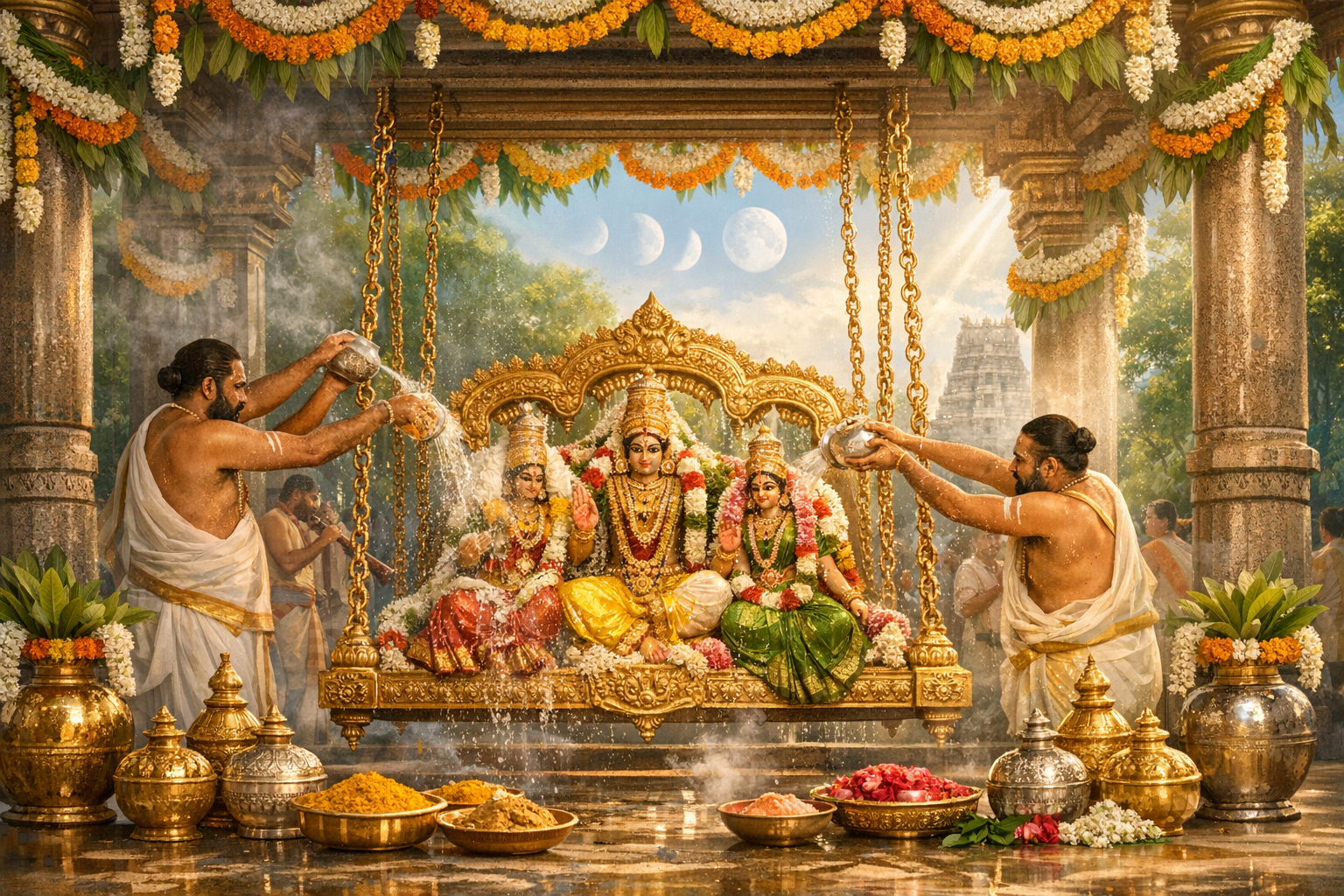
Vasanthotsavam 2026 at the Sri Venkateswara Swamy Temple (Tirumala Tirupati Balaji Temple) will be observed from March 30 to April 1, 2026, aligning with Chaitra Masam and traditionally mapped to the auspicious tithis of Trayodasi, Chaturdasi, and Purnima. Known locally as the Salakatla Vasanthotsavam, this is the principal annual spring festival at Tirumala, welcoming the season of renewal with elaborate Vaishnava temple rites and devotional pageantry.
Salakatla Vasanthotsavam is distinguished from routine observances by its scale and the participation of thousands of pilgrims who witness the Utsava Murthis of Sri Malayappa Swamy with Sridevi and Bhudevi receiving special honors. The festival integrates the seasonal symbolism of Vasanta Ritu with liturgical prescriptions from the Vaikhanasa Agama, which governs the daily and special worship (kainkarya) at Tirumala.
Etymologically, “Vasantha” signifies spring and “Utsavam” denotes a festal elevation of divine presence into the community. Thematically, the festival expresses cooling, cleansing, and renewalqualities made tangible through sandalwood, floral garlands, perfumed waters, and the gentle cadence of Nadaswaram and Tavil as processions move toward the Vasanthotsava Mandapam.
For 2026, the three-day schedule coincides with Chaitra Shukla paksha. While civil dates are fixed (March 30–April 1), the liturgical clock follows the lunar tithi; hence, individual services are sequenced according to when Trayodasi, Chaturdasi, and Full Moon prevail at Tirumala. Devotees may note that service timings are periodically adjusted by Tirumala Tirupati Devasthanam (TTD) in accordance with the tithi boundaries.
Historically, Vasanthotsavam at Tirumala is traceable to the Vijayanagara era, with several traditions attributing royal patronage to Achyuta Devaraya (r. 1529–1542). Over time, the festival was refined within the Vaikhanasa liturgical framework, developing its hallmark featuresSnapana Tirumanjanam, perfumed sandal applications, and public processionswhile preserving the theological core of Sri Vaishnava devotion to Sri Venkateswara.
Ritually, a technical distinction is maintained between the Mula Murti (presiding, immovable deity in the sanctum) and the Utsava Murthis (processional deities). During Vasanthotsavam, honors are primarily rendered to Sri Malayappa Swamy with Sridevi and Bhudevi, ensuring that the grandeur of the rites remains accessible to devotees without altering the inviolable protocols of the sanctum sanctorum.
The centerpiece, Snapana Tirumanjanam, is a ceremonial abhishekam performed with sacred dravyas such as Panchamrita (five nectars), turmeric, sandalwood paste, saffron-infused waters, and fragrant rose water. Vedic hymns, Vishnu Sahasranama, and Vaishnava stotras accompany the ablutions, creating a layered ritual environment that is at once sensory, scriptural, and contemplative.
Services are typically conducted at the Vasanthotsava Mandapam near the temple gardens, a space chosen for its capacity to hold large congregations and for its resonance with the festival’s seasonal aesthetic. The mandapam’s florals, fragrant breeze, and ambient recitation of Veda Parayanam deepen the experiential dimension of darshan during the festival.
Each day generally unfolds after the completion of the temple’s nitya-kainkaryas (daily services) in the sanctum. The Utsava Murthis are brought in procession with Mangala Vadyam, seated on the unjal (swing) for Unjal Seva at designated times, and honored with archana and offerings before the commencement of Snapana Tirumanjanam. Evenings often feature additional processional honors before the deities return to the temple.
The dravya-krama (sequence of anointments) not only follows Agamic rigor but also articulates symbolic meanings: milk and curd evoke nourishment and purity; honey and sugar denote sweetness and auspicious speech; sandal and turmeric cool and protect; saffron and floral waters suggest luminosity and grace. The rite culminates in alankara (adornment) with resplendent jewelry and garlands, affirming the deity’s royal radiance (Sri).
Customarily, Ankurarpana (ritual seed-sowing) is undertaken on the eve to sanctify the festival cycle, reflecting the agricultural metaphor embedded in Vasanta Ritu: new sprouting, fresh intention, and an ethic of sustenance. This prelude sacralizes both the space and the time in which the ensuing three-day observance unfolds.
For devotees, the experiential texture of Salakatla Vasanthotsavam is striking: the pervasive scent of sandal and jasmine, the cadence of Vedic chant, and the sight of Sri Malayappa Swamy’s alankara collectively evoke a quiet, cooling joy. Many describe a palpable sense of renewala feeling that personal vows made in the spring light carry an added potency in the presence of the Lord of the Seven Hills.
Practical considerations for 2026 include early arrival for darshan around the mandapam, adherence to TTD’s dress code (modest, traditional attire encouraged), and awareness of crowd-management advisories issued by TTD. Families with elders or children may prefer mid-morning sessions when movement is steadier and seating is more likely to be available.
TTD periodically releases guidance on arjitha-sevas, access modalities, and seating arrangements for Vasanthotsavam. As allocations and timings can change for operational or security reasons, it is prudent to consult official TTD channels prior to travel for the latest schedule and entry advisories.
From a dharmic perspective, the ethos of Vasanthotsavamseasonal renewal, inner purification, and community sevaresonates across Hinduism, Buddhism, Jainism, and Sikhism. The spring cycle broadly inspires reflection, compassion, and service: values that nurture social harmony and a shared civilizational commitment to ahimsa, dana, and satya.
Environmental stewardship has become an increasing priority. Water use during abhishekams is managed with care, floral offerings are streamlined for sustainability, and post-ritual clean-up emphasizes sanctity of space. These measures align the festival’s grandeur with a contemporary ethic of ecological responsibility.
In terms of crowd flow, pilgrims can expect phased movement via designated queue complexes and guidance by TTD volunteers and security personnel. Standard protocols for temple precincts apply: respectful silence during core rites, no photography where restricted, and mindful participation to ensure unobstructed darshan for all.
Several technical nuances are worth noting. The Utsava Murthis alone receive Snapana Tirumanjanam; the Mula Murti’s nitya-kainkaryas in the garbha-griha proceed as per the daily schedule. Unjal Seva during Vasanthotsavam accentuates the theme of rhythmic balance and seasonal ease, complementing the cooling emphasis of sandal and floral rites.
Devotees visiting during March 30–April 1, 2026, may also consider the broader Chaitra Masam spiritual arc, which includes vrata, parayana (scriptural recitation), and charitable giving. Chaitra’s Shukla Purnima offers a luminous point for sankalpa (spiritual resolve), harmonizing personal practice with the festival’s collective merit (punya).
As a living heritage festival under Tirumala Tirupati Devasthanam, Salakatla Vasanthotsavam weaves textual fidelity, historical continuity, and contemporary community participation into a seamless devotional experience. Its enduring appeal lies in the way the rites translate seasonal change into spiritual momentumcooling the senses, clarifying the mind, and renewing the heart.
In 2026, the confluence of precise tithis, the fragrance of sandalwood, the cadence of Vedic chant, and the radiance of Sri Malayappa Swamy with Sridevi and Bhudevi will once again draw devotees into a shared celebration of grace. Within the luminous expanse of Chaitra Masam, Vasanthotsavam at Tirumala continues to embody the timeless promise of spring: auspicious beginnings, inner harmony, and the joy of darshan.
Inspired by this post on Hindu Pad.