Ascending the broad, finely hewn steps from the Ghats of Puṇyanadi Narmada reveals the Ahalyeshvara Mahadeva Mandir in Māheśvara in all its measured grandeur. The approach itself functions as a contemplative threshold: the river’s slow cadence, the ascending stone, and the temple’s silhouette align to prepare the mind for darśana within a living monument of Hindu temple architecture and India’s cultural heritage.
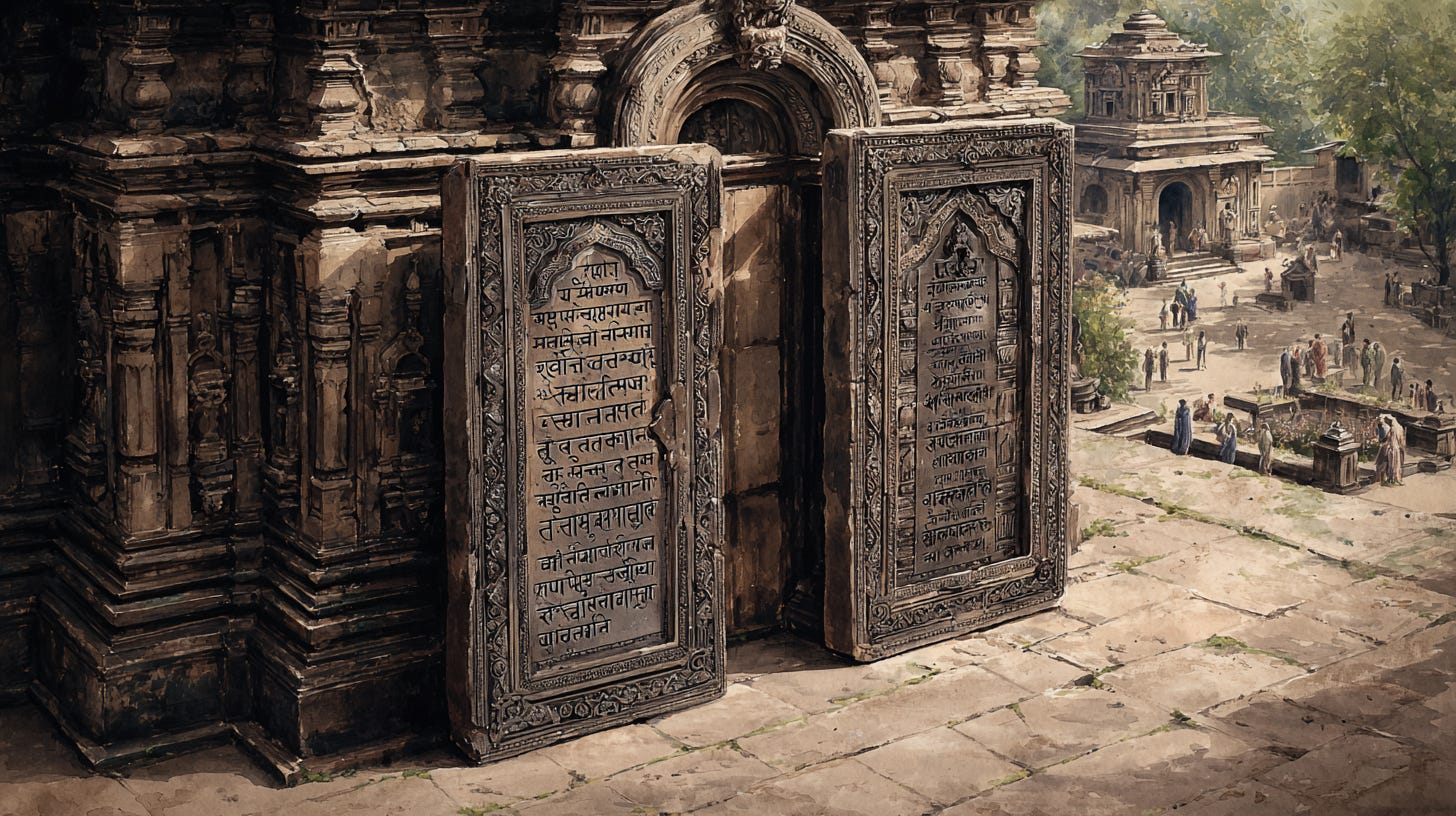
Inside, the natural movement of a devotee proceeds toward the Garbha-Griha. Yet a careful pause at the doorway rewards the attentive observer. Embedded in the doorframe are two smooth black stones, each measuring approximately 3½ by 1½, placed with deliberate precision. These unobtrusive panels hold a narrative that quietly commands scholarly and spiritual attention.
Carved across thirty-seven lines in elegant Dēvanāgari calligraphy, the inscription offers a compact chronicle of the Mandir’s construction. Such epigraphic testimony is invaluable to the study of Temple History: it anchors ritual space in historical time, preserves names, intentions, and patronage, and exemplifies the confluence of devotion, aesthetics, and inscriptional literacy in the cultural life of Māheśvara. For students of Inscriptions and Temple Architecture, these lines serve as a primary source, not merely a decorative artifact.
Visitors frequently describe a layered experience: the cool touch of black stone at the threshold, the soft echo of bells from the sanctum, and the river breeze that threads memory into present devotion. In this setting, the doorway inscriptions act as a bridge between lived bhakti and historical memory. The Mandir thus becomes both a site of worship and an open archivewhere scholarship and pilgrimage coexist without dissonance.
This harmony reflects the civilizational ethos of Sanatana Dharma and resonates across dharmic traditions. Sacred spaces such as the Ahalyeshvara Mahadeva Mandir invite shared reflection on ethical living, disciplined practice, and reverence for knowledgevalues cherished within Hindu, Buddhist, Jain, and Sikh lineages. The doorway stones, with their measured script, symbolize a heritage where plurality is not merely tolerated but curated in stone and sanctified in ritual.
Safeguarding such inscriptions is a collective responsibility. Conservation enables future generations to encounter the same precise Dēvanāgari lines, to study the continuity of Māheśvara’s sacred landscape, and to recognize the temple’s role in Madhya Pradesh’s cultural heritage. Thoughtful visitationattentive to architecture, inscription, and ritualdeepens understanding of India’s living temples and strengthens the unity of its diverse dharmic practices.
Inspired by this post on Dharma Dispatch.