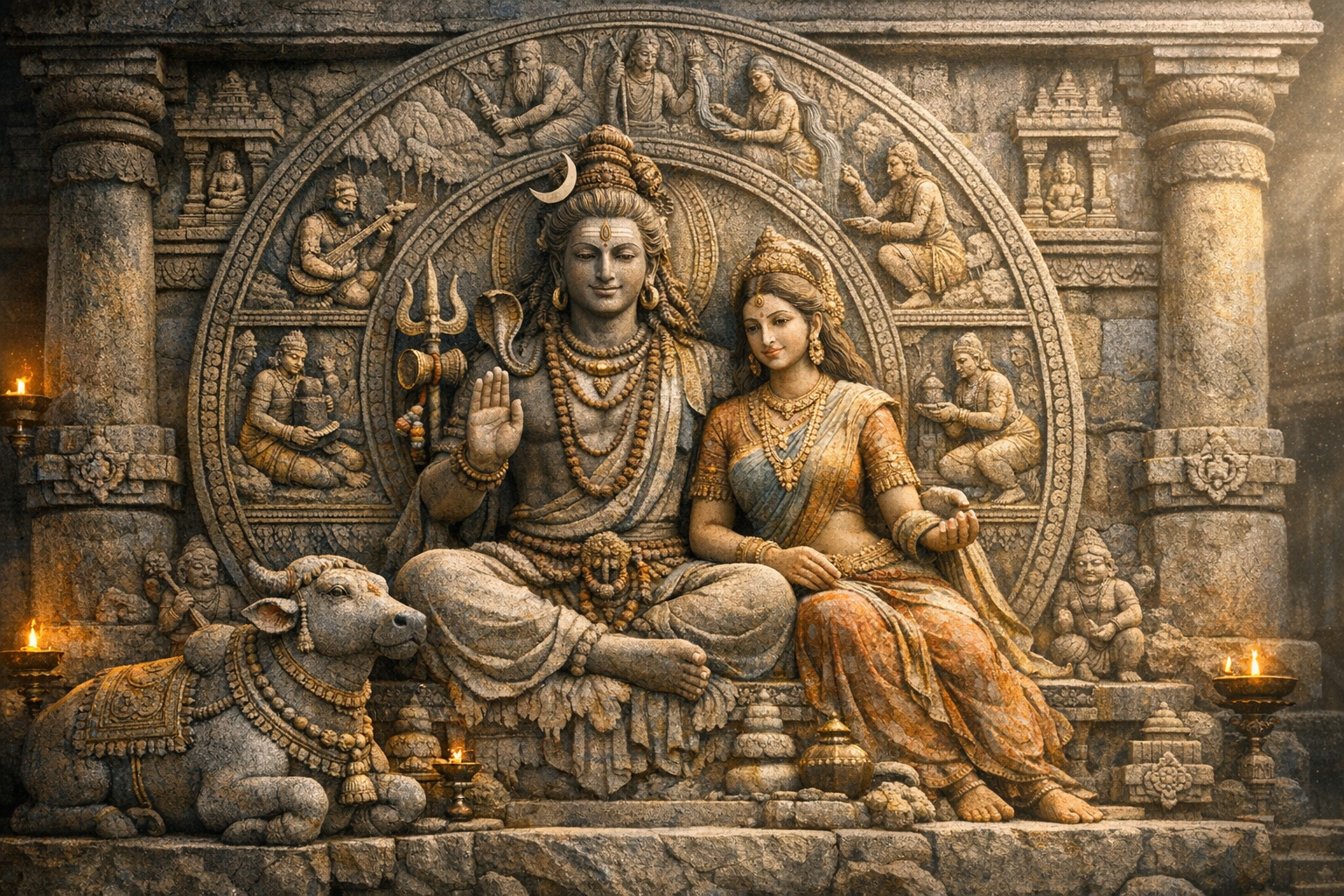
Anugrahamurtis, the grace-bestowing forms of Shiva, occupy a distinctive place within Shaiva iconography as sculptural meditations on compassion, assurance, and liberation. In contrast to Samharamurtis that emphasize destructive power or Upadeshamurtis centered on instruction, Anugrahamurtis foreground the moment of anugrahadivine gracemade visible through protective gestures, benevolent narratives, and restorative presence. Read closely, these images function as a visual theology of mercy, shaping how devotees experience darshan in temples and how scholars interpret the ritual and aesthetic grammar of Hindu art.
In Shaiva thought, anugraha is one of the pañcakṛtyas (five divine acts)sṛṣṭi (creation), sthiti (maintenance), saṁhāra (dissolution), tirobhāva (concealment), and anugraha (grace). Agamic texts such as the Kāmikāgama, Suprabhedāgama, and Kāraṇāgama, together with Śilpaśāstra treatises, anchor these ideas in prescriptive iconography and temple practice. Anugrahamurtis translate this doctrinal axis into stone and bronze, presenting Shiva not as judge or warrior but as the compassionate source of protection, boons, knowledge, and ultimately mokṣa.
Iconographically, Anugrahamurtis tend toward saumya (gentle) and śānta (tranquil) rasa, although they may be embedded within dynamic narrative contexts. The visual grammar frequently includes abhaya-mudrā (gesture of fearlessness) and varada-mudrā (gesture of boon-bestowal), relaxed asanas such as sukhāsana or lalitāsana, and attributes like the triśūla, ḍamaru, akṣamālā, and mṛga. The presence of Umā (Pārvatī), Gaṇeśa, Kārttikeya, and gaṇas often amplifies the familial and protective dimensions of grace, while Nandi’s steady gaze models bhakti and sevā for devotees.
Within the broad family of Anugrahamurtis, several narrative types recur across the Indian subcontinent and beyond. These include Ravananugraha (grace to Rāvaṇa after subduing his arrogance), Kalāntaka/Mṛtyuñjaya (grace to Mārkaṇḍeya by subduing Yama), Kirātārjuna (grace to Arjuna with the Pāśupatāstra), Gaṅgādhara (grace in receiving and channeling Gaṅgā for the world), Candeśānugraha (grace to the devotee Candeśa), Nandīnugraha, Bṛṅginugraha, Somāskanda (familial benevolence), and Kalyāṇasundara (the divine marriage as cosmic welfare). Each type encodes a moral-theological arc: restraint before power, devotion over death, penance preceding empowerment, and compassion channeling cosmic force toward the welfare of beings.
Ravananugraha Murti presents one of the most instructive narratives of humbled power. According to the Purāṇic cycle, the ten-headed Rāvaṇa attempts to uproot Mount Kailāsa, only to be pinned by Shiva’s toe. Recognizing his folly, he sings hymns and is ultimately granted anugraha. The sculptural formula typically shows Shiva with Pārvatī upon Kailāsa, the mountain rendered as a stacked, inhabited form with gaṇas, while below a multi-armed, multi-headed Rāvaṇa strains or plays a veena fashioned from his own sinews. The moral message is precise: greatness without humility coils back upon itself; grace arrives when ego yields.
Archaeologically, Ravananugraha appears in major reliefs and sculptures from the early medieval period onward. Canonical examples are found at the Elephanta Caves (Maharashtra), the Kailāsanātha Temple at Kanchipuram (Pallava period), and the great Kailāsa complex at Ellora (Rāṣṭrakūṭa period). Khmer art across Angkor also portrays the Kailāsa episode with expressive vigor, underlining how the didactic thrust of anugraha traveled with Shaiva idioms across South and Southeast Asia. These pan-regional renderings testify to a shared aesthetic language built on narrative clarity and theological nuance.
Kalāntaka or Mṛtyuñjaya, the grace shown to the young sage Mārkaṇḍeya, crystalizes the Shaiva promise that devotion reconfigures destiny. As the legend recounts, Yama arrives to claim Mārkaṇḍeya at the appointed span, but the devotee clings to the Śivaliṅga. Shiva intervenes, subduing or even striking Yama, thereby granting the devotee renewed life and transcendence of ordinary mortality. The theological pivot here is unmistakable: bhakti aligns the finite with the infinite, and grace unties the strict knot of karmic determinism.
Iconographic treatments of Kalāntaka vary. In some panels, Shiva is dynamic and heroic, one leg raised to restrain Yama; in others, a more tranquil Mṛtyuñjaya steadies the devotee with protective assurance. The Airāvateśvara Temple at Darasuram (Chola period) preserves eloquent reliefs of this cycle, and the theme appears widely across South Indian temples. The recurrent image of the Śivaliṅga as refuge in these scenes reinforces a ritual truth: the axis of worship doubles as the axis of salvation when met with devotion and grace.
Kirātārjuna condenses tapas, testing, and transmission into a single visual sequence. Disguised as a kirāta (hunter), Shiva challenges Arjuna’s ascetic resolve and martial humility before bestowing the Pāśupatāstra. The anugraha here is not mere gift; it is competency licensed by character. The narrative resonates with the larger Mahābhārata ethic that knowledge and power are sanctified only when yoked to dharma.
Artists distinguish Kirātārjuna through the juxtaposition of a penitent warrior and a hunter-divinity whose forest guise belies metaphysical sovereignty. Reliefs at Mamallapuram are often read through this lens (alongside the allied “Descent of the Gaṅgā” interpretation), while expressive versions occur at Ellora and in Hoysala temples of Karnataka. The martial implements, the tense poise of the figures, and the culminating gesture of boon-bestowal together code a grammar of earned grace.
Gaṅgādhara represents a world-scale gesture of compassion. When Bhagiratha’s austerities invite Gaṅgā to descend, Shiva receives the torrent in his matted locks, tempering its force so the earth may be blessed rather than destroyed. Iconographically, Shiva’s jaṭā cradle the river-goddess, while attending figures signal the ecological and civilizational stakes of this descent. In effect, the murti teaches that cosmic energies, when met with wisdom, become channels of welfarea lesson often invoked in discourses on sacred geography and environmental stewardship.
Candeśānugraha vividly encodes the reciprocal covenant between deity and devotee. Candeśa, the paragon of unwavering service, receives Shiva’s embrace or boon, and is elevated as the guardian of temple wealth and ritual propriety. South Indian processional bronzes frequently stage this scene with emotive intimacy: Shiva and Pārvatī extend grace; Candeśa, hands folded, attains proximity that few images so directly dramatize. The visual message is stark yet tendersevā matures into siddhi when graced.
Other consistent anugraha themes include Nandīnugraha, wherein Shiva appoints Nandi as foremost among his gaṇas, and Bṛṅginugraha, where Bṛṅgi’s imbalanced devotion is corrected with transformative compassion. Each murti makes a moral-philosophical point through form: loyalty recognized, bias remedied, and community (saṅgha) reshaped through benevolent authority. These are not only theological claims; they are social blueprints carved in stone.
Somāskanda, depicting Shiva with Umā and Skanda, casts grace in familial terms. Emerging with particular force in Pallava and Chola art, Somāskanda panels appear behind the main liṅga in many sancta, enfolding the axial icon in a visual halo of household benevolence. The composition quietly reorients kingship, domesticity, and pedagogy around divine companionship, with the child-deity Skanda signaling the continuity of dharma across generations.
Kalyāṇasundara, the divine marriage, is another anugraha-inflected type, celebrated in temple festivals and bronzes that emphasize auspicious union. The scene communicates social stability through sacred conjugality, the confluence of śakti and śiva as a model for cosmic and civic harmony. Ritual calendars that re-enact this marriage translate art and theology into communal ethics, reaffirming shared vows of protection and prosperity.
Natarāja, though a more encompassing form, also encodes anugraha within the pañcakṛtya cycle expressed in the dance: the ḍamaru signals creation, the fire dissolution, the lifted hand grants abhaya, the planted foot steadies existence, and the suppression of Apasmara dispels ignorance. In this hermeneutic, Natarāja is not only cosmic motion; the raised hand is an unambiguous promise of safety. Grace is thus not an afterthought but a structural element within the very engine of becoming.
Technically, the sculptural language of anugraha relies on the precision of hasta-mudrā, proportional canons (tāla and pramāṇa), and narrative sequencing laid down in Śilpaśāstra literature. Chola bronzes, forged by the cire perdue (lost-wax) process, finesse micro-gestures of reassurance in ways that stone rarely can, while Pallava and Rāṣṭrakūṭa reliefs exploit scale and depth to draw the viewer into a staged didactic theater. In both media, the viewer’s rasa experience completes the icon: grace received through sight becomes grace embodied in conduct.
Regionally, Anugrahamurtis track the evolution of styles and patronage. Pallava ateliers at Kanchipuram and Mamallapuram favor narrative breadth and courtly idealism; Chola workshops at Thanjavur and Darasuram refine bronze naturalism and devotional intimacy; Hoysala craftsmen at Belur and Halebidu elaborate ornament and expressive detail; and Khmer masters at Angkor adapt Shaiva episodes to local idioms with striking dynamism. This geographic spread underscores a shared civilizational conversation about what divine grace looks like when translated into public art.
For those engaging temples experientially, a practical method enriches viewing. First, identify the core gesture set: abhaya and varada are reliable indicators of anugraha. Second, read narrative cues: the presence of Rāvaṇa, Mārkaṇḍeya, Arjuna, Candeśa, or Gaṅgā will anchor the scene. Third, assess relational dynamics: how Umā, Nandi, gaṇas, or sages respond will telegraph the moral economy of the panel. Finally, stand still for a moment of interior alignment; in traditional aesthetics, darśan is reciprocalthe deity also “sees” the devotee.
Anugrahamurtis also resonate across dharmic traditions through a shared ethic of compassion. Buddhism articulates karuṇā in the Bodhisattva ideal; Jainism lauds dayā and ahiṁsā in the Tīrthaṅkaras’ example; Sikh tradition treasures nadar (divine grace) as transformative. Without flattening doctrinal differences, these convergences illuminate a broad Indic consensus: authentic power is compassionate, and true wisdom is generous. Appreciating Shiva’s Anugrahamurtis through this lens strengthens inter-dharmic understanding and unity.
Several sites offer exemplary encounters with these themes. The Elephanta Caves and Ellora’s Kailāsa present Ravananugraha and related Shaiva cycles with monumental clarity. Kanchipuram’s Kailāsanātha Temple preserves Pallava idioms foundational for later Chola refinements. At Darasuram’s Airāvateśvara and Thanjavur’s Brihadeeshwara Temple, Chola bronzes and reliefs stage anugraha with unrivaled poise. In Southeast Asia, Angkor Wat and allied Khmer complexes extend the visual vocabulary into a regional ecumene.
Beyond scholarship, the lived impact of Anugrahamurtis is frequently noted by temple communities: the calm induced by abhaya, the hopeful readiness summoned by varada, and the ethical orientation suggested by narrative exemplars. These images teach that grace is not passive pardon but enabling powershaping devotion into service, courage, and clarity. In this manner, art tutors the inner life, and theology becomes practice.
Taken together, Anugrahamurtis articulate a complete pedagogy of grace in Shaiva art: humility before greatness, devotion over fear, knowledge governed by dharma, and cosmic force tempered by compassion. As visual scriptures, they are as rigorous as they are consolingprecise in proportion and prescription, expansive in meaning and affect. For students of iconography and seekers alike, learning to read these forms deepens temple darśan and widens inter-dharmic appreciation, allowing grace in stone to become grace in life.
Inspired by this post on Hindu Blog.