St James schools in London are inviting interest from qualified Sanskrit educators to join a well-established program that has introduced generations of pupils to one of the world’s great classical languages. The role aligns language learning with cultural understanding, offering students a clear, structured pathway from beginner foundations in the Prep School to rigorous study at IGCSE/O Level standard in the Senior Schools.
Established in 1975, St James schools have long integrated Sanskrit into the core of their curriculum. All Prep School pupils study Sanskrit, while many Senior School students choose to continue the subject up to IGCSE Level, with some later pursuing Sanskrit at university either as a dedicated degree or as part of related fields such as Indology, linguistics, archaeology, or philosophy.
Sanskrit education at St James is framed as both intellectual training and cultural literacy. The language’s highly systematic grammar develops precision in reasoning, attention to structure, and a rigorous habit of analysis. At the same time, exposure to classical literature and ideas nurtures historical awareness and ethical reflection, fostering the kind of broad-minded perspective valued in UK and global higher education.
Rooted in the civilizational heritage of the Indian subcontinent, Sanskrit connects the shared intellectual and spiritual currents of Hinduism, Buddhism, and Jainism, and it has deeply influenced wider South Asian literary cultures. A program that foregrounds this common ground helps cultivate interfaith and intercultural understanding, reinforcing unity across Dharmic traditions while welcoming learners of all backgrounds.
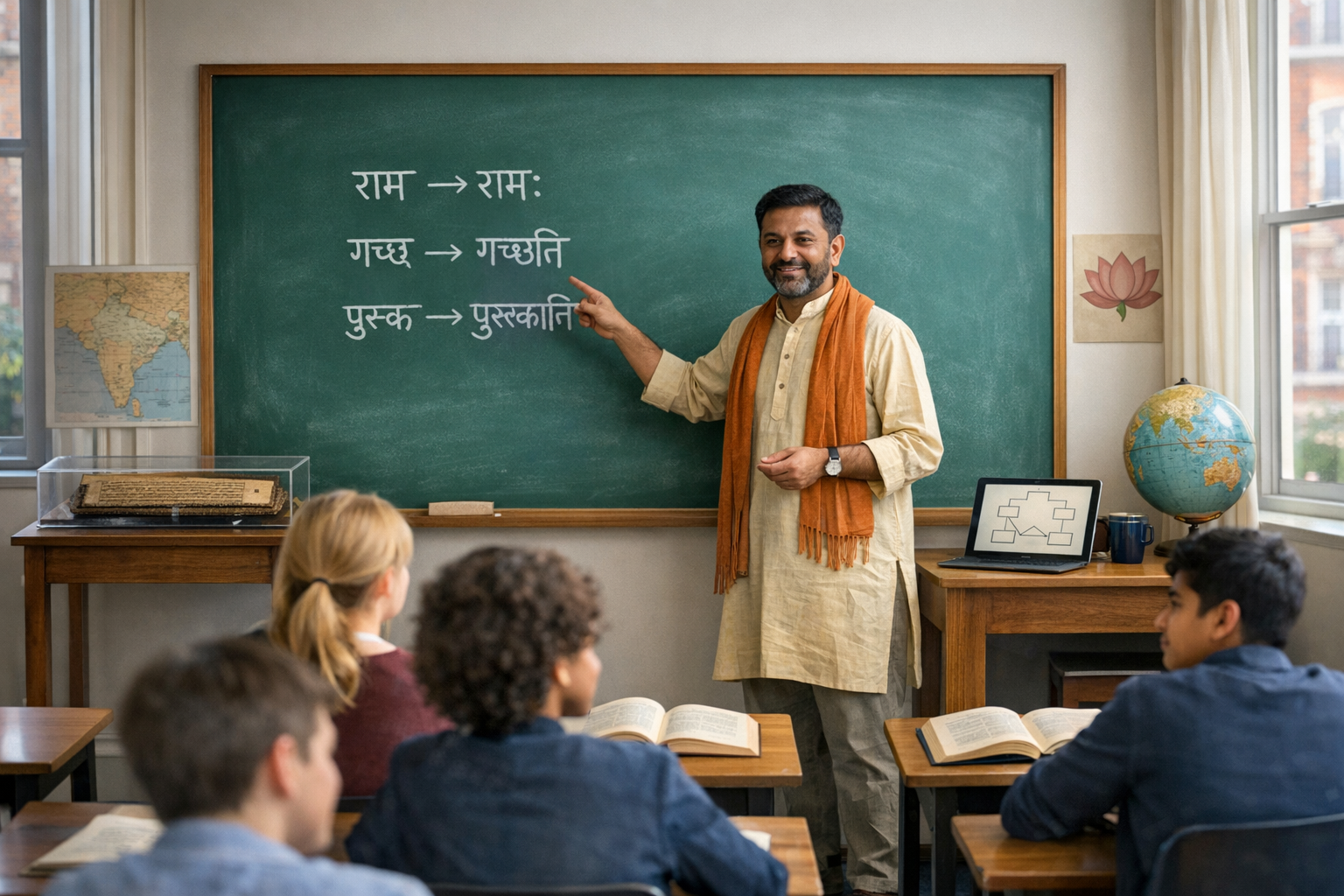
The curriculum typically begins with the Devanagari script, precise phonetics, and foundational vocabulary. Pupils progress through the core building blocks of grammarvibhakti (case endings), lakāra-s (verb tenses and moods), sandhi (euphonic combination), and basic samāsa (compounding)so they can read, parse, and translate with accuracy. Recitation and careful attention to metre support confident pronunciation and memory.
By the upper years, students preparing for IGCSE/O Level work systematically with set texts and unseen passages, consolidating grammar and expanding lexicon. They learn to translate into and out of Sanskrit, demonstrate comprehension in context, analyze literary features such as imagery and metre, and articulate the historical and ethical dimensions embedded in classical narratives. Depending on exam board and year, selections commonly draw from moral tales, epic literature, and celebrated poetry.
Assessment at IGCSE/O Level (or their international equivalents) emphasizes three pillars: linguistic competence (grammar and syntax), textual understanding (translation and comprehension), and interpretive skill (analysis of genre, style, and cultural context). This combination of skills equips students for advanced study in languages, classics, history, and the humanities more broadly.
The teaching role involves designing coherent schemes of work, pacing grammar acquisition thoughtfully, and scaffolding learners from introductory reading fluency to confident exam performance. Effective pedagogy balances the traditional grammar-translation approach with spoken and aural elements that build intuitive command. Equally important is the capacity to differentiate instruction, challenge high achievers, and support learners who need more time to master paradigms.
Ideal candidates bring strong command of classical Sanskrit grammar (including Paninian concepts), sensitivity to adolescent learning, and the ability to present complex ideas clearly. The position requires the right to work in the UK and sufficient proficiency to teach up to O Level/IGCSE standard. Familiarity with exam specifications, lesson sequencing for cumulative grammar, and evidence-led teaching practices will be strong advantages.
High-quality Sanskrit teaching also benefits from judicious use of reference tools and digital resources. Standard dictionaries (e.g., Monier-Williams, Apte), searchable text repositories, and reputable online morphology tools can streamline lesson preparation and deepen students’ independent study. Carefully selected audio-visual materials, metrical chanting, and comparative linguistics (for instance, noting cognates across Indo-European languages) further enrich engagement.
Beyond the classroom, enrichment can include recitation circles, reading clubs, and collaborations with museums or libraries that hold South Asian manuscripts and artefacts. These experiences help students appreciate the wider cultural ecosystem of Sanskrit, from epic storytelling to performative traditions, while reinforcing curricular objectives in a memorable, inspiring way.
The broader educational impact is significant. Alumni who study Sanskrit often gain an enduring appreciation for primary sources, critical philology, and the interconnectedness of language, thought, and culture. These habits of mind serve students whether they pursue university study in the humanities and social sciences or channel their analytical training into fields such as law, economics, or computer science.
St James schools underscore that Sanskrit is not only a subject of historical interest but also a living bridge across traditions. By presenting foundational texts and ideas in a balanced, inclusive manner, the program advances the shared humanistic values at the heart of Dharmic culturesethical inquiry, intellectual humility, and respect for multiple paths of understanding.
Minimum role expectations include two essentials: candidates must already have the right to work in the UK, and they must possess the proficiency necessary to teach up to O Level (or IGCSE) standard. Further details about the school’s Sanskrit program and educational philosophy can be explored via the official “Sanskrit at St. James” pages, which outline the longstanding commitment to classical languages within the broader curriculum: https://www.sanskritatstjames.org.uk/1599-2/
This vacancy represents an opportunity to contribute to a respected London-based program where Sanskrit functions as a rigorous academic discipline and a catalyst for intercultural understanding. Educators with a passion for accurate scholarship, student-centered pedagogy, and the unifying spirit of South Asia’s Dharmic heritage will find the St James environment both intellectually demanding and deeply rewarding.
Inspired by this post on Hindu Human Rights Blog.