
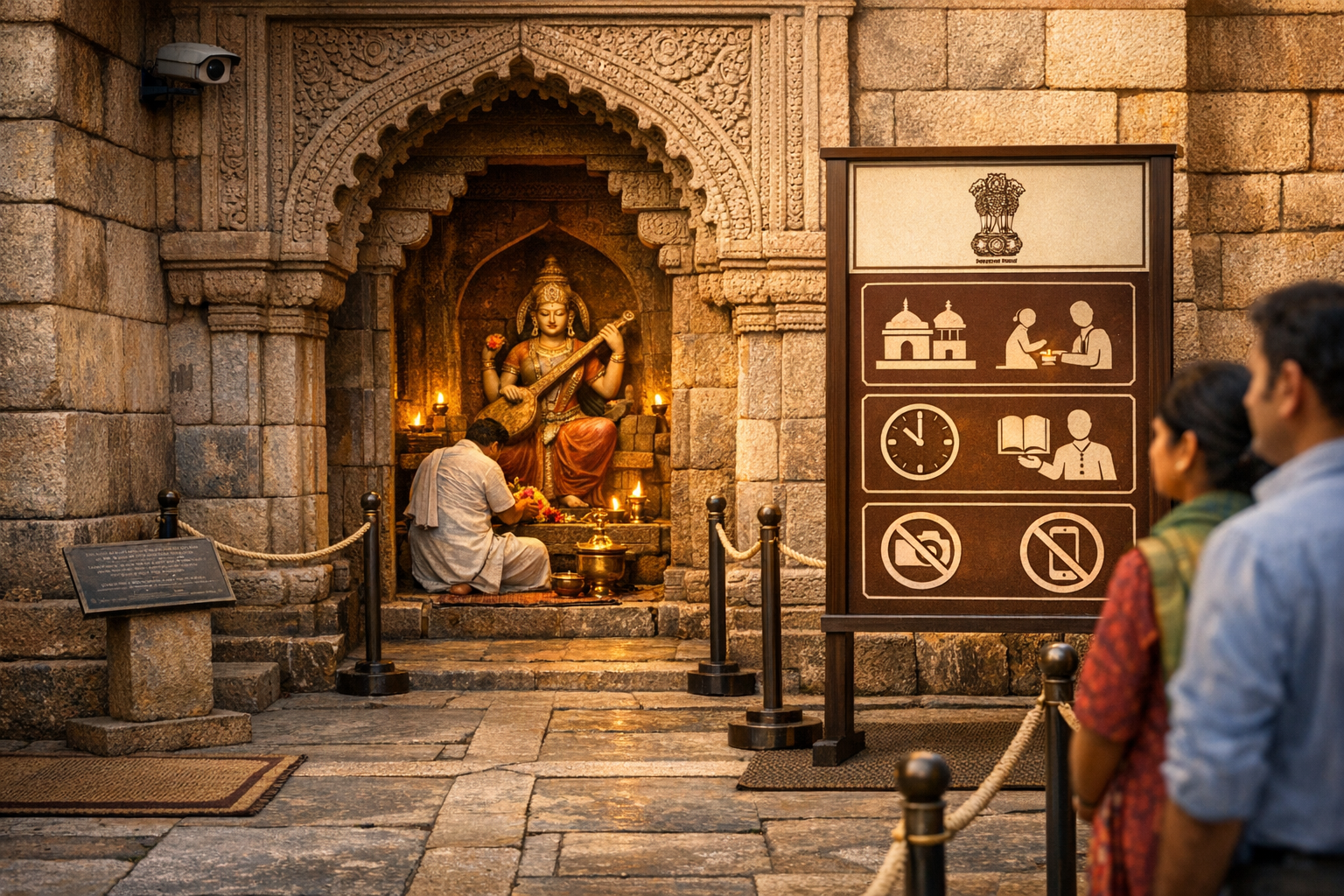
Reports from Dhar, Madhya Pradesh dated May 18, 2026 indicate that an idol of Mata Saraswati was installed within the Bhojshala sanctum, with daily worship (nitya-puja) commencing, and that posters at the complex entrance announced restrictions on entry for non-Hindus following a High Court judgment. As official documentation and independent confirmations continue to surface, this analysis focuses on the heritage, legal, ritual, and community dimensions that shape responsible understanding of the development.
Bhojshala is widely remembered in Malwa as a medieval center of learning associated in public memory with King Bhoja of the Paramara lineage and the veneration of Vāgdevī (Mata Saraswati). Across centuries, the site has accrued layered identities in local narrativesas scholastic precinct, temple space, and, in later periods, a congregational complexmaking its administration intrinsically sensitive and often contested.
The symbol of Saraswati resonates across Dharmic traditions. In Hindu praxis she embodies learning and refined speech; in Buddhist discourse prajñā (wisdom) is central to soteriology; Jain philosophy elevates samyak jñāna (right knowledge); and Sikh teachings emphasize vidyā and the ethical cultivation of understanding through gurbani. This shared reverence for knowledge creates a civilizational bridge that can guide public conduct and institutional choices at Bhojshala.
Because of its composite history, Bhojshala has long required careful stewardship to balance religious practice with conservation. In the past, administrators and local authorities have operated time-bound arrangements around weekly schedules and festival calendars, alongside law-and-order protocols during high footfall periods. These ad hoc mechanisms underscore the need for a durable, rule-bound framework that is legally compliant and socially sensitive.
According to current reports, the installation of a consecrated murti of Mata Saraswati and the initiation of daily worship represent a significant change to on-ground ritual rhythms. Simultaneously, signage reportedly restricting entry for non-Hindus has intensified debate about denominational rights, access, and inclusion. Until detailed government and custodial orders are publicly available, it remains prudent to treat the present configuration as evolving and subject to clarification.
India’s constitutional architecture provides key guardrails. Article 25 guarantees freedom of conscience and the right freely to profess, practice, and propagate religion, subject to public order, morality, health, and other fundamental rights. Article 26 affords religious denominations the right to manage their own affairs in matters of religion, establish and maintain institutions, and administer property, again subject to public order, morality, and health. Any access protocol or managerial policy at Bhojshala must align with these constitutional contours.
For protected monuments, the Ancient Monuments and Archaeological Sites and Remains Act, 1958 (AMASR), and the 2010 Rules regulate alterations, installations, construction, and activities within protected limits and controlled areas. As a general principle, practices that predate notification are often permitted to continue, whereas new installations or structural modifications typically require prior permissions and technical oversight. Whether the reported idol installation at Bhojshala meets these procedural thresholds is a question best answered by the relevant custodial authority after due examination.
The Places of Worship (Special Provisions) Act, 1991 establishes a broad prohibition on conversion of the religious character of places of worship as they existed on 15 August 1947, subject to limited statutory exceptions and ongoing judicial interpretation. The Act’s interface with ASI-notified sites and historically layered complexes has been a matter of legal debate nationally. Any long-term solution at Bhojshala will need to take these statutory dynamics into account, ideally through explicit, transparent orders.
Ritually, installing an idol through Pran Pratishtha is a significant sacral act that involves consecratory mantras, homa, nyasa, and a sequence of purificatory rites intended to invoke divine presence. Once consecrated, the murti becomes the focal point of daily worship, typically including upacharas (offerings), deepa (lamp), naivedya (food offering), and, where appropriate, abhisheka (ritual bathing). In protected heritage precincts, such rites are often calibrated with conservation needs and custodial permissions to ensure no fabric is damaged.
Daily worship (nitya-puja) also alters operational requirements: priestly duty rosters, temple hygiene, secure storage for puja materials, waste segregation, and smoke control for homas to protect stone and pigment surfaces. Best practice recommends close coordination between priests, administrators, and conservators so that living ritual and material conservation reinforce rather than undermine each other.
Access protocols are another sensitive domain. Many Indian temples customarily limit entry to the garbhagriha (sanctum) to authorized worshippers and officiating priests; a smaller subset places additional restrictions on general entry. Denominational rights may permit religion-specific rules, but such rules must remain consistent with constitutional guarantees, statutory prescriptions, and officially notified custodial directions. Language on signage should be precise, non-inflammatory, and accompanied by references to the competent authority whose order it implements.
Comparative practice within Dharmic spaces underscores the value of hospitality alongside sanctity. Jain temples prioritize ritual purity while offering pedagogical access through libraries and discourses; Sikh gurdwaras exemplify universal hospitality through langar while maintaining codes of decorum; Hindu temples often balance restricted inner sanctums with open outer mandapas for darshan. At Bhojshala, clear zoningdistinguishing a ritually restricted core from educational or interpretive areascan help honor sanctity without alienating the wider public.
Stakeholder mapping is essential. Custodial authorities, conservation professionals, local priestly bodies, community representatives across Dharmic traditions, civil administration, and security agencies all hold legitimate interests. A multi-stakeholder advisory group with a published charter, meeting minutes, and grievance redressal pathway can convert contestation into a deliberative process.
International conservation norms offer additional guidance. The Venice Charter and the Nara Document on Authenticity emphasize minimal intervention, reversibility, and respect for cultural continuity. For living heritage, ICOMOS charters encourage safeguarding intangible practices while preventing physical harm to the fabric. Applied to Bhojshala, this would mean enabling worship and learning activities that do not endanger structures, surface treatments, or archaeological layers.
Operational planning should include crowd management (queue systems, shaded holding areas, potable water), emergency egress, first-aid points, multilingual wayfinding, and CCTV with privacy safeguards. During special observances such as Vasant Panchami, a temporary SOP for extended hours, sound levels, and fire safety can prevent cumulative strain on the site.
From a documentation standpoint, high-resolution photogrammetry, 3D laser scanning, condition mapping, and material sampling (where permitted) create a baseline for monitoring wear and tear against ritual-introduced variables like soot and humidity. Digitally publishing non-sensitive parts of this record advances transparency and public trust.
Community perspectives consistently return to a few themes. Devotees often describe Bhojshala as a moral and educational compass anchored in Mata Saraswati’s grace; local residents emphasize the need for predictability and safety; and heritage enthusiasts seek evidence-based conservation. Bridging these expectations requires clarity of orders, courteous enforcement, and visible channels for feedback.
Because Bhojshala is closely identified with learning, a knowledge-forward model can deepen unity across Dharmic traditions. Curated lectures on Sanskrit grammar and poetics, Jain and Buddhist epistemology, Sikh scriptural hermeneutics, and the shared Indic science of phonetics (śikṣā) can transform the precinct into a living classroom. Modest interpretive galleries and a reference libraryplaced outside ritually restricted zoneswould extend access without compromising sanctity.
Inclusive communication matters. Where entry limitations apply to the sanctum or designated zones, signage can simultaneously invite all visitors to public educational spaces, heritage walks, and outreach programs. This approach affirms denominational rights in core worship areas while honoring a broader civic right to learn about the site’s culture and history.
Legally, durable resolution hinges on clear, published orders. Key documents include: (a) the current custodial/administrative order defining worship and access; (b) any ASI permissions or conditions under AMASR; (c) the precise High Court directions that reportedly precipitated the changes; and (d) standard operating procedures for festivals and high-footfall days. Making these accessible in multiple languages reduces rumor and friction.
Policy sequencing can help. First, verify custodial and court directions; second, align on-site practices and signage with those instruments; third, conduct an environmental and structural impact assessment of new ritual routines; fourth, create an education-and-outreach layer that is open to all visitors; and fifth, institute periodic, public reviews.
Ethical language choices on signage and in official communication are pivotal. Clear, non-derogatory phrasing that cites the specific legal or custodial order not only satisfies rule-of-law standards but also models the civilizational value of satya (truthfulness) combined with dayā (compassion).
Economically and socially, stable governance at Bhojshala benefits local livelihoods. Predictable visiting hours, coordinated festival management, and diversified programming (ritual, heritage, and educational) distribute footfall across the calendar, reducing pressure peaks and fostering year-round activity for small businesses and artisans.
Security planning should be prevention-focused and proportionate: layered perimeters, trained volunteers, and liaison with local administration. On days of special observance, temporary traffic plans and women-and-elder-friendly access corridors improve inclusivity and safety.
Media literacy also matters in a fast-moving information environment. Verified copies of orders, authenticated photographs, and authoritative briefings should anchor public discourse. Where uncertainty persists, provisional language“reportedly,” “as per current notices,” “subject to verification”prevents premature conclusions.
For long-term stewardship, a published Conservation Management Plan (CMP) can integrate archaeology, architecture, ritual use, visitor services, risk registers, and monitoring metrics. Annual public reporting against CMP targets embeds accountability.
Ultimately, Bhojshala’s promise lies in harmonizing living worship with a culture of learning that is shared across Dharmic pathways. If managed with constitutional fidelity, technical rigor, and human warmth, the precinct can embody both the sanctity of a temple and the openness of a classroomhonoring Mata Saraswati and the subcontinent’s civilizational ethos of knowledge with compassion.
Pending full publication of official directions, prudence and patience remain wise guides. A transparent, law-abiding, and knowledge-forward approach can help the community navigate change without losing sight of a larger aspiration: unity in diversity, rooted in dharma and oriented to the common good.
Inspired by this post on Struggle for Hindu Existence.
