Bhairava stands among the most profound and awe-inspiring manifestations of Lord Shiva within Śaiva and Tantric traditions. Traditional exegesis parses the name as Bha (creation), Ra (sustenance), and Va (dissolution), underscoring Bhairava’s sovereignty over the universe’s three great functions. Far from a merely fearsome guardian, Bhairava embodies a total cosmologytime, protection, discipline, and liberating wisdomrevered across Hinduism and respected within the wider dharmic family for the deity’s role as a kṣetrapāla (guardian of sacred spaces) and an awakener of insight.
Asitanga Bhairavaoften treated as the first among the Ashta Bhairavas (the octet of Bhairavas)is celebrated here as the Golden Lord of the First Octet. In many lineages, Asitanga presides over the eastern direction, the liminal threshold of dawn, and the stirring of prāṇa (vital force). This directional and chromatic coding is not merely decorative; it expresses a deep symbolic grammar through which Tantric practice encodes cosmological principles into living ritual, temple architecture, and meditative visualization.
Classical lists of the Ashta Bhairavas are found across Śaiva Tantras and Purāṇic literature such as the Skanda Purana and the Śiva Purana, with regional Agamic paddhatis (ritual manuals) specifying local forms and sequences. While particulars vary by lineage and temple tradition, Asitanga’s role as the eastern, luminous, and initiatory presence is a frequent constant. This shared template allows devotees and scholars alike to recognize the deity’s functions across India and Nepal, where Bhairava iconography is both ancient and remarkably adaptive.
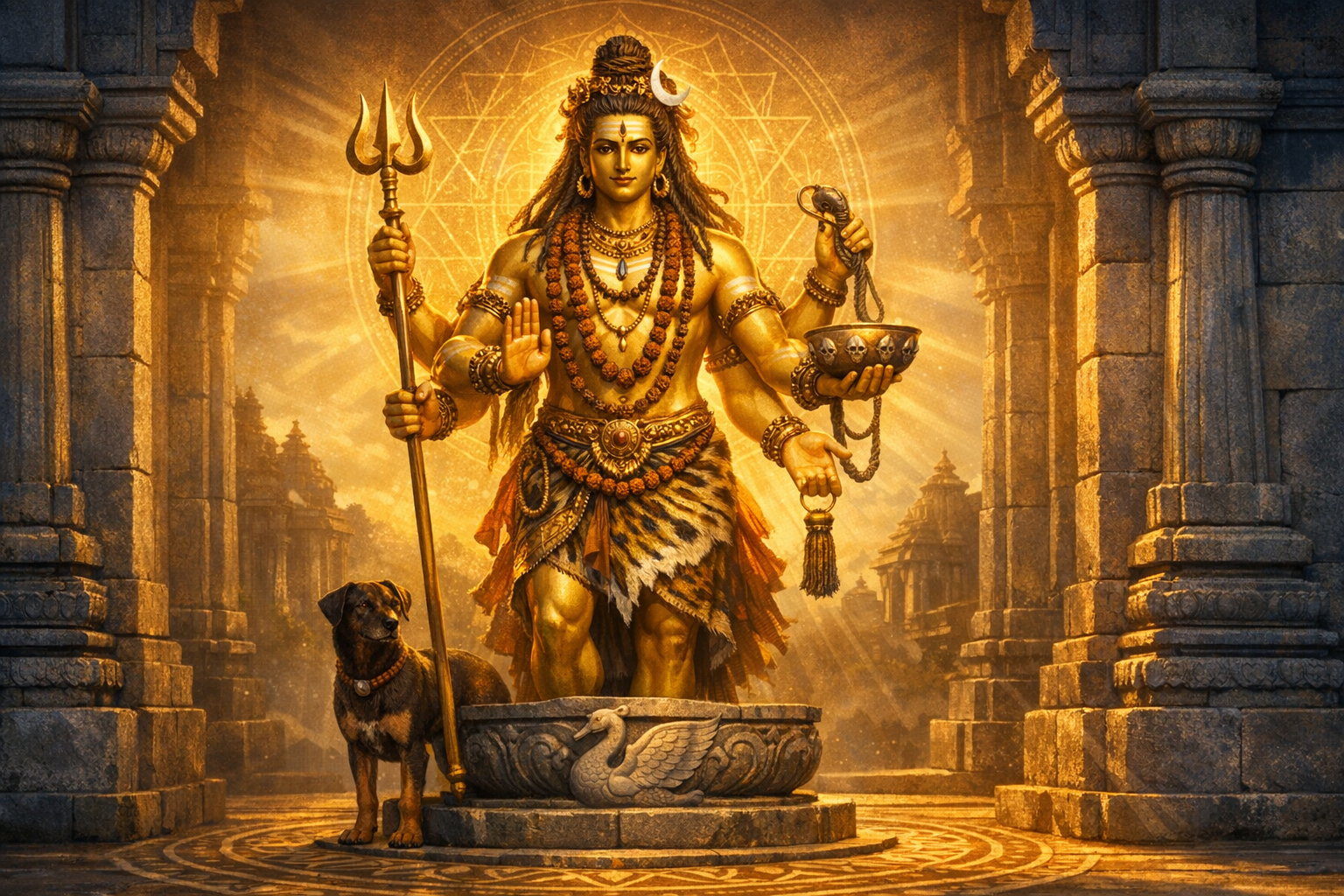
Iconographically, Asitanga Bhairava is frequently described with a golden hue (kanaka or suvarṇa), signaling radiance, discernment, and the quickening of consciousness associated with the first light of day. The form may be one-faced or multi-faced depending on the local canon, and is crowned with a jaṭā-mukuṭa (matted locks), often marked by the crescent moon and the Gaṅgā motif that signal continuity with Shiva’s cosmic identity. The eyes are wide and vigilantexpressing both compassion and uncompromising moral claritywhile the body is adorned with serpents and ash (vibhūti), classic Śaiva emblems of transcendence over fear and mortality.
The number of arms ranges from four to eight in different traditions. Common attributes include the triśūla (trident) and ḍamaru (drum) in the right hands, and the kapāla (skull-bowl) and pāśa (noose) or khaṭvāṅga (ritual club) in the left hands. These implements unify metaphysics and praxis: the triśūla represents the triadic functions (creation, sustenance, dissolution) brought into harmony; the ḍamaru signifies rhythm and mantra as the vibrational matrix of reality; the kapāla confronts impermanence and the alchemy of transformation; and the pāśa or khaṭvāṅga symbolizes disciplined restraint and the yogic harnessing of inner forces. Together, they signal Asitanga’s capacity to catalyze awakening while safeguarding the practitioner.
Vehicles (vāhana) and consort-pairings also convey layered meanings. In many Bhairava sets the dog (śvāna) is a unifying vāhanaan emblem of loyalty, threshold guardianship, and fearless movement through liminal spaces such as cremation grounds. In systems mapping the Ashta Bhairavas to the Ashta Mātrikās, Asitanga is paired with Brahmani, and by association a haṁsa (swan) motif occasionally appears to signal viveka (discriminative wisdom). Both dog and swan imagery converge on a single soteriological point: the crossing of boundaries through clear discernment and steadfast courage.
As the eastern Bhairava, Asitanga aligns with the qualities of sunriseillumination, initiation, and auspicious beginnings. The golden coloration deepens this symbolism: it signifies a sattvic luminosity that orients rather than overwhelms. Within a temple’s sacred geography, Asitanga’s position helps devotees read the mandala-like arrangement of deities, moving from the threshold guardianship of Bhairava toward the inner sanctum while internalizing the rite of passage from darkness to light.
The aesthetics of Asitanga’s ornamentsserpents, skull-garlands (muṇḍamālā), and the tiger-skin waistclothencode a practical ethics rather than mere spectacle. Serpents symbolize awakened kuṇḍalinī and vigilant awareness; the muṇḍamālā affirms impermanence and the urgency of right action; the tiger skin asserts mastery over instinct and fear. Ash (vibhūti) and rudrākṣa garlands anchor the form unmistakably in the Śaiva yogic continuum, where contemplative absorption and fierce compassion are held together in dynamic equilibrium.
Ritually, Bhairava is propitiated throughout the lunar month, with particular emphasis on Kṛṣṇa Pakṣa Aṣṭamī (Kala-Bhairava Aṣṭamī) in many regions. Devotees may encounter the Ashta Bhairavas installed as a coherent circuit in large Śaiva templesespecially in South Indiawhere each shrine offers a facet of protection and empowerment. Offerings are lineage-specific, and typically include lamps, black sesame, flowers, and fragrant substances, together with circumbulation and mantrārcana undertaken with humility and clarity of intent. Visits commonly begin by seeking the guardian’s leave at the Bhairava shrine (kṣetrapāla) before approaching the main liṅga, a ritual choreography that mirrors moving from vigilance to vision.
Mantra practice for Asitanga Bhairava is likewise tradition-bound. While public liturgies often include the Bhairava Gāyatrī and stotras to the Ashta Bhairavas, initiatory mantras and bīja-syllables are best learned from a qualified guru to ensure correct intonation, breath, and gesture (mudrā). This cautious approach is consistent with the tantric ethos of precision and responsibility: power (śakti) unfolds as insight and ethical poise, not as spectacle.
From a temple-architecture perspective, Bhairava’s placement near gateways, corners, or along processional paths reflects the deity’s function as threshold custodian. The iconography instructs the gaze: one learns to notice direction (east for Asitanga), hue (golden radiance), attributes (triśūla, ḍamaru, kapāla), and vāhana (dog, and at times the swan association), thereby reading sculpture as scripture. Such literacy of sacred form strengthens cultural continuity while guiding personal practicean interplay central to Hindu Sculptures and Temple Architecture.
The cross-dharmic resonance of Bhairava reinforces a wider unity within Indic spirituality. In the Newar traditions of Nepal, Bhairava is venerated in both Hindu and Buddhist contexts as a vigilant protector. In Vajrayāna Buddhism, closely related protector deities such as Mahākāla share overlapping guardian symbolism, ritual placement, and ethical tenor. Jain communities, while centered on Tirthankara worship, have historically interacted with regional Śaiva guardians in shared civic and festive spaces; and Sikh teachings, with their emphasis on courage, discipline, and service, harmonize with the protective dharma that Bhairava represents. These convergences affirm a civilizational tapestry that values many valid approaches to truth and inner freedom.
Symbolically, Asitanga’s golden sheen corresponds to a pedagogy of light: knowledge that nourishes, vigilance that protects, and resolve that steadies the heart. The eastern orientation invites practitioners to treat each day’s first clarity as sādhanāconsciously aligning breath, motive, and action. The implements then become internal disciplines: the triśūla as integration of life’s triads; the ḍamaru as mindful rhythm; the kapāla as honest mortality-awareness; and the pāśa/khaṭvāṅga as restraint that empowers rather than constrains.
Comparatively, Asitanga can be read alongside other Bhairavassuch as Ruru, Chanda, Krodha, Unmatta, Kapala, Bhīṣaṇa, and Saṁhārato appreciate a full spectrum of guardianship and grace. While Kalabhairava is widely known as time’s vigilant edge (kāla), Asitanga’s luminous character gives the octet an auspicious beginning. Together the Ashta Bhairavas articulate a circle of protection and transformation, each a necessary station in the pilgrim’s inner and outer journey.
Practitioners and visitors frequently report that time spent before an Asitanga murti evokes steadiness rather than mere awean inner composure that holds alertness and kindness together. That experiential testimony aligns with the iconography itself: a golden guardian who inaugurates and illumines, reminding that vigilance and wisdom are two wings of the same flight. In this light, Asitanga Bhairava is not only a guardian of thresholds but also a herald of insight, inviting entry into a deeper unity that dharmic pathsHindu, Buddhist, Jain, and Sikhtogether affirm as the heart of spiritual life.
In sum, Asitanga Bhairava’s iconography, symbolism, and sacred significance present a coherent, practice-oriented theology. The form is a living mandala: golden like the dawn, eastern in orientation, armed with implements that instruct as much as they protect, and embedded in a ritual ecology that honors diversity without losing clarity. For those reading temple art or reciting stotra, the benefit is the same: a disciplined, compassionate courage that steadies the mind, guards the heart, and opens the way to awakening.
Inspired by this post on Hindu Blog.