Centuries before classical Athens coined the word democracy, ancient India had already nurtured institutions of collective deliberation and public counsel. Within the Vedic tradition, two assembliesSamiti and Sabhaemerge as foundational instruments of governance, social order, and dharma. Far from being mere ceremonial gatherings, they served as structured arenas where rulers, elders, and householders engaged in debate, advice, consent, and oversight.
Texts from the oldest stratum of Hindu civilization attest to these institutions. The Rigveda and Atharvaveda refer to Samiti and Sabha as distinct yet complementary bodies. The ideal animating these assemblies is captured in a celebrated Vedic exhortation to unity in thought and action: samgacchadhvam samvadadhvam sam vo manamsi janatam. Across hymns, Brahmanas, and later Dharmasutras, governance appears inseparable from dharma, a moral and cosmic order binding both ruler and ruled.
Etymology clarifies early functions. Sabha denotes an assembly or council, often implying a more select body and the space (sabha-griha) where it convened. Samiti, by contrast, emphasizes coming together as a broader public assembly. A third term, Vidatha, occurs in the Rigveda, sometimes associated with ritual, distribution, and consultation, suggesting that early deliberation and social provisioning were embedded in sacred contexts.
Scholarly consensus typically distinguishes the two Vedic assemblies as follows. The Samiti was the larger, more inclusive assembly that embodied popular voice and consent on questions of policy, legitimacy, and broad communal interest. The Sabha functioned as a tighter council of knowledgeable elders, nobles, and specialists advising the rajan (king) on law, strategy, ritual correctness, and adjudication. Together they formed a dyad balancing participation with expertise, and public will with judicious counsel.
Membership and social base varied by locale and epoch. The Samiti appears to have included a wider circle of householders and respected local figures, while the Sabha often drew from elders, ritual specialists, and those seasoned in jurisprudence or statecraft. While status, age, and learning conferred influence, the textual memory preserves a political culture in which counsel (mantra), deliberation (manthana), and consent (sammati) were expected norms rather than afterthoughts.
Decision-making methods prioritized consensus and reasoned speech. Deliberation emphasized clarity (vak), moral grounding (dharma), and communal benefit (lokasangraha). Leaders sought agreement through discussion and persuasion more than through coercion. The vocabulary of samaya (shared norm/compact) and riti (custom) underlines that decisions were not merely transactional but investitures of the community’s moral will.
Procedural roles likely included a presiding figure to maintain order, ritual authorities (purohita) to align actions with sacred norms, heralds (suta) charged with communication, and respected assessors (sabhyas or sabhasadas) in judicial matters. The rajan, while pivotal, was not unbounded; the assemblies served as a grammar of accountability, reminding the ruler that kingship is a trust under dharma rather than a personal entitlement.
The judicial dimension of Sabha is especially salient in later normative texts. Dharmasutras and Dharmashastras describe panels of sabhyas sitting in judgment, weighing testimony, and applying standards of proof and proportionality. The Sabha thus bridged sacred and civic life, interpreting customary law within the expectations of ethical conduct, reputation, and restorative balance.
Ritual life intersected with governance in these forums. Public rites, coronations, and communal vows often unfolded before or in connection with assemblies. Even at their most sacred, collective acts retained a civic character: they reaffirmed norms, ratified transitions, honored merit, and enabled inter-generational transmission of social memory.
Texts also preserve glimpsesthough not uniform practiceof participation across knowledge traditions and gender. The celebrated philosophical debates involving Gargi and Maitreyi in the Brihadaranyaka Upanishad testify to a milieu in which learned women could question, reason, and be heard in public settings. While institutional participation varied across time and locality, such episodes signal that intellectual deliberation was not structurally closed to women.
The Mahabharata captures the ethos of counsel and restraint through its reflections on rajadharma, warning that a king indifferent to assemblies or deaf to criticism invites disorder. In the Shanti Parva, legitimate rule arises from concord between the ruler’s duty and the community’s welfare. These narrative and didactic passages, while composed over long periods, preserve the ideal of a listening state bound to public reason.
By the time of the Mahajanapadas, institutional pluralism in the subcontinent becomes more visible. Beyond monarchies, there were gana-sanghasrepublican or oligarchic polities with assemblies and councilsamong groups like the Shakyas, Licchavis, and the Vajji confederacy. Early Buddhist sources, including the Mahaparinibbana Sutta, discuss assembly procedures, quorums, and consensus-building, echoing the older Indic grammar of orderly deliberation.
The Arthashastra integrates these realities into a systematic political science. Kautilya recognizes gana polities as distinct constitutional orders and, with characteristic realism, outlines how a king should relate to themthrough treaties, alliances, or, when necessary, hard power. The very need to theorize engagement with assemblies indicates their political salience and durability.
These currents are not confined to one dharmic lineage. The Buddhist Sangha, governed by Vinaya rules, exhibits structured deliberation, censure, and reconciliation procedures. Jain traditions preserve memories of gana-based organization and collegial decision-making among ascetic and lay bodies. Sikh praxis later articulates the Sarbat Khalsa as a panthic assembly discerning collective guidance. Cross-pollination among Hindu, Buddhist, Jain, and Sikh traditions reveals a shared civilizational comfort with argument, consent, and collective obligation.
Material and architectural traces reinforce the social centrality of assemblies. While Vedic references to sabha-griha point to designated meeting spaces, epic and puranic memory preserves the sabha as a cultural and political stage. In later epigraphy, notably in South India, sabhas in temple towns appear as corporate bodies managing endowments, irrigation, education, and dispute resolutioncontinuous with, and yet administratively more elaborate than, earlier models.
The Chola-period inscriptions at places such as Uttiramerur famously codify village assemblies, laying out eligibility, selection by lot (kudavolai), tenure, recall, and audit norms. Though separated by many centuries from the Vedic age, these records show an enduring Indic preference for layered local governanceur (common assembly), sabha (Brahmin assembly), and nagaram (merchant guild)with defined checks, public finance oversight, and social accountability.
Comparative perspectives are instructive. The Vedic Samiti and Sabha were neither derivative of nor identical to Greek institutions; they arose from a distinct civilizational matrix where political authority, ritual order, and ethical duty were mutually informing. The resulting political culture combined reverence for sacred norms with a practical commitment to debate, counsel, and consensus.
The conceptual heart of these assemblies is dharma, not majoritarian assertion. The emphasis on samaya (shared norms), lokasangraha (social cohesion and welfare), and anuvrata (measured conduct) prioritized stability with justice, memory with adaptation, and authority with accountability. In this respect, Indic assemblies sought not only decisions but legitimacydecisions recognizable as rightful by the community and consonant with ancestral wisdom.
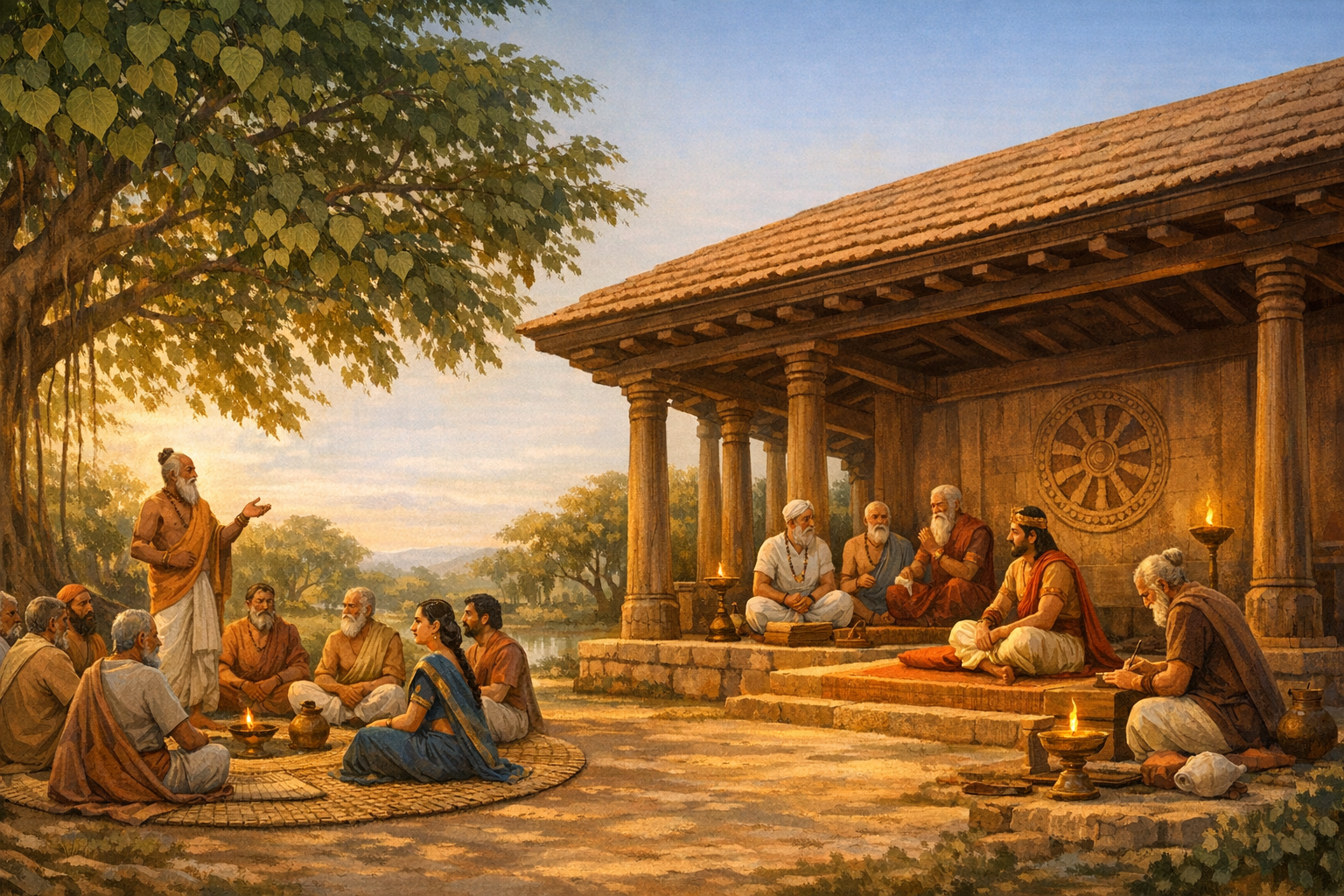
It is not difficult to visualize their human reality: villagers gathering beneath a peepal tree, elders convening in a sabha hall, a ruler listening while a purohita cautions restraint, and respected householders weighing the costs and benefits of a proposed levy or canal. Such scenes, familiar in literary memory and inscriptional practice, evoke a governance model in which ordinary lives, expert counsel, and state power shared one deliberative space.
Modern echoes persist. India’s constitutional panchayati raj framework enshrines the gram sabha as a deliberative cornerstone of village administration, endorsing transparency, local consent, and participatory budgeting. Although contemporary institutions operate within a different legal and electoral order, the civilizational preference for rooted, consultative governance endures.
Methodologically, caution is warranted. Vedic terms span long chronological horizons and diverse regions; their functions evolved. Sources blend ritual, norm, and narrative; they also encode ideals alongside practice. Nevertheless, when read cumulativelyVedas, Brahmanas, Dharmasutras, the Mahabharata, Buddhist and Jain canons, the Arthashastra, and medieval inscriptionsa coherent picture emerges of a society that prized public reason, layered authority, and ethical restraint.
In the deeper arc of South Asian history, Samiti and Sabha are less isolated curiosities than progenitors of a durable grammar of governance. They locate sovereignty within dharma, seat policy within counsel, and tie leadership to accountability. In conversation with Buddhist, Jain, and Sikh modalities of collegial decision-making, they illustrate a dharmic unity centered on dialogue, humility, and shared responsibility.
Thus, the first voices of democracy in ancient Hindu civilization were not a clamor but a conversationstructured, reverent, and exacting. They remind today’s readers that political maturity is measured not only by the ballot but by the quality of listening, the patience of consensus-building, and the readiness to bind power to principle.
Inspired by this post on Hindu Blog.