
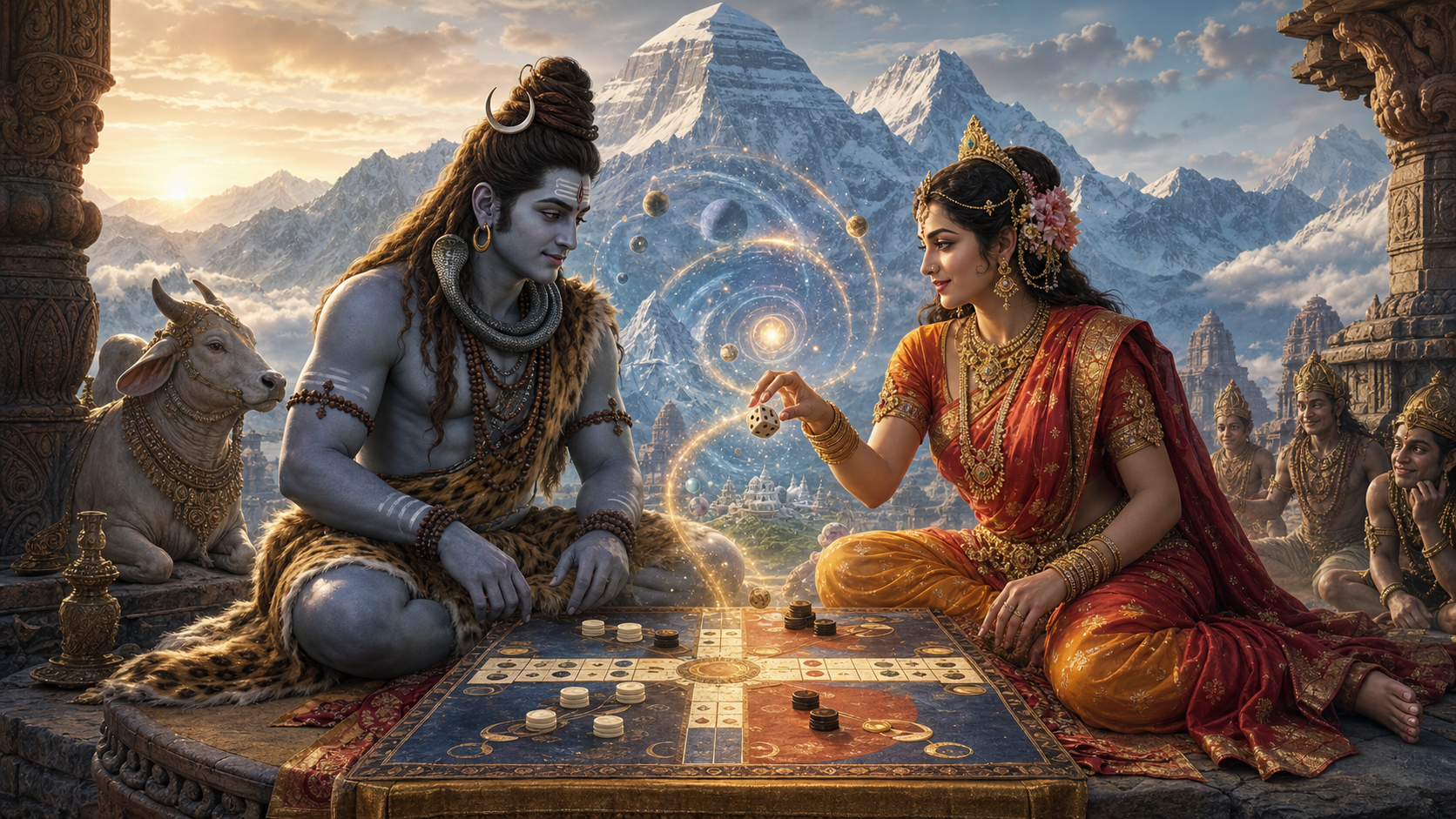
Aksha Krida: a domestic image with cosmic scale
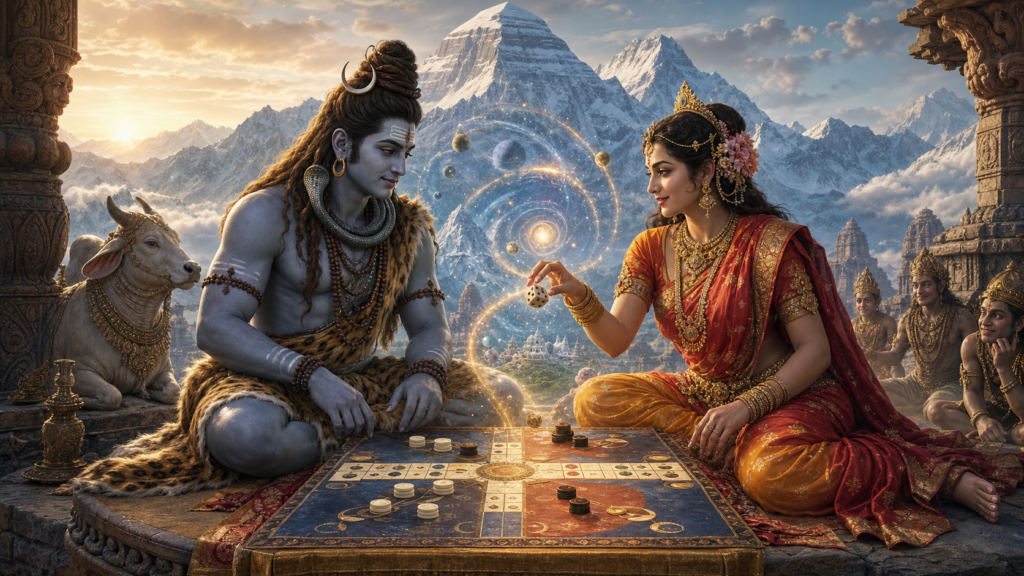
At first sight, Aksha Krida presents an intimate household scene. Shiva and Devi Parvati sit close to one another, a gaming surface between them, while dice, gestures, glances, attendants, and wagers transform a quiet moment on Mount Kailasa into a charged encounter. The ascetic lord who dissolves worlds appears as a husband absorbed in play; the mountain-born goddess appears not as a silent companion but as an alert opponent capable of challenging, defeating, teasing, and correcting him. The image is affectionate, humorous, and potentially unsettling at the same time.
That combination is precisely what gives the motif its unusual power. Aksha Krida is not merely a charming picture of divine domestic life, nor is it adequately explained as an ancient endorsement of gambling. In Puranic narration, temple sculpture, and later painting, the game becomes a model through which artists and theologians explore creation and dissolution, consciousness and power, rule and uncertainty, attachment and withdrawal, conflict and reconciliation. A small board placed between two deities becomes a compressed diagram of cosmic existence.
What the term Aksha Krida means
The familiar spelling Aksha Krida represents the Sanskrit expression akṣa-krīḍā. In this context, akṣa refers to a die or to dice, while krīḍā means play, sport, or a game. Related expressions include akṣadyūta, a game of dice, and dyūta, gambling or gaming. The vocabulary is broader than the name of one standardized modern game. It identifies an activity whose equipment and rules could vary across time, region, text, and artistic medium.
This distinction matters because ancient reliefs do not always display enough surviving detail to reconstruct exact rules. Some early images appear to show a rectangular race or table game involving dice; later paintings explicitly depict chaupar, with its cross-shaped cloth board, pieces, and elongated dice. Scholars have therefore debated whether particular carvings represent backgammon-like play, a race game, or a more general visual convention for dice play. The responsible conclusion is not that every image shows the same game, but that diverse games became vehicles for the same durable Shiva–Parvati theme.
A narrative tradition rather than one frozen story
Aksha Krida does not survive as a single, universally controlling narrative with one sequence of moves and one final result. Puranic literature is layered, and its stories occur in variant recensions, regional adaptations, ritual settings, poems, and visual retellings. In some versions Shiva loses repeatedly; in others the players accuse one another of deception; in still others the game produces separation, a curse, the loss of divine attributes, or a further mythic event. These differences are part of the tradition’s interpretive richness rather than defects to be repaired.
A particularly vivid account occurs in chapter 34 of the Kedara-khanda within the Maheshvara-khanda of the Skanda Purana. The episode begins when the sage Narada visits Kailasa and proposes dice as a form of recreation. Parvati takes up the dice and plays Shiva before Narada and the assembled divine household. The game quickly becomes competitive: victory is disputed, laughter provokes anger, new stakes are offered, and the apparent leisure of Kailasa becomes a debate about power and truth. The translated chapter can be consulted in the Skanda Purana account of Shiva’s defeat.
The sequence is more complicated than the simplified claim that Parvati merely defeats Shiva once. She initially loses a round amid accusations of fraudulent play. In the renewed contest, however, she defeats him and demands the promised stakes. Shiva has wagered unmistakable signs of his identity, including ornaments, the crescent moon, serpents, and garments. Parvati removes what the game has transferred to her, and Shiva’s resistance turns the match into a quarrel witnessed by Narada, Bhringi, the Ganas, and other members of the celestial assembly.
The dispute also exposes a theological fault line. Shiva’s supporters insist that the supreme lord cannot truly be conquered. Parvati rejects the separation implicit in their argument and affirms the unity of Shiva and Shiva’s own feminine power. The text therefore stages two propositions at once: Shiva is unconquerable, yet Parvati defeats him; Shiva transcends form, yet his manifest identity depends upon attributes and power associated with the Goddess. The apparent contradiction is not resolved by eliminating one side. It is dramatized through play.
Shiva eventually withdraws to the forest and resumes yogic meditation. In the following chapter, Parvati assumes the appearance of a Śabarī huntress and draws him back into relationship. The episode ends in reunion rather than permanent estrangement, and Parvati declares that communion and separation cannot finally divide them. The continuation is preserved in the Skanda Purana account of reconciliation. The game consequently forms a complete movement: encounter, contest, differentiation, withdrawal, recognition, and renewed union.
For anyone who has watched a minor disagreement become a dispute about fairness, dignity, loyalty, and belonging, the emotional logic is recognizable. The deities are not diminished by this familiarity. Their domestic interaction allows cosmic questions to be experienced rather than merely defined. Humor, wounded pride, affection, and repair become theological instruments.
The gaming board as a model of cosmic time
A striking cosmological interpretation appears in material associated with the Kashi-khanda of the Skanda Purana. In this mapping, the gaming board represents the ordered universe. Its divisions correspond to the twelve months; light and dark pieces evoke the lunar days arranged in the waxing and waning fortnights; the dice are associated with the sun’s courses; and the opposed results of victory and defeat correspond to manifestation and reabsorption. Devi’s victory is linked with emanation, while Shiva’s victory is linked with cosmic return. This calendrical symbolism is summarized in Sahapedia’s study of Indian board games and divine play.
The board is thus more than a prop. It converts time into spatial relationships that can be seen and traversed. Months become houses, lunar change becomes the movement of contrasting pieces, and solar motion becomes the agency that drives play. Creation is not pictured as a solitary act performed once in a remote beginning. It is imagined as an ongoing sequence in which forms emerge, move through ordered conditions, encounter reversals, and return to their source.
This is a theological and poetic cosmology, not an experimental model in modern astrophysics. It does not predict planetary measurements, quantum events, or the mathematical evolution of the physical universe. Its technical achievement lies elsewhere: it uses the finite architecture of a game to make recurring time, polarity, causation, and cosmic transformation intellectually graspable. Treating that symbolism as symbolism preserves its sophistication; presenting it as disguised modern science would weaken both historical accuracy and philosophical depth.
Shiva and Parvati as relation rather than hierarchy
Parvati is sometimes reduced in popular summaries to Shiva’s gentle wife. The textual and visual record is considerably richer. She is a practitioner of tapas, a mother, teacher, challenger, goddess, and embodiment of Shakti. Oxford’s scholarly overview of Parvati’s place in Hindu tradition notes that her Puranic profile includes ascetic discipline, marriage, motherhood, the dice game, manifestations such as Durga, and the Ardhanarishvara form in which she shares Shiva’s body. Aksha Krida belongs to this larger theology of active divine presence.
In many Shaiva and Shakta interpretations, Shiva can signify the unbounded ground of awareness, while Shakti signifies the capacity through which awareness knows, wills, manifests, and acts. The distinction is analytical rather than a division between two independent substances. Shiva without Shakti would be an abstraction without expression; Shakti without Shiva would lack the luminous ground through which expression is known. Their game gives motion and personality to this inseparability.
The word energy is often used for Shakti, but it requires care. Shakti is not simply physical energy measured in joules. Depending on the tradition, it can mean divine power, capacity, agency, speech, will, knowledge, action, or the Goddess herself. In nondual Kashmiri Shaiva philosophy, for example, Shakti is integral to Shiva’s metaphysical identity and is associated with the power of manifestation and recognition. The historical distinctions among Shaiva schools are outlined by the Internet Encyclopedia of Philosophy.
Modern explanations sometimes describe Shiva and Parvati as Purusha and Prakriti. That comparison can be illuminating if it indicates the relation between conscious presence and manifest nature, but it should not be treated as an exact equation. Purusha and Prakriti are technical categories most closely associated with Samkhya, where their relationship is formulated differently from the Shiva–Shakti relationship in Shaiva and Shakta systems. Aksha Krida draws from a shared Indian philosophical vocabulary while retaining its own Puranic and sectarian contexts.
The scene is also closely related to Ardhanarishvara, the form in which Shiva and Parvati constitute one body. In the dice narrative, they appear as two players because relationship requires distinction: each must have a position, a turn, an intention, and a response. Yet the story repeatedly undermines any absolute separation between them. Ardhanarishvara states unity through one composite body; Aksha Krida states unity through dynamic interaction.
Why does Shiva keep losing?
Shiva’s recurrent defeat is one of the motif’s central mysteries. Don Handelman and David Shulman’s influential study God Inside Out: Śiva’s Game of Dice treats the game as a major expression of Shiva’s mythology. Their interpretation proposes that the world results from the game and that divine play turns Shiva outward into manifestation. This is a scholarly reading rather than the sole doctrine of every Hindu community, but it identifies an important pattern: the god plays despite knowing that loss, transformation, and disorder may follow.
On one level, losing enables manifestation. A deity who never risks anything would remain enclosed in invulnerability. By staking the crescent, serpents, ornaments, animal skin, or vehicle, Shiva allows his concentrated identity to be redistributed. The attributes normally gathered upon his body enter a field of exchange governed by relationship. What appears as humiliation at the narrative level can therefore be interpreted as self-extrusion at the cosmological level: unity permits itself to become plurality.
Parvati’s victory similarly signifies more than the triumph of one spouse over another. As Shakti, she represents the efficacy through which worlds become visible and differentiated. When she wins, power moves outward into form. When Shiva’s principle predominates, forms are drawn back toward stillness and reabsorption. Neither movement is permanently final. Creation without return would become endless dispersal; dissolution without creation would leave no field of experience. Cosmic life requires both turns.
A gendered reading remains relevant, but it must avoid simplistic conclusions. The scene does challenge the assumption that feminine divinity is passive, subordinate, or incapable of defeating masculine authority. Parvati argues, chooses, acts, wins, and compels recognition. At the same time, the motif is not best understood as a permanent war between women and men. Its deeper structure is interdependence: neither player can conduct a two-person game alone, and neither cosmic principle becomes intelligible without the other.
Chance operating inside order
A dice game combines a stable rule system with uncertain local outcomes. The board has boundaries, pieces have permitted movements, turns follow a sequence, and wagers establish consequences. Within those constraints, however, the next throw cannot be commanded by ordinary skill alone. This makes Aksha Krida an unusually precise image for a world that appears ordered at one scale and unpredictable at another.
In contemporary analytical language, a dice-driven board game can be described as a bounded stochastic system. The current position limits which future states are reachable; a randomizing event selects among possibilities; player decisions then respond to the result. There is no evidence that ancient sculptors intended modern probability theory, but the structural analogy is valid. Rules, prior conditions, contingency, and agency jointly shape the outcome.
This structure provides a careful way to think about karma. Karma is not adequately translated as blind fate, nor does it mean that every event is a direct reward or punishment visibly assigned to an individual. Across Indian traditions, the concept has developed in different ways, but it generally concerns action and consequence within larger causal conditions. Like a piece already situated on a board, a living being acts from circumstances not wholly self-created. The next choice still matters, even though choice does not control every factor.
The game therefore avoids two extremes. It does not support absolute determinism, because play includes meaningful turns and responses. It does not support total chaos, because movement occurs within an intelligible field. Human freedom is limited without being meaningless; cosmic order is real without making every event immediately transparent. This middle position gives the motif enduring philosophical relevance.
Lila, maya, and the seriousness of play
Aksha Krida is frequently interpreted through lila, commonly translated as divine play. Yet lila is richer than amusement. Its meanings can include spontaneity, creative freedom, drama, gracious action, joy, and activity not forced by deficiency. Oxford’s overview of lila in Hindu traditions emphasizes that the concept is especially developed in Vaishnava theology but also functions in other Hindu settings. In the Shaiva dice motif, play becomes the mode through which an apparently self-sufficient divinity enters relation, consequence, and form.
Calling existence play does not mean that suffering is trivial or that ethical responsibility can be dismissed. A theatrical performance is constructed, yet the emotions it awakens are real to those who undergo them. A game has conventional rules, yet its consequences can transform relationships. Likewise, lila can indicate that the universe is not produced by divine need while still affirming that embodied experience carries moral and spiritual weight.
The related concept of maya must also be handled with precision. Maya does not have one uniform definition across Hindu philosophy. It can refer to creative power, appearance, measure, concealment, misperception, or the dependent and changing character of phenomenal experience. Translating it only as illusion can wrongly suggest that the world is a meaningless hallucination. Aksha Krida instead presents manifestation as consequential but unstable: pieces occupy real positions within the game, although no position remains permanent.
The narrative’s comedy supports this interpretation. Shiva and Parvati tease, protest, and dispute the result; attendants take sides; dignity is threatened; and the great yogi retreats after losing his possessions. Humor does not desacralize the scene. It breaks the assumption that ultimate reality must always be represented through solemn abstraction. Wonder emerges because the absolute can be intimate without ceasing to be absolute.
The ascetic and the householder in one divine life
Shiva famously holds identities that appear incompatible. He is the yogi absorbed in meditation and the husband seated beside Parvati; the inhabitant of cremation grounds and the center of a divine family; the lord of dissolution and a source of fertility; the unclothed renunciant and the bearer of elaborate cosmic emblems. Aksha Krida does not choose one Shiva and reject the others. It places the contradiction at the heart of the image.
When Shiva loses, he withdraws from domestic conflict into the forest. When Parvati follows and re-engages him, ascetic isolation is drawn back toward relationship. The movement is not a crude claim that family life defeats spiritual discipline or that renunciation defeats intimacy. It presents both as necessary modes. Withdrawal permits recollection and freedom from possession; relationship permits manifestation, care, dialogue, and the continuation of the world.
This tension helps explain why a household scene could occupy prominent space in a Shiva temple. The divine couple embodies a sacred domesticity that is neither sentimental nor perfectly conflict-free. Their union survives competition because it is capable of transformation and repair. Theologically, the universe persists for the same reason: difference does not finally destroy the unity from which it arises.
How artists turned the myth into visual philosophy
One of the best-known early examples appears in the Great Cave on Gharapuri, commonly called Elephanta, near Mumbai. The cave is generally dated to around the sixth century and contains an extensive visual program devoted to multiple manifestations of Shiva. Alongside such forms as Sadashiva, Ardhanarishvara, Gangadhara, the dancing Shiva, the yogic Shiva, and the marriage of Shiva and Parvati, a relief shows the couple playing dice on Kailasa. Smarthistory’s study of the Cave of Shiva at Elephanta places the gaming panel within this larger exploration of divine multiplicity.
The location matters. A visitor does not encounter the dice game as an isolated anecdote. It participates in a sequence of forms that move between meditation and action, union and distinction, protection and destruction, iconic bodies and the aniconic linga. The cave itself becomes a philosophical environment. As the visitor moves physically among the panels, Shiva’s apparently contradictory identities become parts of one sacred topography.
Another important rendering appears in Rameshvara, Cave 21 at Ellora, commonly dated to the sixth century. Its sculptural program includes Shiva and Parvati’s marriage, Ravana shaking Kailasa, Nataraja, Durga, the Saptamatrikas, and the divine dice game. Sahapedia’s account of Rameshvara Cave at Ellora identifies the gaming scene among the cave’s major narrative panels. Here again, play belongs to a network of marriage, power, danger, dance, and divine family life.
The motif continued across centuries and media. A tenth-century relief associated with Maihar in Madhya Pradesh shows Parvati poised with a die, preserving the decisive instant before outcome becomes known. Much later, Devidasa of Nurpur’s Basohli painting of 1694–1695 depicts Shiva and Parvati playing chaupar on a tiger skin. In that work, preserved by The Metropolitan Museum of Art, vivid color, emphatic gesture, and Parvati’s demand for the return of a necklace convert metaphysical play into an emotionally legible marital exchange.
The later painting should not be used as a literal rulebook for every early sculpture. It identifies its own game, equipment, and courtly visual language. Its value lies in showing how the same sacred relationship could be renewed through a historically different form of play. The continuity is iconographic and theological, not necessarily mechanical.
A careful reading of an Aksha Krida image begins with the board but does not end there. The viewer can examine who holds the die, whose hand reaches toward the stake, whether the players meet one another’s gaze, and how their bodies occupy the shared seat. A raised hand may indicate surprise, protest, or preparation to throw. A turned face may implicate the viewer as witness. The distance between the couple can signal intimacy, tension, or the suspended moment before reconciliation.
Attendants provide a second level of interpretation. Ganas may watch, celebrate, quarrel, or carry away a wager such as Nandi. Bhringi’s skeletal body can introduce the problem of devotion that recognizes Shiva while resisting Shakti. Divine attributes identify what is at stake, while their absence may indicate loss. Damage to stone must also be considered: missing hands, eroded dice, or broken board lines can make certainty impossible, so identification should rely upon comparison with related images and texts rather than imagination alone.
Sacred dice do not amount to an endorsement of gambling
Indian sacred literature contains some of the world’s most searching reflections on gambling’s dangers. Rigveda 10.34 portrays the compulsive attraction of dice and the damage suffered by the gambler and his household. A recent University of Copenhagen discussion of the Rigvedic dice hymn emphasizes its close attention to compulsive behavior. The hymn’s emotional world is far removed from any uncomplicated celebration of wagering.
The Mahabharata makes a rigged dice match the site of political dispossession, humiliation, juridical argument, and catastrophic rupture. Yudhishthira’s formal losses do not make the game morally legitimate, and Draupadi’s questions expose the crisis hidden beneath its procedures. Modern scholarship continues to examine the episode as a debate about law, strategy, and dharma, as seen in the Journal of Hindu Studies analysis of the Dyutaparvan.
Aksha Krida should therefore be read at two levels. Within ordinary human life, gambling can produce addiction, deceit, debt, damaged trust, and unjust transfer of wealth. Within the Shiva–Parvati myth, a controlled game becomes a symbolic engine for exploring how manifestation occurs. The metaphysical use of dice does not cancel the ethical warnings attached to human gambling. Indeed, the divine quarrel itself demonstrates how quickly play can expose attachment and destabilize relationship.
A dharmic conversation without erasing differences
The Aksha Krida narrative is specifically rooted in Hindu Shaiva and Shakta traditions, yet its grammar of board, movement, causation, and liberation belongs to a wider South Asian conversation. Jain forms of gyan chaupar used game boards to represent karmic bondage, virtues, faults, ascent, and liberation. Hindu and Sufi communities developed their own versions. The historical circulation of such games shows how a shared cultural form could express distinct theological systems without making those systems identical.
Sikh scripture and interpretation also employ the metaphor of chaupar to discuss the game of embodied life, righteous conduct, truth, and alignment with Hukam. A study published in the Sikh Research Journal examines this scriptural language of board, dice, and spiritual orientation. Buddhist traditions, by contrast, do not require a Shiva–Parvati creator pair; their teachings on conditioned arising, impermanence, intention, and consequence provide a different analysis of how lives unfold within interdependent conditions.
These traditions should not be collapsed into one doctrine. Hindu lila, Jain karmic ontology, Buddhist dependent origination, and Sikh Hukam retain different metaphysical and devotional commitments. Their unity lies in sustained conversation about disciplined action, ethical consequence, limited control, and liberation—not in forced sameness. The gaming metaphor offers a respectful meeting ground because it allows comparison while preserving each tradition’s voice.
What Aksha Krida offers contemporary readers
The first insight concerns control. Human beings often behave as though careful planning should eliminate uncertainty. The dice reject that expectation, while the board rejects the opposite fantasy that nothing is ordered. A mature response requires preparation without entitlement, action without the illusion of total command, and acceptance without passivity. This is as relevant to relationships and public life as it is to spiritual reflection.
The second insight concerns power in relationship. Parvati is not honored by being made invisible, and Shiva is not made supreme by being protected from every loss. Their bond becomes meaningful because each can affect the other. Healthy relationship does not require the elimination of difference; it requires rules that are not manipulated, stakes that are not concealed, the ability to acknowledge injury, and a path from conflict toward recognition.
The third insight concerns identity. Shiva’s ornaments make him recognizable, but the game shows that he is not exhausted by them. Roles, possessions, achievements, and social emblems similarly help organize human life without constituting the whole self. Losing an attribute can feel like annihilation, yet the ascetic Shiva who remains after the wager points toward an identity deeper than what can be owned. Parvati’s power then prevents that inward freedom from becoming sterile isolation.
The fourth insight concerns creativity. New worlds emerge when stable elements are recombined under constraints. Music needs rhythm, poetry needs form, and games need rules; freedom becomes perceptible through its interaction with structure. Aksha Krida imagines cosmic creativity in the same way. The universe is neither a lifeless mechanism nor an arbitrary accident, but an unfolding field in which pattern and novelty continually meet.
Common misreadings that should be avoided
Aksha Krida is not evidence that ancient texts secretly encoded quantum mechanics, simulation theory, or modern cosmological equations. Dice can serve as a meaningful analogy for uncertainty without proving a scientific theory. Shiva should not simply be equated with matter, Parvati with physical energy, or the gaming board with a computer. Such comparisons may stimulate reflection, but they become misleading when presented as historical facts.
The scene should not be reduced to a greeting-card image of perfect marriage. Its tenderness includes competition, satire, anger, partiality, separation, and repair. Nor should it be turned into proof that one gender is metaphysically superior to another. The icon’s enduring strength lies in reciprocal dependence. Parvati’s agency corrects readings that erase the Goddess, while Shiva’s transcendence prevents manifestation from being mistaken for the whole of reality.
Finally, the motif should not be treated as a universal creed accepted in precisely the same form by every Hindu school. Hindu traditions contain plural accounts of divinity, creation, maya, Shakti, and liberation. Academic accuracy requires language such as in this narrative, in a Shaiva reading, or in one influential interpretation. Such qualification does not weaken the sacred image; it locates it honestly within a diverse intellectual civilization.
A disciplined way to contemplate the image
A modern viewer can approach Aksha Krida through four linked observations. First comes form: the board, dice, hands, postures, ornaments, and witnesses. Second comes narrative: who appears to be winning, what has been wagered, and what moment the artist has selected. Third comes philosophy: how order, uncertainty, consciousness, power, manifestation, and return are related. Fourth comes self-examination: which circumstances are inherited, which actions remain possible, and which identities are being defended as though they could never be lost.
This method is a contemporary reflective exercise rather than a scripturally mandated ritual. Its value lies in slowing perception. Instead of consuming the image as decorative mythology, the viewer learns to read it as a layered argument composed in bodies, stone, gesture, and space. The sacred artwork then performs its oldest function: it makes thought visible and invites disciplined attention.
When Shiva and Parvati play, existence becomes possible
Aksha Krida endures because it refuses to separate the cosmic from the intimate. Shiva and Parvati do not create meaning from a distant throne; they reveal it through relation. The board gives their freedom a field, the dice introduce contingency, the rules create order, the wagers permit transformation, and reconciliation restores unity without erasing what has occurred. Every throw brings a world of possibilities into form.
The sacred dice ultimately teach neither fatalism nor reckless chance. They disclose a universe in which stillness requires power, power requires awareness, freedom encounters limits, and difference returns to unity. Shiva’s loss is not the defeat of the divine, and Parvati’s victory is not a temporary domestic amusement. Together they reveal why existence can move at all. The universe is born in the space between the players—between consciousness and manifestation, rule and surprise, separation and love—and its mystery continues with every turn.
Inspired by this post on Hindu Blog.




Leave a Reply
You must be logged in to post a comment.