
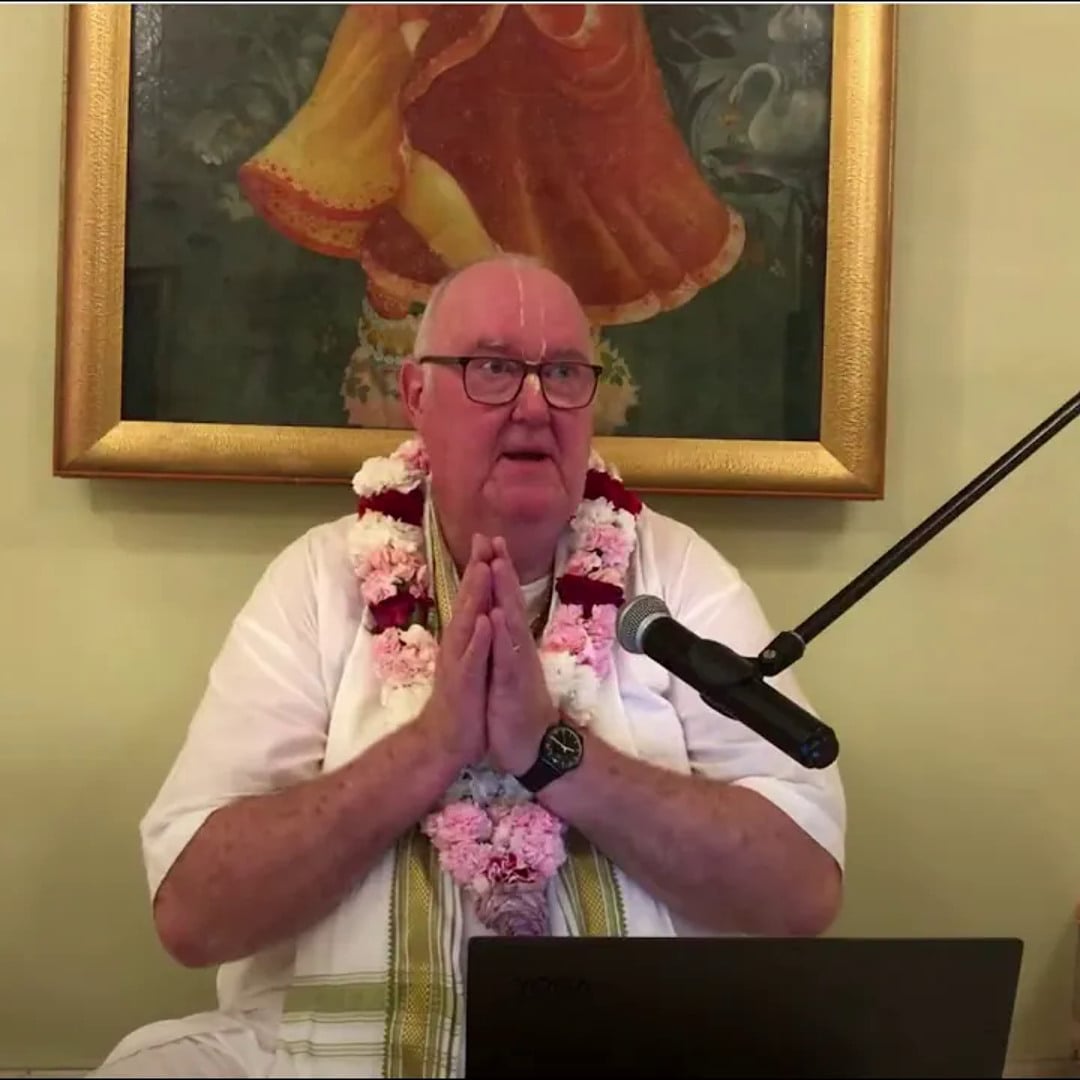
Hospital rooms near the end of life often hold several realities at once: physical decline, clinical uncertainty, anticipatory grief, unfinished family conversations, and questions that medicine alone cannot answer. A recorded account involving Bhakta Prabhu, a Hare Krishna chaplain, and a dying man named Vijay illustrates how spiritual care can enter that complex space without denying its pain. The episode is emotionally powerful because it does not present devotion as an escape from mortality. It presents devotion as a way of meeting mortality with relationship, meaning, remembrance, and service.
The central event is simple. A distressed daughter sought help for her father, a chaplain responded despite fatigue and competing duties, a family gathered in prayer, and Vijay died while the Holy Name was being chanted. Around that sequence lies a much wider subject: the place of Hindu ritual in palliative care, the theology of the soul in the Bhagavad Gita, the psychological value of shared sacred sound, the ethical responsibilities of healthcare chaplaincy, and the disciplined distinction between a meaningful spiritual interpretation and an empirically demonstrable medical claim.
The call that transformed obligation into seva
The account begins with a telephone call from Werribee Hospital. Vijay was receiving palliative care and appeared to be approaching death. His daughter had travelled from England and was experiencing acute distress. Her fear did not arise only from the immediate medical crisis. She had lost her mother during adolescence, and her father’s decline reopened a part of life that had remained traumatic and difficult to comprehend. Earlier bereavement can intensify a later loss by reactivating memories of helplessness, separation, and unanswered questions; such a response is human and does not, by itself, constitute a psychiatric diagnosis.
Bhakta Prabhu initially confronted a familiar tension in caregiving: the need was genuine, but his own schedule and emotional capacity were already strained. Chaplaincy demands sustained attention to fear, grief, moral distress, family conflict, and spiritual uncertainty. He tried to find another person who could attend, but several calls produced no replacement. He eventually interpreted the situation through the devotional category of seva—service offered to Krishna through care for another living being—and accepted that the visit had become his responsibility.
This moment is relatable because service rarely arrives under ideal conditions. Compassion is often required precisely when time is limited and energy is low. Bhakta Prabhu set aside his crowded list of obligations, put on devotional attire, and went to the hospital. His decision should not be romanticized as an argument for limitless self-sacrifice; sustainable chaplaincy requires supervision, rest, referral networks, and collegial support. Yet within this particular account, his willingness to respond became the first gift offered to the family: they would not face the spiritual dimension of Vijay’s final hours alone.
A vigil shaped by love and anticipatory grief
Vijay was described as semi-conscious, surrounded by relatives, with every available seat occupied. The crowded room reflected more than anxiety. It expressed kinship, duty, affection, and the family’s reluctance to accept an approaching separation. End-of-life vigils often contain conflicting impulses: relatives want to remain close, yet they may fear that their presence is somehow preventing the person from letting go; they hope for more time, yet they do not want suffering to continue. These tensions can coexist without hypocrisy.
Families sometimes report that a dying person appears to wait for a particular visitor, a private moment, or verbal permission to die. Such narratives can carry profound emotional meaning, but the timing of death is physiologically complex and usually cannot be attributed with confidence to a single interpersonal cause. Vijay’s survival over several days therefore should not be explained as though the relatives had medically delayed his death. A more careful interpretation is that the family experienced the vigil as prolonged and needed a compassionate framework through which they could accompany him without feeling responsible for controlling the outcome.
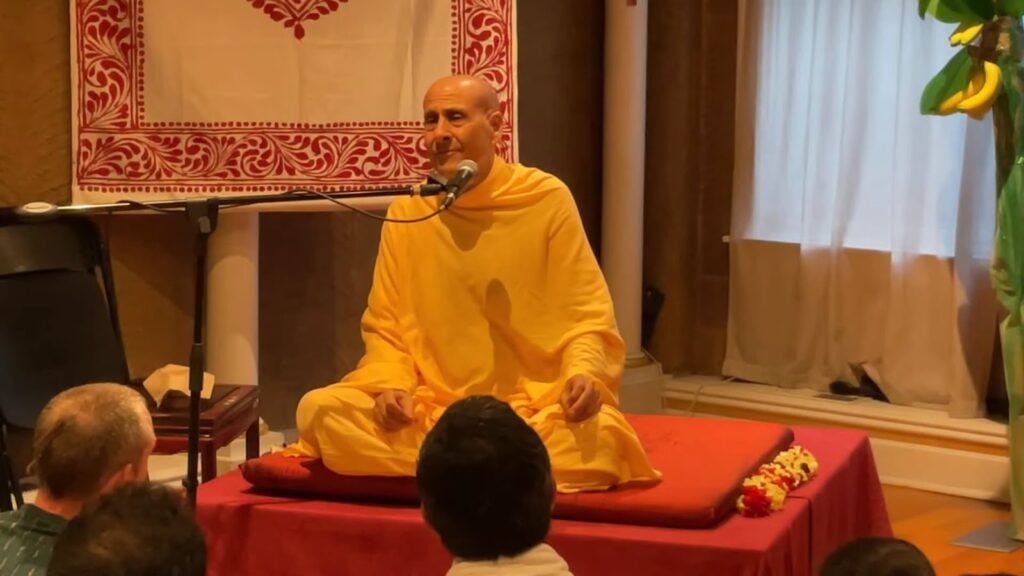
Bhakta Prabhu entered this atmosphere not as a physician and not as someone capable of altering the disease trajectory. His contribution belonged to another dimension of care. He held Vijay’s hand, prayed, read from the Bhagavad Gita, introduced sacred elements associated with Hindu and Vaishnava practice, and invited the relatives to chant together. These actions reorganized the room. A space dominated by passive waiting acquired a shared purpose: the family could offer attentive presence and sacred sound even when ordinary conversation with Vijay was no longer possible.
What palliative care actually includes
Palliative care is sometimes misunderstood as a declaration that nothing more can be done. The World Health Organization defines it more accurately as an approach that seeks to improve quality of life and relieve suffering associated with life-threatening illness, including physical, psychosocial, and spiritual problems. It supports both the patient and the family, can begin well before the final days of life, and may operate alongside disease-directed treatment. Pain control, breathlessness management, nursing care, communication, practical assistance, bereavement support, and spiritual care are complementary rather than competing responsibilities.
Australian standards similarly describe high-quality palliative and end-of-life care as safe, effective, and centred on people with life-limiting illness and their families or carers. The National Palliative Care Standards place the person’s needs at the centre of coordinated care. A major Australian consultation on spiritual care in palliative settings likewise describes spirituality in terms of meaning, purpose, connection, ritual, ceremony, and relationship with what a person regards as sacred.
Spiritual care is therefore not merely an ornamental addition made after clinical work is complete. It addresses questions such as: What has made this life meaningful? What does the patient fear? Which relationships require reconciliation? What practices communicate belonging? What does the patient believe happens at death? Which words, sounds, symbols, or silences offer peace? These questions can matter to religious and non-religious people alike. The appropriate response must remain guided by the patient’s own convictions rather than by a caregiver’s desire to impose an interpretation.
The expression “palliative care of the soul” is best understood as a devotional metaphor, not as a substitute for clinical palliative medicine. Chanting cannot replace analgesia, treatment for breathlessness, nursing observation, mouth care, or other symptom management. Conversely, medication and monitoring do not automatically address fear of spiritual abandonment, anxiety about death, or the family’s need for a meaningful farewell. Whole-person care is strongest when these domains cooperate.
Sacred materials as embodied theology
The account describes Ganges water, Tulsi leaves, and dust from Vrindavan being applied in association with Vijay’s body. Each material carries a dense devotional meaning. The Ganges, or Gaṅgā, is revered as a sacred river associated with purification and liberation. Tulsi is especially beloved in Vaishnava traditions and is closely connected with worship of Vishnu and Krishna. Vrindavan is understood as the sacred geography of Krishna’s earthly pastimes; its dust evokes proximity to the land of divine līlā.
These practices are documented in discussions of culturally responsive end-of-life care for Hindu patients, although customs vary greatly among families, regions, lineages, and sampradayas. No single ritual should be treated as mandatory for every Hindu. Some families may request Ganges water or Tulsi; others may prefer another mantra, scripture, deity, or form of prayer; still others may identify culturally as Hindu while declining ritual altogether. Cultural competence begins with informed curiosity, not assumptions.
In a hospital, sacred substances must also be used in a manner consistent with the patient’s wishes, medical condition, infection-control requirements, and staff guidance. Giving water or leaves by mouth can create an aspiration risk when a person has impaired swallowing or is unresponsive. A small symbolic touch to the lips or skin may sometimes preserve the ritual meaning more safely, but the clinical team should determine what is appropriate. The substances are presented here for their religious significance, not as pharmacological treatments.
The ritual’s emotional force lies partly in its embodiment. Grief can become cognitively overwhelming because there is no practical task capable of reversing death. Sacred actions give the hands something careful and loving to do. Water, leaves, dust, touch, scripture, and sound translate theological convictions into sensory forms. They tell the family that Vijay remains a person with a spiritual identity, not merely a failing body surrounded by equipment.
The Bhagavad Gita and the distinction between body and self
Bhakta Prabhu’s principal teaching to Vijay’s daughter was summarized in the statement that the person is not reducible to the body but is an enduring spirit soul. This is a theological claim, not a conclusion established by biomedical measurement. Within the Bhagavad Gita, however, it provides the conceptual foundation for approaching death as transition rather than annihilation. The body changes, becomes ill, and dies; the self, or ātman, is understood to possess a continuity that material observation cannot exhaust.
Bhagavad Gita 2.13 compares death with the embodied self’s passage through childhood, youth, and old age, presenting another change of embodiment as part of that continuity. Bhagavad Gita 2.20 describes the self as unborn, enduring, and not destroyed when the body is destroyed. For a frightened relative, these verses do not eliminate grief. Their function is to relocate grief within a larger account of existence in which love is not rendered meaningless by biological death.
Hindu philosophical schools do not interpret selfhood, liberation, and the relationship between the individual and the Divine in identical ways. The Gaudiya Vaishnava framework represented in the account understands the jīva as an eternal, conscious, dependent person related to Krishna through devotion. Its doctrine of acintya-bhedābheda describes an inconceivable simultaneous distinction and unity between the living being and the Supreme. Other Vedantic traditions formulate the relationship differently. Academic accuracy therefore requires identifying the teaching as a Krishna-centred Vaishnava interpretation rather than presenting one formulation as the only Hindu view.
Bhakta Prabhu also reassured the daughter that Krishna is the ultimate mother and father. This language has a direct textual basis in Bhagavad Gita 9.17, where Krishna identifies Himself as the father, mother, support, and grandsire of the universe. The pastoral meaning is significant: Vijay’s daughter was not being asked to imagine her father entering an impersonal void. She was being invited to entrust him to a divine relationship understood as older, deeper, and more protective than any earthly bond.
This reassurance does not imply that bereaved people should suppress sorrow because the soul is eternal. The Gita itself is spoken to Arjuna in a condition of grief, moral confusion, and bodily distress. Spiritual knowledge and mourning can coexist. A doctrine becomes pastorally harmful when it is used to shame tears, hurry acceptance, or silence difficult emotions. It becomes supportive when it offers language for hope while allowing grief to remain honest.
Why remembrance at death is central to Krishna consciousness
The instruction to chant continuously was rooted in the Vaishnava importance of remembering Krishna at the end of life. Bhagavad Gita 8.5 teaches that one who leaves the body remembering Krishna attains His nature. In this context, the technical devotional term is smaraṇa, remembrance, while congregational vocal chanting is commonly described as nāma-saṅkīrtana. The Holy Name is not treated merely as information about God. In Gaudiya Vaishnava theology, divine name and divine presence are intimately related.
The Hare Krishna maha-mantra is traditionally recited as: Hare Krishna, Hare Krishna, Krishna Krishna, Hare Hare; Hare Rama, Hare Rama, Rama Rama, Hare Hare. Its repetition gathers attention around the names of the Divine and converts the family’s anxiety into a shared act of devotion. One relative may lose concentration, another may begin to cry, and another may be unable to form words; the collective rhythm can continue to carry the practice when individual composure fails.
Bhakta Prabhu’s call for chanting “24/7” is best read as an urgent devotional exhortation, not a universal clinical protocol. In practice, families can rotate, chant softly, allow periods of silence, and remain attentive to the patient’s known preferences, signs of agitation, neighbouring patients, and hospital procedures. Continuous remembrance does not require exhausting every relative or turning the room into a performance. The governing principles are devotion, gentleness, and respect.
What research can and cannot say about sacred sound
Scientific research can study some psychological and physiological correlates of repetitive sacred speech, but it cannot adjudicate the theological claim that Krishna is personally present in His name or determine the soul’s destination after death. A systematic review and meta-analysis of mantram repetition reported a small pooled reduction in psychological distress, but the evidence base was limited and was not specific to dying patients or to the Hare Krishna maha-mantra. Such findings support cautious investigation of mantra practice as an adjunctive coping method; they do not prove metaphysical doctrines.
Group chanting may also provide benefits that are relational rather than narrowly biochemical. It synchronizes breathing and vocal rhythm, reduces the burden of inventing new words, gives participants a shared focus, and permits emotional expression within a stable structure. In a room filled with uncertainty, repetition can make time feel held rather than empty. These mechanisms are compatible with a devotional interpretation but do not replace it for believers.
The possibility that an unresponsive person may still process sound gives additional ethical weight to speaking gently near the bedside. A small electroencephalography study of actively dying hospice patients found brain responses to auditory changes in some patients who were behaviourally unresponsive. The study did not prove conscious comprehension, and its small sample prohibits broad conclusions. It nevertheless supports the cautious practice of treating the patient as potentially able to register something of the auditory environment.
For that reason, prayer, familiar music, scripture, reassurance, and loving speech may remain meaningful even when no visible response occurs. The appropriate conclusion is not that hearing has been guaranteed or that chanting medically caused a peaceful death. It is that respectful sound can be offered without demanding evidence of reception. The family’s words still express relationship, and the patient’s lack of response should never be mistaken for loss of dignity.
The family as a unit of care
Palliative care recognizes that serious illness affects an entire network of relationships. Vijay was the patient, but his daughter and the surrounding relatives also carried fear, fatigue, uncertainty, and spiritual need. A meta-synthesis of spirituality among family caregivers found that spirituality can help caregivers interpret suffering, reassess meaning, and understand the care they provide. This does not mean that religious belief automatically prevents complicated grief; it means that spiritual resources may form part of a broader support system.
Bhakta Prabhu’s most consequential intervention may therefore have been the transformation of the relatives from anxious spectators into active companions. They could not decide when Vijay would die, but they could hold his hand, recite sacred names, regulate the emotional atmosphere, and release him from any perceived obligation to remain for their sake. A gentle assurance such as “The family loves you, the family will care for one another, and it is all right to rest” can sometimes be as important to relatives as it may be to the dying person.
Shared chanting also created a memory that could accompany the family into bereavement. Instead of remembering only monitors, exhaustion, and helpless waiting, the relatives could remember that Vijay’s final hours were surrounded by prayer. Ritual cannot erase traumatic aspects of death, but it can give grief a coherent narrative: love was expressed, the family remained present, and the departure occurred within a practice Vijay’s community regarded as sacred.
A peaceful death at 3:00 a.m.
According to the recorded account, the family continued chanting after Bhakta Prabhu left. At approximately 3:00 a.m., with relatives gathered near the bed and the Holy Name still being recited, Vijay died peacefully. The temporal association is central to the family’s experience, but it should be described carefully. The chanting formed the spiritual environment of the death; the available testimony does not establish that chanting physiologically determined its timing.
At home, Bhakta Prabhu—who described himself as a deep sleeper—reported awakening suddenly at the same time with goosebumps and an intense awareness of Vijay. The daughter called the following morning and confirmed that her father had died at 3:00 a.m. Bhakta Prabhu interpreted the coincidence as possibly indicating that Vijay had come to thank him for helping create the conditions for a departure accompanied by Krishna’s name.
This interpretation belongs to the category of personal spiritual testimony. It cannot be verified as evidence of post-mortem visitation, yet dismissing it as meaningless would also misunderstand its function. Bereaved people and caregivers often experience coincidences, dreams, sensations, or moments of unusual clarity as continuing bonds with the deceased. A responsible academic account can preserve the testimony, identify it as interpretation rather than proof, and recognize the gratitude and relational closure it conveyed.
Ethical spiritual care is patient-led care
The story is moving because the family welcomed the chaplain’s practices. In another room, the same actions could be intrusive if they contradicted the patient’s beliefs. High-quality chaplaincy does not use vulnerability as an opportunity for conversion. It begins by discovering what the patient values, which community or tradition matters, whether prayer is desired, and how the patient wants spiritual concerns incorporated into care. Healthcare chaplaincy guidance accordingly understands spiritual and pastoral support as relevant across religious and non-religious beliefs.
A widely used clinical framework is the FICA spiritual history tool: Faith or sources of meaning; Importance and influence in the person’s life; Community; and how these concerns should be Addressed in care. Its value lies less in completing an acronym than in preventing assumptions. A patient may identify as Hindu yet prefer silence, regard Krishna as central, request a Sikh granthi because of family history, or find meaning primarily through relationships rather than formal religion.
Consent can become complicated when a patient is semi-conscious or lacks decision-making capacity. Previously expressed preferences, advance statements, family knowledge, and the healthcare team’s assessment should guide decisions. Guidance on care during the last days of life emphasizes attention to mental capacity and to cultural, religious, social, and spiritual preferences. Family members can be essential interpreters of a patient’s values, but their wishes should not automatically override clear prior choices made by the patient.
Clinical and spiritual professionals also need defined roles. The chaplain does not prescribe medication or prognosticate beyond competence. Physicians and nurses do not need to become theologians, but they should know how to ask respectful questions and arrange a referral. Everyone shares responsibility for dignity, communication, privacy, and cultural safety. When these roles collaborate, a Tulsi leaf, a verse from the Gita, or a period of chanting can be integrated without compromising symptom control or clinical standards.
Care must extend to the chaplain as well. Bhakta Prabhu’s account celebrates availability, yet repeated exposure to dying and grief can produce compassion fatigue, moral distress, and burnout. Reflective practice, peer consultation, boundaries, and rest are not signs of diminished devotion. They protect the capacity to serve attentively over time. The ideal system should not depend on one exhausted person being unable to find a substitute.
A shared dharmic reverence for conscious accompaniment
The theological details of Hinduism, Buddhism, Jainism, and Sikhism remain distinct, and genuine unity does not require collapsing those differences. Yet these dharmic traditions contain practices that value disciplined awareness, compassionate presence, non-harm, sacred recitation, and remembrance at decisive moments. Hindu nāma-japa, Buddhist recollection and mindful presence, Jain prayer oriented toward equanimity and ahiṃsā, and Sikh nām simran or the recitation of Gurbani can each help communities accompany illness and death according to their own teachings.
The shared ethical insight is that a dying person should not be reduced to a medical event. Body, consciousness, relationship, moral life, and spiritual aspiration all deserve attention. Dharmic unity is strongest when each tradition is allowed to speak in its own vocabulary while cooperating in compassion. In a plural hospital, the goal is neither uniform ritual nor theological debate. It is the protection of every person’s dignity and freedom to receive the form of spiritual care that is meaningful to them.
A practical framework for families approaching the final days
1. Clarify wishes before a crisis. Families can ask which prayers, scriptures, sacred objects, teachers, or communities should be contacted if speech or decision-making later becomes difficult. These preferences can be recorded alongside other advance-care information. Early conversations reduce the need to guess during emotionally intense final hours.
2. Coordinate ritual with the healthcare team. Staff should be told about desired chanting, visitors, sacred water, Tulsi, touch, dietary concerns, and after-death practices. Coordination protects safety and often reveals flexible solutions. A symbolic touch may be possible even when swallowing is unsafe, and soft chanting may be accommodated when louder congregational singing is not.
3. Create a calm auditory environment. Familiar voices can speak slowly and gently. Chanting can be kept at a comfortable volume, with pauses for rest and clinical care. Arguments, alarming speculation, and distressing conversations should be moved away from the bedside whenever possible. Even when responsiveness has diminished, the patient should be addressed respectfully rather than discussed as though absent.
4. Allow grief without making the patient manage it. Tears are appropriate, but relatives can reassure the dying person that the family will support one another. Children and adults with previous traumatic losses may need additional explanation and bereavement care. No one should be told that sincere faith eliminates sorrow or that emotional difficulty represents spiritual failure.
5. Share the vigil sustainably. A chanting rota, scheduled breaks, food, hydration, and sleep enable relatives to remain present without collapse. Continuous sacred remembrance can be maintained by a community without requiring each individual to remain awake indefinitely. Practical care for the living is part of seva, not a distraction from it.
6. Preserve silence as a valid spiritual practice. Sacred sound can be powerful, but silence may also communicate reverence. The room does not need to be filled constantly because relatives fear an empty moment. Chanting, reading, touch, breath, and silence can alternate according to the patient’s condition and the family’s tradition.
7. Plan for the hours after death. Families can ask in advance about washing, dressing, sacred objects, cremation timelines, organ donation, viewing, and contact with a priest or community leader. Hospital rules and legal requirements differ, but early discussion makes respectful accommodation more likely. Bereavement support should continue after the rituals are completed.
8. Avoid turning one experience into a promise. Vijay’s peaceful departure is a source of hope, but not every death will appear calm, occur during chanting, or produce a striking coincidence. Pain, delirium, agitation, and respiratory changes can occur despite deep devotion and require clinical treatment. The spiritual value of prayer does not depend on obtaining a particular visible outcome.
The priceless gift of helping another remember
For Bhakta Prabhu, the encounter recalled a gift received approximately fifty years earlier. He remembered having once been a young man with little knowledge of God and recognized that a lifetime of Krishna consciousness had enabled him to become an instrument of peace for a dying person and a grieving family. The experience therefore did not elevate the chaplain as the source of grace. It reinforced his understanding that sacred knowledge becomes valuable when it is offered through service.
The account contrasts this joy with the temporary satisfactions of cars, wealth, status, and popularity. The contrast need not imply that material responsibilities are worthless. Its sharper point is that possessions cannot perform the relational work demanded at the threshold of death. The deepest fulfilment described here occurs when another person’s fear begins to soften, spiritual meaning becomes intelligible, and a family discovers how to remain lovingly present.
Real protection, in this framework, does not mean preventing every illness or escaping biological death. It means receiving shelter for consciousness, relationship, and remembrance when ordinary forms of control have failed. The Holy Name gave Vijay’s family a practice when they had no power over the prognosis. It gave their love a voice, their waiting a purpose, and their farewell a sacred form.
A sacred transition held by care, truth, and humility
Vijay’s death should be understood neither as a laboratory demonstration of supernatural causation nor as an emotionally attractive story devoid of practical significance. It is a testimony about what spiritually integrated palliative care can look like when ritual, family participation, scripture, clinical responsibility, and patient-centred respect meet in one room. Its factual limits are part of its integrity: the death was reported as peaceful, the chanting was present, the 3:00 a.m. coincidence was personally meaningful, and the metaphysical interpretation remains a matter of faith.
The most enduring lesson is therefore not that every family must reproduce the same ritual. It is that no person should approach death as though the body were the only reality worthy of care. For a Krishna devotee, remembrance through the maha-mantra may be the sacred shelter sought at life’s final threshold. For another person, the form will differ. In every case, compassionate accompaniment asks the same disciplined question: what would help this person be treated, heard, and loved as a whole human being until the final breath?
Primary narrative source and research note: The hospital episode, dialogue, reported timing, and Bhakta Prabhu’s spiritual interpretation are drawn from the original recorded account. Clinical and cultural context is informed by the World Health Organization, Palliative Care Australia, peer-reviewed palliative-care research, healthcare chaplaincy guidance, and the cited Bhagavad Gita passages. Personal testimony has been identified as testimony, theological teaching as theology, and empirical findings as limited research evidence so that the boundaries among them remain clear.
Inspired by this post on Dandavats.






Leave a Reply
You must be logged in to post a comment.