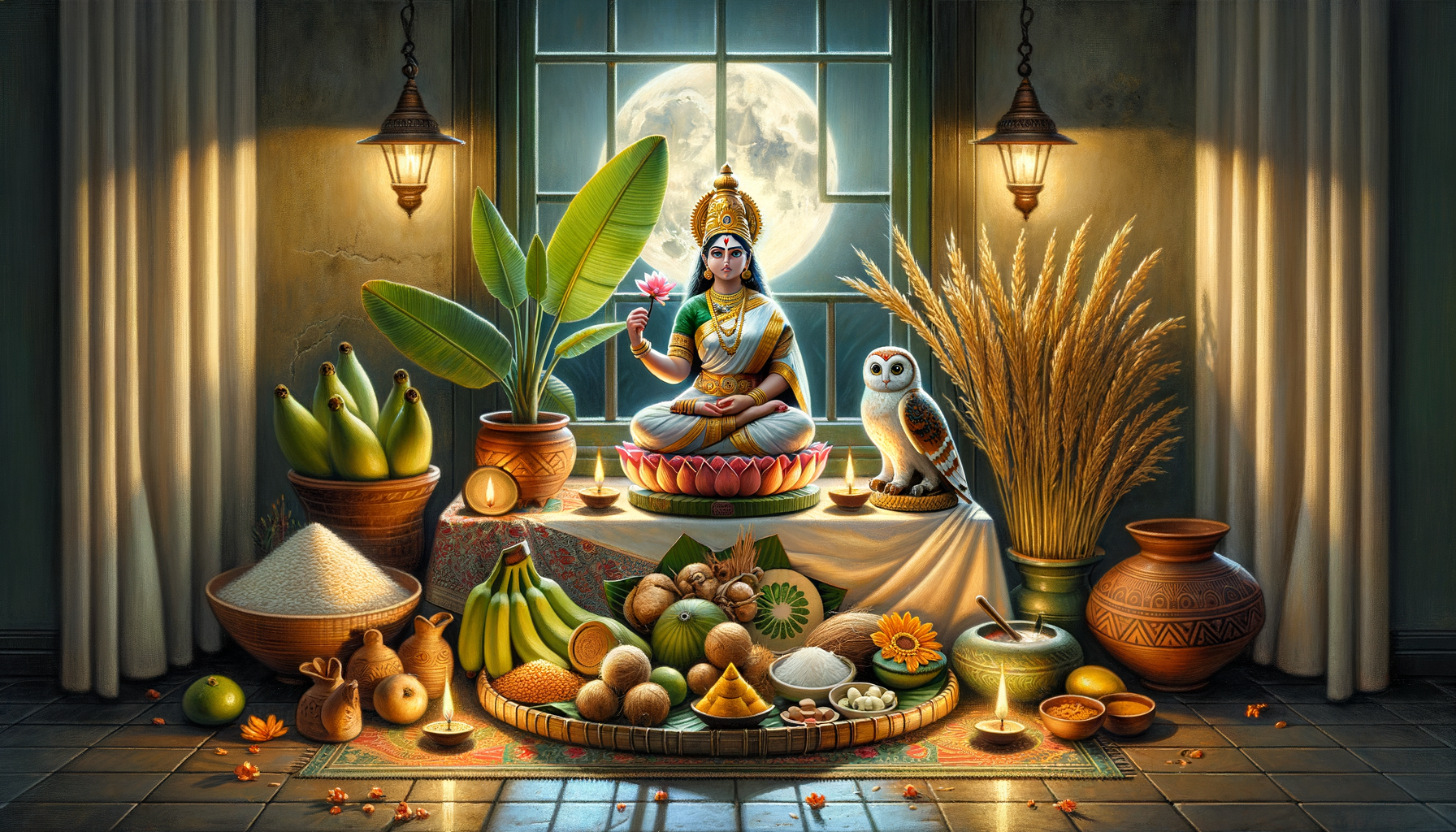
Goddess Lakshmi occupies a vital place in the Bengali Hindu tradition as the benevolent source of wealth, prosperity, and auspiciousness. In Bengal, three distinctive and complementary forms shape the devotional landscape of Lakshmi Puja: Sarapot Lakshmi, Kolabou as a living vegetal form, and the clay idol. Together, these practices illuminate a plural, living heritage that links household economies, seasonal rhythms, and shared ethical values across dharmic communities.
At the heart of Lakshmi Puja in Bengal lies Kojagari Lakshmi Puja, observed on the autumn full moon, also called Sharad Purnima. Many also honor Lakshmi during the harvest cycle and around Diwali, though Bengal typically foregrounds Kali Puja on the Diwali night. The triad of Sarapot, Kolabou, and clay idols appears across these moments in distinct ways, yet all three affirm a common aspiration: prosperity earned through right conduct, gratitude, and generosity.
Sarapot Lakshmi refers to the image of the goddess painted on a flat, circular clay plaque called a sara. In many households, the sara is placed upon a winnowing tray or kulo with paddy, durba grass, haldi, and rice, surrounded by lamps and alpana designs in rice paste. This format is intimate and domestic, evoking a household shrine that can be assembled with modest means and deep intentionality. The visual language is at once iconic and aniconic, allowing devotees to encounter Lakshmi not only as a deity of abundance but also as the ethical center of the home’s daily life.
The ritual grammar around Sarapot Lakshmi underscores sustainability and continuity. Clay plaques are locally crafted, often by traditional potters whose seasonal livelihoods align with festival cycles. Offerings such as puffed rice, coconut, jaggery, and homemade naru reinforce the bond between household labor, food, and reverence. Many recall the glow of lamps pooling on the earthen sara and the faint smell of wet clay as sensory anchors of Kojagari Lakshmi Puja in Bengal.
Kolabou introduces a living vegetal dimension to Lakshmi worship. The banana plant, draped in a white sari with a red border and anointed after ritual bathing, is widely known in Bengal as Kolabou. During Durga Puja, Kolabou appears as part of Nabapatrika, the cluster of nine sacred plants bathed at dawn on Saptami. Popular practice often embraces Kolabou as a form of Lakshmi, a gentle embodiment of fertility, nourishment, and prosperity. Scholarly readings frame Nabapatrika within the wider Shakta tradition of Durga; living tradition in many Bengali homes simultaneously honors Kolabou as Lakshmi’s abundance flowing through vegetation and harvest.
Viewed through this dual lens, Kolabou reveals how Bengal’s ritual culture sustains layered meanings without contradiction. The vegetal form sacralizes the ecology of prosperity: water, soil, and plant life are not peripheral but central to auspiciousness. In honoring Kolabou, families affirm an ethic that prosperity must be wholesome and reciprocal, a principle that resonates deeply across dharmic traditions where right livelihood, compassion, and restraint shape social wellbeing.
The clay idol of Lakshmi presents the most familiar iconographic form: the goddess seated or standing upon a lotus, with the owl as vahana in the Bengali iconographic canon. The idol is often flanked by vessels of grain and coin imagery, symbolizing prosperity that circulates rather than accumulates stagnantly. The visual field is completed by lotus motifs, conch, lamps, and the footprints of Lakshmi drawn in alpana at thresholds to invite auspicious entry.
On Kojagari Lakshmi Puja night, families keep vigil, mindful of the devotional reminder ke jage, se pabe, who remains awake in sincerity receives grace. The emphasis falls less on spectacle and more on quiet alertness, a participatory stillness that links material aspirations to ethical intention. Stories narrated in Bengali homes often describe the contrast between Lakshmi and Alakshmi, urging hospitality, cleanliness, and charity as safeguards of fortune.
Across Sarapot, Kolabou, and clay idols, a consistent message emerges: wealth carries responsibility. In practice, this aligns with broader dharmic values shared among Hindu, Buddhist, Jain, and Sikh communities in the subcontinent. Dana, daya, and seva are cherished across these traditions, reminding devotees that prosperity is most meaningful when it nurtures families, supports artisans, and sustains the wider community. Bengal’s Lakshmi Puja thus becomes a bridge between personal worship and public ethics.
The triad also showcases Bengal’s plural devotional aesthetics. Sarapot Lakshmi centers the home and the clay craft heritage; Kolabou sacralizes the vegetal world and the harvest cycle; the clay idol embodies classical iconography and temple-inspired decorum. None stands alone as the single authentic expression; rather, the three together reveal a composite spirituality that is historical, agrarian, and artistic. This plurality harmonizes with the Indic idea of Ishta, the chosen form, where multiple valid paths lead to reverence and realization.
For households exploring these practices today, the choice of form can follow family lineage, availability of space, and ecological considerations. Sarapot Lakshmi is compact and deeply traditional; Kolabou reconnects the household with river, field, and courtyard garden; the clay idol offers pedagogical clarity for children learning Lakshmi’s iconography. In each case, sustainability-led choicesunbaked or locally baked clay, natural dyes, and biodegradable offeringsextend the festival’s ethical core into material selection.
Community engagement further enriches the observance. Visiting neighborhood potters supports artisanal continuity; sharing prasad with neighbors reinforces social harmony; and explaining the symbolism of the owl vahana, the lotus, and the footprints helps younger generations appreciate Lakshmi Puja as a tapestry of meanings rather than a single event. In diverse neighborhoods, simple gestures of hospitality during Kojagari Lakshmi Puja can foster interfaith understanding grounded in shared human values of gratitude and generosity.
Taken together, Sarapot, Kolabou, and the clay idol form a nuanced portrait of Lakshmi worship in Bengal. They reveal how a household ritual can be at once scholarly in symbolism, practical in daily ethics, and luminous in emotional memory. As lamps flicker on the full moon night and the crisp designs of alpana blossom around doorways, Bengal’s Lakshmi Puja continues to embody abundance as a living relationship: between people and the divine, home and harvest, beauty and responsibility.
Inspired by this post on Hindu Blog.