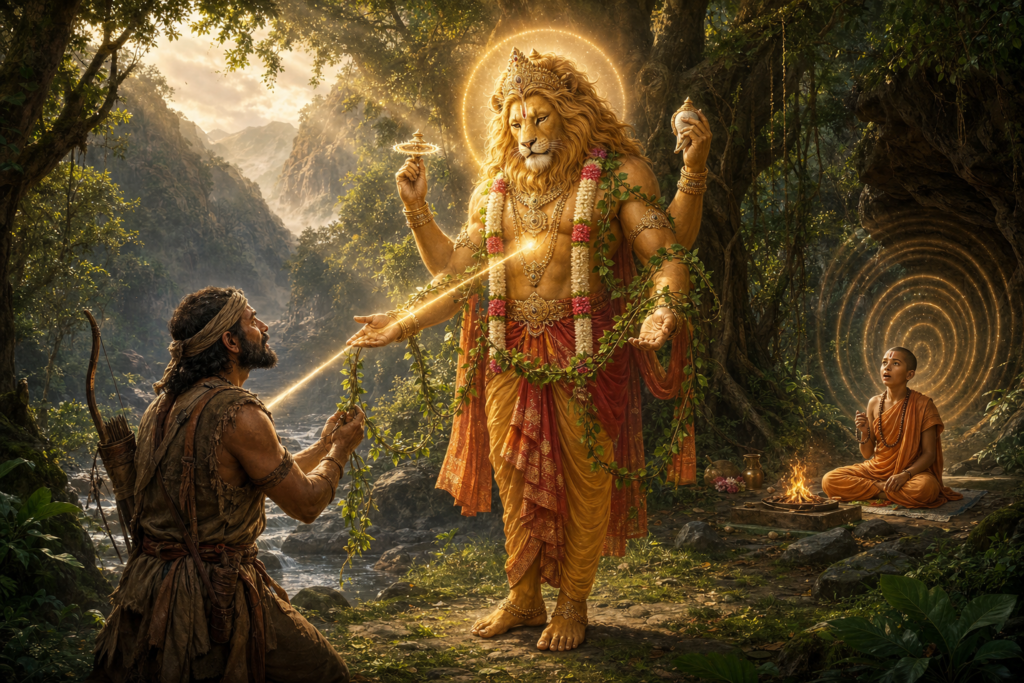
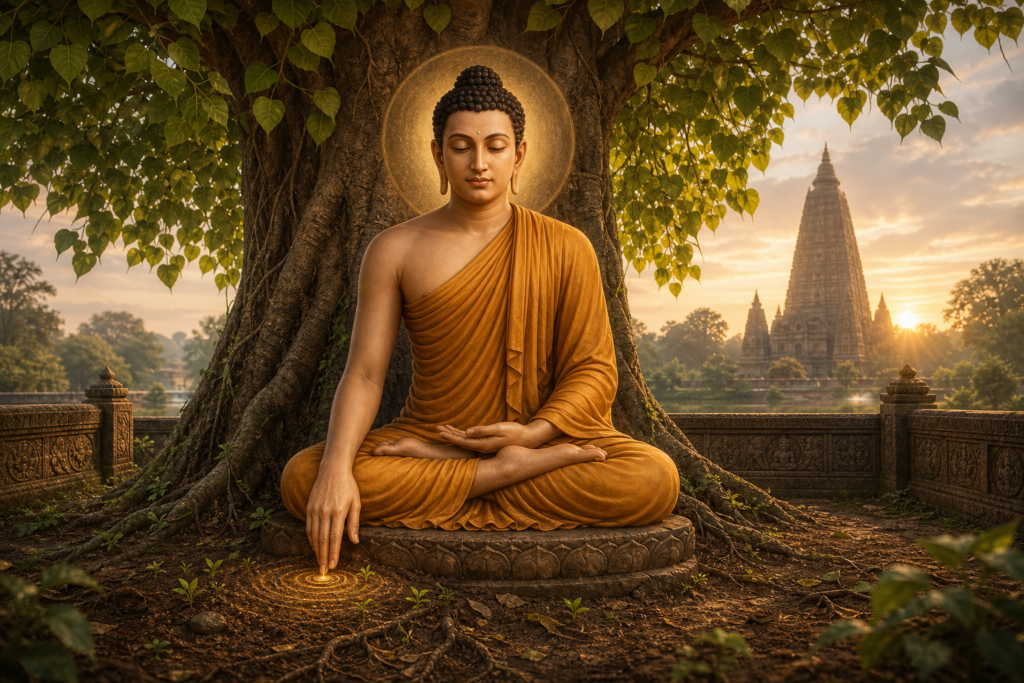
Viral videos on social media recently claimed that the sun god chants the “OM” mantra from Surya Loka. Public responses ranged from reverent belief to outright skepticism. A careful, balanced reading invites a more nuanced understanding that honors both scientific observation and the sacred symbolism cherished in dharmic traditions.
From a scientific perspective, the Sun does not transmit audible sound through the vacuum of space. However, space scientists study solar oscillationspressure waves and plasma vibrationsthrough helioseismology. These data are sometimes “sonified” (converted into the human hearing range), producing deep drones or tonal textures. It is unsurprising that some listeners perceive these renderings as reminiscent of “OM,” even though such likeness arises from data transformation rather than literal chanting by the Surya Mandala.
Within the dharmic worldview, the sacred syllable “OM” signifies primordial resonance and ultimate reality. Across Hinduism, Buddhism, Jainism, and Sikhism, it holds integrative meaning: in Hindu practice it anchors Vedic mantras and Surya worship; in Buddhism it appears in meditative formulas such as Om Mani Padme Hum; in Jainism it encapsulates reverence for the Panch Parameshti; and in Sikh thought, Ik Onkar affirms the oneness that “OM” evokes. Read this way, the phrase “the Sun chants OM” functions as a spiritually resonant metaphor affirming unity in spiritual diversity.
This synthesis of perspectives suggests an approach that is both academically grounded and devotionally sensitive. Scientifically, solar oscillations and sonification explain why certain audio tracks may recall the deep, continuous quality associated with “OM.” Spiritually, Surya symbolizes illumination, order, and lifequalities that align with the contemplative power of mantra. Holding both truths together strengthens mutual respect among dharmic traditions while maintaining intellectual clarity.
For many practitioners, sunrise ritualsSurya Namaskar, japa of “OM,” and mindful breathingcreate a felt connection to cosmic rhythm. The idea that the Sun embodies or “voices” sacred harmony can deepen awe and gratitude, encouraging daily practice that is both personal and inclusive. Such meaning-making does not depend on literal proof; rather, it invites inner alignment, ethical living, and reverence for a shared spiritual inheritance.
Media literacy remains essential. When encountering extraordinary claims, it is prudent to consult helioseismology research, peer-reviewed studies, and official releases from space-science institutions. Doing so reduces polarizationbetween believers and skepticsand preserves a tone of respectful inquiry that dharmic philosophies prize, especially the pursuit of truth (satya) with humility and openness.
Ultimately, whether taken as poetic symbolism or as an evocative interpretation of scientific sonifications, the notion that the Sun echoes “OM” can serve as a contemplative bridge. It encourages people to unite around shared valuesknowledge, devotion, and compassionwhile celebrating the plurality of paths within Hinduism, Buddhism, Jainism, and Sikhism. In this spirit, Surya Loka stands not only as an abode of radiance but also as an enduring invitation to experience unity in spiritual diversity.
Inspired by this post on Hindu Pad.