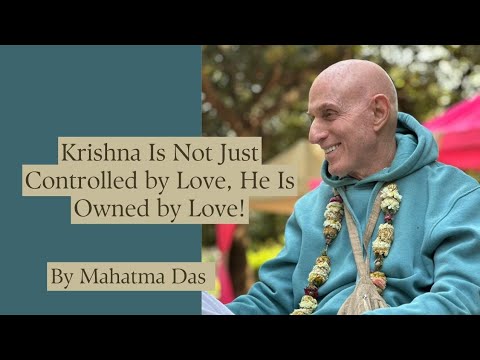
On October 12, 2025, in Alachua, Florida, His Grace Mahatma Prabhu (Mahatma Das) presented a Sunday Feast Class titled “Krishna Is Not Just Controlled by Love, He Is Owned by Love!” The guiding assertion—“Krishna will never rob the soul of its autonomy, love must be given not taken”—framed a precise and humane exploration of devotion, emphasizing agency, dignity, and mutuality in the relationship between the individual soul and Sri Krishna.
Situated within the bhakti tradition, the lecture clarified that Sri Krishna responds to affection that is freely offered. Devotion (bhakti) is described not as mechanical performance or fear-based compliance, but as voluntary surrender (ātma-nivedana), heartfelt service (seva), and love (prema) that arise from inner conviction. In this theological view, the autonomy of the jīva is never negated; rather, love voluntarily “binds” the Infinite through reciprocity, a theme central to Gaudiya Vaishnavism and wider Hindu Dharma.
The session further outlined practical disciplines that cultivate such love without coercion: attentive nāma-japa, congregational kīrtana, reflective study of śāstra (śravaṇa, kīrtana, smaraṇa), and service within community. Participants often report a deepened sense of inner freedom when practice is grounded in consent and care. The class thus discouraged any form of pressure in spiritual life and underscored that love is authentic only when it is chosen.
These principles resonate across dharmic traditions, reinforcing unity in diversity. Buddhism’s mettā and karuṇā cultivate compassion as a self-directed, voluntary ethic. Jainism’s ahiṃsā and aparigraha rely on freely embraced restraint and responsibility. Sikhism emphasizes prem and seva, honoring the soul’s direct, unmediated relationship with the Divine. Hindu Dharma likewise recognizes Ishta and the legitimacy of multiple paths. Taken together, these convergences affirm that love offered without compulsion is a shared dharmic value that strengthens harmony among Hinduism, Buddhism, Jainism, and Sikhism.
At a communal level, the lecture’s insights translate into inclusive practice: encourage open dialogue, honor each individual’s pace of growth, design accessible spaces for kīrtana and study, and prioritize seva that uplifts all. Such an approach aligns with love and tolerance, fosters belonging, and sustains spiritual integrity while preserving personal freedom.
Presented with academic clarity and devotional depth, the Alachua Sunday Feast Class offers a complete articulation of how love—not control—“wins” Sri Krishna’s heart while safeguarding spiritual autonomy. A related reference is available at https://www.dandavats.com/?p=116229, and the lecture was shared with an accompanying YouTube thumbnail (idbYABM9s7A).
Inspired by this post on Dandavats.