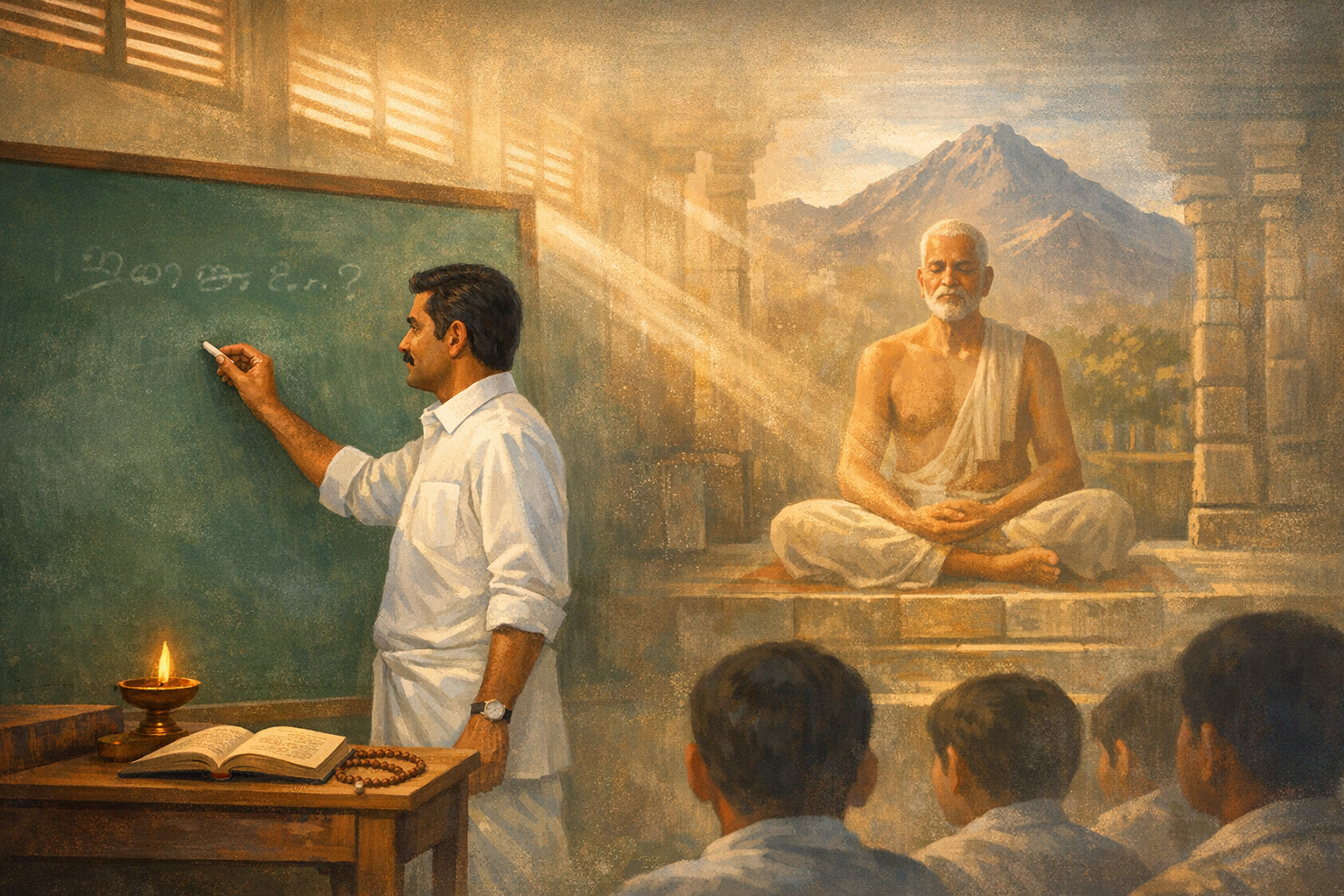
A luminous reminiscence from Hindu Higher Secondary School, Triplicane, recalls the cultural texture of Chennai’s 1980s classrooms, where learned teachersoften addressed with affectionate honorifics such as Raoji, Iyengarji, and Iyerjiwove language instruction with living examples of dharmic values. Among them, a Tamil teacher, Mr. Raoji, frequently shared an account of meeting Bhagavan Sri Ramana Maharshi. The narrative was simple in outline yet philosophical in depth: a quiet audience, an unassuming sage, an immeasurable silence, and a permanent alteration in inner orientation. Even decades later, that account remains a compelling illustration of the Guru–Shishya Tradition and the enduring relevance of Advaita Vedanta for contemporary seekers across India’s dharmic landscape.
Situated in the heart of Chennai’s Triplicanea neighborhood close to major temples and traditional learning centersthe school cultivated an educational ethos where linguistic competence and ethical sensibility were developed side by side. Within this milieu, the teacher’s narrative did more than recount a spiritual episode; it offered a case study in how lived experience can crystallize the philosophical teachings students encountered in literature and scripture. The effect was quietly profound: adolescents learned that inner freedom and clarity are not abstractions but realizable states that have moved countless practitioners throughout South India and beyond.
Ramana Maharshi (1879–1950) is widely recognized as a seminal sage of modern India. After a sudden and decisive awakening at the age of sixteen, he journeyed to Arunachala (Tiruvannamalai) and remained near that sacred mountain for the rest of his life. His methodātma-vichāra, commonly rendered as Self-Inquirycentered not on elaborate ritual or philosophical disputation but on an immediate, experiential examination of the “I”-sense. Rather than multiplying concepts, he invited seekers to attend to the source of the “I thought” itself; in this direct approach, what remains is the Self: luminous, unobjectifiable awareness.
According to the recollection shared in the Triplicane classroom, Mr. Raoji traveled to Sri Ramanasramam in the mid-20th century, drawn by accounts of the Maharshi’s natural simplicity and the extraordinary tranquility reported by those who sat in his presence. The ashram routine was spare and dignified. Devotees often described how Bhagavan would sit quietly in the hall, his gaze steady, his presence unadorned. There were no promises of miracle-working or secret techniquesonly an open invitation to return attention to its source. What imprinted itself on the teacher’s memory was the sense that silence itself served as upadeśa (instruction): language fell away, but understanding deepened.
The experiential core of this meeting, as he conveyed it, was an unexpected interior stillness. In that stillness, ordinary mental agitation seemed to recede, replaced by a pervasive clarity that did not owe itself to any argument or suggestion. The encounter confirmed what documented ashram conversations and recorded dialogues also testify: that Ramana Maharshi’s teaching communicates itself as much through presence as through words. The pedagogical implication shared with students was directexposure to a realized teacher can catalyze inquiry more effectively than conceptual elaboration alone.
Self-Inquiry, in Ramana Maharshi’s presentation, is radical in its simplicity. First, observe the stream of mentation and identify the recurrent “I”-sense that claims experiences: “I think,” “I feel,” “I act.” Next, turn attention toward this very “I-thought” rather than its countless objects. Persistently ask, “Who am I?”not as an intellectual riddle, but as an attentional vector returning awareness to its origin. As attention abides in its source, vṛttis (thought-waves) quieten; the “I-thought,” no longer reified, resolves into the Self, which is not an object but the ground of knowing itself.
This method is technically subtle. The question “Who am I?” is not intended to elicit a descriptive answer. Instead, it serves as a wedge that loosens identification with transient phenomena (body, emotion, cognition, social persona). Unlike purely analytical neti neti (“not this, not this”) approaches, ātma-vichāra turns inward immediately, tracing the sense of identity back to its luminous base. Where habits (vāsanās) assert themselves, complementary practicesdevotional surrender (śaraṇāgati), japa, and ethical refinementsupport steady abidance.
Bhagavan frequently affirmed that jñāna (knowledge) and bhakti (devotion) converge. While Self-Inquiry is nondual in emphasis, its maturation often proceeds through humility, gratitude, and loving remembrance. This integrated pathway aligns with the Upanishadic vision: the Self is both the object and subject of love (Bṛhadāraṇyaka Upaniṣad), and wisdom naturally flowers as compassion. In the classroom retelling, this synthesis proved memorablestudents recognized that rigorous introspection and heartfelt devotion are not competing strategies but complementary disciplines that stabilize realization.
Philosophically, Self-Inquiry proceeds by examining the “I” as the apparent subject. When attention is tethered to the subject, objective identifications thin out. From an Advaita Vedanta standpoint, the “I-thought” is the primal modification; its dissolution uncloaks the Self as sat-cit-ānanda (being-consciousness-bliss). Pedagogically, this was presented as a rigorous form of first-person phenomenology: an inquiry conducted not by accumulating beliefs but by removing misidentifications until only unmediated awareness remains.
Ethically, practice rests on a stable foundation. Yamas and niyamas (non-harming, truthfulness, non-excess, contentment, self-discipline, and study) are not ornamental; they condition the mind for subtle discernment. Without basic alignment in conduct and speech, introspective practice is repeatedly pulled outward by reactivity. The Triplicane narrative emphasized that the teacher’s reverence for his students and devotion to pedagogy were themselves expressions of sādhanā; right work and right relation are not separate from contemplative life.
Arunachala itselfcelebrated in Shaiva literature as the immovable lingam of lightfigures centrally in Ramana’s life and teaching. Sri Ramanasramam, set at the foot of this mountain, became an emblem of quiet completeness. Devotees’ descriptions of the old hall, visits to Virūpākṣa Cave and Skandashram, and the Kārttikai Deepam celebration illuminate a larger cultural context: spiritual attainment does not require withdrawal from sacred geography and shared ritual memory; rather, such places can anchor and amplify the contemplative impulse through inherited rhythms of collective practice.
From a textual perspective, Ramana’s guidance resonates with the Upanishadic mahāvākyas and finds practical echoes in works he recommended (for example, the Ribhu Gita). While exegesis varies across commentarial schools, a common interpretive thread emphasizes that liberation (mokṣa) is not attainment of something new but recognition of what already is. Students were encouraged to see this as a methodological pointer: knowledge in the highest sense is self-revelation, not acquisition.
This teaching bears instructive parallels across the dharmic traditionsaffirming a shared civilizational commitment to inner freedom while respecting doctrinal distinctions. In Buddhism, careful attention to moment-to-moment experience through satipaṭṭhāna and vipassanā develops non-clinging and insight into the conditioned nature of phenomena; although classical Buddhist thought articulates anattā (non-self) differently from Vedantic ātman, both promote sustained first-person investigation that loosens egoic fixation and reveals freedom from suffering. In Jainism, disciplines such as samayik (equanimity), pratikraman (ethical reflection), and dhyāna (meditative absorption) refine awareness and reduce karmic influxan ethic of meticulous self-examination that complements the Vedantic appeal to stable, witnessing consciousness. In Sikhism, the centrality of Naam Simran and the directness of the Guru’s shabad-guidance cultivate God-centered awareness and humility; this living remembrance harmonizes with the Vedantic counsel to abide as pure awareness, dissolving self-importance through love and surrender. Together, these resonances affirm unity in spiritual diversity: multiple paths, one aspirationclarity, compassion, and liberation.
For contemporary practitioners, the Triplicane account offers a practical template. Begin with ethical steadiness and simple daily rhythms (regular sitting, mindful speech, kindness in action). During quiet practice, return attention to the felt sense of “I” and let the question “Who am I?” draw awareness back to its origin. When restlessness surges, stabilize with breath awareness, soft japa, or contemplative reading. Throughout, relate to others with sincerity and respect; dharma matures not only in meditation halls but also in classrooms, homes, and workplaces.
From an educational standpoint, the teacher’s testimony modeled a core feature of the Guru-Shishya Tradition: knowledge transmitted by character and presence, not merely by content. Students reported heightened interest in classical texts when they saw how a living master’s presence could clarify ideas that seemed abstract on the page. In this way, a single narrative functioned as both spiritual teaching and curricular enrichmentdemonstrating that India’s intellectual heritage reaches full potency when scholarship and sādhanā move together.
Methodologically, Self-Inquiry aligns with a rigorous phenomenology: it asks what remains when the knower refuses to be objectified. This is not a denial of the world but a clarification of identity. When the “I” is no longer fused with changing content, action becomes less reactive and more responsive. Decisions benefit from clarity; relationships benefit from humility. In both personal and civic life, these outcomes strengthen social trust and foster coexistenceideals that harmonize with the shared ethical aspirations of Hinduism, Buddhism, Jainism, and Sikhism.
The Triplicane narrative ultimately presented a threefold insight. First, spiritual realization is not the monopoly of any era; it can and does occur in modern times. Second, the teacher–saint connection remains a vital bridge between youthful curiosity and mature discernment. Third, unity across dharmic traditions is not achieved by erasing differences, but by honoring a common pursuit: freedom from suffering, self-mastery, and compassionate action grounded in clear seeing.
Years after those 1980s classroom sessions, the memory of Mr. Raoji’s visit to Sri Ramanasramam endures as more than a story. It remains a pointer: silence can teach, presence can heal, and Self-Inquiry can reveal that the wholeness sought was never absent. In an age of information saturation, this testimony still communicates with crystalline simplicity: turn within, abide as awareness, and let understanding express itself as kindness in the world.
Inspired by this post on Hindu Pad.