
When the autumn night becomes theology
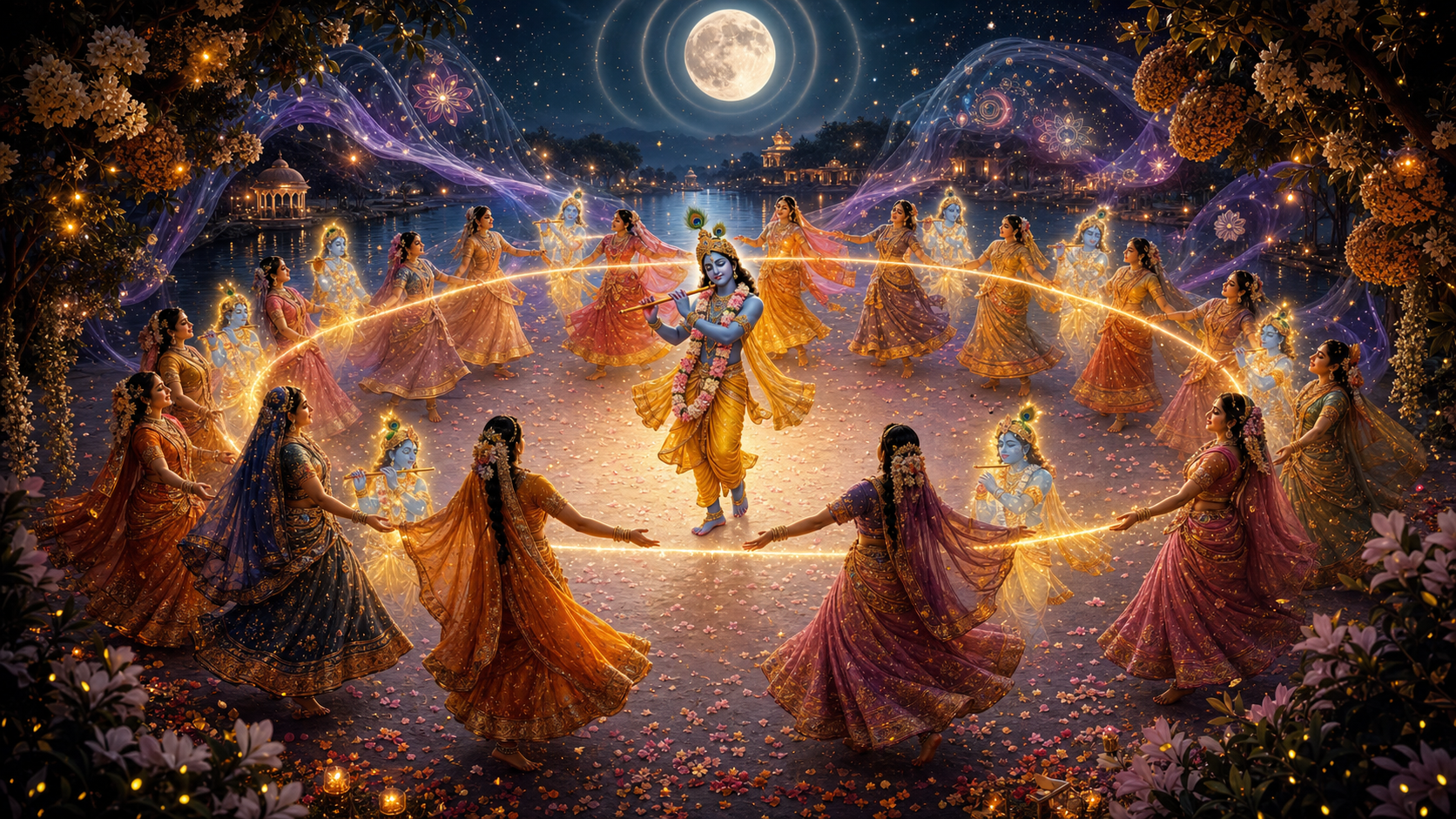
Under the autumn full moon, the Bhagavata Purana slows the world to the cadence of a flute. Jasmine blossoms perfume the air, the Yamuna reflects the night sky, and the Gopis of Vrindavan hear a melody that interrupts every ordinary claim upon their attention. The scene is intimate, but its scale is cosmic: celestial beings gather to watch, conventional time expands, and Bhagavan Krishna becomes personally present beside every participant in the circular dance. Raas Lila is therefore presented not merely as an episode of pastoral romance but as a revelation of divine love, spiritual freedom, and the mysterious relation between the one and the many.
The essential interpretive key appears before the dance begins: yoga-māyām upāśritaḥ. Krishna undertakes the Lila through Yogamaya. Any reading that passes over this phrase risks one of two opposite errors. It may reduce the episode to ordinary erotic conduct, or it may dissolve its embodied beauty into an abstract allegory. The narrative permits neither reduction. Bodies, music, longing, fatigue, conversation, and movement remain vividly real within the story, yet their meaning is governed by a divine power that conceals Krishna’s limitless majesty while revealing the sweetness of direct relationship.
The familiar statement that the universe stood still should be understood as sacred poetics grounded in the text’s cosmic imagery. The moon and stars are described as astonished, heavenly drums sound, flowers descend, and the music fills every direction. The stillness is not scientific reportage; it signals that ordinary measures of place, time, and identity no longer adequately describe the event. Yogamaya creates a threshold at which village life remains recognizable while divine reality becomes perceptible through it.
The five-chapter architecture of the Raas Lila
The principal account occupies chapters 29–33 of the Bhagavata Purana’s Tenth Canto, a unit widely known in devotional reception as the Rāsa-pañcādhyāyī, or five chapters of the Rāsa. Chapter 29 describes the flute’s summons, the Gopis’ arrival, Krishna’s testing words, and his disappearance. Chapter 30 follows the searching Gopis through the forest. Chapter 31 contains the celebrated Gopi Gita, their song of separation. Chapter 32 narrates Krishna’s return and the debate about reciprocity in love. Chapter 33 presents the circular dance and then confronts its apparent ethical difficulty directly.
This order is the theology. The dance cannot be responsibly isolated from the summons, test, disappearance, search, lament, reunion, ethical question, and warning against imitation. Separation removes possessiveness; dialogue gives the Gopis an articulate voice; Krishna’s confession of indebtedness reveals the stature of their devotion; and King Parikshit’s objection prevents the audience from treating the episode as morally uncomplicated. The completed sequence transforms what first appears to be desire into a study of devotion purified of bargaining and ownership.
An academically careful interpretation also distinguishes three related but non-identical layers. The first is the Sanskrit narrative itself. The second consists of commentarial explanations developed by Vaishnava teachers and different Vedantic lineages. The third includes later poetry, theology, painting, music, ritual, and dance traditions. These layers illuminate one another, but a later interpretation should not automatically be presented as an explicit statement of the earliest textual layer. This distinction becomes especially important when discussing Yogamaya, Rādhā, the Gopis’ social identities, and the technical language of devotional rasa.
The phrase that changes the meaning of the dance
Bhagavata Purana 10.29.1 begins with the striking expression bhagavān api: even though Krishna is Bhagavan, complete in divine plenitude, he turns his attention toward loving play on the fragrant autumn nights. The verse closes with yoga-māyām upāśritaḥ, indicating that he resorts to, takes shelter of, or engages Yogamaya. Translation choices vary because the expression contains both agency and mystery. What remains clear is that the text marks the Lila as an operation of divine power before describing any intimate action.
Maya in this context should not be flattened into the English word illusion if illusion is understood to mean a simple lie or a nonexistent fantasy. Across Hindu philosophical and theological literature, māyā has a broad semantic range involving manifestation, concealment, measurement, appearance, and extraordinary power. Yogamaya is the divine capacity through which an impossible relation becomes experienceable: the unlimited appears within a finite landscape, the omniscient Lord participates in spontaneous affection, and the one Krishna stands beside many Gopis without becoming divided.
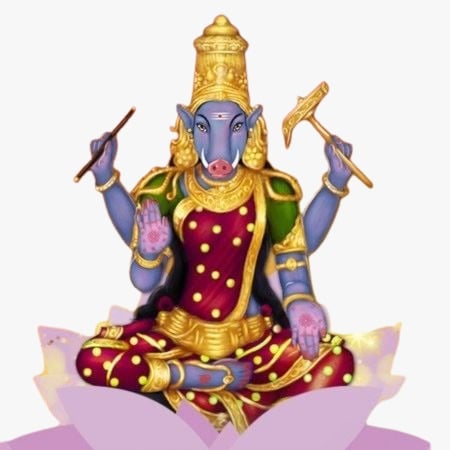
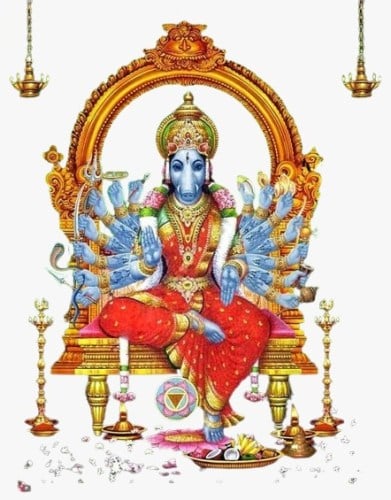
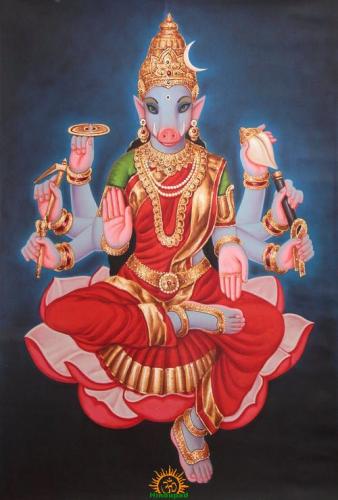
Yogamaya already plays an active role earlier in Krishna’s birth narrative. In Bhagavata Purana 10.2, she transfers the unborn Balarama from Devaki’s womb to Rohini’s and appears through Yashoda. The chapter associates her with names including Durgā, Bhadrakālī, Vijayā, Vaiṣṇavī, Caṇḍikā, Nārāyaṇī, Śāradā, and Ambikā. She is thus both power and personified divine presence. Her involvement in the Raas Lila belongs to a larger pattern in which she arranges the circumstances of Krishna’s embodied manifestation.
The Bhagavad Gita supplies another dimension. In Bhagavad Gita 7.25, Krishna describes himself as yoga-māyā-samāvṛtaḥ, covered by Yogamaya and therefore not manifest to everyone as the unborn and imperishable Lord. Concealment here does not oppose revelation; it regulates it. Those who see only an extraordinary cowherd miss the divine identity, while those drawn into loving relationship encounter a reality that bare displays of omnipotence could not produce. The veil hides majesty so that intimacy can flourish.
Later Gaudiya Vaishnava theology commonly distinguishes Yogamaya, the internal potency that nourishes Krishna’s spiritual relationships, from Mahamaya, the external potency associated with conditioned material perception. This distinction is highly influential and particularly useful for interpreting the Raas Lila, but it should be identified as a developed theological formulation rather than treated as the only possible meaning of every occurrence of māyā. Other Hindu sampradayas organize the relation between deity, Shakti, world, and appearance through different metaphysical vocabularies.
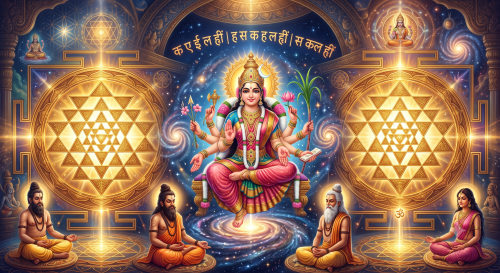
The association of Yogamaya with both Krishna’s intimate potency and names of the Goddess offers an important basis for respectful dialogue between Vaishnava and Shakta traditions. Their theological rankings and ritual emphases may differ, yet the traditions meet in recognizing that divine manifestation is inseparable from divine power. Unity does not require collapsing Yogamaya, Durga, Radha, and every form of Shakti into a single undifferentiated concept. It is better served by acknowledging both the shared sacred vocabulary and the distinctive interpretations preserved by living traditions.
The flute, the Gopis, and the interruption of ordinary life
The autumn setting is not decorative scenery. The cool night, blossoming jasmine, forest groves, riverbank, moonlight, and gentle wind create a sensorial world in which nature participates in revelation. Vrindavan is not represented as inert space surrounding a miracle. Its trees, animals, water, flowers, and sky respond to Krishna. This ecological intimacy helps explain why Braj later becomes sacred geography: divine presence is remembered through paths, groves, riverbanks, sounds, and seasons rather than confined to a purely conceptual realm.
Krishna’s flute crosses household and social boundaries without issuing a verbal command. The Gopis recognize the melody as a personal summons because their attachment to Krishna already exists. The Bhagavata describes them leaving tasks unfinished: milk remains on the stove, domestic work is interrupted, adornment is incomplete, and family members attempt to restrain some of them. Those physically prevented from going turn inward in meditation. The narrative therefore presents several modes of response to grace—outward movement, inward absorption, resistance from the surrounding world, and unwavering remembrance.
The Gopis should not be reduced to anonymous figures who merely decorate Krishna’s glory. They make decisions, endure opposition, answer theological arguments, search the forest, interpret footprints, sing sophisticated poetry, question Krishna’s conduct, and evaluate the nature of reciprocal love. Their collective voice carries much of the five-chapter unit. In a striking reversal of conventional hierarchy, the devotees eventually place the deity under a debt that he declares himself unable to repay.
When the Gopis arrive, Krishna initially tells them to return home. He refers to the dangers of the night forest, the anxiety of relatives, household obligations, and accepted standards of marital conduct. He even states that devotion may be cultivated through hearing, seeing, meditation, and praise rather than physical proximity. Read superficially, the speech appears to dismiss them. Within the narrative, however, it operates as a test that compels their motivation to become explicit.
The Gopis reply that Krishna is not an optional object competing with other relationships. He is the indwelling Self and deepest beloved through whom every legitimate relationship obtains its ultimate meaning. Their argument moves from social identity to spiritual ontology. They have not come seeking wealth, status, protection, or even liberation; they seek service and presence. Krishna, described as self-satisfied, accepts the force of their response and joins them. Bhakti is thus represented not as a commercial exchange but as wholehearted orientation toward the divine.
This movement beyond conventional duty does not create a general rule allowing intense private desire to override ethical responsibility. The story establishes exceptional conditions: Krishna’s divine identity, Yogamaya’s operation, the Gopis’ purified devotion, and the narrator’s later prohibition against imitation. Removing those conditions turns transcendence into pretext. The episode cannot legitimately be invoked by a human authority to evade consent, fidelity, accountability, or the protection of vulnerable people.
Why Krishna disappears before the dance is complete
As Krishna gives the Gopis his attention, a subtle pride arises among them. Each begins to feel specially favored. Krishna then disappears. The disappearance is not an incidental dramatic twist; it prevents divine intimacy from becoming possession. Yogamaya allows closeness, but the same sacred arrangement removes the visible beloved when closeness produces self-importance. The emotional center of the narrative consequently shifts from enjoyment to searching.
In chapter 30, the Gopis ask the trees, plants, earth, and animals whether they have seen Krishna. They discover footprints and reconstruct his movements from the signs on the ground. In their intense absorption, they reenact episodes from his earlier life and imitate the roles of Krishna and figures encountered in his childhood pastimes. Memory becomes embodied interpretation: they do not merely recall a catalogue of deeds but enter the pattern of the Lila through voice, gesture, and collective imagination.
The footprints suggest that Krishna left the group with one especially favored Gopi. The text later shows that she too experiences pride and is left alone. A significant textual distinction is necessary here. The name Rādhā does not appear as an explicit character designation in the five-chapter unit, although Bhagavata Purana 10.30.28 contains the expression anayārādhito nūnam, meaning that this particular Gopi has especially worshiped or pleased Krishna. Later Vaishnava commentators discern an intentional resonance with Rādhā’s name and identify the distinguished Gopi accordingly. The identification is central to later devotion, but the difference between textual statement and exegetical recognition should remain visible.
The search culminates in the Gopi Gita, a nineteen-verse song that is at once lament, praise, recollection, and petition. The Gopis remember Krishna’s protection of Vraja, the beauty of his speech and smile, the dust-covered face seen when he returns with the cows, and the pain caused by a moment’s obstruction of sight. Separation makes every feature of the beloved newly luminous. Their grief is not empty despair; it organizes memory around the divine and turns absence into continuous remembrance.
Vaishnava theology describes this mode as viraha or vipralambha, love in separation. Presence gives delight, while separation discloses the depth and constancy of attachment. Yogamaya therefore does more than arrange a beautiful meeting. She intensifies relationship by alternating disclosure and concealment. This teaching must remain within its theological setting: deliberate emotional withdrawal in an ordinary human relationship is not sanctified merely because a divine narrative uses absence pedagogically. Human manipulation and divine Lila are not interchangeable categories.
Reunion and the end of transactional love
Krishna reappears in chapter 32 smiling, garlanded, and clothed in yellow. Relief does not silence the Gopis. They ask him to classify those who love only when loved, those who love even the unresponsive, and those who seem to love neither. Beneath the philosophical form of the question lies a direct challenge: what kind of beloved disappears from people who have surrendered everything? The exchange gives devotional longing intellectual and ethical force rather than presenting unquestioning submission as its highest expression.
Krishna explains that affection based only on return resembles self-interested exchange, whereas compassion can love without repayment. He then says that apparent non-reciprocation may intensify a devotee’s concentration, comparing it to the consuming thought of someone who briefly acquires and then loses a treasure. In Bhagavata Purana 10.32.21, he interprets his disappearance as an act intended to deepen their attachment, not as the cessation of love.
The theological climax follows in Bhagavata Purana 10.32.22. With the words na pāraye ’haṁ, Krishna declares himself unable to repay the Gopis’ spotless devotion even over a divine lifetime. Their own goodness must serve as its reward. This is one of bhakti theology’s boldest reversals: omnipotence does not cancel relational obligation. Divine fullness freely acknowledges a debt to self-giving love.
The exchange offers a relatable insight without reducing sacred narrative to popular psychology. Many people know the longing to be uniquely recognized and the fear that affection is merely transactional. The Gopis’ question takes that anxiety seriously, while Krishna’s response redirects love away from calculation. The ideal presented is not emotional dependency but a devotion whose integrity does not depend on reward, social approval, or even uninterrupted consolation.
The sacred geometry of the circular dance
After reconciliation, the Gopis link arms and the Rāsa begins on the Yamuna’s bank. Bhagavata Purana 10.33.3 describes Krishna expanding and entering the space between every pair of Gopis. Each experiences him as standing beside her. The circle has no privileged corner, yet it possesses a divine center expressed at every point. Its geometry becomes theology: complete intimacy with one participant does not diminish complete intimacy with another.
The multiplication of Krishna should not be imagined as the fragmentation of a limited substance. Verse 10.33.19 explicitly associates the many forms with the self-satisfied Lord. Later Vaishnava thought reads this as an expression of divine fullness: the one remains one while becoming personally available to many. Raas Lila thereby dramatizes a central devotional problem—how the absolute can sustain irreducibly personal relations without becoming finite or partial.
Each Gopi feels completely seen, but none gains exclusive ownership of Krishna. That distinction is crucial. Possessiveness says that another person’s joy reduces one’s own claim; the circular dance portrays divine love as non-competitive abundance. Yogamaya does not erase individuality to create unity. She preserves each participant’s distinct experience while harmonizing all participants around the same beloved. Unity here is relational, not uniform.
The dance is emphatically embodied. Feet establish rhythm, hands form gestures, eyebrows move, voices answer one another, earrings swing, perspiration appears, flowers loosen, and ankle bells fill the night with sound. Fatigue is acknowledged, and Krishna responds with care. The body is not treated as an obstacle that must disappear before spiritual meaning can emerge. Instead, gesture, sound, beauty, and coordinated movement become media of devotion under Yogamaya’s direction.
The cosmic dimension expands as Gandharvas sing, celestial drums resound, flowers fall, and heavenly spectators gather. Yet the episode remains anchored in the local ecology of Braj. This simultaneous intimacy and vastness explains the phrase Krishna’s cosmic dance: a riverbank in Vrindavan becomes the meeting place of earthly devotion, celestial wonder, and metaphysical disclosure. Cosmic does not mean impersonal; it means that the most personal exchange reveals a reality encompassing every level of existence.
Time itself comes under Yogamaya. Bhagavata Purana 10.33.38 says that a night of Brahma passed before Krishna directed the Gopis to return home. The statement marks an extraordinary dilation of time: what belongs to an immeasurable cosmic duration is experienced within the frame of an autumn night. The Lila is eternal in theological significance yet enters narrated time so that it can be remembered, recited, painted, and performed.
Yogamaya’s work in the Raas Lila can therefore be summarized through five coordinated functions. She veils overwhelming divine majesty, protects spontaneous intimacy, multiplies Krishna’s presence without dividing him, expands time beyond ordinary chronology, and aligns different fields of perception so that the Lila can occur without collapsing the social world of Vraja. These are not disconnected miracles. Together they create the conditions under which divine love can be both exclusive in feeling and universal in scope.
Rāsa, rasa, and Lila: three terms that require precision
The popular spelling Raas Lila represents Sanskrit rāsa-līlā. In this compound, rāsa refers to the circular group dance, while līlā denotes divine play or freely expressed activity. The related word rasa means taste, flavor, aesthetic relish, or the affective essence experienced through art and devotion. The words overlap suggestively in later interpretation, but they should not be treated as simple synonyms. Raas names the dance form; rasa helps explain the quality of experience awakened through it.
Lila does not mean that the event is trivial or ethically careless. The term indicates action arising from fullness rather than deficiency. Ordinary desire reaches outward because something appears lacking; divine play, in the theological account, proceeds from plenitude. This distinction explains why the Bhagavata repeatedly identifies Krishna as self-satisfied even while narrating intense loving exchanges. His participation is not presented as an attempt to fill a personal absence through the Gopis.
Classical Sanskrit aesthetics uses rasa to describe the distilled experience generated when emotion is shaped by performance. Later bhakti theologians, especially Rupa Goswami in the sixteenth century, adapt this aesthetic vocabulary to analyze enduring relationships with Krishna. Devotion may be experienced through reverence, service, friendship, parental affection, or conjugal sweetness. The Raas Lila becomes a pre-eminent revelation of mādhurya-rasa, but the fully developed technical system belongs to later reception and should not be projected backward without qualification.
Gaudiya Vaishnava interpretation often contrasts aiśvarya, awareness of divine majesty, with mādhurya, the sweetness that permits intimate relationship. Yogamaya regulates this balance. If the Gopis perceived Krishna only as the omnipotent ruler of the cosmos, spontaneous dancing, teasing, complaint, and affection would give way to formal awe. By veiling majesty without abolishing divinity, Yogamaya enables a love so intimate that the devotees can question Krishna and he can confess indebtedness to them.
Krishna’s Raas and Shiva’s Nataraja form may both be described as cosmic dance, but they should not be collapsed into one iconographic or theological event. Nataraja’s dance classically evokes cosmic processes such as creation, maintenance, concealment, and liberation; the Raas centers reciprocal bhakti and Krishna’s simultaneous presence with many devotees. Hindu unity becomes more intellectually credible when related traditions are allowed to resonate without losing their distinctive forms.
The ethical question the Bhagavata refuses to avoid
King Parikshit voices the objection that many readers naturally feel. Krishna descends to uphold dharma, so how can his conduct appear to cross marital and social boundaries? The question in verses 10.33.26–28 is not supplied by a hostile outsider; it arises within the scripture’s own teacher–student dialogue. Its presence shows that reverent reading need not suppress moral intelligence. Doubt can become a disciplined path toward clearer interpretation.
Shukadeva first answers with the analogy of fire in Bhagavata Purana 10.33.29. Fire consumes varied substances without acquiring their impurity, and spiritually powerful beings are not affected in the same manner as conditioned agents. The analogy asserts an ontological difference between the divine and ordinary persons. By itself, however, it could be dangerously misused, so the next verses establish a decisive boundary.
Verse 10.33.30 warns, naitat samācarej jātu: such conduct must never be imitated by one who does not possess divine power. The comparison is to someone other than Rudra attempting to drink the poison produced from the cosmic ocean. The following verse directs the intelligent person toward authoritative instruction rather than indiscriminate imitation of exceptional acts. The warning is not a later apology attached to the story; it is part of the canonical narrative.
This anti-imitation principle has direct contemporary relevance. No guru, performer, institutional leader, or self-proclaimed incarnation can cite Raas Lila as permission to seek sexual access, suspend consent, conceal exploitation, or place personal conduct beyond scrutiny. The Bhagavata’s distinction between Krishna and an ordinary imitator closes that route. Spiritual charisma does not eliminate ethical accountability for human beings.
Shukadeva also answers metaphysically. Verse 10.33.35 identifies Krishna as the indwelling witness within the Gopis, their husbands, and all embodied beings. Verse 10.33.36 explains that the Lord assumes a humanlike form and performs such deeds so that those who hear may become devoted to him. The argument depends upon Krishna’s divine identity; it cannot be transferred to an ordinary person who merely claims spiritual superiority.
Verse 10.33.37 adds that the cowherd men, influenced by Krishna’s Maya, believed their wives remained beside them and consequently felt no jealousy. Later commentarial traditions offer more elaborate accounts involving Yogamaya’s duplicate forms or the Gopis’ spiritual identities. The base verse and later explanations should be distinguished, but both make the same theological point: the Lila occurs through an extraordinary coordination of perception, not through an ordinary pattern of secret betrayal. This claim belongs to the sacred narrative and must not become a defense of deception in everyday life.
The intended effect of hearing the episode is stated in the concluding verse, 10.33.39. Faithful hearing or description leads toward supreme devotion and the conquest of lust, characterized as a disease of the heart. The narrative’s own test is therefore transformative: if engagement with Raas Lila encourages exploitation, voyeurism, or imitation, it has been misunderstood. Its stated movement is from kāma, desire organized around acquisition, toward prema, love organized around self-giving devotion.
A responsible gender-sensitive reading should neither erase the Gopis’ agency nor ignore the premodern social language surrounding them. They leave, answer, search, sing, challenge, and interpret; they are not silent objects. At the same time, the story should not be used to romanticize the abandonment of dependants or to impose sacrificial expectations upon women in ordinary life. The Gopis function within Vaishnava theology as exemplary devotees whose spiritual authority comes from the depth of their love, not from passive compliance.
From sacred text to living performance
Raas Lila has never remained confined to manuscript commentary. In Braj, episodes of Rādhā and Krishna developed into forms combining narration, music, dialogue, mime, and dance. The Centre for Cultural Resources and Training’s account of Kathak notes the importance of Ras Lila in the Braj region and its relationship to the development of expressive storytelling. Performance turns scriptural interpretation into communal memory: theology is heard in melody, recognized in gesture, and mapped onto sacred geography.
In Manipur, Raas Lila took on a highly refined regional form under eighteenth-century royal patronage. Flowing movement, restrained expression, devotional music, distinctive costuming, and circular choreography articulate Rādhā–Krishna bhakti through Manipuri aesthetic principles. The CCRT overview of Manipuri dance describes its characteristic movement vocabulary and the human chain of Gopis around Rādhā and Krishna. This tradition demonstrates how a shared Sanskritic and Vaishnava narrative can become deeply local without ceasing to be recognizably connected to Vrindavan.
Braj theatre, Kathak interpretation, Manipuri Raas, temple music, miniature painting, kirtan, and festival observance do not merely illustrate a fixed story. Each medium emphasizes a different theological dimension: circularity, longing, graceful restraint, musical call and response, sacred landscape, or the relation between Rādhā and Krishna. No single artistic tradition exhausts the Lila. Their plurality reflects the same principle dramatized in the dance—distinct forms can orient themselves toward one divine center without surrendering their individuality.
The preservation of these traditions requires more than presenting them as colorful entertainment. Their gestures, music, languages, seasonal calendars, ritual disciplines, community institutions, and relationships with sacred places carry interpretive knowledge. When those contexts disappear, choreography may survive while much of its meaning is lost. Cultural heritage work therefore benefits from supporting practitioners, documenting lineages, protecting sacred ecologies such as the Yamuna and Braj landscape, and allowing communities to explain the devotional purposes of their art.
A respectful place within the wider dharmic conversation
The Raas Lila belongs specifically to Krishna-centered Hindu traditions, and respectful unity does not require Buddhists, Jains, or Sikhs to adopt its Vaishnava metaphysics. A constructive dharmic conversation can nevertheless recognize shared ethical concerns: the transformation of craving, discipline of the ego, non-possessive love, concentrated remembrance, compassion, humility, and the danger of mistaking spiritual language for permission to indulge harmful impulses.
Buddhist analyses of craving, Jain disciplines directed against the passions, Sikh emphasis on loving remembrance of the Divine Name, and Vaishnava teachings on the transformation of kāma into prema arise from distinct doctrines and practices. They should not be declared identical. Their value in dialogue lies precisely in the possibility of comparing how different traditions train desire without erasing differences concerning God, soul, liberation, grace, and revelation. Unity becomes durable through informed hospitality rather than forced equivalence.
Yogamaya also offers a useful model for such plurality. In the Raas circle, difference is not eliminated; each Gopi retains a distinct relationship while participating in a shared harmony. As a comparative image rather than a claim of doctrinal sameness, the circle suggests that spiritual unity need not demand one language, one aesthetic, or one philosophical school. It asks whether distinct paths can remain rooted while meeting one another without hostility.
How the Raas Lila can be read responsibly today
A disciplined reading follows five principles. It reads all five chapters rather than extracting the dance alone. It distinguishes the Bhagavata’s wording from later commentarial development. It honors the explicit warning against imitation. It learns the difference between Rāsa as dance, rasa as sacred aesthetic experience, and Lila as divine play. Finally, it approaches the episode with enough humility to let its ethical questions challenge devotion rather than using devotion to silence ethical questions.
Such a reading also corrects several common misconceptions. Yogamaya is not merely a convenient fantasy that excuses contradiction; she is the theological principle governing manifestation, concealment, time, and relational intimacy. The Gopis are not passive ornaments; they are the narrative’s most demanding theologians of love. The episode does not authorize imitation; it expressly prohibits it. Rādhā’s centrality in later devotion is profound, but her identification in these chapters emerges through interpretive recognition rather than an explicit use of her name.
The emotional accessibility of the story remains part of its power. A reader may recognize the wish to be uniquely seen, the ache of absence, the temptation to possess what is loved, and the humiliation of discovering pride within devotion. The Raas Lila does not deny these experiences. It reorganizes them around a divine center where love becomes less possessive, individuality becomes less competitive, and intimacy becomes compatible with the flourishing of others.
Yogamaya is therefore best understood as a veil that reveals. She conceals enough of Krishna’s majesty for the residents of Vrindavan to love him without paralysis, yet she reveals enough of his infinitude for each Gopi to encounter his complete presence. She stretches one night toward eternity, turns a forest clearing into sacred cosmos, and protects the distinction between divine Lila and human imitation. Her apparent illusion serves a deeper truth: the absolute is not diminished by intimacy.
At the center of Krishna’s cosmic dance stands a paradox. Every Gopi experiences a complete relationship, yet no relationship excludes the others. Krishna remains one, yet he is beside each devotee. The night passes, yet it touches eternity. Separation wounds, yet it deepens remembrance. The deity receives worship, yet confesses that the devotees’ love cannot be repaid. Yogamaya holds these opposites together without reducing one side to the other.
The enduring significance of the Raas Lila lies in this transformation of vision. What appears at first to be a moonlit dance becomes a rigorous meditation on divine freedom, devotional agency, sacred aesthetics, ethical restraint, and the inexhaustible capacity of love. The circle closes without becoming a prison: each participant belongs fully, none possesses the center, and the music draws multiplicity into harmony. That is the divine veil’s final revelation.
Inspired by this post on Hindu Blog.


Leave a Reply
You must be logged in to post a comment.