
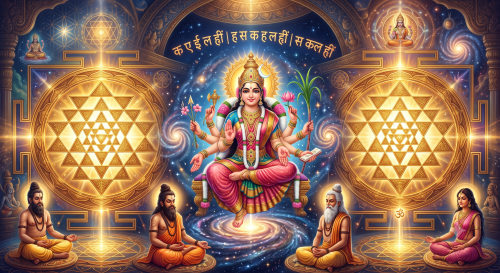
A foundational map of Sri Vidya. The Yogini Hridaya Tantra occupies a distinctive place in the Sanskrit literature of Sri Vidya, the Goddess-centered tradition devoted principally to Tripurasundari or Lalita. It does not treat sacred geometry, mantra, meditation, ritual, theology, and the human body as separate subjects. Instead, it presents them as mutually corresponding expressions of one divine reality. The Sri Chakra is the geometric body of the Goddess, mantra is her sonic body, the cosmos is her manifested body, and the practitioner’s consecrated body becomes a field in which these dimensions are recognized as one. This integrated vision explains why the text remains important to historians of Tantra, students of Hindu philosophy, and traditionally initiated practitioners of Shri Vidya Sadhana.
Yogini Hridaya and Yogini Hridaya Tantra are the same work. The titles Yogini Hridaya, Yoginīhṛdaya, and Yogini Hridaya Tantra ordinarily identify the same foundational scripture rather than three different books. Yoginīhṛdaya may be translated as “Heart of the Yogini.” In this context, hṛdaya signifies the heart, core, or innermost essence of a teaching. The added word Tantra emphasizes the work’s identity as an esoteric scripture concerned with revelation, ritual, embodied contemplation, and transmission. It does not indicate that a separate expanded edition called the Yogini Hridaya Tantra exists alongside an unrelated Yogini Hridaya.
More than a conventional textbook. Describing the work as a “textbook on Sri Vidya Sadhana” is useful if textbook means a foundational source that organizes doctrine and practice. It can be misleading, however, if it suggests a modern beginner’s manual with self-contained instructions. The Yogini Hridaya is compressed, allusive, and filled with technical vocabulary whose meanings depend upon commentarial interpretation and lineage-based explanation. It presupposes familiarity with mantra theory, the Sri Chakra, nyasa, mudra, subtle-body visualization, and the metaphysics of Shakti. It therefore functions less like an introductory workbook and more like an advanced map whose symbols become intelligible through sustained study.
Date and historical setting. The precise date of the Yogini Hridaya cannot be established with certainty. Contemporary scholarship commonly places it around the eleventh or twelfth century, although the larger Tripura tradition may have taken shape during the tenth and eleventh centuries. No autograph manuscript survives, and references to similarly titled works do not always prove that the present text existed in exactly the same form. The Oxford University Press study and translation describes it as a major medieval Sanskrit ritual and religious text of Sri Vidya while acknowledging the complex history behind its received form.
Kashmirian influence and pan-Indian transmission. The vocabulary and nondual metaphysics of the text display strong affinities with post-scriptural Kashmir Shaivism, especially traditions concerned with recognition, vibration, and reflective consciousness. This has led scholars to regard a northwestern or Kashmirian background as likely, though a southern origin cannot be completely excluded. Whatever its earliest location, Sri Vidya developed a powerful presence in South India, where Sanskrit manuscripts, ritual digests, temple traditions, monastic institutions, and household lineages preserved and reinterpreted it. The history of the Yogini Hridaya therefore demonstrates the intellectual mobility of premodern India: teachings traveled across regions and were renewed through commentary rather than confined to a single birthplace.
Its relationship to the Vamakeshvara Tantra. Traditional classifications frequently treat the Yogini Hridaya as the concluding portion of a larger textual complex associated with the Vamakeshvara Tantra and the Nityashodashikarnava, whose title evokes the “Ocean of the Sixteen Nityas.” The opening of the Yogini Hridaya itself refers back to matters left concealed in the Vamakeshvara teaching. Bhaskararaya later commented on the materials as an eight-chapter whole and explicitly regarded the Yogini Hridaya as its latter section. From this traditional perspective, the texts form complementary parts of one revealed corpus.
A necessary scholarly qualification. Textual historians have also identified reasons to treat the Yogini Hridaya and the earlier Vamakeshvara or Nityashodashikarnava material as related but originally distinct compositions. Their emphases differ, early commentators do not always cite them as a single work, and their treatment of Sri Vidya mantra traditions is not identical. One plausible reconstruction holds that the Yogini Hridaya was composed as a more philosophical, contemplative, and devotional complement to an earlier ritual corpus and was subsequently received as its concluding portion. Both descriptions are therefore meaningful: the traditional history presents an integrated scripture, while critical scholarship investigates the stages through which that integration occurred.
A dialogue of revelation. The scripture takes the form of a conversation in which Devi questions Bhairava about teachings that remain concealed, and Bhairava discloses their inner significance. This dialogical structure is characteristic of many Tantric scriptures, where divine conversation establishes authority while dramatizing the movement from partial knowledge to deeper recognition. The widely used scholarly edition contains approximately 375 stanzas, although verse totals can vary slightly among recensions and editorial systems. Its material is arranged in three major chapters called saṅketas: Cakra-saṅketa, Mantra-saṅketa, and Puja-saṅketa.
The meaning of saṅketa. The word saṅketa can suggest a sign, convention, secret agreement, encounter, or prescribed mode of practice. Each chapter is therefore more than a collection of information about a separate ritual object. The three saṅketas describe encounters with the divine through form, sound, and worship. Cakra-saṅketa addresses the Sri Chakra as manifested Shakti; Mantra-saṅketa examines the Goddess as sacred phonemic power; and Puja-saṅketa integrates geometry and mantra within consecrated action. Their sequence teaches that a diagram cannot be separated from its mantra, and neither can be understood fully apart from contemplative embodiment.
What Sri Vidya signifies. Sri Vidya may be rendered as “auspicious knowledge,” “splendid wisdom,” or the sacred knowledge of Sri. It denotes both a body of revelation and the living tradition centered on Lalita Tripurasundari. The term vidyā can also designate a Goddess-mantra, because knowledge in this tradition is not merely conceptual. It is transformative participation in divine awareness. Sri Vidya accordingly joins theology, mantra, yantra, puja, yoga, and nondual contemplation. Its goal is not simply to secure favors from a distant deity but to recognize the Goddess as the power through which the knower, the act of knowing, and the known become manifest.
Tripurasundari, the supreme Yogini. The principal deity is Tripurasundari, the “Beauty of the Three Worlds,” also revered as Lalita, Kameshvari, Mahatripurasundari, and in some contexts Shodashi. Her many names do not represent disconnected deities; they disclose different theological, ritual, and contemplative dimensions of Shakti. She is envisioned as gracious and radiant, yet she is also the sovereign power of creation, maintenance, withdrawal, concealment, and liberating disclosure. Calling her the supreme Yogini identifies her as the mistress of divine powers and their patterned manifestation, not merely as one member of a group of sixty-four Yoginis.
Why “heart” is the decisive word. The heart in the Yogini Hridaya is simultaneously doctrinal, cosmic, ritual, and experiential. It is the innermost point from which multiplicity unfolds without becoming separate from its source. This is reflected by the bindu at the center of the Sri Chakra: an apparently dimensionless point that contains the potential of the entire diagram. The title therefore directs attention beneath external forms toward their generative principle. Geometry, speech, sensory experience, time, breath, and consciousness are intelligible because they arise from a shared center. The text’s emotional power lies in this proposal that complexity need not imply fragmentation; the many can remain rooted in an undivided heart.
Shiva and Shakti as inseparable principles. The text’s metaphysics depends upon the inseparability of consciousness and its power of self-awareness. Shiva names luminous consciousness, while Shakti names its capacity to know, reflect, desire, differentiate, and act. A Shiva entirely without Shakti would be inactive abstraction; a Shakti unrelated to consciousness would be unintelligible energy. Their union is not merely a mythological marriage between two external beings. It is a philosophical account of how awareness and manifestation belong together. The Sri Chakra, mantra, and the practitioner’s body all become expressions of this indivisible polarity.
Will, knowledge, and action. Shakti is repeatedly understood through the triad of icchā, jñāna, and kriyā: will, knowledge, and action. These are not three unrelated faculties. Will inclines consciousness toward manifestation, knowledge gives differentiated form to what is intended, and action brings that form into expression. The triad provides a bridge between cosmic theology and ordinary experience. Every deliberate human act also moves through intention, understanding, and execution. This correspondence gives the text a relatable psychological depth while preserving its theological claim that finite capacities participate in universal Shakti.
The Sri Chakra as sacred geometry. The best-known visual focus of Sri Vidya is the Sri Chakra or Sri Yantra. Its core consists of nine interpenetrating primary triangles: five associated with Shakti and four associated with Shiva. Their intersections generate forty-three smaller triangles arranged around a central bindu. Lotus circles and an outer square enclosure with four openings complete the familiar two-dimensional form. The exact construction is geometrically demanding, but the text is not interested in geometry for its own sake. Each region is a theological field inhabited by powers of the Goddess and a contemplative stage through which apparent multiplicity is traced back to its center.
The nine enclosures. Sri Chakra worship organizes the diagram into nine āvaraṇas, or enclosures. These extend from the outer square through lotus petals and successive circuits of triangles to the innermost triangle and bindu. Each enclosure has its own presiding forms of Tripurasundari, attendant deities, mantras, powers, and contemplative meanings. The progression from circumference to center can represent movement from differentiated experience toward nondual recognition. Yet the center does not invalidate the outer regions. Because every enclosure proceeds from the same Shakti, ritual integration is more accurate than rejection of the world.
A dynamic cosmogram rather than a static symbol. The Cakra-saṅketa presents the Sri Chakra as an outward manifestation of the Goddess’s power that emerges from her and is eventually reabsorbed into her. Creation and dissolution are thus visualized as reciprocal movements. The adept does not merely look at a diagram placed on an altar; the adept imaginatively participates in the process by which undivided consciousness becomes cosmos and cosmos returns to its source. This makes the Sri Chakra a cosmogram, a ritual field, a map of consciousness, and a discipline of identification at the same time.
The bindu and the emergence of plurality. At the center, the bindu signifies the unified presence of Shiva and Shakti. Traditional explanations describe lunar, solar, and fiery dimensions of this generative center, while the intersecting triangles express the differentiation of creative and reabsorptive powers. From this center arise the levels of the chakra, the letters of sacred speech, the categories of manifestation, and the structures of embodied experience. The relation is not that of a craftsman standing outside a manufactured object. Cause remains present within effect, just as a single light can appear through many reflections without being divided into unrelated substances.
Macrocosm and microcosm. A governing principle of the text is correspondence between the universe and the human body. Sacred seats, phonemes, deities, planets, lunar powers, sensory faculties, and ontological principles can be contemplated both cosmically and bodily. The body is therefore not treated as an obstacle that must simply be despised or escaped. Once ritually purified and imaginatively reconstructed, it becomes a condensed universe and a legitimate site of revelation. This embodied approach distinguishes Sri Vidya from interpretations of spirituality that locate holiness only beyond material existence.
Mudra as gesture and divine power. The first chapter connects the Goddess’s creative will with ten mudras. A mudra is not merely a decorative hand position. It may be a ritual seal, a deity, a specific power of consciousness, and the embodied gesture through which that power is made present. The ten mudras correspond to regions of the Sri Chakra and to stages in the adept’s movement from ordinary experience toward identification with the godhead. Hand, mind, mantra, and visualization must therefore converge. A gesture without its contemplative meaning would preserve the outer shape while losing the function the text assigns to it.
Mantra as the sonic body of the Goddess. The Mantra-saṅketa rejects the assumption that a mantra is simply a sentence whose value lies in dictionary meaning. Sacred syllables are treated as concentrated forms of Shakti. Their sequence, grouping, resonance, deity associations, and placement within the body form an interconnected system. The mantra signifies the Goddess while also being her audible or mentally apprehended presence. Recitation is consequently joined to visualization, breath, attention, and identification. Sound becomes a method through which consciousness recognizes its own power of manifestation.
Panchadashi, Shodashi, and textual precision. Sri Vidya traditions are widely associated with a fifteen-syllable mantra called Panchadashi and with sixteen-syllable forms called Shodashi. The Yogini Hridaya’s mantra chapter analyzes a fifteen-syllable vidya arranged in three clusters or kūṭas, while broader Sri Vidya theology also gives special significance to the sixteenth lunar power. This explains why descriptions of the tradition sometimes speak of fifteen syllables and sometimes of sixteen. The numbers need not be treated as a simple contradiction: they refer to related but distinct ritual and lineage configurations.
Kadi and Hadi lineages. Popular introductions sometimes classify the Yogini Hridaya under the Kadi current because Kadi practice became especially prominent in later Sri Vidya. The modern scholarly translation, however, identifies the mantra presupposed by the received Yogini Hridaya as a Hadi form, while the related Vamakeshvara or Nityashodashikarnava material gives a Kadi form. The distinction is named after the initial phoneme of the relevant mantra sequence. Rather than publishing restricted formulas, a responsible account notes that this variation is important for textual history and for understanding why lineage commentaries do not always interpret the corpus identically.
Six levels of mantra interpretation. The mantra chapter analyzes the vidya through six meanings: bhāvārtha, the natural or essential meaning; sampradāyārtha, the meaning transmitted through tradition; nigarbhārtha, the inner meaning; kaulikārtha, the Kaula meaning; sarvarahasyārtha, the completely secret meaning; and mahātattvārtha, the meaning according to the highest reality. These are not six competing translations of one sentence. They are nested interpretive procedures that correlate phonemes with deities, elements, senses, cosmic processes, bodily locations, and levels of consciousness.
Sacred speech and the structure of reality. The Yogini Hridaya treats the Sanskrit phonemic matrix as a model of manifestation. Speech proceeds from subtle, undifferentiated potential toward articulated sound, just as consciousness appears as increasingly determinate forms. Letters are therefore not arbitrary tokens pasted onto a previously completed universe. Within the text’s theological framework, they are powers through which differentiation becomes intelligible. The mantra condenses this process, and meditative analysis reverses it by tracing articulated sound toward subtler awareness. This is a religious theory of language rather than a claim about modern acoustic physics or historical linguistics.
The identity of deity, mantra, chakra, and self. A central insight of Sri Vidya is that Tripurasundari, her mantra, the Sri Chakra, the cosmos, the guru, and the deepest self cannot ultimately be isolated from one another. They remain distinguishable at the level of ritual procedure, but contemplation discloses their shared ground. The diagram gives form to what mantra expresses as sound; nyasa establishes the same powers in the body; puja relates them through consecrated action; and knowledge recognizes their unity. The result is a disciplined nondualism in which plurality is preserved as meaningful expression rather than dismissed as mere error.
Puja in three dimensions. The third and longest section, Puja-saṅketa, discusses worship through the categories para, parāpara, and apara. These can be understood as supreme, intermediate, and more externally articulated modes. At the highest level stands identity with the absolute; at the intermediate level, contemplative visualization or bhāvanā; and at the externally expressed level, formal ritual worship. The three are not mutually hostile. External action is deepened by visualization, and visualization is fulfilled in recognition of the divine reality it presents.
Nyasa and the consecrated body. Nyasa literally involves placing or depositing. In Tantric ritual, mantras, phonemes, and deities are ritually placed on parts of the body through touch, gesture, recitation, and visualization. The Yogini Hridaya describes elaborate correspondences involving Ganeshas, planets, lunar constellations, Yoginis associated with bodily constituents, zodiacal divisions, sacred seats, and the enclosures of the Sri Chakra. The aim is not to pretend that an anatomical body literally contains astronomical objects. Nyasa constructs a ritual body in which cosmic order is recognized through embodied awareness.
From the outer enclosure to the center. In Sri Chakra puja, the deities of the diagram are mentally installed and worshipped in an ordered progression from the outer regions toward the bindu. Offerings, mantras, mudras, visualization, and meditative identification coordinate the journey. No single act carries the entire meaning. The sequence gradually transforms the practitioner’s relation to space, body, language, and deity. What begins as worship directed toward a sacred diagram becomes the recognition that worshipper, worship, and worshipped arise within one field of Shakti.
External worship and internal worship. The text’s ritual world should not be reduced either to physical ceremony or to private psychology. An externally drawn Sri Chakra provides a stable field for precision, lineage memory, and communal continuity. Internal visualization renders that field present within consciousness and the subtle body. The two modes can support one another. The diagram disciplines imagination, while contemplation prevents the diagram from becoming an inert object. This relationship helps explain why Sri Vidya can sustain temple, household, monastic, and meditative forms without requiring them to be identical.
Kundalini, breath, and subtle embodiment. The worship chapter incorporates Kundalini-oriented visualization, subtle centers, breath, mantra recitation, and the ascent of power through the contemplative body. These passages should not be mistaken for a generic modern manual of seven-chakra wellness. Their meanings belong to a specific Sri Vidya ritual grammar in which phonemes, lunar powers, sacred seats, and Sri Chakra enclosures are coordinated. The body being described is partly physiological but fundamentally ritual and imaginal. Its categories should therefore be interpreted within the text’s own symbolic system rather than converted into unsupported medical claims.
The indispensable role of initiation. The scripture repeatedly presents its deepest teaching as something received orally and transmitted with discrimination. Traditional Sri Vidya distinguishes academic access to a text from ritual authorization to perform a practice. Initiation, or diksha, places mantra and procedure within a living chain of responsibility, while the guru evaluates the student’s adhikāra, or preparedness. This principle is not a rejection of scholarship. It recognizes that reading about a complex ritual does not by itself provide the pronunciation, sequencing, corrections, ethical formation, or contextual judgment required for competent performance.
Secrecy as disciplined transmission. Esoteric language can tempt readers toward either sensationalism or suspicion. In the Yogini Hridaya, concealment serves several functions: it preserves lineage integrity, prevents decontextualized use, marks the progressive nature of instruction, and communicates that realization cannot be reduced to publicly circulated formulas. Secrecy has also had social and historical consequences that deserve critical study, but it need not be romanticized as evidence of supernatural danger. A balanced approach respects traditional boundaries without turning them into fear-based claims.
Siddhi, enjoyment, and liberation. Like many Tantric scriptures, the Yogini Hridaya attributes both extraordinary powers and liberation to accomplished practice. These claims belong to the text’s religious worldview and should be reported as such rather than presented as experimentally verified promises. More philosophically, the tradition coordinates bhukti, meaningful participation in embodied life, with mukti, freedom from limiting identification. Its highest aspiration is liberation while living, achieved through recognition of the non-separation of consciousness and Shakti. Worldly efficacy is therefore subordinated to a transformation in how self and cosmos are understood.
Amritananda’s Dipika. The Yogini Hridaya is difficult to interpret without its commentarial tradition. The earlier major commentary is the Dipika, or “Lamp,” attributed to Amritananda, probably of the thirteenth or fourteenth century. It reads the text through concepts associated with nondual Shaiva philosophy and helps connect its compressed verses to a wider metaphysical system. The commentary does more than define unusual words. It determines correspondences, resolves syntactic ambiguity, and shows how ritual statements can carry contemplative meanings. Any academic study should therefore distinguish the base scripture from the interpretations supplied by the Dipika.
Bhaskararaya’s Setubandha. Bhaskararaya, the influential eighteenth-century Sri Vidya scholar and practitioner, composed the Setubandha as a commentary on the larger Vamakeshvara–Yogini Hridaya corpus. Traditionally dated to 1733, it treats the materials as a unified work and became an important bridge between scripture, ritual analysis, and later practice. Its title appropriately suggests the building of a bridge. The Setubandha clarifies many difficult passages while also representing a historically later interpretive horizon. Amritananda and Bhaskararaya should thus be studied as authoritative commentators whose readings illuminate, but do not simply duplicate, the earlier text.
Manuscripts and printed editions. The Yogini Hridaya survives through a manuscript culture distributed across India rather than through a single uncontested original. The Institut Français de Pondichéry manuscript catalogue records the work under its related titles, illustrating the bibliographic overlap among Yoginīhṛdaya, Nityāṣoḍaśikārṇava, and Vāmakeśvaratantra. Printed Sanskrit editions have often included the Dipika and Setubandha, allowing readers to encounter scripture and commentary together. That arrangement is valuable, but it can also make it easy to attribute a commentator’s explanation directly to the root verses.
The modern English translation. André Padoux and Roger-Orphé Jeanty published The Heart of the Yogini: The Yoginīhṛdaya, a Sanskrit Tantric Treatise with Oxford University Press in 2013. It provides an English translation, introduction, explanatory material, glossary, notes, and bibliography. Its chapter organization as “Encounter in the Cakra,” “Encounter in the Mantra,” and “Encounter in the Worship” captures the experiential force of saṅketa. The volume is especially useful because it combines philological analysis with awareness of Sri Vidya practice while openly acknowledging passages whose symbolic constructions remain difficult or uncertain.
Why editions sometimes disagree. Differences in verse totals, mantra classification, spelling, chapter boundaries, and the relationship among associated titles do not automatically show that one source is fraudulent. Premodern Sanskrit texts were copied, reorganized, glossed, and transmitted through regional and lineage networks. A responsible reading asks which manuscript family, printed edition, commentary, and ritual tradition supports a particular statement. Where evidence remains inconclusive, phrases such as “traditionally regarded,” “the received text indicates,” or “modern scholarship proposes” are more accurate than absolute claims.
How the scripture should be read. A productive academic reading begins by separating four layers: the Sanskrit root text, early commentary, later ritual interpretation, and modern explanation. Technical terms should be studied within the paragraph and ritual sequence in which they occur rather than translated through isolated dictionary definitions. The Sri Chakra should be examined simultaneously as geometry, pantheon, cosmology, body map, and contemplative process. Mantra discussions require similar care, since phonemic analysis, deity identification, and meditative use operate together. This layered method prevents both devotional oversimplification and reductive dismissal.
What the text is not. The Yogini Hridaya is not merely a book about drawing the Sri Yantra, a collection of magical formulas, a manual of modern energy healing, or a philosophical essay detached from ritual. It is also not evidence that every practice marketed under the name Tantra belongs to an ancient and continuous system. Its world is technically precise, lineage-conscious, and rooted in medieval Sanskrit categories. Appreciating that specificity makes the scripture more compelling, because its synthesis of form, sound, body, and consciousness is richer than popular stereotypes of Tantra.
Not to be confused with the Yogini Tantra. The Yogini Hridaya Tantra is distinct from the work commonly called the Yogini Tantra, a later northeastern Indian scripture associated especially with Kali and Kamakhya. Similar titles can easily produce mistaken search results, cataloguing errors, or blended summaries. The Yogini Hridaya belongs specifically to the Tripurasundari-centered Sri Vidya corpus and is structured around Sri Chakra, mantra, and puja. The distinction is essential for students seeking reliable editions or historical information.
The Sacred Feminine without a simplistic gender binary. The theological elevation of Tripurasundari gives the Yogini Hridaya exceptional importance for the study of Goddess traditions. Yet Shakti should not be reduced to a symbolic synonym for biological womanhood, nor Shiva to biological manhood. They are divine principles whose polarity explains consciousness and manifestation. At the same time, the text’s female-centered pantheon and its recognition of a Goddess as cosmic sovereignty challenge religious models in which feminine divinity remains secondary. Both its metaphysical symbolism and its historical social setting deserve attention.
A surprisingly contemporary intellectual insight. Modern readers commonly separate language from matter, mind from body, symbol from reality, and contemplation from action. The Yogini Hridaya offers a radically integrated alternative. A line, syllable, gesture, breath, deity, and mental image can participate in the same ordered field when joined through disciplined awareness. Even readers who do not accept the scripture’s theological premises can recognize the sophistication of this model. It asks how knowledge changes when ideas are not only understood intellectually but also visualized, sounded, enacted, and embodied.
Continuity in living Sri Vidya. Sri Vidya remains a living tradition rather than only an archival subject. It continues in Indian and Nepalese lineages, temples, households, monastic networks, and communities beyond South Asia. Contemporary practice is diverse: some lineages emphasize formal Navavarana puja, others contemplative interiorization, Vedic integration, devotional recitation, or philosophical study. Ethnographic research on modern Sri Vidya, including the open-access study “The Experience of Srividya at Devipuram”, shows how textual authority, guru transmission, new media, community life, and personal religious experience interact in the present.
Respectful dialogue among Dharmic traditions. The Yogini Hridaya is specifically a Shakta–Shaiva scripture and should not be made artificially identical with Buddhist, Jain, or Sikh teachings. Genuine unity does not require erasing difference. Hindu and Buddhist Tantric traditions share historically significant interests in mantra, mandala, initiation, and transformed embodiment, although their doctrines and ritual systems remain distinct. Jain and Sikh traditions offer their own disciplined approaches to knowledge, ethical conduct, devotion, and liberation. Comparative study becomes fruitful when shared concerns are acknowledged alongside irreducible differences, allowing Dharmic traditions to meet through respect rather than appropriation.
Ethics before technique. The text’s complexity makes humility an intellectual and spiritual requirement. Sacred language should not be commercialized as a guaranteed solution for wealth, health, control over others, or instant awakening. Historical claims should be distinguished from devotional memory, and traditional claims should not be mocked simply because they arise from a different epistemology. For practitioners, lineage guidance and ethical self-discipline protect the integrity of sadhana. For scholars, careful citation and attention to textual variation perform a comparable function.
A sound path for further study. A serious student can begin with the historical introduction and structural overview before approaching the three saṅketas in order. Familiarity with Tripurasundari theology, the nine enclosures of the Sri Chakra, basic mantra theory, nyasa, and nondual Shaiva vocabulary will make the verses more intelligible. The Dipika and Setubandha should then be compared with a modern annotated translation. Academic readers can study these materials openly, while anyone intending to perform restricted mantra, nyasa, or Navavarana procedures should seek instruction from a qualified Sri Vidya lineage rather than reconstructing practice from fragments online.
Its enduring value as a guide. The Yogini Hridaya Tantra can rightly be called an essential guide to Sri Vidya Sadhana when its genre is understood. It does not replace a guru, initiation, commentary, or patient study. Its deeper achievement is to reveal the architecture that makes those practices coherent. Chakra supplies the geometry of manifestation, mantra supplies its vibratory language, and puja transforms both into embodied recognition. Together they present Tripurasundari not as an object confined to an image but as the living unity of consciousness, power, cosmos, and self.
Conclusion. The Yogini Hridaya is compelling because it turns the idea of a sacred “heart” into a complete philosophical and ritual system. From the bindu emerge triangles, enclosures, deities, letters, worlds, and bodies; through disciplined worship, those differentiated forms are contemplated again in relation to their source. Its teaching is simultaneously devotional and analytical, geometric and sonic, cosmic and intimate. Read with historical care and respect for traditional transmission, it stands as one of the most sophisticated surviving witnesses to Sri Vidya, Shakti worship, and the wider intellectual heritage of Hindu Tantra.
Inspired by this post on Hindu Pad.



Leave a Reply
You must be logged in to post a comment.