
The question at the heart of the Kanwar Yatra
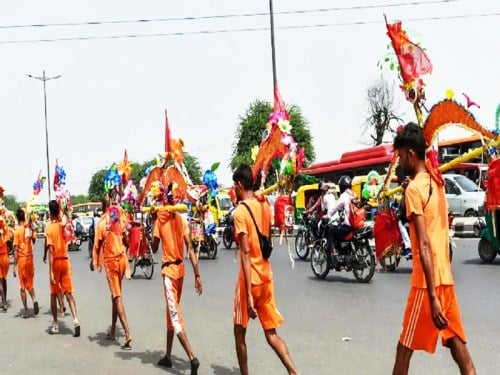
Before sunrise in Sultanganj, the banks of the Ganga begin to fill with pilgrims dressed predominantly in saffron. Each Kanwariya approaches the river with a purpose: to collect Gangajal, suspend the filled vessels from a kanwar, and carry the sacred water on foot to Baba Baidyanath Dham at Deoghar. The physical scene is striking, but its meaning cannot be reduced to spectacle. Every careful step links a river, a Jyotirlinga, a sacred month, a demanding vow, and several layers of Hindu memory.
The direct answer is that Kanwariyas offer Gangajal at Deoghar Babadham during Shravan because the act unites three devotional ideas. Water is a principal substance used in the abhisheka, or ritual bathing, of a Shiva linga; the Ganga is revered as an exceptionally sacred and purifying river closely associated with Shiva; and Shravan is traditionally regarded as a particularly auspicious period for Shiva worship. The Sultanganj-to-Deoghar pilgrimage gives these ideas an embodied form: the offering is not merely obtained but carried through sustained effort.
Kanwar, Kanwariya, Gangajal, and jalabhishek
A kanwar is a carrying frame, conventionally made around a bamboo pole, with water vessels suspended from its two ends. A person undertaking the vow is commonly called a Kanwariya, Kanwaria, or Kanvar pilgrim. Gangajal literally denotes water from the Ganga, while jalabhishek refers to the ceremonial pouring of water over a consecrated deity, especially a Shiva linga in this context. Together, these terms describe a complete ritual process: collection, protected transportation, disciplined walking, and final offering.
Why the destination is Baba Baidyanath Dham
Deoghar, also called Babadham or Baidyanath Dham, is one of eastern India’s most important centres of Shiva worship. Its principal shrine houses the linga revered at Deoghar as one of the twelve Jyotirlingas. The complex contains 22 temples, and the main Baidyanath shrine rises approximately 72 feet, according to Jharkhand Tourism’s account of Baidyanath Dham. For devotees, the site is not simply a temple at the end of a road. It is the sacred destination that gives the water-bearing vow its direction and completion.
The sacred corridor from Sultanganj to Deoghar
The pilgrimage begins at Sultanganj in Bihar and concludes at Deoghar in Jharkhand. Government descriptions use slightly different measurements: Sultanganj is commonly stated to be about 105 kilometres from Babadham, while the walked pilgrimage route is also reported as approximately 109 kilometres. These figures are not necessarily contradictory. Distances vary with the selected ghat, the route followed, administrative diversions, and the points chosen as the beginning and end of measurement. The essential fact is that Kanwariyas carry the water for roughly a hundred kilometres across an inter-state sacred corridor. The route and customary sequence are documented by the Government of India’s Shravani Mela account.
Why Gangajal is collected at Sultanganj
Sultanganj is ritually distinctive because the Ganga flows northward there, a condition described as Uttarvahini and considered especially auspicious in Hindu sacred geography. Ordinarily, the river’s broad movement is toward the east and southeast, so a visibly north-flowing reach acquires special religious significance. Sultanganj is also associated with Ajgaibinath, an established centre of Shiva devotion. Collecting water there therefore joins a revered river orientation, a Shaiva pilgrimage town, and the traditional road to Baidyanath Dham.
The kanwar as ritual object and practical technology
The kanwar is both sacred equipment and a simple load-balancing system. Two vessels of approximately equal mass hang on opposite sides of a flexible pole. When the loads and suspension lengths are reasonably balanced, rotational force around the carrier’s shoulder is reduced and the water can be transported more steadily. The flexibility of bamboo absorbs part of the motion created by walking, although it does not remove the considerable strain placed on the shoulders, feet, and back. Decoration transforms this practical yoke into a visible expression of devotion, group identity, and personal vow.
Many Kanwariyas observe rules intended to preserve the sanctity of the water and the seriousness of the undertaking. Common disciplines include bathing before collection, keeping the vessels protected, eating simple vegetarian food, abstaining from intoxicants, walking barefoot, maintaining personal restraint, and preventing the kanwar from touching the bare ground. Stands are used when the load must be set down. Customs differ among families, regional groups, gurus, and categories of Kanwariyas, so no single list should be presented as universal.
Why Shravan is central to the observance
Shravan is a month of the Hindu lunisolar calendar that generally overlaps July and August. Its exact civil dates vary by year and by regional calendar convention, including differences between systems that begin the lunar month after the full moon and those that begin it after the new moon. Across many regions, however, Shravan is strongly associated with Shiva worship, fasting, temple visits, jalabhishek, and special observance on Mondays. The Deoghar pilgrimage expands these household and temple practices into a month-long public movement known as the Shravani Mela.
The monsoon setting also contributes to the month’s symbolic atmosphere. Rain restores rivers, fields, and vegetation after intense summer heat. Within ritual interpretation, water consequently suggests cooling, renewal, fertility, purification, and life itself. The connection between Shravan, water, and Shiva is therefore calendrical, theological, environmental, and experiential at the same time.
Why water is poured over a Shiva linga
Abhisheka is an established form of Hindu consecration and worship in which water or other permitted substances are poured over a sacred image. In Shiva worship, the continuous movement of water across the linga can signify purification, surrender, the calming of inner turbulence, and the return of individual intention to a larger sacred reality. The rite is not merely the transfer of a liquid from one vessel to another. Through mantra, sankalpa, bodily discipline, and offering, ordinary material is placed within a structured relationship between devotee and deity.
Gangajal carries an additional layer of significance. The Ganga is revered as a divine river whose water connects earthly geography with cosmic and ancestral memory. Shiva is closely associated with the river in the celebrated account of its descent, in which he receives its tremendous force in his matted locks before allowing it to reach the earth in a moderated flow. Offering Ganga water to Shiva consequently returns a sacred substance to the deity who receives, regulates, and releases it for the welfare of the world.
Samudra Manthana and the name Neelkantha
One of the principal devotional explanations for the Shravan offering comes from Samudra Manthana, the churning of the cosmic ocean. Devas and asuras churned the ocean in pursuit of amrita, the nectar of immortality. Before the desired nectar appeared, the process released Halahala, an overwhelmingly destructive poison. Faced with a danger that threatened living beings, the divine participants sought Shiva’s protection. Shiva drank the poison as an act of cosmic compassion, preventing it from spreading through creation.
The episode is narrated in Puranic literature, including the Bhagavata Purana, Canto 8, Chapter 7. It is more accurate to say that the churning produced various substances, beings, and treasures than to describe all of them as rubies. Popular retellings often enumerate fourteen ratnas, or treasures, but their lists vary, and Halahala is a lethal poison rather than a jewel. This distinction preserves the force of the tradition while avoiding an imprecise literal translation.
Widely repeated devotional interpretations add that sacred water was offered to cool or soothe Shiva after he consumed the poison. Some versions connect the cooling action with the Ganga and the crescent moon visible in Shiva’s iconography. The offering of Gangajal during Shravan is consequently understood as a ritual re-enactment of gratitude: Shiva protects creation from the poison, and the devotees respond with water, reverence, and remembrance.
An academic distinction is useful here. The Puranic narrative clearly establishes the emergence of Halahala, the appeal to Shiva, and his compassionate consumption of the poison. The more specific claim that the modern Sultanganj-to-Deoghar Kanwar Yatra began immediately when other deities poured Ganga water on him belongs to later devotional explanation and regional tradition. The two layers need not be treated as adversaries. Scripture supplies the theological event, while living tradition translates its meaning into an annually repeated bodily practice.
Shiva’s epithet Neelkantha, the blue-throated one, expresses the same moral theme. In common retellings, the poison is contained in his throat rather than allowed to enter and destroy his body or be expelled into the world. Symbolically, the image presents a disciplined response to danger: destructive power is confronted, contained, and transformed without being passed onward. The pilgrim’s cooling water becomes a gesture of gratitude toward that protective restraint.
The regional tradition concerning Lord Rama
A second explanation places the origin of the custom in Treta Yuga, the second of the four yugas in traditional Hindu cosmology and sometimes loosely rendered in English as the Silver Age. According to a regional devotional account, Lord Rama carried Ganga water from Sultanganj in a kanwar and offered it to Lord Shiva at Babadham. This tradition gives the journey the authority of Rama’s exemplary devotion and presents Shiva worship as fully harmonious with reverence for Vishnu’s avatara.
The Rama account should be described carefully as sacred tradition rather than as an event established by modern chronological evidence. Sacred history locates meaning within cosmic time, exemplary action, and inherited memory; academic history asks for datable texts, inscriptions, material remains, and contemporaneous records. These methods answer different questions. A respectful account can preserve the tradition exactly as devotees understand it while remaining transparent about the type of evidence available.
How the Rama and Ravana traditions relate to Deoghar
Baidyanath Dham is also associated with a prominent legend concerning Ravana. In its many regional versions, Ravana performs austerities to Shiva and seeks to carry a powerful linga to Lanka, but the linga is placed on the ground before the journey is completed and becomes permanently established at the site associated with Deoghar. This narrative primarily explains the presence and immovability of the linga, whereas the Rama tradition explains the exemplary carrying and offering of Gangajal. The stories occupy different roles within the same sacred geography and should not be collapsed into a single episode.
What Kanwariyas do during the pilgrimage
The customary sequence begins with bathing and collecting Ganga water at Sultanganj. The vessels are secured to the kanwar, and the pilgrim makes a sankalpa, or solemn intention, associated with the journey. Kanwariyas then proceed along the designated route toward Deoghar, frequently walking barefoot and travelling in family, village, or friendship groups. Many ordinary pilgrims complete the distance over several days, while some categories, including fast-moving Dak Bams, follow stricter schedules and distinct practices.
The walk converts devotion into measurable effort. Heat, monsoon rain, wet roads, blisters, crowded resting places, disturbed sleep, and the repeated lifting of the load all test the original intention. A first-time pilgrim may begin with excitement but discover that the deeper experience lies in maintaining patience when the novelty has disappeared. At that point, the kanwar is no longer merely an object on the shoulder; it becomes a continuous reminder of the vow.
The chant “Bol Bam” is one of the route’s defining sounds. Devotionally, Bam invokes Shiva; socially, the repeated call identifies the travelling community and can help groups sustain rhythm and morale. The chant turns an otherwise dispersed crowd into a recognisable ritual body. Anthropological treatments, such as Ruma Bose’s Walking with Pilgrims, examine how the journey combines religious motivation with everyday relationships, personal agency, rural life, and changing social conditions.
On reaching Babadham, Kanwariyas traditionally bathe in Shivganga before entering the Baba Baidyanath Temple and offering the carried Gangajal to the Jyotirlinga. Crowd-management procedures may affect the exact route, queue, access point, and permitted objects during a particular Shravani Mela. The enduring ritual structure nevertheless remains clear: water is collected at the Ganga, guarded through the journey, and poured in jalabhishek at its vowed destination.
What the offering means to an individual pilgrim
Kanwariyas undertake the yatra for many reasons. Some express gratitude after recovery from illness or the resolution of a family difficulty. Some pray for courage, livelihood, marriage, children, or the welfare of relatives. Others seek penance, self-discipline, continuity with family custom, or an experience of Shiva’s presence. The public appearance of the pilgrimage is collective, but the sankalpa may be intensely personal and known only to the pilgrim and the deity.
The act should not be interpreted as a simple commercial exchange in which physical hardship automatically purchases a desired result. At its most developed theological level, the vow changes the person making it. Carrying the water requires restraint, cooperation, attention, and humility. The pilgrim reaches Deoghar with the same water collected at Sultanganj, but ideally not with exactly the same inner disposition with which the journey began.
A three-level interpretation of the ritual
The Gangajal offering can be analysed on three connected levels. At the material level, a human body transports river water in balanced vessels across a long distance and pours it over a stone linga. At the social level, families, volunteers, priests, governments, transport systems, medical workers, vendors, and local residents sustain a temporary pilgrimage network. At the cosmological level, Ganga, Shiva, Shravan, Samudra Manthana, Rama, and Baidyanath Dham are brought into one meaningful sequence. The power of the Kanwar Yatra lies in the simultaneous operation of all three.
Sacred geography made visible
The route transforms geography into relationship. Sultanganj is not merely the point where water is available, and Deoghar is not merely a destination selected for administrative convenience. The Ganga in Bihar and the Jyotirlinga in Jharkhand become ritually connected by the Kanwariya’s body. Each completed journey redraws that connection, creating a moving sacred line across villages, towns, fields, roads, and state boundaries.
This movement also explains the emotional force of arrival. After days of protecting the vessels, the moment of jalabhishek is brief. Its brevity does not diminish its importance; it concentrates the entire road into a single action. The water that has remained physically above the pilgrim’s shoulder is finally released over the linga. Fatigue, hope, gratitude, and memory converge in that pour.
Shravani Mela as a social institution
During Shravan, the individual vow becomes the Shravani Mela, a large and extended religious gathering. Official accounts describe enormous flows of pilgrims and a continuous saffron-clad presence along the route. Temporary accommodation, drinking-water points, toilets, medical assistance, security arrangements, lighting, information services, traffic controls, and kanwar stands are required to support the movement. The mela is therefore both a devotional event and a complex exercise in public health, logistics, crowd management, and inter-state coordination.
Informal service is equally important. Residents, charitable groups, and volunteers provide rest, food, water, directions, and practical help. Such seva changes the social meaning of the route: people who are not carrying kanwars can still participate by caring for those who are. The pilgrimage is consequently produced through reciprocal roles—some walk, some host, some heal, some clean, and some maintain order.
The mela also supports transport providers, small traders, craftspeople, food sellers, and seasonal workers. This economic activity should be recognised without reducing the pilgrimage to commerce. Sacred gatherings have always required material systems. The academic question is not whether devotion or economy is present, but how religious purpose, livelihood, public administration, and local culture interact without allowing exploitation or unsafe practices to overwhelm the vow.
A shared dharmic ethic without erasing differences
The Kanwar Yatra is specifically a Shaiva Hindu pilgrimage, and its distinctive theology should be represented accurately. At the same time, its highest public values—self-restraint, non-harm, compassion, service, care for water, and respect for fellow travellers—resonate with ethical teachings found across Hindu, Buddhist, Jain, and Sikh traditions. Dharmic unity does not require traditions to become identical. It is strengthened when each path retains its integrity while encouraging humility, responsibility, and peaceful cooperation.
The image of Neelkantha is especially relevant to this shared ethic. Shiva accepts danger to protect living beings rather than directing harm toward rivals. A pilgrimage inspired by that image reaches its fullest meaning when strength is expressed through patience, not intimidation; when public roads are used with consideration; and when devotion protects vulnerable people, animals, and the environment.
Environmental responsibility is part of reverence
If Ganga water is treated as sacred, the river and pilgrimage route cannot be treated as disposable. Plastic decorations, discarded food containers, ritual waste, and unmanaged sanitation can impose serious costs on waterways and host communities. Environmentally responsible Kanwar practice favours reusable materials, designated waste collection, clean resting areas, lawful disposal of offerings, and protection of local water sources. Cleanliness is not an external modern demand added to devotion; it is a practical expression of reverence for the sacred substance being carried.
Discipline must include health and public safety
The physical demands of a hundred-kilometre monsoon walk should not be romanticised. Dehydration, heat stress, infection, falls, foot injuries, traffic exposure, exhaustion, and crowd pressure are real risks. Responsible pilgrims prepare gradually, use safe drinking water, attend promptly to wounds, rest when medically necessary, and follow official route and queue instructions. People with significant health conditions require appropriate medical advice before attempting an austere form of the journey. Seeking help does not invalidate devotion; protecting life is consistent with the compassionate meaning attributed to Shiva’s act.
Tradition, legend, and history can be discussed together
A comprehensive explanation should neither dismiss inherited narratives nor present every devotional detail as a modern historical fact. The Samudra Manthana episode belongs to an identifiable Puranic textual tradition. The cooling-water explanation and the account of Rama carrying Gangajal to Babadham function as living devotional traditions. The present Sultanganj-Deoghar route is an observable and administratively documented pilgrimage practice. Distinguishing these categories makes the account more accurate while preserving the religious meaning of each layer.
Why the offering continues to matter
Kanwariyas offer Gangajal at Deoghar in Shravan because the ritual joins sacred water with sacred effort. It remembers Shiva as Neelkantha, honours Ganga as a purifying river, preserves the regional memory of Rama’s devotion, and directs the offering toward Baba Baidyanath’s Jyotirlinga. The walk turns belief into discipline, the route turns landscape into pilgrimage, and jalabhishek turns a long private vow into one concentrated act of surrender.
The most enduring insight appears at the journey’s end. Gangajal is abundant at Sultanganj, yet the offering at Deoghar is precious because it has been carried with attention. The pilgrimage teaches that devotion is measured not only by what is offered but also by the responsibility, restraint, compassion, and perseverance with which it reaches its destination.
Research note: This account expands and critically clarifies the tradition presented by HinduPad. Route, temple, and Shravani Mela details were checked against publications from District Deoghar, Jharkhand Tourism, and the Government of India’s Ministry of Tourism. Puranic narrative, regional sacred history, modern administrative description, and interpretive analysis have been identified separately to avoid presenting unlike forms of evidence as interchangeable.
Inspired by this post on Hindu Pad.





Leave a Reply
You must be logged in to post a comment.