

Budh Pujan in Shravan 2026 at a glance: The schedule supplied for this observance records five Wednesday civil dates: 12 August, 19 August, 26 August, 2 September and 9 September 2026. All five dates fall on Budhwar. However, the first date requires a calendar qualification: in the sunrise-based Marathi Amanta reckoning, the unambiguous Shravan Wednesdays are 19 August, 26 August, 2 September and 9 September. The night of 12 August is transitional because the lunar month begins late that evening in commonly consulted Maharashtra almanacs.
This distinction is more than a technical footnote. Hindu observances are determined through a panchang, in which the lunar month, tithi, weekday, sunrise and location all matter. A Gregorian date can therefore be correct in one regional convention yet misleading in another. A family or temple that explicitly lists 12 August for Budh Pujan may retain it, especially if its tradition recognizes the late-night beginning of Shravan; a sunrise-based household calendar in Maharashtra will ordinarily begin the weekly sequence on 19 August.
What Budh Pujan means: Budh Pujan is a vrata, or disciplined religious observance, dedicated to Budha, the Navagraha deity corresponding to Mercury. It is performed on Budhwar, the weekday associated with Budha, and acquires additional devotional importance when Wednesday occurs during Shravan. The observance is especially familiar in Maharashtra and is also maintained by communities in parts of Karnataka and Gujarat. Its form may range from a brief household prayer to a fuller Navagraha puja conducted in a temple.
Shravan is a major season of vrata, worship, pilgrimage, scriptural recitation and dietary discipline. In Maharashtrian practice, different weekdays may be associated with different forms of devotion: Monday with Shiva, Tuesday with Mangala Gauri and Wednesday with Budha, followed by other customary weekday observances. This pattern turns the lunar month into a sustained spiritual rhythm rather than a collection of isolated festival dates. The repetition can give each week a deliberate pause for prayer, ethical reflection and family participation.
Why the 2026 dates need careful reading: Maharashtra generally follows the Amanta lunar calendar, in which a month concludes with Amavasya. Much of North India follows the Purnimanta system, in which the named month concludes with Purnima. The two systems share the same lunar phases but assign the month name differently during part of the cycle. This is why Shravan can begin about fifteen days earlier in a North Indian calendar than in a Marathi calendar.
A location-specific 2026 panchang comparison for Nagpur places Amanta Shravan from 13 August through 11 September for Maharashtra, Gujarat, Karnataka, Goa, Andhra Pradesh, Telangana and Tamil Nadu. It also explains that the ritual day in the panchang is generally reckoned from sunrise. A separate Marathi Shravan calendar gives the same civil-date span and places the lunar beginning at approximately 11:07 p.m. on 12 August, subject to location-specific calculation.
2026 date schedule supplied with the observance: Wednesday, 12 August 2026 is the transitional date printed in the supplied schedule; Wednesday, 19 August is the first full Wednesday after the Marathi Shravan sunrise boundary; Wednesday, 26 August is the second; Wednesday, 2 September is the third; and Wednesday, 9 September is the fourth and final full Shravan Wednesday before the month ends on 11 September.
The practical calendar conclusion: Households following a conventional Maharashtra sunrise-based panchang can confidently plan Budh Pujan for 19 August, 26 August, 2 September and 9 September 2026. The additional 12 August observance should be followed only when the family, temple or chosen almanac expressly includes the late-night transition. This approach preserves the supplied five-date tradition without presenting a transitional civil date as universally binding.
North Indian dates should not be copied from the Marathi sequence. In the Purnimanta calendar, Shravan 2026 extends from 30 July to 28 August; its Wednesdays are 5 August, 12 August, 19 August and 26 August. The difference does not imply that one calendar is more authentic than another. It reflects longstanding regional methods of naming the same lunar cycle.
How a date should be verified: The most reliable workflow is to select the city where the puja will occur, confirm whether the household follows Amanta or Purnimanta reckoning, check the local sunrise and lunar-month boundary, and then compare the result with the family sampradaya or temple calendar. A panchang prepared for Mumbai, Toronto, Bengaluru or Ahmedabad may show different clock times even when the civil date remains unchanged. Travelers and members of the diaspora should therefore use the location of worship rather than automatically applying Indian Standard Time.
Budha within the Navagraha tradition: Navagraha means a sacred grouping of nine celestial influencers: Surya, Chandra, Mangala, Budha, Brihaspati, Shukra, Shani, Rahu and Ketu. The grouping is not identical to the modern astronomical list of planets because it includes the Sun and Moon as well as Rahu and Ketu, the ascending and descending lunar nodes. An IIT Bombay resource on Hindu iconography documents both the traditional grouping and the varied placement of Navagraha figures in Indian temples.
The religious figure Budha and the physical planet Mercury belong to related but distinct explanatory frameworks. In astronomy, Mercury is the smallest planet and the planet nearest the Sun, completing an orbit in approximately 88 Earth days. In Jyotisha and ritual culture, Budha is a graha associated symbolically with intellect, language, calculation, adaptability, exchange and commerce. Astronomical measurements describe a physical world, whereas puja expresses a theological and cultural relationship with sacred time.
Budha is not Gautama Buddha: The planetary deity Budha should not be confused with the Buddha of the Buddhist tradition. English spellings can appear deceptively similar, but the names represent distinct religious identities and histories. Maintaining that distinction is an important form of respect within the wider family of Dharmic traditions. Shared Indic vocabulary can invite thoughtful comparison, yet it should never erase the independent teachings and communities of Hinduism, Buddhism, Jainism or Sikhism.
Traditional descriptions connect Budha with clear understanding, articulate speech, memory, learning, diplomacy and sound judgment. These associations explain why students, teachers, accountants, merchants, writers, analysts and people facing communication difficulties may feel drawn to Budh Pujan. Such correspondences belong to the interpretive language of Jyotisha. They should be presented as inherited religious beliefs rather than scientifically demonstrated causal effects.
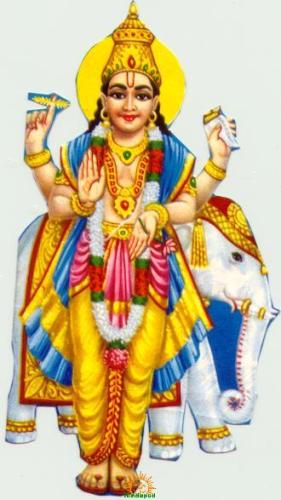
Budha’s iconography is not completely uniform. Regional images may show a dignified male deity with weapons or protective attributes, a boon-granting gesture, a lion or a chariot. Green is widely associated with Budha in contemporary worship, while artistic forms and the number of arms or horses can vary by text, period and locality. Variation is normal in Hindu sacred art and does not invalidate a household image that differs from a temple sculpture.
Green gram, green cloth and green flowers or leaves are common modern associations, although no single material is compulsory across every lineage. Emerald also has a historical relationship with Mercury in Indian gem traditions; the Metropolitan Museum of Art notes the connection among emerald, Mercury, Wednesday and Budha. That historical association does not make an expensive gemstone necessary for puja, nor does it justify wearing one without qualified, individualized guidance.
Understanding the vrata: A vrata is broader than food restriction. It is a chosen discipline involving intention, conduct, worship and remembrance. A meaningful Budhwar vrata may include measured speech, honest accounting, careful study, avoidance of gossip, respectful listening, charitable giving and a simple diet. This broader interpretation keeps the observance accessible to those who cannot fast and places ethical conduct beside ritual correctness.
The original rationale for the observance is often expressed through Budha graha dosha. In Jyotisha, a dosha refers to an interpreted difficulty or imbalance in a horoscope. A devotee may undertake Budh Pujan as a prayerful response to concerns involving education, communication, professional decisions or commerce. Budha graha dosha is not a medical or psychological diagnosis, however, and ritual language should not replace clinical assessment, financial diligence or professional advice.
The customary benefits of Budh Pujan are described as clarity, concentration, eloquence, discrimination and steadiness in decision-making. Academic accuracy requires these benefits to be framed as devotional expectations and symbolic aims, not guaranteed outcomes. The observable practical value lies in the habits the vrata encourages: pausing before speaking, reviewing facts, maintaining a study routine, resolving misunderstandings and aligning commercial activity with honesty.
A simple home-puja arrangement: A household may prepare an image or murti of Budha, a Navagraha representation, or the established family deity through whom Budha is approached. A clean cloth, water, a lamp, incense if suitable, sandal paste or another customary fragrance, akshata, flowers, fruit, a simple naivedya and green gram are sufficient for a modest observance. Materials should reflect family practice, availability and environmental responsibility rather than competitive display.
The worship space should be cleaned and arranged before the puja begins. The devotee traditionally bathes, wears clean clothing and sits facing the direction prescribed by household custom. Green clothing may be used as a symbolic preference, but it is not a condition for valid devotion. Cleanliness, attention and sincerity carry greater ritual significance than purchasing a new garment solely for the occasion.
Step 1 — Sankalpa: The observance begins with a clear intention. The sankalpa may identify the date, place, family and purpose of the worship, such as cultivating wise speech, disciplined study, ethical livelihood or harmony in relationships. A hereditary or priestly formula may be used when known. Otherwise, a short prayer in the devotee’s own language is appropriate, because the function of sankalpa is to make the commitment conscious and specific.
Step 2 — Opening remembrance: Many households first remember Ganesha and the guru lineage before invoking the Navagrahas. This is followed by a respectful mental salutation to Surya and the other grahas, with focused attention then placed on Budha. The sequence may differ by sampradaya. A family that worships Budha through Vishnu, Krishna, Ganesha or another established deity should retain that inherited form rather than replacing it with a generic online procedure.
Step 3 — Dhyana and avahana: The devotee contemplates Budha’s qualities and invites the sacred presence into the worship. The purpose is not to imagine that a physical planet has entered the room. Within ritual theology, avahana establishes a focused relationship between deity, symbol, place and worshipper. Quiet attention to clarity, learning and responsible communication gives the meditation a coherent ethical direction.
Step 4 — Offerings: A concise Panchopachara puja commonly includes gandha, pushpa, dhupa, dipa and naivedya—fragrance, flowers, incense, light and food. Water and akshata may also be offered according to custom. Green gram or another locally accepted sattvic item can be included because of its conventional association with Budha. An offering should be fresh, modest and suitable for later distribution rather than discarded as waste.
Step 5 — Mantra japa: A widely used short mantra is ॐ बुं बुधाय नमः. A devotee may repeat it 9, 27 or 108 times when that practice is consistent with family instruction. Numerical repetition is a method of sustaining attention, not a competition. Correct pronunciation should be learned from a knowledgeable practitioner, and anyone who has received a specific mantra through initiation should follow that instruction instead of substituting a general formula.
Japa may be performed with a mala or by keeping a simple count. The body can remain steady, the breath natural and the recitation audible enough to maintain concentration without disturbing others. If Sanskrit pronunciation is still being learned, a sincere prayer in Marathi, Kannada, Gujarati, Hindi, English or another familiar language may accompany the mantra. The central devotional purpose is recollection joined with disciplined attention.
Step 6 — Reflective prayer: After japa, the devotee may pray for truthfulness in speech, patience in listening, discernment in study, accuracy in calculation and fairness in trade. This stage converts abstract planetary symbolism into an ethical commitment. A prayer for examination success, professional growth or financial stability becomes more responsible when paired with study, competent advice, transparent records and considerate communication.
Step 7 — Naivedya and completion: Fruit, cooked sattvic food or another customary preparation is offered and later shared as prasada. The puja concludes with namaskara, a brief request for forgiveness for errors and, where customary, arati or pradakshina. The lamp should be handled safely, and incense may be omitted in homes where smoke affects children, older adults, pets or people with respiratory sensitivity.
Fasting rules: There is no single universal Budhwar fasting rule across Maharashtra, Karnataka and Gujarat. Some observers take fruit, milk or a light sattvic meal; some eat once after worship; others avoid selected foods without undertaking a complete fast. A strict nirjala fast should never be assumed to be mandatory. Family tradition and physical capacity should determine the form of restraint.
Children, pregnant or breastfeeding individuals, older adults, people with acute illness and anyone managing a health condition may participate through prayer, japa, reading, seva or dietary simplicity rather than restrictive fasting. Medication should never be stopped or rescheduled without medical advice. The National Institute of Diabetes and Digestive and Kidney Diseases emphasizes individualized medical planning for people with diabetes who intend to fast for religious reasons.
Dana and seva: Many devotees complement Budha worship with charity. Green gram, food, stationery, books or support for education may be offered according to means and local custom. The strongest symbolic connection is not the color of the gift but its relationship to nourishment, learning and responsible exchange. Charity should preserve the dignity of the recipient and should not be treated as a commercial payment for a guaranteed astrological result.
The vrata also offers an opportunity to repair communication. A person may use each Wednesday to correct an inaccurate statement, answer an overdue message, reconcile an account, apologize for harsh speech or listen carefully to someone who has been overlooked. These actions do not replace puja; they embody the qualities traditionally associated with Budha. The emotional power of the observance often lies in this quiet movement from recitation to conduct.
For a student, Budh Pujan can frame a weekly cycle of prayer, organized revision and honest self-assessment. The puja cannot substitute for study, sleep or competent teaching, but it can mark a protected period in which distraction is reduced and learning is treated with reverence. A notebook, textbook or writing instrument may be placed near the altar if family custom permits, then returned to ordinary use with renewed purpose.
For a professional or business household, the vrata can become a reminder that intelligence without ethics is incomplete. Clear contracts, accurate bookkeeping, fair pricing, confidentiality and restrained speech are practical forms of Budha-oriented discipline. Claims that a ritual alone will reverse business losses should be treated cautiously. Prayer may support composure and reflection, but commercial decisions still require evidence, lawful practice and qualified advice.
Family participation: A simple weekly format can involve children in lighting an electric or supervised oil lamp, arranging flowers, learning the names of the Navagrahas, reciting a short prayer and sharing prasada. Adults can explain the difference between religious symbolism and astronomy without belittling either field. Such conversations allow inherited practice, scientific literacy and respect for diverse beliefs to coexist within the same household.
Home and temple forms: A household puja may last fifteen to thirty minutes, while a temple observance can include formal sankalpa, archana, abhisheka, extended mantra recitation or Navagraha homa. A complex homa should be undertaken only with appropriate knowledge, space and fire safety. No household should feel that a brief, sincere puja is inferior merely because it lacks the scale of a sponsored temple ritual.
Observing the full sequence: When the vrata is undertaken for all Shravan Wednesdays, continuity is generally more important than elaborate performance. The same short procedure can be repeated on each valid date. The devotee may select one practical discipline for the month—such as avoiding gossip, maintaining a study schedule or keeping accurate accounts—and review it after the final Wednesday. This creates a visible connection between vrata and personal responsibility.
If a Wednesday is missed: Regional traditions differ on whether a missed observance should be resumed, completed on the next Wednesday or concluded with an additional puja. There is no responsible basis for declaring a universal penalty. A devotee may continue on the next available date and consult the family priest when a formal sankalpa contained a specific number of observances. Fear should not be used to sell unnecessary remedies.
Best time of day: Morning worship after bathing and before the main meal is widely preferred, but the exact time is not universal. A family panchang may recommend a particular hora or local muhurta. Where work, school, disability or caregiving makes morning worship impossible, a respectful evening puja is often more sustainable than abandoning the vrata. The transitional night of 12 August 2026 is the special case that requires explicit local guidance.
Is a horoscope required? No horoscope is necessary for a general devotional Budh Pujan. A birth chart becomes relevant only when the puja is prescribed as an individualized Jyotisha remedy. Even then, a competent consultation should explain the chart-based reasoning instead of relying on alarming generalizations. Ordinary Wednesday worship can be undertaken as an expression of devotion, gratitude and commitment to wisdom.
Is green compulsory? No. Green is a prominent symbolic association, and contemporary guides often recommend green gram or green cloth, but devotion does not become invalid when these materials are unavailable. Seasonal flowers, local fruit and an existing clean cloth are sufficient. The same principle applies to emeralds: their historical association is culturally interesting, but they are neither a prerequisite for puja nor a universally safe astrological prescription.
Common errors to avoid: The most frequent problems are treating every online date as location-independent, confusing Amanta and Purnimanta Shravan, presenting optional offerings as compulsory, making medical or financial guarantees, and using fear of dosha to promote costly services. Another error is confusing Budha with Gautama Buddha. Careful terminology, local calendar verification and modest ritual claims preserve both accuracy and religious dignity.
Environmental care can also form part of the observance. Small quantities of biodegradable offerings are preferable to plastic decorations and excessive packaging. Oil, flowers and food should not be released into public water systems. Edible naivedya can be shared, reusable vessels can replace disposable plates, and flowers can be composted where appropriate. Restraint is consistent with the disciplined character of vrata.
Relationship to other Shravan observances: Budh Pujan exists within a larger devotional ecology that can include Shravan Somwar, Mangala Gauri Vrat, Nag Panchami, Narali Purnima, Krishna Janmashtami and local temple festivals. Participation in one observance does not require adopting every other practice. Families may emphasize different deities and rituals while sharing the broader values of devotion, self-restraint, generosity and respect for sacred time.
Regional diversity should therefore be understood as a strength rather than a contradiction. Maharashtra, Karnataka, Gujarat and North India may use different month boundaries, languages, offerings and ritual sequences. Hindu traditions have long accommodated such plurality through sampradaya, kula practice and local panchang authority. The same spirit of respectful plurality supports constructive relationships among Hindu, Buddhist, Jain and Sikh communities without collapsing their distinct doctrines.
2026 planning checklist: The household should first choose its calendar tradition and worship location; confirm whether 12 August is recognized as a transitional observance; reserve 19 August, 26 August, 2 September and 9 September as the full Marathi Shravan Wednesdays; select a realistic form of fasting or non-food discipline; gather simple reusable puja materials; decide on a manageable japa count; and identify one ethical practice involving learning, speech or honest exchange.
Budh Pujan in Shravan is most meaningful when calendar precision, devotional humility and ethical conduct remain together. The ritual honors Budha as a Navagraha deity, while the weekly vrata gives practical form to clarity, thoughtful speech and disciplined learning. In 2026, careful attention to the late-night lunar transition on 12 August prevents confusion and allows each household to follow its own legitimate panchang tradition with confidence.
Research basis: The regional description and earlier yearly schedules derive from the source article on Budh Pujan in Shravan. The 2026 calendar qualification is supported by the cited Amanta and Purnimanta panchang comparisons. The ritual procedure is intentionally presented as a general household framework because precise mantras, offerings, fasting rules and completion rites vary by family, temple and sampradaya.
Inspired by this post on Hindu Pad.

Leave a Reply
You must be logged in to post a comment.