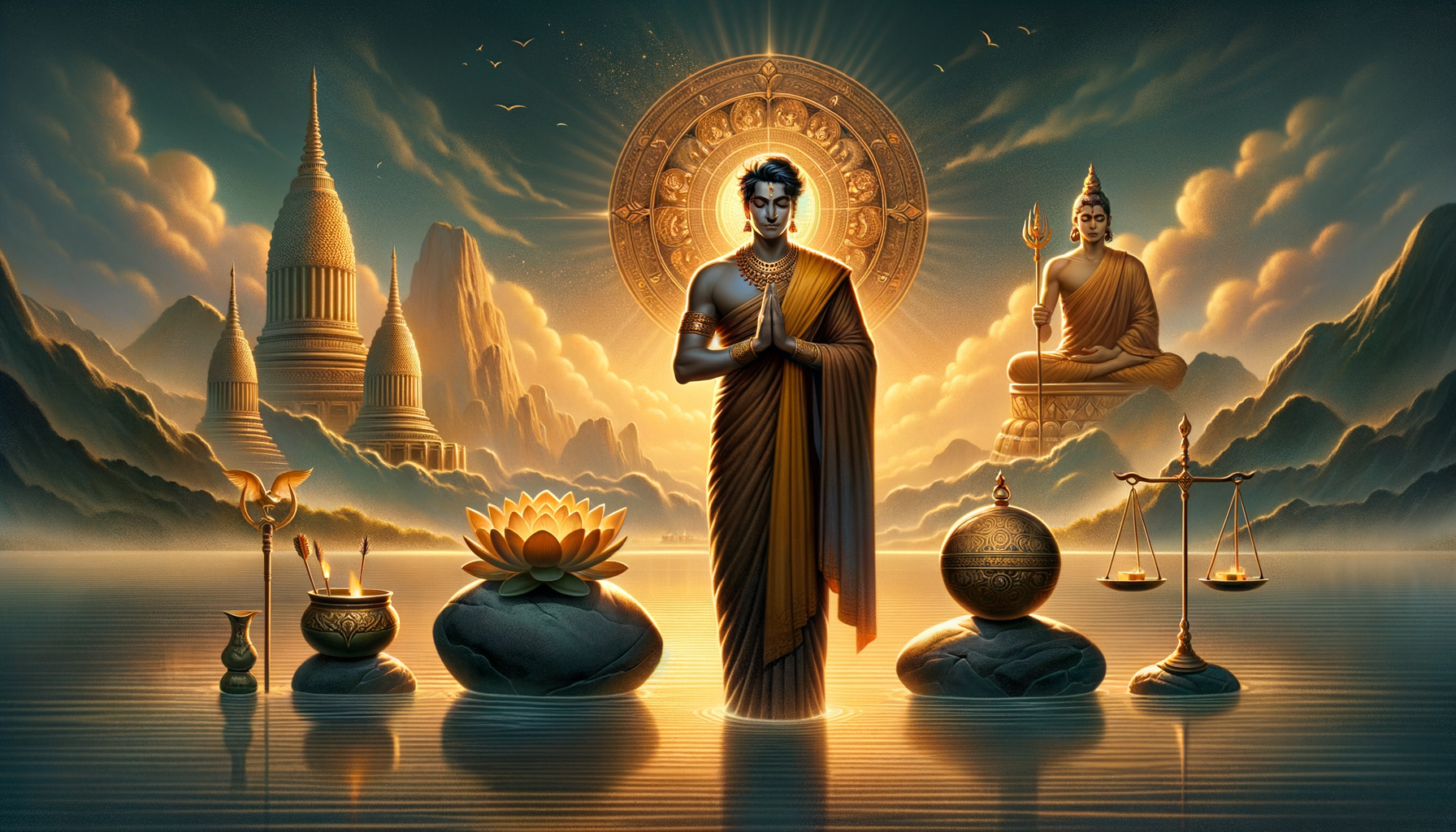
In the Ramayana, three brothers—Ravana, Kumbhakarna, and Vibhishana—undertook austere penance and received boons from Brahma. While Ravana sought near-immunity from celestial beings and Kumbhakarna ended with an infamous boon of profound sleep, Vibhishana asked for something both simple and revolutionary: unwavering adherence to dharma, clarity to discern right from wrong, and the courage to speak truth even when it was uncomfortable. This choice, grounded in ethical leadership and spiritual wisdom, ultimately shaped the destiny of Lanka and the outcome of the war.
Among the three, Vibhishana’s request stands out as the wisest boon. Rather than demanding dominion or invincibility, he aligned himself with righteousness (dharma) and moral discernment. Brahma’s blessing fortified this orientation, granting Vibhishana the strength to uphold dharma even under familial pressure. That resolve later enabled him to advise Ravana against adharma, and when counsel failed, to seek sharanagati with Sri Rama—an ethical transition that preserved both integrity and the larger moral order described in Hindu scriptures.
This dharmic alignment had tangible consequences. Ravana’s boon excluded humans, leaving him vulnerable to Lord Rama, whose human incarnation epitomized the triumph of dharma. Vibhishana’s knowledge of Lanka, his strategic counsel, and his commitment to truth materially aided Rama’s campaign. After the war, Rama installed Vibhishana as king of Lanka, affirming a crucial principle in the epic: power that does not bow to dharma is unstable, whereas authority rooted in righteousness earns legitimacy and endurance.
The lesson resonates beyond epic literature. Across dharmic traditions—Hinduism, Buddhism, Jainism, and Sikhism—the shared ideal is clear: choose virtue over domination, truth over expedience, and compassion over coercion. Buddhist dhamma, Jain ahimsa and satya, and Sikh seva and sach align with the Ramayana’s dharma and provide a unifying ethical vocabulary. This unity of values underscores a civilizational insight: sustainable wellbeing emerges from integrity, restraint, and service, not from mere accumulation of power.
For contemporary life, Vibhishana’s boon suggests a practical orientation. In organizations, communities, and public life, prioritizing moral clarity and accountability mitigates conflict and builds trust. Ethical leadership—grounded in dharma and guided by truth—creates resilient institutions and humane governance. The Ramayana thus functions not only as an ancient Hindu text but also as a living guide to decision-making under pressure, illuminating the path through the perennial tension between dharma and adharma.
Vibhishana’s choice also reframes ‘success’ through the lens of Sanatana Dharma: the highest boon is not invulnerability but the inner strength to remain aligned with righteousness. By asking for steadfast virtue rather than dominion, Vibhishana demonstrated that spiritual insight can be strategically decisive. In this way, the Ramayana offers a shared heritage of moral reasoning to all dharmic traditions, inviting a collective commitment to truth, compassion, and just action.
Seen through this lens, the wisest boon is less about supernatural protection and more about ethical transformation. It clarifies why Vibhishana’s path altered the fate of Lanka, why Rama’s victory felt inevitable within the moral architecture of the epic, and why these teachings endure. The Ramayana’s narrative, centered on Lord Rama, Ravana, and Vibhishana, continues to inform contemporary understandings of leadership, duty, and the enduring power of dharma over power.
Inspired by this post on Hindu Blog.