
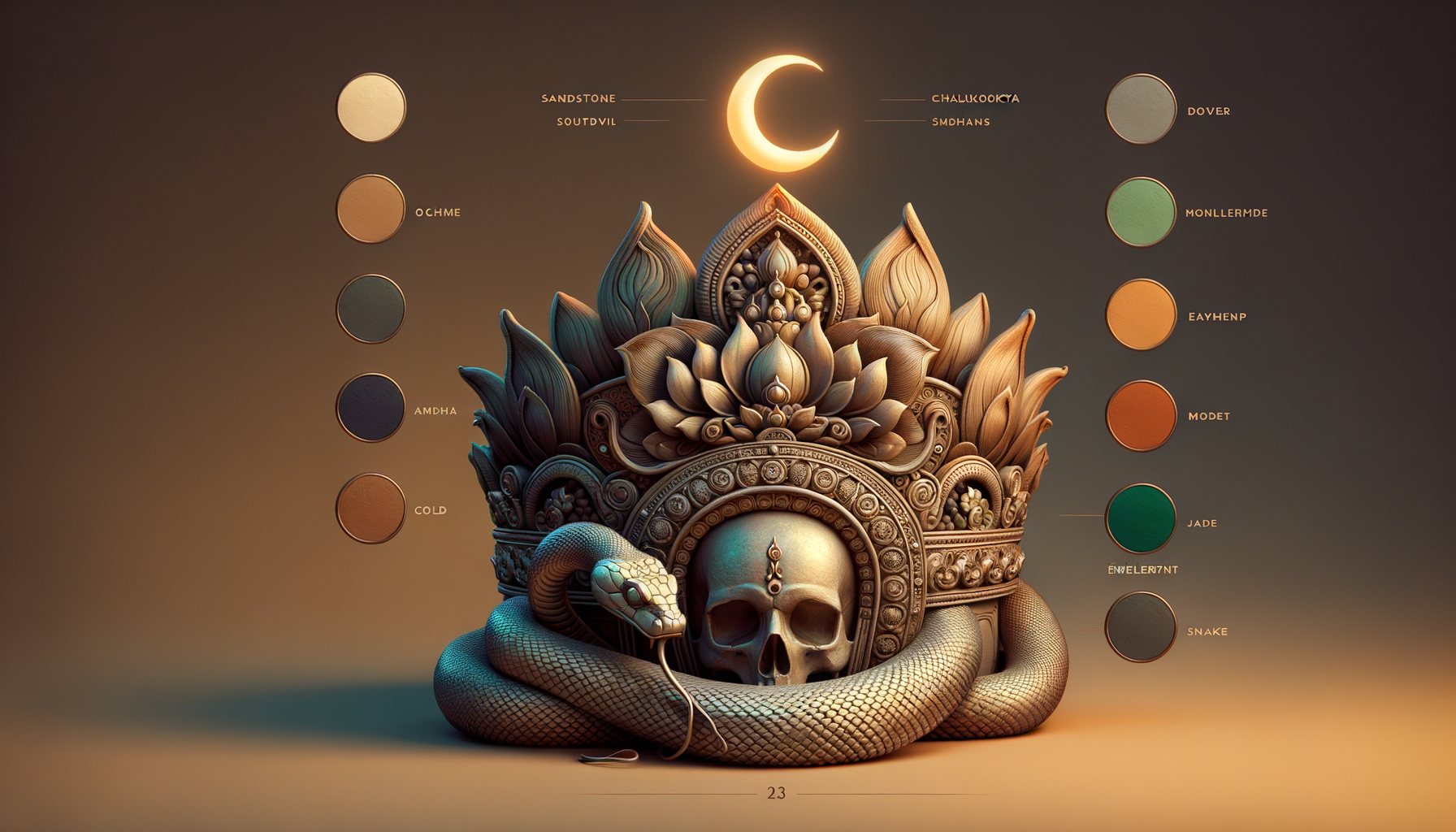
Across the sacred arts of ancient India, the image of Lord ShivaAdiyogi, Mahadevfunctions not merely as aesthetic form but as a distilled philosophy of consciousness. Among the most evocative features is the Jata Mukuta, the matted hair crown that, in many early depictions including those at the Badami cave temples, bears the triad Kaumudi – Kapala – Sarpa. Read as a compact spiritual map, this “crown of consciousness” encodes a disciplined path toward clarity, compassion, and fearlessness.
The Jata Mukuta signifies tapas and sovereign mastery over pranic currents. Matted locks imply restraint and inner order rather than disorder; they symbolize the yogic stabilizing of energy in the sushumna nadi and the containment of cosmic forces traditionally associated with Shiva. In temple sculpture and Shaiva iconography, this crown signals a life oriented toward moksha, where sensory flux is transformed into steady awareness.
Kaumudi, the crescent moon set upon Shiva’s jata, embodies cooling moonlight, emotional equanimity, and the cyclical measure of time. As a luminous marker of rhythmtithi, waxing and waningit points to a mind that moves in harmony with nature’s cadence. The symbolism resonates across dharmic traditions: Buddhist literature often invokes the moon as an image of compassion and calm clarity; Jain reflections on sama (equanimity) mirror its soothing quality; Sikh gurmat poetry employs lunar metaphors for serenity and remembrance of the Divine. Kaumudi thus signals a gentle governance of thought and feeling.
Kapala, the skull, confronts impermanence (anitya) with unsparing honesty. In Shaiva traditions, it functions as a memento that frees consciousness from ego-attachments; in Buddhist Vajrayana it appears as a sacred vessel of wisdom; and in Jain and Sikh teachings, contemplation of mortality deepens detachment and ethical seriousness. Rather than morbid, Kapala is medicinalan icon of humility that opens the way to truth.
Sarpa, the serpent encircling Shiva’s crown and neck, represents alert awareness and transformative energy. In yogic vocabulary it suggests the awakening of kundalini and the courage to transmute fear. As a pan-dharmic symbol, the serpent or naga protects the Buddha (Mucalinda), arches as a canopy over Tirthankara Parshvanatha in Jain art, and, as a metaphor in Sikh teachings, can mark the shedding of ignorance. Sarpa is therefore a seal of vigilance, protection, and inner renewal.
Seen together upon the Jata Mukuta, Kaumudi – Kapala – Sarpa form a coherent triad of practice. Kaumudi cools and clarifies the mind; Kapala empties pride and anchors insight in impermanence; Sarpa vitalizes awareness and steadies courage. The ensemble suggests a balanced sadhana where composure, discernment, and energy are held in dynamic equilibriuman inner architecture as precise as the outer Temple Architecture that frames it.
Early Chalukya sculptures at Badami offer an invaluable record of these Shaiva conventions, preserving a visual grammar that traveled widely across the subcontinent. Such carvings are not only art-historical documents from Ancient India; they are pedagogical diagrams, translating complex metaphysics into accessible forms for pilgrims, practitioners, and scholars alike.
For many devotees and contemplatives, extended viewing of Shiva’s Jata Mukuta becomes a living meditation. Attention settles; breath softens; Kaumudi is intuited as the mind’s cooling, Kapala as the release of egoic weight, Sarpa as the ascent of alertness along the sushumna nadi. This reflective engagement is consonant with practices found across Hinduism, Buddhism, Jainism, and Sikhism, where image and insight mutually illuminate.
At a civilizational level, the triad also gestures toward dharmic unity. By joining serenity (Kaumudi), truthful humility (Kapala), and fearless transformation (Sarpa), it affirms shared valuesahimsa, inner freedom, responsibility toward self and societythat thread through these traditions. The result is not uniformity but a “Unity in Diversity,” a common ethical horizon supporting diverse paths.
In contemporary life, Shiva’s Jata Mukuta with Kaumudi – Kapala – Sarpa remains a portable mandala: a reminder to cool the mind, honor impermanence, and act with awakened courage. Rooted in Shaivism yet resonant across dharmic lineages, this crown of consciousness invites steady clarity amid changean enduring guide from temple sculpture to daily practice.
Inspired by this post on Hindu Blog.
