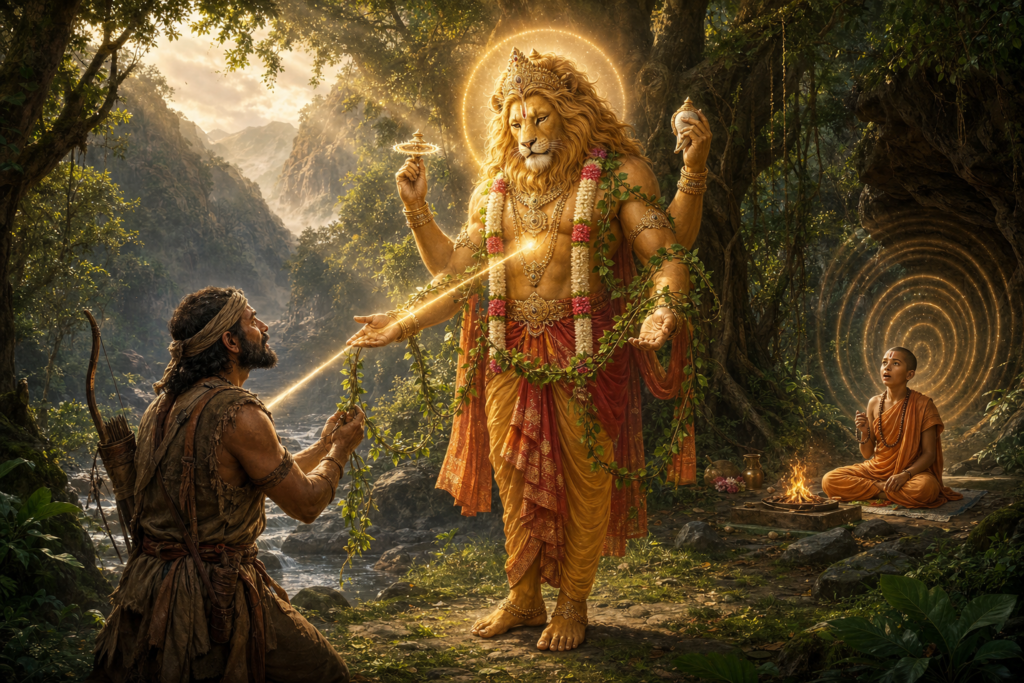
Trishanku Katha, preserved in the Brahma Purana and echoed across Hindu mythology, illuminates the delicate balance between personal desire and the moral law of dharma. The narrative centers on the royal lineage descending from Dridashva to the righteous King Trayaruni, and then to his son Satyavratalater renowned as Trishankuwhose choices challenge sacred norms and cosmic order.
While King Trayaruni upheld religious dictates with steadfast integrity, Satyavrata diverged from this path. The royal court’s spiritual anchor was the great sage Vashishtha, who advised adherence to dharma as the foundation of just rule and inner harmony. It is within this setting that Satyavrata’s extraordinary aspiration emerged.
Accounts describe Satyavrata’s wish to ascend to svarga (heaven) in his mortal bodya desire that, though bold, conflicted with established ritual principles and the natural cycle of birth and death. Vashishtha, committed to the sanctity of scriptural injunctions, declined to perform the required sacrifice, underscoring that dharma cannot be bent to satisfy individual ambition.
After being rebuffed, Satyavrata approached Sage Vishwamitra. Motivated by compassion, resolve, and a well-known rivalry with Vashishtha, Vishwamitra undertook a powerful yajna to fulfill the king’s aspiration. This pivotal moment reveals how tapas (austerity), intention, and ritual power intersect in the Puranas.
As the sacrifice unfolded, Trishanku began to rise skyward. Indra, guardian of cosmic order, refused entry to heaven and cast him down. In a dramatic assertion of ascetic power, Vishwamitra halted Trishanku mid-descent and created a new celestial realmTrishanku Swargapositioned between earth and heaven. The image of the king suspended in the sky remains one of the most striking symbols in Hindu storytelling.
Ethically, the Trishanku Katha interrogates unchecked desire, the responsibilities that accompany spiritual power, and the inviolability of dharma. It also highlights the nuanced role of the guru: Vashishtha embodies restraint and scriptural fidelity, while Vishwamitra represents transformative will and tapas, each reflecting complementary pathways within the wider dharmic tradition.
Beyond sectarian boundaries, the narrative resonates across dharmic traditionsHinduism, Buddhism, Jainism, and Sikhismthrough shared themes of ethical conduct, humility before moral law, karmic consequence, and respect for wise guidance. These common values foster unity in spiritual diversity, encouraging seekers to align aspiration with responsibility and compassion.
For contemporary readers, the story offers enduring insight: leadership must be anchored in principle; ambition requires ethical guardrails; and spiritual practice is most powerful when harmonized with cosmic order. As a result, Trishanku Swarga becomes not merely a celestial image but a metaphor for consequences that arise when desire outpaces discipline.
Multiple Puranic and regional tellings add texture to the account. Many identify Satyavrata as another name for Trishanku and situate him within the Ikshvaku lineage, while some traditions connect him to King Harishchandra. Such variations are typical of Puranic literature and enrich the narrative without altering its core teaching on dharma, humility, and the measured use of spiritual power.
Inspired by this post on Hindu Pad.