
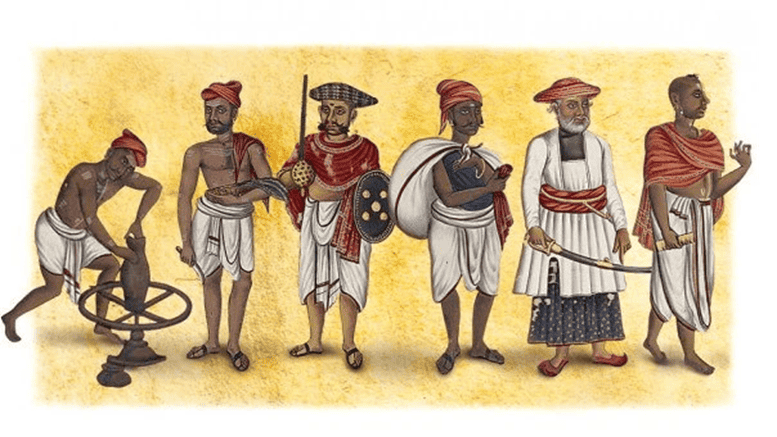
The Varna system is among the most debated concepts associated with Sanatana Dharma. It is frequently presented in two opposing ways: either as a timeless system of inherited hierarchy or as a perfectly fluid arrangement based only on personal merit. Neither formulation adequately represents the complexity of the scriptural record, the diversity of Hindu interpretation, or the long history of social practice in the Indian subcontinent.
The subject is not merely theoretical. When birth-based discrimination limits a person’s education, vocation, worship, marriage, or social dignity, the consequences are deeply personal. A student judged by a surname, a worker treated as ritually inferior, or a family excluded from community life experiences caste not as an abstract category but as a restriction on human possibility. Any serious examination of Varna must therefore combine textual precision with moral clarity.
A devotional question often frames the discussion: would an all-compassionate Supreme Lord create some human beings as inherently superior and others as inherently inferior solely because of birth? The question expresses an important intuition about divine justice, but an academic analysis cannot rest on intuition alone. It must ask what the relevant texts actually say, what they leave unstated, how traditional commentators have interpreted them, and how textual ideals differ from historical institutions.
Varna, jāti, and caste are related but not identical
The Sanskrit term Varna describes a fourfold classificatory scheme: Brāhmaṇa, Kṣatriya or Rājanya, Vaiśya, and Śūdra. In normative literature, these categories are associated respectively with learning and ritual responsibility, protection and governance, production and exchange, and service or labor. This is a broad social model, not a detailed catalogue of the thousands of communities that have existed across South Asia.
Jāti generally refers to a more localized birth community, often associated historically with kinship, endogamy, region, customary occupation, and collective identity. The English word caste has been used for both Varna and jāti, which easily produces confusion. Varna may function as a theological or normative model, while jāti has often governed everyday social relations. The two have influenced one another, but treating them as exact synonyms obscures both scripture and history.
This distinction does not make caste discrimination unreal, nor does it prove that every historical Varna arrangement was fluid. It simply prevents a four-part textual model from being mistaken for the entire social history of India. Hereditary status, occupational restriction, endogamy, unequal access, and practices of untouchability developed in different forms and degrees across regions and periods. Their history cannot be explained by a single verse, a single ruler, or a single religious community.
What Yajurveda 31.11 actually says
The discussion commonly begins with a verse from the Puruṣa hymn preserved in the Yajurveda:
“Brāhmaṇāsya mukham āsīd bāhū rājanyaḥ kṛtaḥ | Ūrū tadasya yad vaiśyaḥ padbhyāṁ śūdro ajāyata ||”
(Yajurveda 31.11)
A close translation states that the Brāhmaṇa was the Cosmic Person’s mouth, the Rājanya was made his arms, the Vaiśya was his thighs, and the Śūdra arose from his feet. This literal sense can be checked against the text and word analysis presented by Vedapath’s edition of Śukla Yajurveda 31.11.
The frequently offered explanation that the mouth represents Vedic knowledge, the arms represent protection, the thighs represent economic support, and the feet represent labor is a functional interpretation of the image rather than a word-for-word translation. That distinction is important. A translation reports the direct linguistic sense; an interpretation explains what the symbolism may mean within a larger theological or social framework.
The cosmic-body image can support a reading of organic interdependence. A living body cannot flourish through the mouth alone, the arms alone, or the feet alone. Knowledge without protection is vulnerable, power without wisdom is dangerous, commerce without labor cannot sustain society, and labor without recognition becomes exploitation. All four functions appear within one Puruṣa, suggesting that society is imagined as an interconnected whole rather than as four unrelated populations.
At the same time, the verse does not explicitly explain how an individual enters a Varna, whether Varna can change during a lifetime, or how the symbolism should be translated into institutions. It also does not itself provide the expanded occupational definitions sometimes presented as its direct meaning. Those definitions arise from later interpretation and from other texts, including Bhagavad Gita 18.42–44. The verse should therefore neither be isolated as conclusive proof of inherited inequality nor made to say more than its language establishes.
The decisive expression in Bhagavad Gita 4.13
Lord Krishna’s statement in the Bhagavad Gita supplies a different and more analytical vocabulary:
“Cāturvarṇyaṁ mayā sṛṣṭaṁ guṇa-karma-vibhāgaśaḥ |”
(Bhagavad Gita 4.13)
The cited line says that the fourfold order was created according to a division of guṇa and karma. Multiple traditional translations collected by the IIT Kanpur Gita Supersite render the key expression in terms of qualities and actions, qualities and duties, or the modes of nature and their corresponding work. The complete verse adds that Krishna, although the creator of this ordering, is to be known as immutable and not bound as an agent.
Guṇa in the Gita is a technical concept, not simply a flattering description of talent. The text describes sattva, rajas, and tamas as dynamic qualities of embodied nature. They influence clarity, desire, activity, attachment, inertia, and understanding in changing combinations. No ordinary person is presented as a chemically pure embodiment of only one guṇa, and spiritual discipline is intended to transform the person’s relationship to all three.
Karma in this context includes action, responsibility, and the work arising from one’s disposition and situation. It should not be reduced to a modern job title, and guṇa should not be treated as a personality quiz that permanently labels a child. The compound guṇa-karma-vibhāgaśaḥ directs attention to qualities and conduct, but the verse does not provide an administrative procedure for assigning Varna or state that social authorities possess infallible knowledge of another person’s inner nature.
The strongest conclusion warranted by Bhagavad Gita 4.13 is therefore precise but limited: the verse explicitly explains the fourfold order through guṇa and karma rather than explicitly naming birth as its defining criterion. This provides substantial scriptural ground for rejecting the claim that ancestry alone proves wisdom, courage, fitness to govern, spiritual realization, or moral worth. It does not, by itself, settle every historical and commentarial debate about whether birth has any role in traditional Varna theory.
Bhagavad Gita 18.41–44 describes qualities and responsibilities
The eighteenth chapter makes the relationship between disposition and duty more explicit:
“Brāhmaṇa-kṣatriya-viśāṁ śūdrāṇāṁ ca parantapa | Karmāṇi pravibhaktāni svabhāva-prabhavair guṇaiḥ ||”
(Bhagavad Gita 18.41)
The verse states that the duties of Brāhmaṇas, Kṣatriyas, Vaiśyas, and Śūdras are differentiated according to qualities arising from their own nature. Traditional translations on the Gita Supersite’s Bhagavad Gita 18.41 page consistently retain this connection among duty, qualities, and nature, even when their English terminology differs.
The following verses clarify the ethical profile of each function. Bhagavad Gita 18.42 associates Brāhmaṇa responsibility with composure, self-restraint, austerity, purity, patience, uprightness, knowledge, realization, and faith. The emphasis is demanding: learning without humility, ritual status without self-control, or lineage without truthfulness does not satisfy this description.
Bhagavad Gita 18.43 associates Kṣatriya responsibility with heroism, vigor, firmness, skill, courage in conflict, generosity, and leadership. Political power is thus joined to duty and discipline rather than personal privilege. A ruler who possesses authority but lacks courage, competence, restraint, or concern for the protected population fails the moral substance of the role.
Bhagavad Gita 18.44 associates Vaiśya work with agriculture, animal husbandry, and trade, while describing Śūdra work in terms of service. The traditional translations of Bhagavad Gita 18.44 confirm these occupational associations. These verses reflect an ancient agrarian society; applying their principles today requires interpretation rather than mechanically converting every modern profession into a fixed hereditary rank.
Svabhāva, or one’s own nature, is also more complex than preference. It may include temperament, cultivated habits, moral development, education, and the effects of previous action as understood within Hindu philosophies of karma. Families and communities can shape these qualities, but social conditioning should not be confused with an unchangeable biological essence. A person denied education and then declared intellectually unfit has not been impartially evaluated; the denial itself has helped produce the apparent outcome.
Traditional commentators do not speak with one voice on every implication of these passages. Some interpret the Gita within inherited social structures, while modern reformist readings place greater emphasis on observable qualities and work. Academic honesty requires acknowledging this range. The text strongly foregrounds disposition and conduct, but a claim that every Hindu scripture uniformly rejects birth as socially relevant would be as inaccurate as the claim that the Gita defines Varna by birth alone.
Social function is not the measure of spiritual worth
A crucial distinction separates differentiated responsibility from unequal spiritual value. The Gita can discuss different forms of work while also teaching a vision of the Self that transcends social classification. Bhagavad Gita 5.18 describes the wise as seeing with equality a learned and humble Brāhmaṇa, a cow, an elephant, a dog, and a person placed beyond conventional social respectability. The translations and major commentaries collected for Bhagavad Gita 5.18 connect this equal vision to recognition of the same spiritual reality amid different embodiments.
Bhagavad Gita 6.29 similarly presents the yogin as seeing the Self in all beings and all beings in the Self. Bhagavad Gita 9.32 affirms that those who take refuge in Krishna can attain the highest goal even when social convention has marginalized them or restricted their access. These passages do not automatically abolish every social distinction within the text, but they make inherited spiritual inferiority impossible to defend as an ultimate truth.
This is where the emotional and philosophical significance of the teaching becomes visible. A person’s occupation may describe an activity, but it cannot exhaust identity. Social usefulness is not the same as spiritual rank, and no form of honest work makes the indwelling Self less sacred. Service cannot be praised as necessary while the people performing it are humiliated; such a contradiction empties the language of interdependence of its ethical meaning.
The frequently cited verse about birth and refinement
A widely repeated Sanskrit maxim expresses the progression from unrefined birth to spiritual realization:
“Janmanā jāyate śūdraḥ, saṁskārād bhaved dvijaḥ | Vedapāṭhād bhaved vipraḥ, brahma jānāti brāhmaṇaḥ ||”
Its received meaning is that every human being begins in an unrefined condition; saṁskāra makes one twice-born, Vedic study makes one a learned Vipra, and realization of Brahman makes one a true Brāhmaṇa. The verse powerfully conveys an educational and spiritual ascent in which discipline and realization matter more than an unexamined claim of status.
Textual caution is nevertheless necessary. The four-line form is often described generally as a Smriti verse, yet it is frequently circulated without a stable chapter-and-verse citation, and variants occur in later compilations. It should be identified as a traditional didactic maxim unless a specific edition and location are supplied. Its message can illuminate the argument, but uncertain attribution should not be disguised as settled textual provenance.
The Mahabharata makes conduct central—but its record is plural
Another verse commonly invoked in this discussion is:
“Na kulena na jātyā vā brāhmaṇo bhavati kaścana | Karmabhir brāhmaṇo jñeyaḥ…”
Its traditional meaning is that neither family lineage nor birth alone makes a Brāhmaṇa; the identity is known through action. As with the preceding maxim, the shortened wording should not be assigned a precise location without verification. The underlying idea, however, has clear parallels in identifiable Mahabharata passages.
In the dialogue between Yudhisthira and the serpent in the Vana Parva, Yudhisthira argues that birth alone does not make a Brāhmaṇa or a Śūdra and that the defining virtues and conduct are decisive. The same dialogue observes that human lineages are difficult to classify with certainty and presents character as the chief criterion. The passage can be read in the Mahabharata, Vana Parva, Section CLXXIX.
Other parts of the Mahabharata preserve more birth-centered assumptions, while still describing moral conduct as capable of elevating or degrading status. For example, the Anusasana Parva discussion in Section CXLIII contains both inherited classification and the assertion that a Śūdra established in good conduct may be regarded as possessing the status of a Brāhmaṇa. This tension is important evidence, not an inconvenience to be hidden.
The Mahabharata is a vast, layered work containing dialogue, narrative, law, theology, debate, and competing voices. Selecting one congenial sentence and treating it as the epic’s only position produces apologetics rather than scholarship. Its enduring value lies partly in its willingness to stage moral conflict. The epic repeatedly asks whether conventional status can survive the failure of conduct, and its most searching passages refuse to make virtue a hereditary possession.
What Valmiki, Vyasa, and Satyakāma can—and cannot—prove
Sage Valmiki is popularly remembered as Ratnakara, a person transformed from wrongdoing into a sage through spiritual awakening. This account belongs to an influential hagiographic tradition, but it should not be presented as a securely recoverable biography from the oldest layer of the Valmiki Ramayana. Its enduring value is theological and ethical: no past condition permanently excludes a person from repentance, discipline, knowledge, or sanctity.
Vyasa offers a more textually grounded illustration of reverence crossing simple genealogical boundaries. The Mahabharata identifies him as the son of the sage Parashara and Satyavati, who was raised in a fisherman’s household and worked ferrying travelers. The Adi Parva’s account of Satyavati and Vyasa nevertheless presents Vyasa as the arranger of the Vedas and the revered source of the Mahabharata tradition. His authority is grounded in knowledge, ascetic power, and spiritual accomplishment rather than diminished by his maternal social setting.
The Chāndogya Upanishad’s account of Satyakāma Jābāla is especially relevant. Unable to name his paternal lineage, Satyakāma truthfully reports what his mother told him. Gautama recognizes the extraordinary truthfulness of the response and accepts him for initiation and instruction. The episode in Chāndogya Upanishad 4.4 has generated different commentarial readings, but it unmistakably places truthfulness at the center of spiritual eligibility.
Such narratives are best used as interpretive examples, not as modern sociological data. They demonstrate what a tradition admires: truth, tapas, learning, transformation, and realization. They do not by themselves establish how every village, kingdom, temple, or lineage organized social relations at every point in history.
How Varna became entangled with hereditary caste
Over long periods, normative Varna categories became associated with numerous jāti communities. Birth, marriage rules, inherited occupations, political authority, control over education, landholding, and concepts of ritual status interacted in regionally distinct ways. Some communities changed occupations or claimed new status; others faced severe and durable exclusion. The history contains both mobility and rigidity, making absolute descriptions unreliable.
Colonial classification later documented, standardized, and sometimes hardened social identities, but colonial rule did not invent caste from nothing. Birth-based distinctions and exclusion existed before European administration, just as contestation, mobility, devotional equality, and social reform also existed before it. A factual account must resist both extremes: caste should not be portrayed as the unchanging essence of all Hindu civilization, and its harms should not be dismissed as entirely foreign creations.
The distinction between an ideal and its historical application is therefore indispensable. A scripture may describe duties as arising from qualities, while an institution may assign them by ancestry without examining qualities at all. A community may celebrate the divine presence in everyone while denying some members equal access. The contradiction should be acknowledged and corrected, not concealed through selective quotation.
A responsible contemporary interpretation
A contemporary reading can preserve the Gita’s insight that people possess different dispositions, abilities, and forms of responsibility without converting difference into inherited rank. Every complex society requires education, ethical guidance, public protection, administration, production, trade, skilled labor, care, and service. These functions are mutually dependent, and individuals should be free to develop their capacities through education, experience, and disciplined choice.
Such a reading also requires safeguards. No family should possess a monopoly on knowledge, worship, leadership, or economic opportunity. No child should inherit a presumption of intellectual superiority or social pollution. No occupation should become a justification for humiliation. Aptitude must not become a euphemism for privilege, especially when unequal access to education has shaped the very abilities being measured.
Nor should guṇa and karma be used to blame marginalized people for their circumstances. The doctrine of karma addresses moral causation across a much larger philosophical horizon; it is not a license to treat suffering as deserved or to withhold compassion. Within Dharma, another person’s hardship creates an obligation to serve, protect, and restore justice. A theory that excuses indifference contradicts the disciplines of compassion, self-control, and welfare that the same traditions praise.
From this perspective, Brāhmaṇa is ethically meaningful only where knowledge is joined to humility and realization; Kṣatriya only where power protects rather than exploits; Vaiśya only where prosperity supports social welfare and honest exchange; and Śūdra only where service is honored rather than degraded. Birth cannot substitute for the qualities a role demands, and a label cannot sanctify conduct that violates Dharma.
Dharmic unity requires honesty rather than homogenization
Hindu, Buddhist, Jain, and Sikh traditions possess distinct scriptures, institutions, and historical engagements with social hierarchy. Unity among them should not require pretending that all teach an identical doctrine of Varna. It is stronger when their differences are respected and their shared ethical resources—compassion, nonviolence, truthfulness, self-discipline, service, and the rejection of arrogance—are brought into constructive conversation.
These traditions have produced saints, teachers, reformers, monastics, householders, poets, and communities that challenged inherited pride and affirmed the spiritual capacity of people across social backgrounds. Their examples support a broad Dharmic principle: identity may shape a person’s history, but it does not place a ceiling on wisdom, devotion, ethical excellence, or liberation.
Frequently asked question: Does the Bhagavad Gita say Varna is based only on birth?
No cited Gita verse defines Varna solely by birth. Bhagavad Gita 4.13 explicitly names guṇa and karma, while 18.41 names qualities arising from svabhāva and then describes characteristic duties. However, the verses do not provide a complete social policy or explicitly resolve every relationship among birth, upbringing, disposition, and occupation. Claims on either side should remain no broader than the textual evidence.
Frequently asked question: Is the Puruṣa hymn a literal occupational manual?
No. Yajurveda 31.11 presents cosmic-body imagery. Reading the mouth as knowledge, the arms as protection, the thighs as production, and the feet as service is a coherent functional interpretation, but those expanded definitions are not the verse’s literal wording. The image may express unity and interdependence, yet its institutional implications must be argued rather than assumed.
Frequently asked question: Are Varna and caste the same?
Not exactly. Varna is a fourfold normative classification, whereas jāti refers to numerous localized communities commonly organized through birth and marriage. Caste is an English umbrella term often applied to both. Their histories overlap, but failing to distinguish them produces misleading claims about scripture and society.
Frequently asked question: Does acknowledging textual complexity excuse discrimination?
No. Complexity explains why simplistic claims fail; it does not weaken the obligation to oppose humiliation, exclusion, or inherited inequality. The spiritual vision of the same Self in all beings, the Gita’s emphasis on qualities and conduct, and the broader Dharmic commitment to compassion provide strong grounds for equal dignity. Historical wrongs should be studied honestly so that religious interpretation contributes to repair rather than denial.
The most defensible conclusion
The Vedas and the Bhagavad Gita do not support the simplistic assertion that human worth is fixed by ancestry. Yajurveda 31.11 places the four social functions within one Cosmic Person, while the Gita explicitly explains the fourfold order through guṇa, karma, svabhāva, and corresponding responsibility. The Mahabharata and Upanishadic narratives add powerful testimony that conduct, truthfulness, discipline, and realization are indispensable to spiritual identity.
It would nevertheless be inaccurate to claim that every traditional text rejects hereditary classification or that historical Hindu societies never enforced birth-based hierarchy. The textual record contains multiple voices, and social history records real discrimination. A credible defense of Sanatana Dharma does not require denying this evidence. It requires distinguishing foundational spiritual insights from practices that violate human dignity and applying the tradition’s own resources for ethical correction.
The enduring principle is not that every person must be placed into a permanent category. It is that knowledge should be demonstrated through wisdom, authority through protection, prosperity through responsible stewardship, and service through dignified contribution. No one becomes inherently superior through birth, and no one becomes spiritually inferior through honest labor. True Dharma is measured by justice, character, self-realization, compassion, and the welfare of all beings.
Inspired by this post on Hindu Post.








Leave a Reply
You must be logged in to post a comment.