
ISKCON 60th Anniversary Week—Day 3
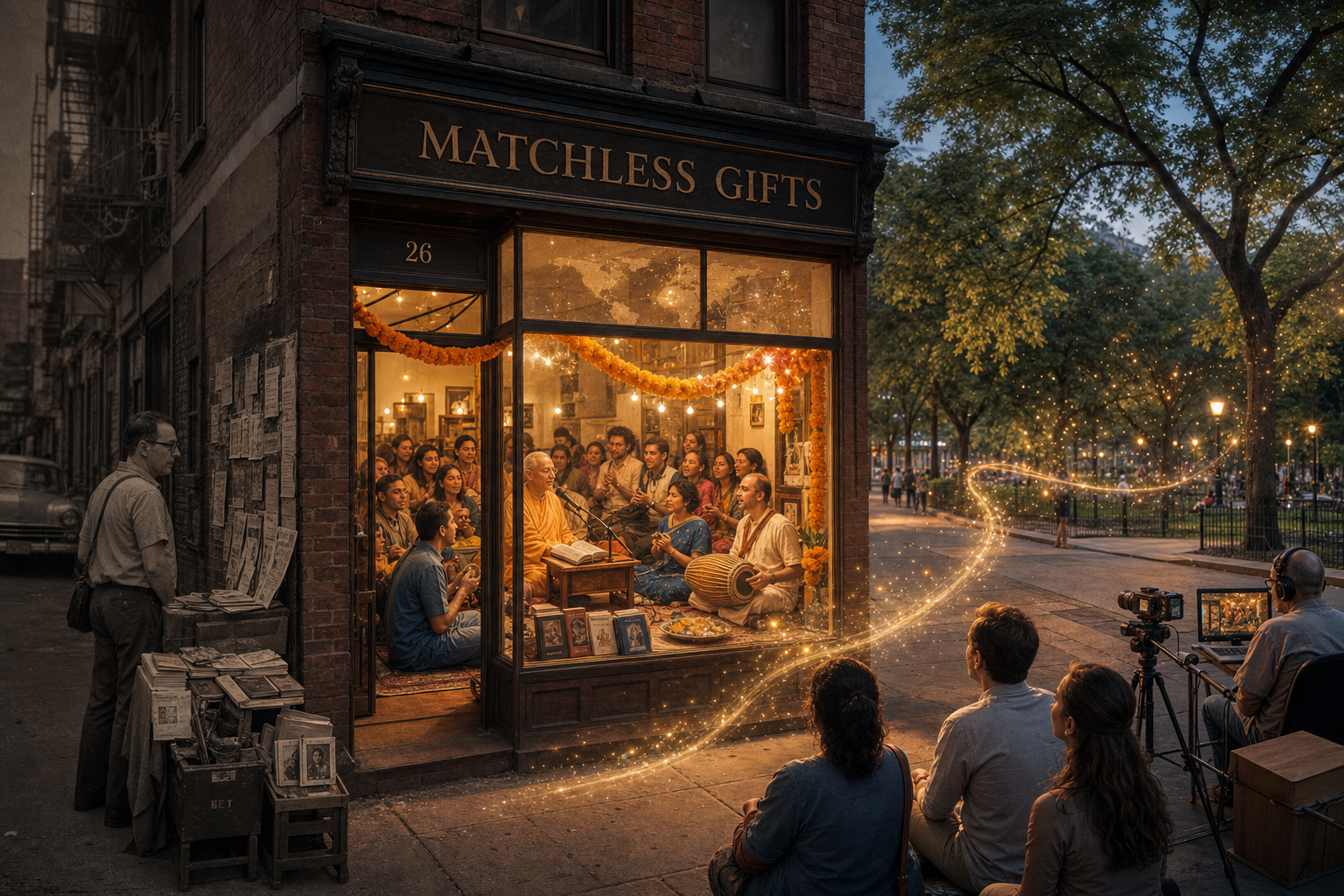
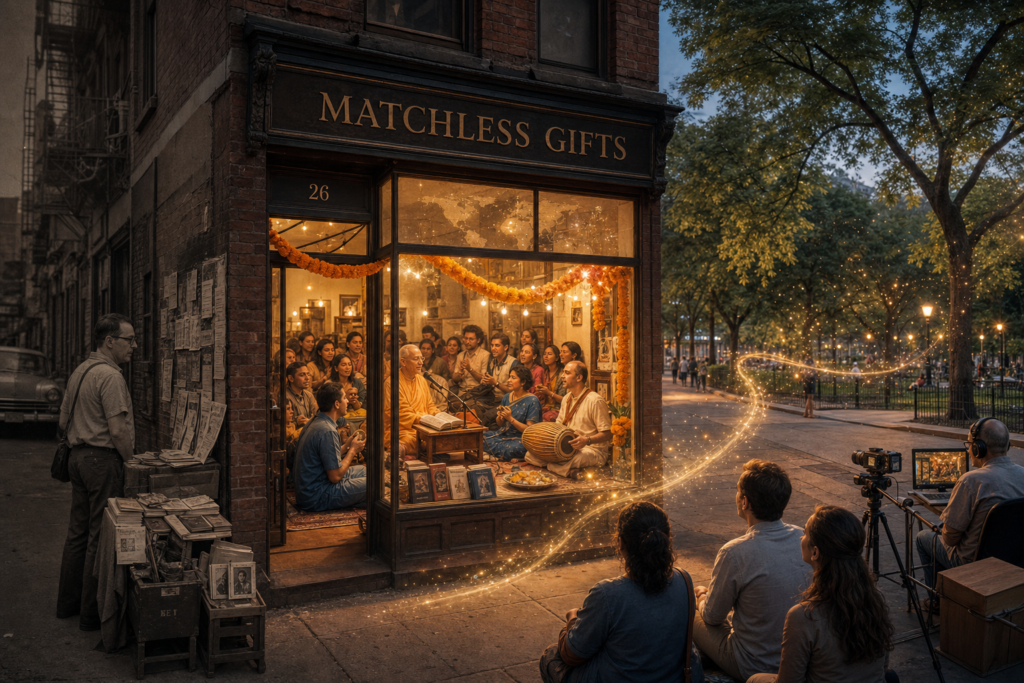
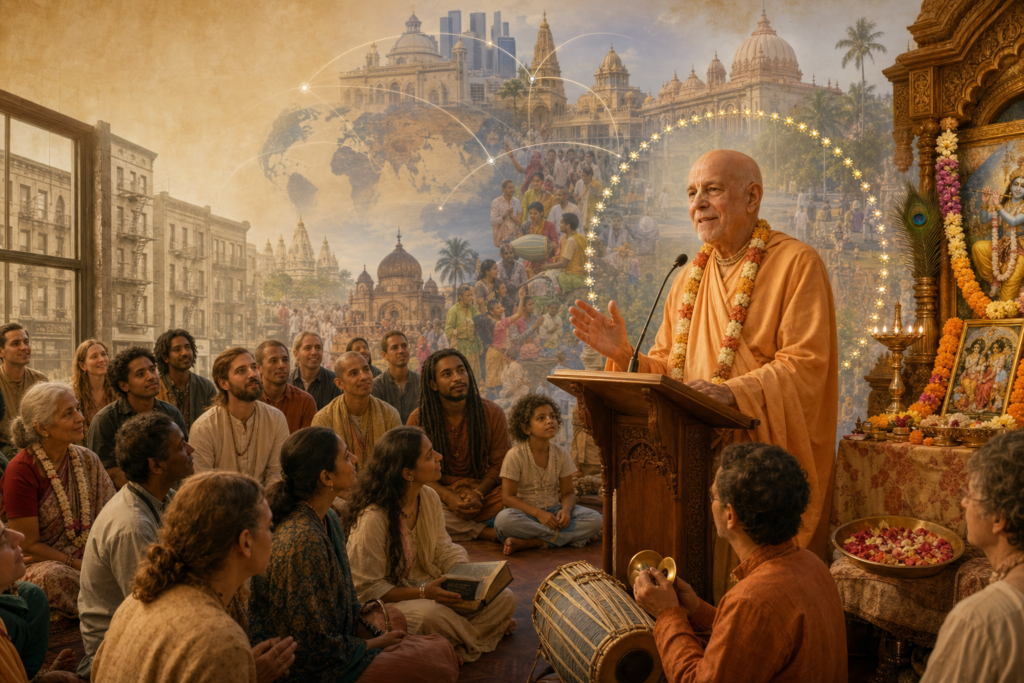
On Wednesday, July 8, 2026, the third day of ISKCON’s 60th Anniversary Week returned attention to a remarkably small New York storefront with an exceptionally large historical legacy. Matchless Gifts at 26 Second Avenue was the setting in which A.C. Bhaktivedanta Swami Prabhupada gathered an early community of spiritual seekers, established a regular program of bhakti-yoga, and founded the International Society for Krishna Consciousness in 1966. Sixty years later, the anniversary observance treated the address not simply as an old building but as a living site of religious memory.
The Day 3 program was part of a week of events held from July 6 to July 13, culminating on the sixtieth anniversary of ISKCON’s incorporation. According to the official schedule, the evening session ran from 6:00 p.m. to 9:00 p.m. and featured Vamanadeva Das, Adideva Das, Laksmi Nrismha Das, and Adarsi Das. The broader anniversary program combined kirtan, classes, historical recollections, harinama through the surrounding streets, visits to nearby sacred sites, and the sharing of prasadam.
Watch the Day 3 program
The recorded program from ISKCON 26 2nd Avenue @Matchless Gifts can be viewed on YouTube: ISKCON 60th Anniversary Week—Day 3. The recording is significant as both a devotional presentation and a contemporary historical document, preserving voices connected with ISKCON’s institutional memory at the place where the movement formally began.
Why 26 Second Avenue matters
The importance of 26 Second Avenue becomes clearer when its physical scale is compared with the movement that developed from it. The original center was neither a monumental temple nor a well-funded institution. It was a modest commercial storefront on Manhattan’s Lower East Side, previously occupied by a curio shop whose sign read “Matchless Gifts.” Prabhupada retained the name, and it acquired an enduring spiritual resonance: the storefront’s former commercial identity came to symbolize the gift of Krishna consciousness offered through teaching, chanting, devotional service, and community.
For many visitors, the emotional power of the site lies precisely in this contrast. Its limited dimensions make the beginnings of ISKCON appear tangible. The rooms demonstrate that global institutions do not always begin with wealth, administrative complexity, or architectural grandeur. They may begin with a clear purpose, disciplined practice, personal hospitality, and a small community prepared to listen and participate.
The anniversary therefore invites more than nostalgia. It provides an opportunity to examine how religious ideas move across cultures, how a community forms around repeated practices, and how an informal circle of participants develops into a durable institution. In this respect, Matchless Gifts is relevant to the study of modern Hindu history, transnational religion, urban spirituality, immigration, cultural translation, and the preservation of sacred heritage.
From the Jaladuta to the Lower East Side
Prabhupada arrived in the United States in 1965 after crossing the Atlantic aboard the cargo ship Jaladuta. He was sixty-nine years old and carried with him the early volumes of his English translation and commentary on the Srimad-Bhagavatam. His material resources were limited, and his first year in the United States involved considerable uncertainty. After spending time in Butler, Pennsylvania, he returned to New York and continued speaking wherever opportunities emerged.
In the spring and summer of 1966, assistance from a small number of interested young people enabled him to rent the storefront at 26 Second Avenue and an apartment across the courtyard. The arrangement gave his work a stable base. Regularity was crucial: a fixed address allowed lectures, kirtan, discussions, cooking, publication work, and personal instruction to occur repeatedly rather than as isolated encounters.
The Lower East Side supplied a distinctive social environment. The neighborhood contained artists, students, immigrants, countercultural communities, and people questioning conventional social and religious institutions. Prabhupada did not dilute the central claims of Gaudiya Vaishnava theology to fit this setting. Instead, he translated its concepts into accessible English, answered questions directly, demonstrated devotional practices, and allowed newcomers to learn through participation.
This combination of doctrinal continuity and practical adaptation helps explain the early center’s effectiveness. Sanskrit theological categories were not presented merely as abstract ideas. They were embodied through sound, food, study, service, daily discipline, and relationships within a developing community. The storefront became a compact spiritual laboratory in which philosophy and practice continually informed each other.
What took place inside Matchless Gifts
Early handbills advertised morning meetings and evening gatherings on Monday, Wednesday, and Friday. Participants heard Prabhupada speak on texts such as the Bhagavad Gita, joined in congregational chanting, asked philosophical questions, and received sanctified vegetarian food. These activities established a repeatable structure that could later be reproduced in other cities.
The central public practice was kirtan, the collective chanting of sacred names. The Hare Krishna maha-mantra—Hare Krishna, Hare Krishna, Krishna Krishna, Hare Hare / Hare Rama, Hare Rama, Rama Rama, Hare Hare—required no prior knowledge of Sanskrit grammar or Hindu ritual procedure. A new participant could first listen, then respond, and eventually join fully in the chanting. This low threshold for participation did not make the practice theologically superficial; within Gaudiya Vaishnavism, sacred sound is understood as a direct means of remembering and approaching the divine.
Bhakti-yoga, as practiced in the storefront, involved more than musical expression. It integrated hearing about Krishna, chanting divine names, studying scripture, preparing and honoring prasadam, serving others, cultivating ethical restraint, and directing ordinary activities toward a devotional purpose. The method was therefore both contemplative and communal. It addressed personal consciousness while situating the practitioner within relationships of responsibility and service.
Prasadam also carried theological and social meaning. Food prepared and offered to Krishna was received as grace and then shared without requiring social status or prior membership. In a diverse urban environment, eating together helped transform visitors into a community. The practice joined metaphysics, hospitality, nutrition, ritual, and social inclusion in a single recurring activity.
The incorporation of ISKCON as an institutional turning point
On July 13, 1966, the International Society for Krishna Consciousness was legally incorporated in New York. Incorporation converted a developing circle of students into a religious society with a defined public identity and formal objectives. The decision to include “Krishna” in the organization’s name was especially consequential. It preserved theological specificity at a time when a more generalized expression might have seemed easier to introduce to an unfamiliar audience.
The incorporation document articulated seven purposes. These objectives functioned as an early technical framework for ISKCON’s religious, educational, communal, architectural, ecological, and publishing activities. They also demonstrate that the organization was conceived from the beginning as more than a local meditation group.
1. The Society would systematically communicate spiritual knowledge and teach techniques of spiritual life intended to address imbalances in values and contribute to unity and peace.
2. It would teach Krishna consciousness as presented in the Bhagavad Gita and Srimad-Bhagavatam, locating its message within a defined scriptural tradition.
3. It would bring members closer to one another and closer to Krishna while developing an understanding of the soul’s relationship with the divine.
4. It would teach and encourage sankirtan, the congregational chanting of the holy name associated with the teachings of Sri Chaitanya Mahaprabhu.
5. It would establish sacred places dedicated to Krishna for the benefit of members and society at large.
6. It would bring members together to teach a simpler and more natural way of life.
7. It would publish and distribute books, periodicals, magazines, and other writings in support of these purposes.
These purposes help explain the movement’s subsequent development. Public kirtan reflected the fourth purpose; temples and communities expressed the fifth and sixth; scriptural translation and the later work of the Bhaktivedanta Book Trust advanced the second and seventh. The worldwide network that emerged was therefore not an accidental collection of unrelated projects. Its principal activities were already present, in conceptual form, in the founding document.
From Matchless Gifts to Tompkins Square Park
The anniversary week’s harinama route between Matchless Gifts and Tompkins Square Park retraced one of the most important geographical relationships in early ISKCON history. The storefront provided an interior space for teaching and community formation, while the park opened the practice of kirtan to the city. Moving between the two allowed a devotional tradition rooted in India to become audible and visible within New York’s public life.
On October 9, 1966, Prabhupada and his early followers held a historic outdoor chanting session beneath an American elm in Tompkins Square Park. The gathering included poet Allen Ginsberg and other figures associated with the era’s counterculture. The tree later became known as the Hare Krishna Tree and is recognized by New York City Parks as a notable feature of the park.
The relationship between storefront and park reveals an effective model of religious communication. Study and formation occurred in a stable interior setting; public chanting brought the practice into an open civic space; interested participants could then return to the storefront for sustained learning. Contemporary anniversary processions preserve this spatial pattern and turn the surrounding neighborhood into a historical map that can be encountered on foot.
Why the Day 3 testimonies are historically valuable
The presence of senior devotees during Day 3 gave the program an oral-history dimension. Institutional records can establish dates, legal milestones, addresses, publications, and formal decisions, but personal testimony can preserve different forms of evidence: the atmosphere of early gatherings, the practical demands of service, the character of relationships, and the ways participants understood events while they were unfolding.
Oral history must be approached with the same care applied to other historical sources. Memory is selective, shaped by later experience, and sometimes organized around a community’s established narratives. Nevertheless, firsthand recollections remain indispensable when they are considered alongside photographs, audio recordings, films, correspondence, legal documents, lecture transcripts, newspapers, and contemporaneous publications.
The Day 3 recording consequently serves several audiences. Devotees may receive it as remembrance and spiritual association. Historians may examine it as evidence of how a religious community narrates its origins after six decades. Students of heritage preservation may observe how testimony becomes connected to an authenticated physical setting. Members of the wider public can encounter the human scale of a movement often known primarily through its later global visibility.
A restored space and the ethics of preservation
Matchless Gifts has undergone careful restoration intended to recreate important features of its 1966 appearance. Research for the project drew upon archival photographs, film, books, interviews, memorabilia, and recollections from early disciples. Floors, walls, ceilings, artwork, furnishings, and signage were studied so that the site could function as a living museum rather than as an ordinary modern meeting room without visible historical context.
This method raises an important question in heritage practice: what should be preserved when the most significant history of a place lies in activities rather than architecture? At 26 Second Avenue, the answer requires both material and intangible preservation. The storefront, sign, interior arrangement, and artifacts provide physical evidence, while kirtan, scriptural discussion, hospitality, recollection, and prasadam preserve patterns of practice.
A living sacred site cannot be treated exactly like a static museum. Worshippers and visitors continue to use it, and that use is part of its authenticity. Preservation must therefore balance historical interpretation with contemporary devotional life. The anniversary week demonstrated this balance by combining tours and memories with the same broad categories of activity—chanting, teaching, service, and shared food—that characterized the early community.
Gaudiya Vaishnavism and the wider Dharmic landscape
ISKCON is situated within Gaudiya Vaishnavism, a devotional tradition centered on loving service to Radha and Krishna and strongly associated with the teachings of Sri Chaitanya Mahaprabhu. Its theology, rituals, scriptural canon, and lineage are distinct, yet its history also belongs to the wider story of Hindu traditions adapting to new languages, regions, technologies, and social environments.
The commemoration can also support respectful understanding among Hindu, Buddhist, Jain, and Sikh communities. These traditions should not be collapsed into a single doctrine, because each possesses its own history, texts, institutions, and philosophical positions. At the same time, they can meet constructively around shared commitments to disciplined practice, compassion, self-examination, service, ethical responsibility, the transmission of wisdom, and the protection of sacred heritage.
Matchless Gifts offers a particularly useful case study in such dialogue. It shows how a tradition can maintain a clear identity while communicating across cultural boundaries. Authentic pluralism does not require the erasure of difference. It requires sufficient confidence for traditions to explain themselves accurately, listen carefully to others, and cooperate where ethical and social concerns converge.
How a storefront became a worldwide movement
ISKCON expanded rapidly after 1966. Temples and communities were established in additional North American cities and later across Europe, Latin America, Africa, Asia, and other regions. Public festivals, scriptural publishing, vegetarian food distribution, rural communities, educational programs, and temple worship became recognizable features of the movement’s international presence.
Several organizational mechanisms made this expansion possible. Prabhupada trained disciples to reproduce a core program; translated texts created a portable curriculum; congregational chanting required relatively little infrastructure; prasadam joined spiritual practice with hospitality; and a clearly defined institutional name connected geographically distant communities. The movement combined central theological commitments with considerable local adaptability.
Media also played an important role from the beginning. Printed handbills advertised the storefront meetings, books supplied theological depth, magazines sustained communication, recordings carried sacred sound, and early documentary films preserved the visual character of the community. The Day 3 livestream belongs to this longer history. Digital broadcasting now allows a program held in the original storefront to be viewed by a worldwide audience in real time or through an archive.
The continuity between the seventh purpose of ISKCON—publishing and distributing writings—and contemporary digital communication is especially notable. The medium has changed from handbills, books, and periodicals to websites, livestreams, and searchable video archives, but the educational logic remains recognizable. Communication is treated not as an accessory to the tradition but as one of its foundational institutional activities.
What the anniversary teaches
The sixtieth anniversary demonstrates that heritage is sustained through repeated acts of remembrance and practice. Buildings survive because communities continue to recognize their meaning. Oral histories remain available because someone records them. Rituals cross generations because experienced practitioners teach newcomers. Archives become useful because documents, images, objects, and recordings are organized and interpreted rather than merely stored.
The anniversary also highlights the relationship between vision and infrastructure. Prabhupada’s spiritual purpose was expansive, but its earliest expression depended on practical details: rent, a reliable meeting place, printed notices, cooking facilities, schedules, legal registration, books, musical instruments, and volunteers. The history of Matchless Gifts shows that religious charisma and administrative competence need not be opposing forces. Durable communities generally require both.
There is also a deeply relatable lesson in the site’s modesty. Significant work often begins before ideal conditions exist. The early participants did not wait for a grand temple, broad social recognition, or abundant resources. They worked with a narrow storefront, a small circle of people, and a disciplined daily practice. The subsequent history does not make those beginnings less fragile; it makes their persistence more striking.
Sixty years later, the original gift remains visible
Day 3 of ISKCON’s 60th Anniversary Week was meaningful because it joined place, practice, memory, and technology. Senior devotees assembled at the movement’s founding address; kirtan again connected the storefront with the streets of the Lower East Side; historical testimony was recorded; and a global audience could witness the observance through digital media.
Matchless Gifts endures as more than the answer to a historical question about where ISKCON began. It demonstrates how Gaudiya Vaishnava teachings entered a new cultural setting without surrendering their central identity, how participation created community, and how a clearly articulated mission grew from one room into an international movement. Its history gives scholars a rich example of transnational religion and gives spiritual communities a practical lesson in courage, continuity, and service.
The most powerful feature of 26 Second Avenue may still be its scale. A visitor can stand inside the room and recognize that the distance between a small beginning and a worldwide legacy was crossed through countless acts of teaching, chanting, cooking, writing, organizing, listening, and serving. The sixtieth anniversary honors that accumulated work while returning attention to the simple practices from which it grew.
Research sources: Historical and event details were verified through the official Matchless Gifts anniversary schedule, the ISKCON News anniversary announcement, the official history of ISKCON, the Matchless Gifts site history, the Seven Purposes of ISKCON, and the account of the restored storefront.
Inspired by this post on Dandavats.






Leave a Reply
You must be logged in to post a comment.