
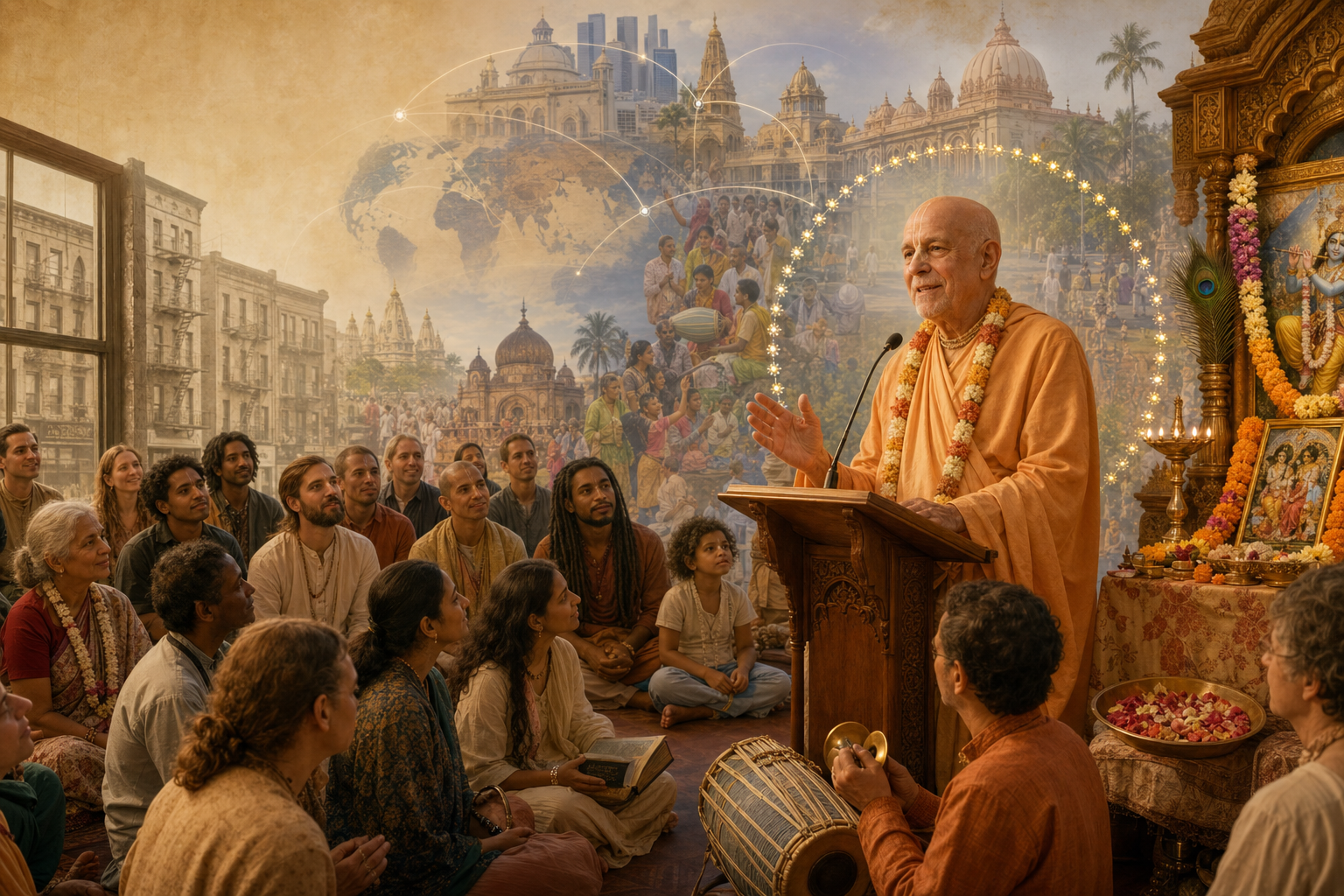
The second day of ISKCON’s 60th Anniversary Week brings attention to HG Anuttama Prabhu and to a question larger than any single commemorative program: how can a spiritual movement preserve the integrity of its founding vision while serving communities that have changed dramatically over six decades? The anniversary is therefore more than a celebration of institutional longevity. It is an opportunity to study the historical development, theological foundations, leadership culture and continuing social significance of the Hare Krishna Movement.
Primary recording: The Day 2 presentation is available at https://www.youtube.com/watch?v=dUTbbCjDHJo and was published by the channel ISKCON 26 2nd Avenue @Matchless Gifts. The recording should be treated as the primary source for HG Anuttama Prabhu’s complete remarks, tone and emphasis. The discussion below supplies the historical and theological context needed to understand why this anniversary, this location and this speaker are significant.
Why the sixtieth anniversary matters. ISKCON, the International Society for Krishna Consciousness, was formally established in New York City in 1966 by His Divine Grace A. C. Bhaktivedanta Swami Prabhupada. A sixtieth anniversary marks a transition from living memory into multigenerational history. Early participants may remember the movement’s formative years directly, while younger members encounter those years through books, recordings, photographs, temples, family narratives and inherited practices. The anniversary consequently becomes a meeting point between memory and scholarship, devotion and documentation, gratitude and institutional self-examination.
The emotional force of that history is difficult to separate from its modest beginnings. Srila Prabhupada arrived in the United States in 1965 after crossing the Atlantic aboard the cargo ship Jaladuta. He possessed limited material resources, had no large organization waiting for him and was attempting to communicate a sophisticated Vaishnava tradition in an unfamiliar cultural setting. Within the following year, he gathered a small group of students in New York, taught the Bhagavad-gita and Srimad-Bhagavatam, led public kirtan and established ISKCON. What began in a rented storefront eventually developed into an international network of temples, farms, schools, publishing projects and devotional communities.
26 Second Avenue and the meaning of “Matchless Gifts.” The association of the anniversary program with ISKCON 26 2nd Avenue @Matchless Gifts carries unusual historical importance. The small Lower East Side storefront at 26 Second Avenue served as ISKCON’s first temple. “Matchless Gifts” was the name left on the shopfront by an earlier business, but the phrase acquired a fitting spiritual resonance. In the emerging community, the matchless gift was not understood as a commodity. It was the opportunity to hear about Krishna, chant the holy names, study bhakti philosophy and participate in a disciplined form of devotional life.
The location offers a useful corrective to triumphal accounts of religious history. Durable institutions do not always begin with wealth, social prestige or political influence. They can begin with sustained teaching, repeated practice, personal trust and a community willing to accept responsibility. For contemporary visitors, the storefront’s scale makes the movement’s later global expansion feel tangible. It demonstrates how institutional growth may arise from a small group’s consistent attention to a clearly articulated spiritual purpose.
The Gaudiya Vaishnava foundation. ISKCON belongs to the Gaudiya Vaishnava tradition, a devotional lineage associated especially with Sri Caitanya Mahaprabhu, whose sankirtana movement developed in Bengal and Odisha in the sixteenth century. Its central practice is bhakti, loving devotional service to the Supreme. Krishna is approached not merely as an abstract concept but as the supreme personal reality with whom the individual soul has an eternal relationship. This personalist theology informs ISKCON’s worship, music, ethics, scriptural interpretation and understanding of spiritual community.
A key philosophical formulation in this tradition is acintya-bhedābheda-tattva, commonly explained as the inconceivable simultaneous oneness and difference between the Supreme and the energies of the Supreme. The individual being is spiritually related to Krishna and shares a qualitative spiritual nature, yet does not become identical to Krishna in every respect. This formulation allows the tradition to speak of intimacy without erasing distinction, unity without uniformity and dependence without denying meaningful personal agency.
ISKCON’s teaching is grounded especially in the Bhagavad-gita, Srimad-Bhagavatam and Caitanya-caritamrita, as presented through the Gaudiya Vaishnava disciplic succession. Scriptural study is not treated solely as an intellectual exercise. Knowledge is expected to shape intention, conduct and consciousness. Hearing sacred teachings, reflecting on them and applying them in daily life form an integrated process. The tradition therefore joins theology with practice: philosophical claims are tested through disciplined attention, service, ethical restraint and the cultivation of devotion.
Chanting as a spiritual technology. The most recognizable ISKCON practice is the chanting of the Hare Krishna maha-mantra: Hare Krishna, Hare Krishna, Krishna Krishna, Hare Hare / Hare Rama, Hare Rama, Rama Rama, Hare Hare. Within Gaudiya Vaishnavism, the mantra is not regarded as entertainment, a slogan or a merely symbolic reminder. It is understood as a direct form of engagement with the divine names. Chanting may be performed individually as japa or collectively as kirtan and sankirtana.
From a practical perspective, chanting organizes attention through sound, rhythm, repetition and intentional remembrance. In congregational kirtan, call-and-response participation also reduces the distance between performer and audience. Everyone can listen and respond, regardless of scholarly preparation. This accessibility helped the early movement cross linguistic and social boundaries. At the same time, accessibility should not be mistaken for superficiality: sustained japa requires patience, regularity and the repeated redirection of a distracted mind.
The practice belongs to the broader Vaishnava framework of śravaṇam, hearing; kīrtanam, chanting or glorification; and smaraṇam, remembrance. These disciplines show why sound occupies such a central place in Krishna consciousness. Hearing precedes many forms of understanding, while repeated chanting turns theology into embodied practice. The participant does not simply learn a definition of devotion but enters a daily pattern intended to reshape attention, desire and relationships.
HG Anuttama Prabhu and the responsibilities of mature leadership. The devotional honorific “HG” means “His Grace.” HG Anuttama Prabhu has long been associated with ISKCON service in leadership development, communications and interreligious engagement. His presence during the anniversary week is relevant because a global spiritual institution depends upon more than historical memory. It needs leaders capable of interpreting inherited principles, educating new generations, communicating across cultures and addressing difficult questions without weakening theological clarity.
Leadership in a devotional movement differs in important respects from leadership in a commercial organization. Administrative competence remains necessary, but authority is expected to be connected with service, character, spiritual discipline and accountability. The Sanskrit concept of seva reverses the assumption that leadership primarily confers status. A leader is entrusted with responsibility for people, teachings, resources and institutional credibility. The higher the position, the greater the obligation to listen carefully, act transparently and place collective spiritual welfare above personal prestige.
ISKCON’s development also illustrates a classic institutional challenge: a founding generation must eventually transmit responsibility to successors. Srila Prabhupada created the Governing Body Commission in 1970 as part of the movement’s administrative structure. The historical transition following his physical departure in 1977 required the community to distinguish the founder-acharya’s unique role from the responsibilities of later teachers and governors. That process has involved learning, correction and continuing debate about authority, pastoral care, standards and accountability.
An anniversary becomes meaningful when it acknowledges both achievement and responsibility. Institutional maturity is not demonstrated by pretending that every phase of development was free from difficulty. It is demonstrated by preserving reliable records, learning from experience, protecting community members, strengthening systems of care and returning repeatedly to stated spiritual principles. Honest reflection need not diminish devotion. When conducted responsibly, it can protect devotion from sentimentality and protect institutions from avoidable repetition of past errors.
Communication as a form of stewardship. ISKCON’s history is inseparable from communication. Srila Prabhupada lectured, translated Sanskrit texts, wrote extensive commentaries, answered correspondence and trained students to distribute books. His books gave the young movement a stable intellectual center and enabled readers far from a temple to encounter Gaudiya Vaishnava thought. Publishing was therefore not incidental publicity; it was a principal vehicle for theological transmission.
The communications environment of the twenty-first century is considerably more fragmented. A brief video clip can circulate without its surrounding argument, and religious vocabulary can be interpreted through categories foreign to its tradition. Responsible communication must therefore combine accessibility with context. Technical terms should be explained without being emptied of meaning, historical claims should be distinguished from devotional interpretation and questions should be answered with accuracy rather than defensiveness. Digital reach is valuable only when it is accompanied by intellectual and ethical care.
This responsibility extends to the way a community describes other traditions. Clear commitment to Krishna consciousness does not require contempt for another person’s sacred path. Academic accuracy and Dharmic civility both require careful distinctions among Hindu, Buddhist, Jain and Sikh philosophies, while recognizing their long histories of dialogue, debate and cultural interaction. Unity among Dharmic traditions is strongest when it does not erase real doctrinal differences. Respectful engagement allows distinct traditions to meet without demanding that one be reduced to a version of another.
Unity without homogenization. Gaudiya Vaishnavism possesses its own theology, lineage, ritual culture and understanding of liberation. Buddhism, Jainism and Sikhism likewise contain internally diverse schools, texts and institutions. A responsible anniversary reflection can affirm ISKCON’s specific identity while supporting a broader culture of nonviolence, truthful dialogue, religious literacy and mutual dignity. Such unity is not a claim that all doctrines are identical. It is a disciplined commitment to coexistence, learning and principled cooperation.
This approach also reflects an important feature of Hindu civilization: philosophical disagreement has often existed alongside shared sacred geographies, languages, artistic forms and social relationships. Debate can sharpen understanding when it is conducted without dehumanization. For contemporary audiences, this is more than a historical observation. Families, workplaces and neighborhoods frequently include people with different devotional commitments. The ability to remain rooted while treating others fairly is therefore a practical spiritual skill.
From personal discipline to community culture. Krishna consciousness is sustained through recurring practices rather than occasional inspiration alone. Daily japa, scriptural study, deity worship, kirtan, association with practitioners, service and the honoring of prasadam create a structured devotional environment. Initiated practitioners traditionally undertake ethical disciplines that include abstaining from meat eating, intoxication, gambling and illicit sexual activity. These commitments are intended to reduce habits believed to agitate consciousness and obstruct sustained spiritual attention.
The significance of discipline becomes clearer when it is separated from mere rule enforcement. A practice has transformative value when its purpose is understood, when senior members model it responsibly and when individuals receive guidance appropriate to their stage of development. Rules without compassion can produce concealment or fear; compassion without standards can leave spiritual aspiration undefined. Mature community life requires both clarity and pastoral sensitivity.
For many participants, the temple provides a rhythm missing from otherwise fragmented daily life. Bells, arati, kirtan, scripture classes, festival calendars and shared prasadam connect private conviction with collective practice. The temple can function simultaneously as a sacred space, classroom, kitchen, cultural center and network of mutual support. Its health should therefore be measured not only by attendance or construction but also by the quality of education, relationships, care and ethical conduct it cultivates.
Prasadam and the theology of hospitality. Food offered to Krishna and subsequently honored as prasadam occupies a central place in ISKCON community life. The practice joins devotion, sensory experience and hospitality. Preparing food with care, making an offering and sharing it with others turns an ordinary biological necessity into an occasion for remembrance and service. It also gives visitors an immediate experience of the tradition before they possess technical knowledge of its philosophy.
Hospitality has institutional consequences. A movement that welcomes guests must also learn to welcome sincere questions. Newcomers may be attracted by music, philosophy, vegetarian food, meditation, Indian culture or a search for community. Their motives and levels of understanding will differ. Thoughtful education allows initial interest to mature without coercion. It explains practices, acknowledges complexity and gives individuals time to understand the commitments associated with a devotional path.
Global expansion and cultural translation. ISKCON’s international development demonstrates that a tradition can travel while retaining recognizable practices. Temples across different countries chant the same maha-mantra and study a common body of texts, yet they operate within distinct languages, legal systems and cultural expectations. Translation is therefore unavoidable. The essential question is not whether adaptation will occur, but how to distinguish legitimate adaptation from the loss of foundational teachings.
Several criteria can guide that distinction. Adaptation should preserve the theological center of bhakti to Krishna, remain accountable to scripture and recognized lineage, support rather than obstruct core spiritual practices and avoid presenting local custom as universal revelation. At the same time, inherited habits should not automatically be treated as eternal principles merely because they are familiar. Careful discernment allows communities to be culturally intelligent without becoming spiritually vague.
This balance matters especially for second- and third-generation members. They may inherit devotional practices while speaking different first languages and navigating social environments unlike those of their parents or grandparents. They need more than nostalgia. They need rigorous education, meaningful service, trustworthy mentors and room to ask difficult questions. When transmission is reduced to external conformity, younger members may experience tradition as a burden. When principles are explained and embodied with integrity, the same tradition can become a durable spiritual home.
Education as preservation and renewal. A sixty-year-old movement must educate at several levels simultaneously. Beginners need clear introductions to Krishna, bhakti, karma, reincarnation, guru, mantra and scripture. Established practitioners need deeper study of Sanskrit terminology, Vaishnava theology, hermeneutics, history and ethics. Leaders require additional training in governance, safeguarding, conflict resolution, financial stewardship, teaching and pastoral care. Without this layered educational structure, a global community risks producing either inaccessible scholarship or oversimplified messaging.
Education also protects against two opposite errors. The first is anti-intellectualism, in which sincere feeling is treated as a substitute for careful study. The second is sterile intellectualism, in which religious knowledge becomes detached from humility, conduct and service. The Gaudiya Vaishnava ideal joins understanding with transformation. Learning should deepen devotion, while devotion should create the patience and honesty necessary for serious learning.
What institutional success should mean. Numerical growth, property, publications and public visibility offer useful but incomplete measures. A spiritual institution must also ask whether members are developing compassion, steadiness, truthfulness, humility and genuine attachment to devotional practice. It must consider whether families receive support, whether children are protected, whether women and men can contribute with dignity, whether leaders are accountable and whether disagreements are handled without intimidation or factional hostility.
These questions are demanding because spiritual institutions consist of imperfect human beings gathered around transcendent ideals. The gap between an ideal and its implementation can cause disappointment, but it can also inspire reform. The appropriate response is neither cynicism nor denial. It is sustained institutional work guided by scripture, ethical reasoning, evidence, consultation and the humility to correct what has not served the community well.
How to approach the Day 2 recording. Viewers can listen on several levels. One level concerns historical memory: how are Srila Prabhupada, 26 Second Avenue and ISKCON’s early years remembered? A second concerns theology: which principles are presented as permanent, and how are they connected with scripture? A third concerns leadership: what responsibilities accompany the movement’s transition into its seventh decade? A fourth concerns personal application: which habits of hearing, chanting, service and reflection can move spiritual life from admiration to practice?
It is also useful to notice the relationship between conviction and humility. A speaker representing a mature tradition must communicate definite teachings while recognizing the audience’s varied experiences. Effective spiritual communication neither conceals commitment nor treats questions as threats. It creates a setting in which fidelity, reasoned explanation and humane engagement reinforce one another.
A legacy that remains active. The most compelling feature of ISKCON’s history is not simply that a movement founded in a small New York storefront survived for sixty years. It is that practices introduced there continue to be repeated daily across languages and generations. The sound of the maha-mantra, the study of Bhagavad-gita, the sharing of prasadam and the aspiration to serve Krishna connect contemporary communities with the founding period while giving each generation a responsibility of its own.
Day 2 of ISKCON’s 60th Anniversary Week therefore stands at the intersection of remembrance and renewal. HG Anuttama Prabhu’s participation draws attention to the importance of leadership, communication and thoughtful transmission in the life of a global spiritual society. The anniversary honors Srila Prabhupada’s extraordinary achievement, but its deepest value lies in the questions it places before the present: what must be preserved, what must be learned, how should service be organized and how can Krishna consciousness be communicated with both conviction and care?
Six decades after ISKCON’s incorporation, the storefront at 26 Second Avenue remains a powerful image of spiritual possibility. Its history suggests that lasting change can begin through attentive hearing, disciplined practice, courageous teaching and sincere relationships. The next chapter will depend on whether those qualities are renewed rather than merely remembered. In that sense, the 60th anniversary is not only a record of what has been accomplished; it is an invitation to carry a living tradition forward with knowledge, humility, unity and devotion.
Inspired by this post on Dandavats.








Leave a Reply
You must be logged in to post a comment.