
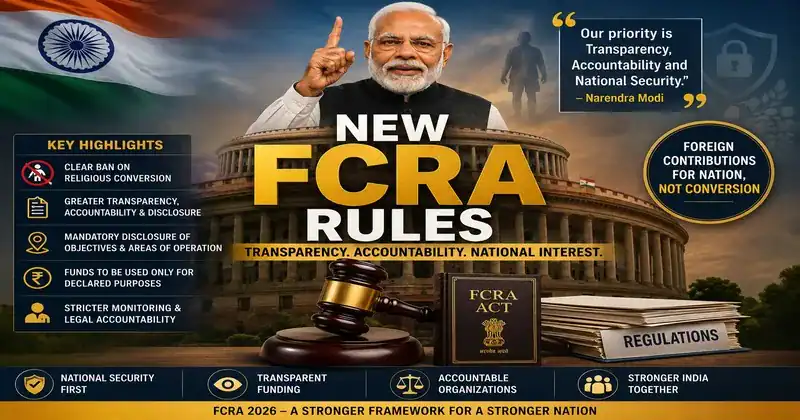
India’s debate over foreign-funded civil-society organisations has entered a more demanding phase. The immediate catalyst is the Foreign Contribution (Regulation) Amendment Rules, 2026, notified on 22 June 2026, together with revised compounding provisions for violations. These measures replace broad descriptions of charitable work with a system that links permission to specified purposes, declared locations, identifiable decision-makers and traceable donors. The result is more than a technical compliance update: it is a contest over sovereignty, religious freedom, charitable autonomy, political influence and the evidentiary standards that should govern allegations of foreign interference.
The controversy was presented forcefully in Virendra Parekh’s 4 July 2026 commentary. It welcomes the new framework as a decisive attempt to prevent foreign contributions from financing proselytisation, political campaigns and activities considered contrary to India’s national interest. Its central proposition is substantially correct: an FCRA certificate cannot be treated as a general licence to receive and deploy foreign money at institutional discretion. The purposes, locations, governance arrangements and actual use of every contribution are becoming central to regulatory supervision.
The source commentary also employs sweeping descriptions of missionaries, churches and the so-called jholawalla ecosystem. Such expressions convey political anger but are too imprecise for an academic account. A serious analysis must distinguish between lawful charity, protected religious teaching, voluntary changes of belief, prohibited inducement or coercion, partisan political activity and conduct demonstrably connected to foreign intelligence or terrorism. These categories cannot be collapsed into one another merely because an organisation receives money from abroad.
What the FCRA regulates. The Foreign Contribution (Regulation) Act, 2010 regulates the acceptance and utilisation of donations, securities and certain articles received from foreign sources. Its stated purpose is to prevent foreign contributions and foreign hospitality from adversely affecting India’s sovereignty, democratic institutions, public order and national interest. Persons conducting definite cultural, economic, educational, religious or social programmes ordinarily require either a five-year registration or prior permission for a particular donor, amount and project. Political parties, election candidates and several other specified categories are prohibited from accepting foreign contributions.
FCRA regulation is not new. The first comprehensive statute was enacted in 1976 amid concern about foreign influence over Indian political and public life. It was replaced by the more detailed 2010 Act, and the framework was tightened again through the 2020 amendment. The 2020 changes prohibited recipients from transferring foreign contributions to other persons, reduced the general ceiling on administrative expenditure from 50 to 20 per cent, introduced stronger identity requirements and required initial foreign remittances to enter through a designated FCRA account at the State Bank of India’s New Delhi Main Branch. The 2026 rules therefore continue an established movement toward centralised monitoring and recipient-level accountability.
Even before the latest rules, registration was never a blank cheque. An association had to use foreign contributions for the programme for which permission was granted, maintain separate accounts, file annual returns and remain within statutory restrictions. What changed in 2026 is the degree of specificity. The regulatory certificate is now expected to identify not simply a broad sector such as education or religion, but the scheduled activity and the State or Union Territory in which that activity will occur.
Purpose-specific and geography-specific permission. New rule 9(1B) requires an applicant to select its purposes from the schedule appended to the rules and name every State or Union Territory in which it proposes to work. Associations registered before the amendment have one year from its commencement to submit Form FC-6F identifying the purposes and territories they wish to retain. Adding or deleting a purpose or territory requires an application, a governing-body resolution and regulatory approval. The prescribed fee also increases by ₹300 for each additional purpose and each additional State or Union Territory.
This architecture turns an FCRA certificate into a defined regulatory perimeter. A health organisation registered to operate mobile clinics in one State cannot assume that the same certificate automatically covers an unrelated advocacy project elsewhere. A cultural trust approved to conserve manuscripts cannot freely redirect funds to political communication. For regulators, the model creates a clearer audit trail. For organisations, it demands project coding, location-based accounting and prior review whenever a programme evolves.
The new schedule is broad but prescriptive. It enumerates permitted work across religious, cultural, economic, educational and social fields. The listed activities include hospitals, maternal healthcare, sanitation, food security, disability services, vocational training, environmental education, digital inclusion, preservation of languages, archaeological conservation, classical arts, traditional knowledge and livelihood programmes. This breadth matters because the rules do not abolish foreign-supported philanthropy. They seek to confine it to activities declared in advance and capable of being verified.
The religious schedule similarly permits a substantial range of work. Foreign contributions may support the construction and maintenance of temples, mosques, churches, gurudwaras, monasteries, synagogues and other places of worship. Permitted activities also include preservation of sacred texts, pilgrim amenities, dharamshalas, langars, annadans, community kitchens, devotional arts, religious archives, counselling, de-addiction services, traditional sacred crafts, burial or cremation grounds and inter-faith peace initiatives. The notification expressly recognises the documentation and revival of indigenous and tribal faith practices.
This faith-neutral structure has particular significance for India’s dharmic traditions. Hindu temples, Buddhist monasteries, Jain institutions and Sikh gurudwaras can all benefit from clearer recognition of heritage preservation, religious education, community kitchens, sacred literature and inter-faith dialogue. Equal application is essential. Oversight cannot be credible if identical conduct is treated differently according to the religious identity of the institution involved.
What the proselytisation exclusion means. The schedule uses the phrase excluding proselytisation in three religious entries: institutions studying or preserving religious philosophy and history; religious education, moral instruction, satsangs, discourses and meditation retreats; and the documentation or revival of indigenous and tribal systems of worship. The practical signal is clear: foreign contributions approved under these entries cannot be used to pursue conversion-oriented activity.
The notification does not, however, separately define proselytisation. That omission may create difficult boundary questions. Religious teaching can explain a tradition’s doctrines; a publication can advocate belief; an inter-faith conversation can influence personal conviction; and an adult can voluntarily adopt another faith. Administrators will therefore need to distinguish ordinary religious expression from an organised attempt to secure conversion through a foreign-funded programme. Clear guidance and case-specific evidence would reduce the danger of inconsistent enforcement.
The exclusion should not be misdescribed as a general prohibition on every religious activity or as a suspension of individual freedom of conscience. Article 25 of the Constitution protects the freedom to profess, practise and propagate religion, subject to public order, morality, health and other constitutional provisions. In Rev. Stainislaus v. State of Madhya Pradesh, the Supreme Court held that the right to propagate a religion does not include a fundamental right to convert another person. The judgment arose from laws directed against conversion by force, fraud, inducement or allurement, making the factual circumstances of any alleged violation especially important.
A balanced constitutional approach must protect both sides of the freedom-of-conscience equation. No person should be pressured to abandon an inherited tradition through money, deception, coercion or exploitation of vulnerability. At the same time, no adult should be harassed merely for studying another religion, changing a belief voluntarily or participating in lawful dialogue. Regulation of foreign funding and regulation of personal belief are connected subjects, but they are not legally identical.
Political and ideological boundaries. The claim that the 2026 rules newly prohibit all foreign-funded political activity requires qualification. The parent Act already bars political parties from receiving foreign contributions and empowers the government to identify organisations of a political nature. The new schedule adds more granular restrictions: awareness programmes concerning constitutional rights, fundamental duties and civic responsibilities must be strictly non-political, while contemporary arts inspired by Indian traditions must exclude political or ideological content.
These clauses will require careful interpretation. A civic-education programme can explain voting, constitutional remedies or public duties without supporting a party. Environmental research can evaluate a major project without becoming an electoral campaign. Conversely, a nominally educational grant can be structured to mobilise voters, produce partisan messaging or finance agitation. The relevant inquiry should examine the donor agreement, expenditure trail, communications, beneficiaries and actual conduct rather than infer political purpose from disagreement with government policy.
Governance accountability now reaches effective control. The amended rules define a key functionary to include company directors, partners, trustees, the Karta of a Hindu undivided family, governing-body members and any other person exercising control over management or affairs. This functional definition is intended to prevent responsibility from being avoided through informal power structures. Boards will need updated registers, conflict-of-interest declarations, approval protocols and documented allocation of FCRA duties.
Associations with foreign nationals, other than persons of Indian origin, serving as key functionaries will ordinarily not be considered eligible for registration or prior permission, although the Central Government may specify exceptions and conditions. The rule raises legitimate sovereignty and control concerns, but it also affects international charities, research collaborations and faith-based networks. Organisations with multinational governance structures will need to examine whether advisory roles amount to effective control.
Donor transparency becomes more demanding. Form FC-4 now seeks details of official websites and social-media accounts, expanded activity reporting and project-level expenditure information. Where money is routed through a donor-advised fund or another intermediary remittance vehicle, the annual return must identify the ultimate donor, address, email and amount. This is a significant response to layered funding structures in which the transmitting institution may not be the original source of financial support.
Traceability can reveal conflicts of interest, coordinated influence and diversion of funds. It can also protect honest organisations by demonstrating exactly who financed a project and where the money went. Yet donor information and beneficiary data must be handled proportionately. Public accountability does not justify careless exposure of sensitive medical records, the identities of vulnerable beneficiaries or personal information unrelated to the regulatory purpose.
Utilisation thresholds reshape project finance. Under the prior-permission route, a second or subsequent instalment may be released only after 75 per cent of the previous instalment has been utilised and the utilisation has undergone field inquiry. Form FC-3BB requires extensive financial and project information, including professional certification. This requirement is designed to discourage the accumulation or diversion of unspent foreign money, but it may complicate projects whose expenditure is seasonal or dependent on construction milestones, procurement cycles and emergency conditions.
New rule 14A also defines reasonable activity for cancellation and renewal purposes by reference to the use of at least ₹10 lakh in foreign contribution during the preceding two financial years. The provision does not state that every organisation below the threshold is instantaneously cancelled. It establishes the quantitative standard by which reasonable activity is to be assessed under the relevant statutory provisions. Small trusts receiving irregular grants will nevertheless need to consider the threshold in their renewal planning.
Compounding has become expensive. A separate notification issued under section 41 revises the amounts payable to compound specified offences. Depending on the violation, the amount may be ₹1 lakh or a percentage of the foreign contribution involved, whichever is higher. Using foreign contributions for speculative investment can attract 30 per cent of the amount invested, subject to the prescribed minimum, together with recovery of the returns. Diversion to an unauthorised purpose, or use in an unapproved State or Union Territory, can also produce substantial percentage-based liability.
Compounding should not be confused with every possible criminal or administrative consequence under the Act. It is a statutory mechanism for settling specified offences instead of undergoing full prosecution, subject to its conditions. Serious or repeated non-compliance may still lead to suspension, cancellation, restrictions on utilisation and other proceedings. This makes preventive compliance considerably less expensive than attempting to regularise a violation after funds have been spent.
For an FCRA-registered organisation, the practical response is a purpose-and-location control matrix. Every grant should be mapped to the certificate, donor instrument, approved territory, project budget and bank trail. Payments should carry project codes; programme teams should obtain compliance clearance before moving activity across a State boundary; social-media communication should be archived; and annual returns should reconcile narrative reports with the ledger. Boards should review unspent balances, administrative expenditure and the 75 per cent instalment threshold at regular intervals.
The human consequences of these procedures deserve attention. A village clinic awaiting its next instalment may experience the field inquiry as a delay in medicines or salaries. A small monastery preserving manuscripts may lack a specialised compliance department. At the same time, villagers, donors and beneficiaries have a legitimate interest in knowing that money promised for healthcare, education or heritage preservation was not redirected to political mobilisation or private gain. Effective regulation must recognise both realities.
The Kerala Assembly’s objection. On 1 July 2026, the Kerala Legislative Assembly adopted a resolution calling for the withdrawal of the 2026 rules and the pending amendment bill. The resolution argued that the changes threaten the autonomy of voluntary organisations working in education, healthcare, disaster relief, disability support and marginalised communities, while raising constitutional and federal concerns. According to reported proceedings, it received 111 votes in favour and two against.
That resolution is part of democratic scrutiny, not proof that Kerala’s institutions endorse unlawful conversion or foreign interference. Equally, describing every objection as a defence of misconduct avoids the substantive issues: the burden on smaller organisations, the breadth of administrative discretion, ambiguity surrounding proselytisation, territorial restrictions and the procedural safeguards available when registration is refused or cancelled. Those concerns should be evaluated on their merits.
The rules in force must be separated from the bill still pending. The source commentary treats the proposed asset-vesting framework as though it were already operative law. That is inaccurate as of 10 July 2026. The Foreign Contribution (Regulation) Amendment Rules, 2026 are in force, but the Foreign Contribution (Regulation) Amendment Bill, 2026, introduced in Lok Sabha on 25 March, remains pending according to the parliamentary record.
If enacted, the bill would create a more extensive Designated Authority framework for foreign contributions and assets associated with an organisation whose certificate is cancelled, surrendered or deemed to have ceased. Such funds and assets would vest provisionally in the authority. They could be returned if registration were renewed, restored or freshly granted within the prescribed period; otherwise, they could vest permanently and be transferred or disposed of for public purposes. The proposal also covers assets created partly from foreign contribution, subject to a mechanism concerning the ascertainable portion funded from other sources.
The proposed legislation contains safeguards and complications that polemical summaries often omit. It directs that the religious character of a permanently vested place of worship be maintained by entrusting its management or operation to an appropriate person. It also proposes to reduce the maximum imprisonment for a general contravention from five years to one year and require prior Central Government approval to initiate an investigation. The bill is therefore not simply a uniform escalation of punishment; it combines stronger asset-management powers with elements of penalty rationalisation and centralised investigative control.
The judicial background supports regulation but does not eliminate scrutiny. In Noel Harper v. Union of India, the Supreme Court upheld key provisions of the 2020 amendment. It held that there is no absolute right to receive foreign contributions and accepted Parliament’s authority to impose a stringent framework intended to protect sovereignty, public order and the general public. The judgment also approved the prohibition on transferring foreign contributions to third parties and the requirement that recipients use the money themselves for permitted purposes.
Noel Harper does not automatically validate every future rule, decision or enforcement action. Delegated legislation must remain within the parent Act, and administrative orders can still be tested for arbitrariness, discrimination, procedural unfairness or lack of evidence. A registration regime may be constitutionally strict while a particular cancellation is legally defective. Courts will therefore remain important in defining the limits of discretion under the 2026 framework.
Claims of foreign interference require proof. Parekh associates foreign funding with protests over the farm laws, the Citizenship Amendment Act, nuclear and port projects, and development in Great Nicobar. Such claims may justify investigation when supported by bank records, donor instructions, communications or evidence of coordinated action. They should not be presented as established facts solely because a protest inconvenienced the government or opposed a strategically important project. Legitimate dissent and covert foreign direction are different phenomena.
The same evidentiary discipline applies to allegations against religious organisations. It is neither accurate nor constructive to suggest that every church exists only to convert or that all faith-based charity is a façade. Christian institutions, like Hindu, Buddhist, Jain, Sikh and secular organisations, vary greatly in purpose and conduct. Where an institution uses foreign funds for prohibited proselytisation, inducement, partisan activity or diversion, the response should be firm and documented. Where it operates a lawful hospital, school, shelter or relief programme, its work should be assessed fairly.
This principle advances unity among dharmic traditions without weakening the rule of law. Hinduism, Buddhism, Jainism and Sikhism possess distinct philosophies and institutions, yet each has an interest in freedom of conscience, preservation of sacred heritage and protection from coercive interference. A neutral FCRA system can safeguard these interests by following money rather than stereotypes, examining conduct rather than communal identity and supporting inter-faith peace without requiring philosophical uniformity.
Technology can assist, but it cannot replace judgment. The suggestion that artificial intelligence could help supervise thousands of annual returns, websites and social-media accounts has practical merit. Automated systems can identify mismatches between declared purposes and expenditure descriptions, unusual donor networks, duplicated invoices or activity outside approved territories. They can help regulators prioritise inspections in a system involving approximately 16,000 registered associations and foreign receipts that the 2026 bill’s statement of objects estimates at around ₹22,000 crore annually.
Automated flags must never become automatic findings of guilt. Religious vocabulary, political discussion and regional-language content are highly sensitive to context. Any technology used for FCRA supervision should have documented criteria, bias testing, secure data practices, human review and a process through which an organisation can correct inaccurate conclusions. Efficient monitoring and natural justice are complementary requirements.
The decisive issue is implementation. The new rules can improve accountability if the government publishes clear interpretive guidance, processes FC-6F and FC-3BB applications within predictable periods, records reasons for adverse decisions and offers meaningful review. Field inquiries should use consistent standards. Minor clerical mistakes should be distinguished from deliberate diversion, while serious violations should attract proportionate and timely action.
Recipient organisations must respond with equal seriousness. Religious status, charitable intent and past public service cannot substitute for accurate books, transparent donor relationships and adherence to approved purposes. Trustees and directors should understand that compliance is now a governance obligation rather than a year-end filing exercise. Donors, meanwhile, should avoid conditions that blur humanitarian assistance with political influence or conversion-oriented objectives.
The enduring significance of the 2026 FCRA rules lies in their shift from institutional permission to continuous, transaction-level accountability. That shift can protect India from covert influence and strengthen confidence in genuine charity, but only if enforcement is evidence-based, faith-neutral and procedurally fair. The strongest defence of sovereignty is not indiscriminate suspicion. It is a transparent system capable of identifying real misconduct while preserving lawful service, religious freedom, democratic dissent and cooperation across India’s diverse traditions.
Inspired by this post on Hindu Post.









Leave a Reply
You must be logged in to post a comment.