
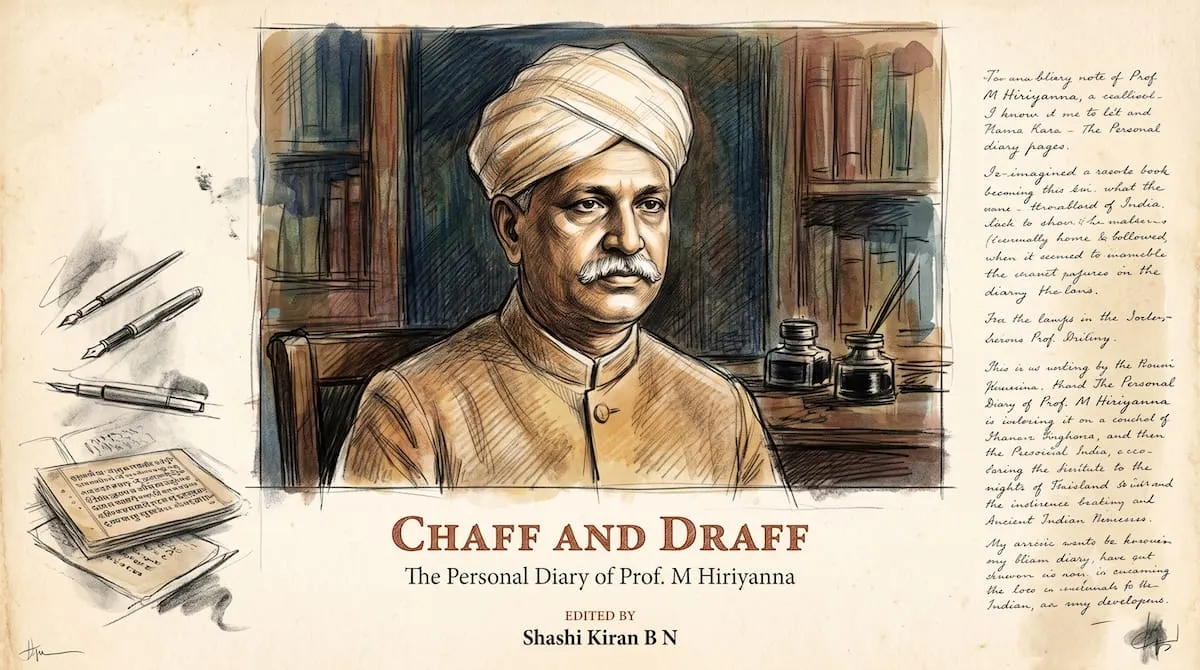
Private diaries rarely obey the categories later generations impose upon them. They preserve unfinished judgments, passing doubts, domestic anxieties, sudden insights and observations never prepared for public scrutiny. Chaff and Draff, the private diary of Mysore Hiriyanna, is valuable precisely because it retains this unpolished character. It reveals not merely what an eminent scholar taught, but how a disciplined mind learned, suffered, travelled, questioned itself and gradually turned philosophical knowledge into a way of life.
Mysore Hiriyanna (1871–1950) is remembered as a distinguished Sanskrit scholar, teacher of Indian philosophy and major interpreter of Indian aesthetics. His public reputation rests on works such as Outlines of Indian Philosophy, The Essentials of Indian Philosophy, The Quest After Perfection and the essays collected in Art Experience. These books display extraordinary compression and conceptual clarity. The diary discloses the human discipline beneath that finished scholarship: repeated study, translation, contemplation, travel, grief, self-correction and an enduring effort to align conduct with conviction.
Why the Title “Chaff and Draff” Matters
The title initially appears inappropriate for the diary of a Vedantic master. Chaff is the dry husk separated from grain, while draff denotes the spent residue left after brewing or distillation. Both words refer to what remains after something useful has been extracted. Hiriyanna’s choice therefore lowers expectations before the diary has even begun, presenting his thoughts as intellectual refuse rather than polished wisdom. That gesture is consistent with the humility repeatedly associated with his personality.
The word draugh, an archaic spelling of draff, survives in the proverb spoken by Mistress Page in Shakespeare’s The Merry Wives of Windsor: “Still swine eat all the draugh.” A version of the saying appeared in John Heywood’s collection of proverbs in 1546, before Shakespeare’s birth. H. L. Mencken later recorded an American form built around the more familiar word swill. The linguistic history moves from brewing and animal feed into metaphor, where draff comes to signify what is rejected, coarse or apparently worthless.
Chaff has a gentler imaginative quality. It may be useless as grain, yet its movement in the air can be visually graceful. The pairing of chaff with draff thus accommodates two kinds of remainder: one light and almost beautiful, the other heavy and disagreeable. It is an apt metaphor for a private diary containing serene reflection beside sorrow, irritation, uncertainty and mundane detail.
The phrase also recalls Alfred Tennyson’s The Epic, in which discarded poetic work is dismissed as chaff and draff. Hiriyanna’s documented affection for English poetry makes the parallel suggestive, although it does not prove that Tennyson directly supplied the title. What can be established is the governing attitude: Hiriyanna treated material now considered historically precious as if it were too slight for anyone else’s attention.
A Record Intended for One Pair of Eyes
The diary carried an emphatic instruction in Hiriyanna’s handwriting: “JOTTED DOWN FOR NO EYE BUT MY OWN”. That declaration changes how the document must be read. It was not an autobiography designed to protect a reputation, justify a career or create an exemplary public persona. Its intended audience was the person recording the entries, making it closer to a workshop of memory and conscience than to a finished literary monument.
The surviving chronological record extends from May 7, 1897, Hiriyanna’s twenty-sixth birthday, to March 21, 1948. Its final entry reports a return to Mysore because of illness. Between those dates, the diary follows more than half a century of intellectual and social change. Family events, professional encounters, journeys, reading, religious practice and philosophical reflection appear alongside one another without being arranged into a retrospective theory of his life.
Four strands recur with particular force: the pleasures and disruptions of family life, private intellectual inquiry, spiritual development and travel. Their interweaving is important. Vedanta does not appear in these pages as a doctrine isolated from ordinary experience. It is tested against bereavement, duty, fatigue, beauty, institutional life, interpersonal disappointment and the persistent instability of the mind.
The entries also place Hiriyanna within the Indian intellectual renaissance of the late nineteenth and early twentieth centuries. They record contact with or proximity to figures such as Raja Ravi Varma, Kuppuswami Sastri, Rabindranath Tagore, D. V. Gundappa, P. D. Gune, P. K. Gode, Sarojini Naidu, Gopal Krishna Gokhale, Bhagavan Ramana Maharshi and two Sankaracharyas of Sringeri. The diary therefore offers evidence not only about an individual life but also about networks through which scholarship, art, spirituality and public culture circulated across Bharat.
How a Private Diary Should Be Read
Historical value does not make a diary infallible. A diary is a primary source, but it remains selective. It records what seemed important at a particular moment, often without supplying the background required by later readers. Silence may indicate equanimity, discretion, exhaustion or simply a lack of interest in recording a matter. Hiriyanna’s failure to dwell on professional disappointments, for example, is consistent with restraint, but it cannot by itself establish that he felt no pain.
This distinction protects the diary from two opposite errors. It should not be treated as an oracle whose every passing thought carries doctrinal authority. Neither should its domestic and emotional details be dismissed as irrelevant to philosophy. The document becomes most illuminating when read as evidence of philosophical formation: it shows how convictions were refined through experience before they appeared in the controlled language of lectures and books.
The preparation of such a private record for publication also requires editorial judgment. Dates, obsolete place names, unidentified persons and allusions to Sanskrit and English literature must be clarified without making the diary sound more systematic than it was. B. N. Shashi Kiran’s compilation and editing are consequently part of the intellectual significance of Chaff and Draff. Preservation made the document available; contextual editing made it usable as biographical and historical evidence.
The Unexpected Traveller
Recollections by pupils often present Hiriyanna as a quiet scholar absorbed in his study and classroom. The diary complicates that image by documenting extensive journeys across Karnataka, the Madras and Bengal Presidencies, the United Provinces and other regions. He appears not as a restless tourist but as a reflective traveller who observed landscapes, temples, institutions, architecture, dress, public conduct and the changing relationship between settlement and environment.
His travel entries tend to be longer than routine domestic notes. Nature awakened both his literary sensibility and his religious imagination. English Romantic poetry supplied one language for landscape, while Vedic and classical Sanskrit literature supplied another. Instead of remaining sealed in separate cultural compartments, these inheritances met in his descriptions of hills, rivers, trees, ruins and sacred places.
The journeys also preserve a social geography transformed by railways, urban expansion and modern infrastructure. Hiriyanna travelled after the colonial railway system had redirected older routes and reorganized the practical experience of distance. His notes therefore capture places at an intermediate moment: traditional pilgrimage and hospitality networks remained active, even as new transport systems altered the movement of people, goods and knowledge.
His 1907 view from the hill at Tiruchirappalli encompassed the town, the branches of the Cauvery and a densely wooded Srirangam in which coconut and mango trees partly concealed the monumental temple complex. The value of this description is environmental as well as aesthetic. It records the historical relationship among river, vegetation, settlement and temple before later construction changed the visual field.
At the Jambukesvara temple, Hiriyanna observed renovation supported by the Natukoti Chetties. He was especially impressed by the organization required to construct a new ratha, comparing its logistical scale to a major work of engineering. The episode reveals how merchants, artisans, religious institutions and local communities cooperated in sustaining sacred art. Temple history, in this setting, is inseparable from the history of patronage, technical skill and civic organization.
His impressions of Madurai likewise combine connoisseurship with practical observation. The size and maintenance of the temple, the quality of its sculpture, the large tank and a banyan tree spreading like a grove all receive attention. Such descriptions demonstrate that his aesthetic thought did not arise solely from texts. It developed through repeated encounters with built form, natural beauty, ritual space and skilled workmanship.
Dharmachatrams and the Social Infrastructure of Travel
The diary provides valuable evidence about Dharmachatrams, charitable lodging institutions that supported travellers and pilgrims. Hiriyanna stayed in places bearing names such as Lakshmi Sattram, Chettiyar Chatram, Mangamma’s Choultry, Cocanada Chatram and Kanakamma Choultry. Their geographical spread indicates that hospitality was supported through durable networks of endowment, community responsibility and religious merit.
These institutions embodied Dharma in an applied social form. They converted wealth, property and voluntary service into shelter for people in transit. Their operation challenges the modern assumption that public welfare must always originate in a centralized state. At the same time, evidence of hospitality cannot independently settle every question about hierarchy, access or caste in premodern and colonial society. A careful history must hold both realities together: strong traditions of public generosity could coexist with social restrictions that varied by place and period.
The replacement of many Dharmachatrams by commercial accommodation marks more than a change in travel habits. It reflects a shift from hospitality understood as a shared ethical obligation toward lodging organized predominantly through market exchange. The contrast between Dharma and Artha should not be reduced to a simple opposition, because traditional institutions also required money and administration. It nevertheless raises a significant question: what forms of civic virtue disappear when every human need becomes a priced service?
Hiriyanna and the Indo-European Intellectual Encounter
Hiriyanna’s intellectual formation occurred under colonial rule, when Indian traditions were being translated, classified and debated through new academic institutions. This environment was unequal because political power shaped education and cultural prestige. Yet it also produced important research in archaeology, epigraphy, philology, numismatics and comparative philosophy. The diary shows a scholar participating in this encounter without surrendering the Sanskritic foundations of his thought.
German scholarship occupied an especially important place in nineteenth- and early twentieth-century Indology. Hiriyanna’s decision to employ tutors for German indicates his determination to engage research in its original scholarly language. This was more than linguistic ambition. It was a method of intellectual independence, enabling him to assess European interpretations of Indian philosophy instead of depending entirely on English summaries.
English literature nevertheless became part of his inner vocabulary. Shakespeare, Wordsworth, Tennyson and Cardinal Newman accompanied Sanskrit texts in his memory. During a solitary excursion near Chamundi Hill, he could move from Newman’s prose and devotional poetry to Kalidasa’s Megha-duta. Such juxtaposition was not a careless mixing of traditions. It demonstrated a comparative intelligence capable of receiving beauty from different sources while maintaining a clear philosophical centre.
A letter to the Shakespeare scholar A. C. Bradley reportedly explained a difficult passage in Tennyson’s In Memoriam through concepts drawn from Indian philosophy. The incident is revealing because intellectual traffic did not move in only one direction. Indian categories could illuminate English literature just as European philology could assist the study of Sanskrit sources. Hiriyanna’s scholarship thus participated in a reciprocal, if politically unequal, field of interpretation.
The diary also records appreciation for a Christian pastor’s discourse on the Bhagavad Gita. The episode is best approached with historical balance. Colonial missionary institutions frequently operated within structures of cultural power, but an individual act of listening does not amount to intellectual submission. Hiriyanna’s response reflects the confidence of a lifelong student willing to evaluate an interpretation on its merits. Such openness is compatible with strong commitment to one’s own tradition.
His use of terms such as “idol” and colonial spellings including Chitaldrug, Seringapatam, Nerbuda, Cocanada and Trichinopoly further reveals the linguistic atmosphere of the period. These choices should not automatically be read as endorsements of colonial categories. They show how deeply official maps, education and English usage had entered everyday scholarly expression, even among thinkers rooted in Indian Knowledge Systems.
A Spiritual Practice Conducted Under Observation
The most significant philosophical revelation in Chaff and Draff is the distance between Hiriyanna’s tranquil public manner and his active interior life. Doubt, guilt, uncertainty, aspiration and self-reassurance appear repeatedly. This does not weaken his standing as a Vedantin. It clarifies what Sadhana demands. Stability was not an inherited temperament requiring no effort; it was cultivated through disciplined attention.
His practice can be understood through the sequence of Shravana, Manana, Nidhidhyasana and Dhyana. Shravana is attentive reception of teaching; Manana is rational reflection that tests and clarifies what has been heard; Nidhidhyasana is sustained assimilation through contemplation; and Dhyana is meditative absorption. Together, they describe a movement from information to understanding and from understanding to transformed awareness.
The diary functions as a parallel instrument within this process. Writing slows experience sufficiently for the mind to inspect it. A fear can be named, an inconsistency exposed and a resolution recorded. The value of journaling here is neither sentimental confession nor the modern pursuit of constant self-expression. It is closer to ethical and philosophical auditing, in which conduct is repeatedly compared with the life one claims to value.
Grief and the Formation of Vairagya
The decisive emotional event in Hiriyanna’s life was the death of his wife when he was thirty-nine. The diary compresses the loss into a devastating sentence: “She is safe but I shall not find her.” Its power lies in the tension between metaphysical reassurance and human separation. Belief does not cancel grief; it changes the horizon within which grief must be endured.
Bereavement intensified his movement toward vairagya, or dispassion. In Advaita Vedānta, vairagya is not hatred of the world, emotional numbness or refusal of responsibility. It is freedom from the demand that impermanent objects provide permanent security. Hiriyanna’s experience shows why this distinction matters. His sorrow remained real, but it increasingly became material for self-control, contemplation and spiritual reorientation.
He did not remarry. The diary presents that decision not as a theatrical act of asceticism but as the consequence of a gradually consolidated conviction. Human life appeared inseparable from suffering, and disciplined nonattachment offered a means of meeting that fact without bitterness. His renunciation was therefore inward before it was social: it concerned the governance of desire, memory and expectation.
Kaladi, the birthplace of Adi Shankara, became his spiritual home, and he contributed to it by establishing a philosophical library. At Nerur he meditated near the Samadhi of Sadashiva Brahmendra and repeatedly recited Atmavidyavilasa. He studied Advaita and the Upanishads with Mahamahopadhyaya Harihara Sastri and received Darshana of Bhagavan Ramana Maharshi at Tiruvannamalai. These journeys joined textual learning, Guru-Shishya Tradition, sacred geography and contemplative practice.
The Philosopher as Family Man
Vairagya did not remove Hiriyanna from domestic concern. The diary records delight in births, marriages and professional successes within the extended family. It shows sustained concern for his daughter and anger when medical negligence allegedly contributed to the death of an infant relative. The contrast is instructive: philosophical restraint did not eliminate affection or moral outrage.
This domestic dimension prevents an abstract reading of his Vedanta. Duty was not performed in an empty philosophical space. It involved illness, money, education, travel arrangements, family expectations and the vulnerability of loved ones. His spiritual development occurred within these obligations, demonstrating that the household can become a field of Sadhana rather than merely an obstacle to it.
The diary also captures moments of uncomplicated scholarly happiness. Completing a translation of the Isha-Upanishad produced visible excitement, followed almost immediately by plans to begin work on the Kena Upanishad. During a long railway journey, he rendered the central teaching of the Isha Upanishad into English verse. The episode brings together discipline and play: philosophical labour had become so natural that travel boredom could be transformed into creative study.
The Restrained Rasika
Another unexpected dimension is Hiriyanna’s identity as a Rasika, a cultivated appreciator of beauty. His observations in Prayagraj connect the appearance and restrained ornamentation of women he encountered with descriptions of heroines in Sanskrit poetry. The passage belongs to the social vocabulary of its period and should be read critically, especially where it generalizes between regions. Yet its dominant mood is aesthetic reverence rather than possession.
This capacity for aesthetic attention helps explain his later importance in Indian aesthetics. Hiriyanna did not regard beauty as decorative surplus. In his philosophical work, art temporarily loosens the grip of private desire and permits a more impersonal mode of awareness. The spectator’s ordinary anxieties recede, making possible an experience of delight not dependent upon acquiring or controlling the object perceived.
His account intersects with the theory of Rasa, in which emotion presented through art becomes available as aesthetic relish rather than immediate personal disturbance. Through sādhāraṇīkaraṇa, a particular emotional situation is universalized. Grief represented in drama, for example, is not identical to a spectator’s private bereavement, yet it can awaken a refined understanding of sorrow that transcends individual circumstance.
Dhvani, or suggestion, is crucial to this process because art often communicates more than its literal statements contain. Meaning is evoked through tone, image, rhythm, association and emotional resonance. Hiriyanna’s sensitivity to landscape and poetry in the diary shows this principle operating before it is formulated as theory. A hill, river or remembered line of verse becomes significant because it suggests a unity exceeding its immediate physical form.
Hiriyanna’s Vedantic account distinguishes aesthetic self-forgetfulness from Moksha. Art can temporarily suspend narrow self-interest and disclose harmony, but the effect eventually passes. Spiritual freedom requires stable knowledge and transformation, not only a powerful aesthetic interval. Art is therefore neither trivial entertainment nor a substitute for realization. It is a preparatory experience that demonstrates how consciousness feels when the pressure of egoistic desire is reduced.
Aphorisms as Compressed Intellectual Practice
Throughout Chaff and Draff, Hiriyanna recorded short thoughts produced by observation and contemplation. These remarks were not organized as a formal philosophical treatise, yet they show the habits behind his mature scholarship. Their compression reflects a mind trained to separate a governing principle from the incidental circumstances that first revealed it.
Several reflections concern the modern problem of distraction. Hiriyanna perceived an increase in external stimulation accompanied by a weakening of mental steadiness. The observation has acquired new relevance in the digital age, where attention is fragmented by continuous alerts, rapid media cycles and algorithmic competition. His implied remedy is not nostalgia but deliberate strengthening of concentration and judgment.
Other entries examine tradition, intuition and ethical knowledge. Tradition appears as a form of civilizational conscience rather than a mechanical command to repeat the past. Intuition is not irrational guessing; it is the capacity of a prepared mind to reach a sound conclusion without displaying every intermediate step. Truth, meanwhile, becomes clearer through right action, suggesting that moral discipline is an instrument of knowledge rather than merely its consequence.
His educational reflections unite manual ability, intellectual training and emotional cultivation. Education becomes defective when it develops the head while neglecting skilled work and character. This integrated model remains relevant to debates about Indian Education, where examination performance is often separated from craftsmanship, service, aesthetic sensitivity and ethical maturity.
His observations about institutions are similarly nuanced. Institutions can support ordinary ability through continuity and structure, yet excessive procedure may obstruct originality. Collective bodies also possess weaker memory than living communities unless records, rituals and responsible custodians preserve their purpose. These insights apply to universities, cultural organizations, temples and public administrations alike.
Local autonomy forms another recurring concern. Hiriyanna associated the durability of Indian civilization with meaningful power retained by local communities. The argument should not be converted into an automatic rejection of national institutions, but it does identify a persistent governance problem: systems become brittle when decision-making is detached from local knowledge, responsibility and participation.
His aesthetics also resists reducing art to propaganda. Art may possess an ethical vision without becoming an instrument for compulsory moral instruction. Once aesthetic experience is subordinated entirely to state policy or ideological messaging, its capacity to enlarge awareness is diminished. The distinction remains important wherever literature, cinema and visual culture are judged only by whether they deliver an approved social lesson.
What the Diary Contributes to Dharmic Unity
Hiriyanna’s path was grounded in Advaita Vedānta, but the diary need not be used to establish a hierarchy among Dharmic Philosophies. Hindu, Buddhist, Jain and Sikh traditions differ on the nature of self, ultimate reality, liberation and scriptural authority. Those differences deserve accurate study rather than artificial homogenization. Unity becomes intellectually credible when it permits principled disagreement.
At the level of practice, however, the diary illuminates concerns shared across Dharmic traditions: disciplined attention, ethical action, humility before knowledge, nonattachment, contemplative inquiry, reverence for teachers and service beyond the isolated ego. These shared orientations create space for dialogue without erasing doctrinal distinctions. Hiriyanna’s willingness to learn across intellectual boundaries strengthens this model of confident pluralism.
His life also cautions against confusing sectarian certainty with spiritual maturity. A genuine seeker can possess firm convictions while acknowledging doubt, emotional vulnerability and the need for correction. Such humility is especially valuable in discussions of Dharma, where inherited knowledge should invite deeper responsibility rather than intellectual arrogance.
A Practical Method for Contemporary Readers
The diary offers a practical model of lifelong learning. Study was regular rather than episodic; travel became observation; grief became inquiry; beauty became contemplation; and writing became a means of self-examination. None of these activities required a division between academic knowledge and spiritual life. Each could support the other when governed by patience and intellectual honesty.
A contemporary adaptation of this method would begin with careful reading, continue through rational examination, and culminate in sustained reflection and conduct. A journal could record not only feelings but also unresolved questions, errors of judgment, significant observations and the practical consequences of philosophical beliefs. The aim would be clarity rather than performance.
Hiriyanna’s example also restores slowness to scholarship. His concise published prose emerged from years of reading, memorization, translation and revision. In an environment that rewards rapid opinion, the diary demonstrates that brevity becomes authoritative only after prolonged preparation. Compression without depth produces slogans; compression after depth produces insight.
Why Chaff and Draff Is Historically Important
Chaff and Draff is not a complete autobiography, and it should not be asked to perform that function. It leaves unanswered questions about Hiriyanna’s professional relationships, finances, teaching methods, editorial choices and changing interpretations of Indian philosophy. Its greatest biographical value lies in creating a reliable foundation from which a fuller study can proceed.
As intellectual history, the diary connects several fields usually studied separately: Vedanta, Indian aesthetics, colonial education, English literary culture, sacred travel, family life, philanthropy and regional social geography. It reveals how a philosopher’s ideas emerge from a whole environment rather than from abstract reasoning alone. Books supply arguments; diaries reveal the habits, losses and encounters from which arguments acquire urgency.
The deepest emotional impression comes from the disparity between Hiriyanna’s self-assessment and the document’s present value. Material he regarded as residue now appears as an archive of rare importance. The irony contains a broader lesson for cultural preservation: manuscripts, letters and notebooks may appear ordinary to the families holding them, yet they can preserve dimensions of Indian history absent from official records.
Inside this supposedly worthless chaff and draff lies the formation of a Vedantic life. The diary does not present perfection already achieved. It presents attention repeatedly recovered after distraction, conviction tested by grief, scholarship renewed through curiosity and detachment cultivated without abandoning affection. That unfinished movement is precisely what makes Hiriyanna’s private record so valuable to students of Indian philosophy, intellectual history and spiritual practice.
Sources and Scope
This analysis draws principally on the detailed Dharma Dispatch study of Chaff and Draff. The publication context and identification of B. N. Shashi Kiran as editor are corroborated by the Center for Ancient History and Culture at Jain University. Hiriyanna’s technical approach to Rasa, Dhvani and Indian aesthetics may be studied further through the institutional overview of Art Experience provided by IGNCA.
Inspired by this post on Hindu Post.







Leave a Reply
You must be logged in to post a comment.