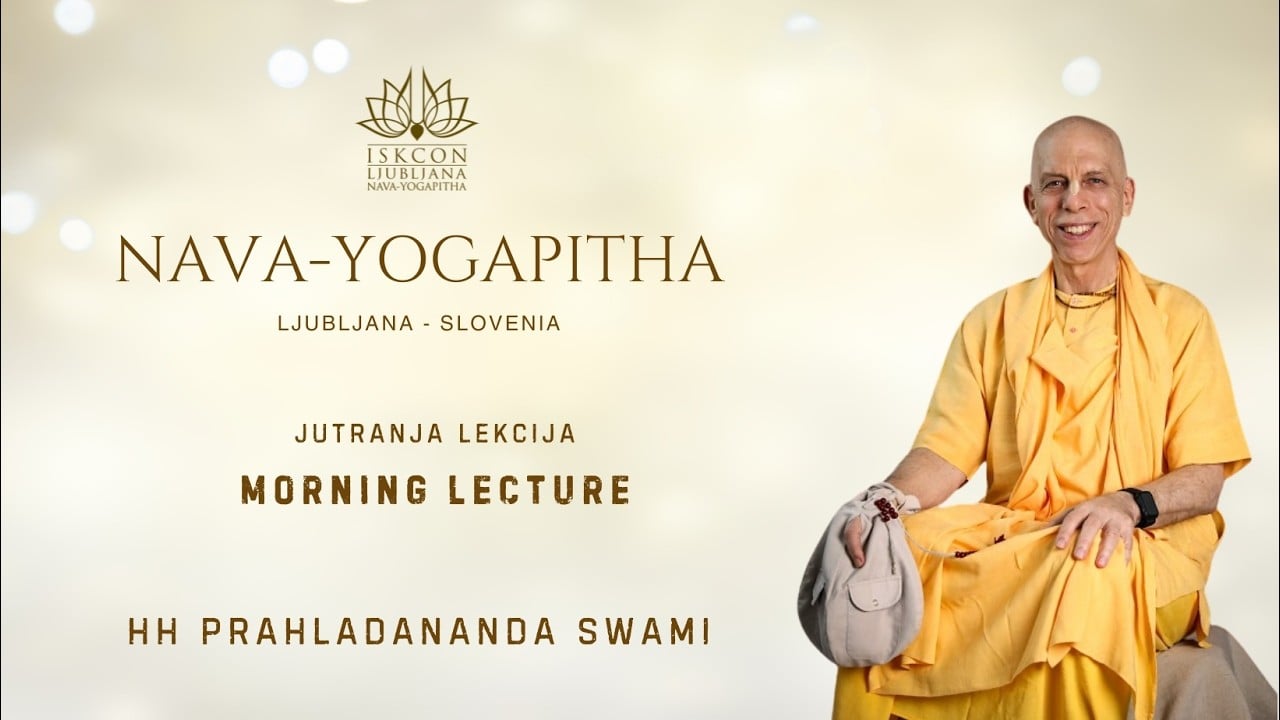
In a live discourse from ISKCON Ljubljana Hare Krišna center HH Prahladananda Swami examined Srimad Bhagavatam 1.13.50 with a focus on how spiritual clarity emerges when duty (dharma), detachment (vairāgya), and devotion (bhakti) converge. Streamed as part of the Duhovni program iz Hare Krišna centra v Ljubljani, the session positioned the verse within the narrative arc of Canto 1, Chapter 13, where Vidura’s uncompromising guidance catalyzes Dhṛtarāṣṭra’s decision to renounce habitual attachments and re-center life around self-realization.
Srimad Bhagavatam (Bhagavata Purana) functions in the Vaiṣṇava tradition as a comprehensive theology of devotion to Krishna, yet it also provides a universal ethical psychology relevant across dharmic schools. Its opening canto establishes the post-war moral landscape and, in Chapter 13, brings forward a seminal inquiry: how should a conscientious elder, faced with the reality of time (kāla) and mortality, conclude life in a way that illuminates the self (ātman) rather than prolong delusion?
Within this chapter, Vidura returns from pilgrimage with the gravitas of lived wisdom. He speaks to Dhṛtarāṣṭra as a true well-wisher, pointing outwithout sentimentalitythe ephemeral nature of body, wealth, and social position. The counsel is not nihilistic; rather, it restores proportion: the eternal self must be prioritized over the flickering claims of circumstance. The narrative records that Gandhārī aligns with this higher calling, underscoring that even intimate ties must ultimately serve, not obstruct, the path of liberation.
Srimad Bhagavatam 1.13.50 is widely read as a keystone in this exhortation. While phrased within the idiom of renunciation, the verse’s thrust is constructive: reclaim agency from the tyranny of habit and fear, and redirect life-energy to practices that directly awaken God-consciousness. In the dramatic logic of the chapter, the directive is not merely to “leave home,” but to leave the inner architectures of dependencyfear of loss, social deference divorced from truth, and the reluctance to face impermanence.
Vidura’s pedagogy exemplifies the compassionate rigor of a sādhu: he neither flatters nor humiliates. Instead, he reframes. Time (kāla) is presented as the great equalizer that dissolves pretense; relationships (bandhu) are honored yet shown as contingent; the body (deha) is a precious instrument, not an identity. Such framing invites decisive practiceneither rash escapism nor paralyzing sentimentbut a lucid, value-aligned transition consistent with dharma.
Philosophically, the verse (situated in the chapter’s denouement) emphasizes three interlocking recognitions: impermanence is non-negotiable; the self is categorically distinct from the body-mind composite; and wisdom demands timely reconfiguration of duties. This triad converts metaphysics into method. Instead of lamenting change, the practitioner leverages change to deepen commitment to the changeless self and to Krishna, the supreme shelter in Vaiṣṇava theology.
In the bhakti-yoga frame that informs ISKCON’s teachings, renunciation is not negation but redirection. Detachment (vairāgya) is paired with positive absorption: śravaṇa (hearing), kīrtana (chanting), and smaraṇa (mindful remembrance) of Krishna. In that sense, Srimad Bhagavatam 1.13.50 advocates an integrated ethic: clarify identity (ātma-tattva), streamline duties in line with that clarity, and employ disciplined, joyful devotion so that the heart’s gravity naturally shifts from the temporary to the eternal.
The life-stage ethic (āśrama-dharma) that undergirds the chapter does not dismiss household responsibilities; it sequences them. Vanaprastha, properly understood, is the humane transition from managing estates and expectations to managing consciousnesshonoring family with gratitude while modeling freedom from possessiveness. The text thus safeguards both relational dignity and spiritual urgency, rejecting the false binary of family versus freedom.
For contemporary practitioners, the prescriptive edge of 1.13.50 can be translated into concrete commitments: establish a stable daily sādhana anchored in śravaṇa and kīrtana; practice mindful austerities that simplify life and recover attentional bandwidth; cultivate gratitude and non-possessiveness (aparigraha) in finances and consumption; and schedule regular retreat-like intervals that function as an “internal vanaprastha,” reducing noise and strengthening spiritual focus. Such measures embody renunciation as clarity, not deprivation.
These insights resonate across the broader dharmic family. Buddhism’s emphasis on anicca (impermanence) and right effort, Jainism’s core virtue of aparigraha (non-possessiveness), and Sikh teachings on detachment amid duty converge with the Bhagavata’s vision: live truthfully, serve compassionately, and loosen the grip of egoic craving. Read in this inclusive light, Srimad Bhagavatam 1.13.50 strengthens inter-traditional unity by demonstrating how shared principles can support diverse practices without erasing distinctive theologies.
The Ljubljana setting itself is instructive. A “global” Bhagavata culture has emerged in which communities far from the subcontinent engage classical Sanskrit theology with local sensibilities. ISKCON Ljubljana’s offeringslike this session with HH Prahladananda Swamiillustrate how rigorous scriptural discourse can remain accessible, emotionally intelligent, and community-building. This intellectual-spiritual hospitality allows seekers from varied dharmic backgrounds to participate without coercion or sectarianism.
Commentarially, the tradition consistently highlights Vidura’s role as the catalyst of right-timed renunciation. Classical expositors emphasize that genuine compassion sometimes takes the form of difficult truths delivered with pure intent. The verse’s placement at the chapter’s close functions as a moral fulcrum: listening matures into movement. The test of hearing (śravaṇa) is whether life reorganizes around the realized priority.
From the standpoint of spiritual psychology, the verse speaks to the universal struggle with comfort zones. Habit makes even suffering feel familiar; 1.13.50 disrupts that loyalty. By bringing mortality and meaning into the same frame, it encourages a stable courageacceptance without resignation, renunciation without bitterness, devotion without fanaticism. The result is a humane austerity: decisive, compassionate, and sustainable.
In sum, Srimad Bhagavatam 1.13.50 distills the chapter’s message into an actionable ethic: acknowledge time’s verdict, affirm the self’s transcendence, and act now with wise detachment and loving devotion. Read alongside cognate insights in Buddhism, Jainism, and Sikhism, the verse becomes a bridge rather than a boundaryan invitation to shared depth. HH Prahladananda Swami’s treatment in the ISKCON Ljubljana setting underscores this unifying horizon, demonstrating how scriptural fidelity and inter-dharmic friendship can grow together to elevate individual lives and communal harmony.
Inspired by this post on Dandavats.