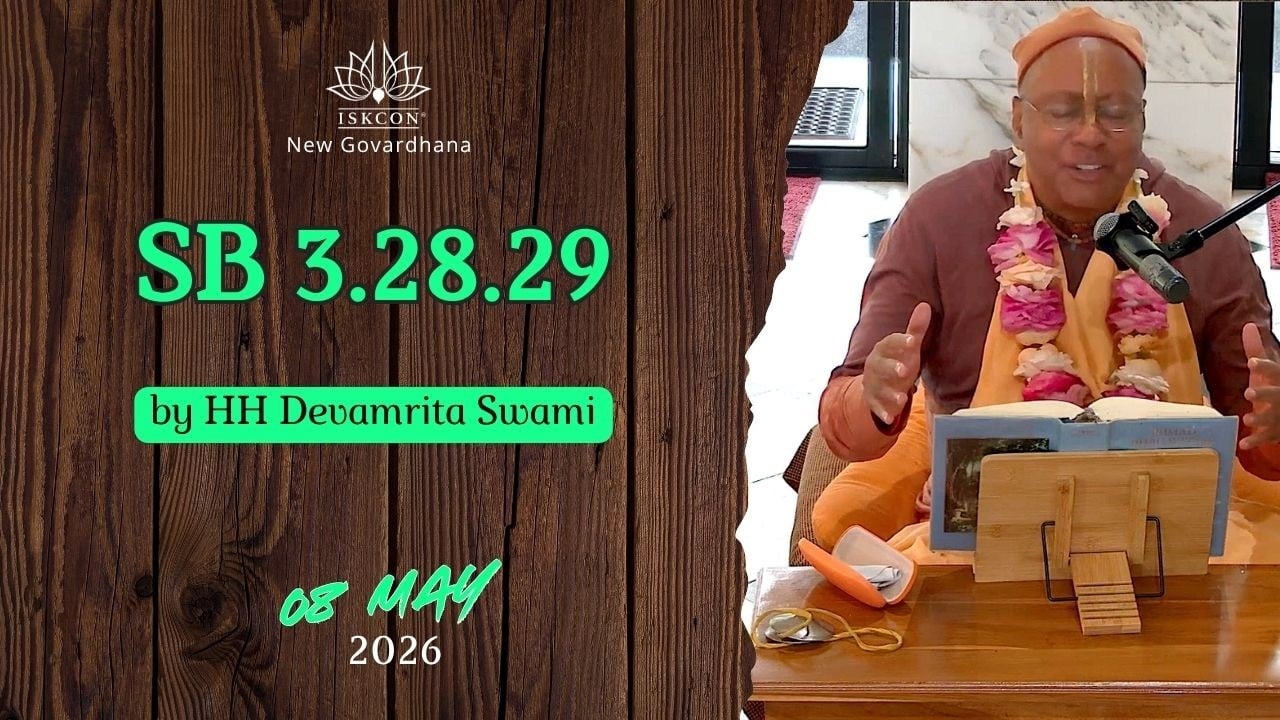
On Fri 08 May 2026, HH Devamrita Swami delivered a Srimad Bhagavatam class at ISKCON New Govardhana Temple centered on Srimad Bhagavatam 3.28.29 (SB 3.28.29). The session situated this verse within Kapila Muni’s theistic Sāṅkhya and its synthesis with bhakti-yoga, clarifying how contemplative attention on the Supreme Person’s features culminates in an ethically charged, emotionally stabilizing, and devotionally potent meditative practice. In keeping with the New Govardhana ethos of sādhusanga and scriptural rigor, the discussion emphasized practical methods alongside careful textual analysis, inviting practitioners to engage with the verse as living guidance rather than abstraction.
SB 3.28 belongs to the Third Canto’s dialogue between Kapila and Devahuti, where Kapila prescribes a graduated dhyana that moves from the feet to the face of the Lord. This progression is not mere poetics; it is a cognitive and devotional architecture that steadies the senses, organizes attention, and aligns affect with the object of love and service. In SB 3.28.29 specifically, the meditation concentrates on the Lord’s lotus-like countenance and beneficent smile, the apex of the upward visualization that consolidates prior focus into a single, heart-opening absorption.
Read as a practical protocol, SB 3.28.29 invites the mind to rest, without strain, on a distinctly personal object of meditation. The face functions as the most communicative aspect of the form; its glance and smile convey grace and reassurance, neutralizing fear and inner agitation. By guiding attention to this locus, the verse promotes a gentle but decisive transition from scattered cognition to steady awareness, encouraging the kind of intimate remembrance that Vaishnava traditions describe as natural to the soul when impediments recede.
Gaudiya Vaishnava commentators explain that this face-centered dhyana harmonizes aesthetics and ontology. The beauty here is not merely sensory; it is ontological beauty that discloses the Supreme’s charactercompassion, protectiveness, and reciprocity. Meditators thus do not attempt to dissolve individuality into abstraction; rather, they refine individuality through relationship, where remembrance of the Lord’s features awakens gratitude, humility, and a service disposition. SB 3.28.29 crystallizes that encounter at the point where vision, emotion, and devotion meet.
Kapila’s instruction in this chapter also demonstrates how bhakti reorients Sāṅkhya analysis of the three guṇas (sattva, rajas, tamas). As attention rests on the Lord’s face, agitation (rajas) and inertia (tamas) lose momentum, while clarity and luminous steadiness (sattva) prevail. This sattvic stabilization, however, is not the goal in itself; it becomes a platform for affectionate devotion (bhakti), moving the practitioner from mere tranquility to positively charged remembrance that transforms conduct and priorities.
Technically, SB 3.28.29 dovetails with the classical arc of aṣṭāṅga-yoga. Yama and niyama establish ethical ground; stable āsana and regulated prāṇāyāma reduce inner noise; pratyāhāra withdraws the senses; dhāraṇā fixes attention on specific features of the Lord; dhyāna sustains that flow; and samādhi glimpses the Lord as Paramātmā dwelling in the heart. In this mapping, the face-centered absorption of verse 29 is part of dhāraṇā-to-dhyāna continuity, where attention becomes soft yet continuous, easing into devotional stillness.
For contemporary practice, the class highlighted a humane, incremental approach. Begin with a quiet, clean space, a steady seat, and gentle breath regulation that lengthens the exhale. Mentally traverse the Lord’s form, gradually arriving at the face, and allow the remembrance of compassionate eyes and a reassuring smile to soften inner resistance. In Gaudiya practice, this dhyana resonates with and is reinforced by nāmaattentive hearing and chanting of the mahā-mantraso that sound and image cooperate to anchor the mind without force.
Modern cognitive perspectives help articulate why this verse’s method is effective, while not reducing it to neurophysiology alone. A friendly, benevolent face is a universal cue of safety; orienting to it calms the limbic system, supports attentional control, and promotes parasympathetic balance. SB 3.28.29 leverages that universality while transcending it: the Lord’s features are not merely imagined therapeutics; they are taken as real and supra-material, meaning the calm achieved is a doorway into relationship and service, not an end-state of neutrality.
When consistently practiced, face-centered dhyana shifts inner posture from defensiveness to receptivity, allowing envy, anxiety, and compulsive rumination to loosen their hold. The resultant composure naturally expresses itself as compassion and responsibilitypractical bhakti that seeks the welfare of others. In this way, SB 3.28.29 serves as both a contemplative instruction and an ethical engine, making devotional remembrance inseparable from day-to-day conduct.
Viewed through a broader dharmic lens, this verse participates in a family resemblance across Hindu, Buddhist, Jain, and Sikh contemplative lineages. Hindu bhakti traditions meditate on the Lord’s rūpa and līlā; Buddhist practices include Buddha-anusmṛti and loving-kindness that gentle the mind; Jain dhyana on Tīrthaṅkaras elevates consciousness through purity and restraint; Sikh simran centers the heart on the Nām. While metaphysical frameworks differ, the shared commitment to attention, compassion, self-discipline, and service sustains unity within diversityan ethos that honors multiple authentic paths without erasing their distinctives.
The New Govardhana setting underscores how sangha shapes success in meditation. Hearing SB 3.28.29 in the company of dedicated practitioners, under experienced guidance, adds traction to individual effort. Community routineskīrtana, scriptural study, sevacreate feedback loops that carry the dhyana off the meditation seat and into speech, decisions, and relationships, turning insight into character.
Two practical clarifications arise from this verse. First, visualization supports, but does not replace, sound-based remembrance; in the Gaudiya understanding of Kali-yuga, attentive nāma-sankīrtana remains primary while verse-guided visualization enriches it. Second, the form contemplated is not anthropomorphic projection; it is the Lord’s personal form, distinguished from matter, approached with humility and reverence, and confirmed by the transformative fruits of practiceclarity, kindness, and selfless service.
As a working routine, practitioners may stabilize the day with short, consistent sittings anchored in SB 3.28.29’s cue. Morning: a brief session aligning breath and attention, concluding with kīrtana. Midday: a reset that re-contacts the smile and softens accumulated tension. Evening: reflective reading of SB 3.28 and related purports to refine understanding, followed by prayerful chanting. Over weeks, this rhythm moves remembrance from episodic effort to an abiding atmosphere.
Ultimately, SB 3.28.29 portrays meditative intimacy that is both contemplative and participatory: attention rests on the Lord’s lotus face, emotion warms into gratitude, and behavior aligns with compassion and integrity. The fruit is steadiness in devotionan inner poise that honors the shared dharmic aspiration toward wisdom and service, while welcoming dialogue and mutual uplift across traditions. In that spirit, the New Govardhana class served as a timely reminder that profound scriptural instruction becomes truly transformative when it informs how one lives, listens, and loves.
Inspired by this post on Dandavats.