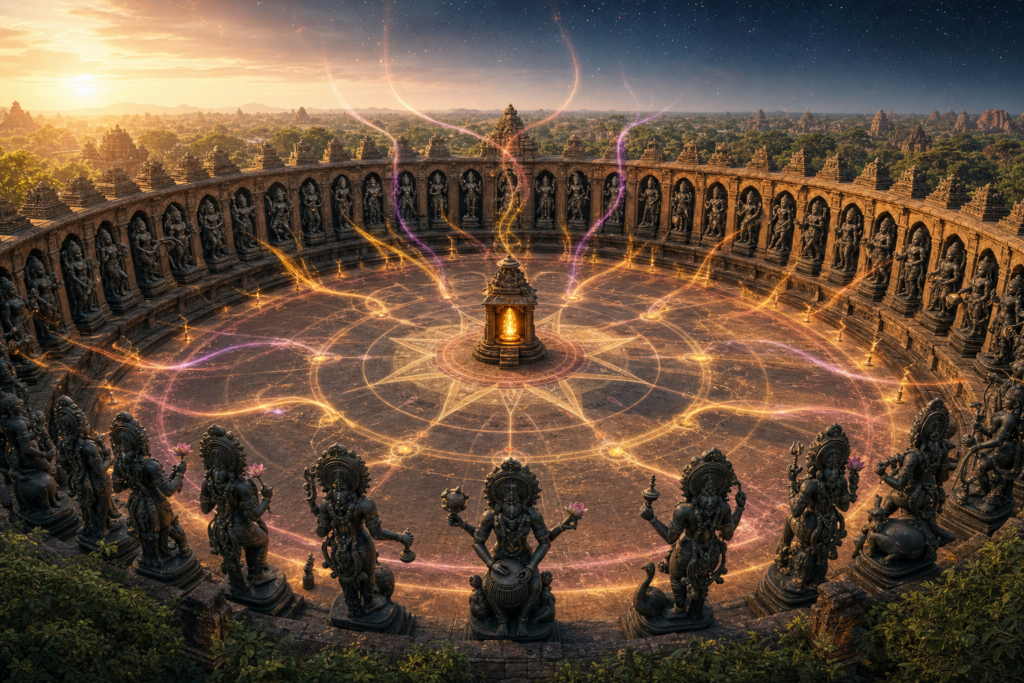
Pradeśa-mātra is a precise yet evocative term in Hindu philosophy that captures how the Supreme Reality can be contemplated as both immeasurable and approachable. Found in the interpretive landscape around the Chandogya Upanishad and resonant with related passages in the Katha Upanishad, it frames the Supreme Self (Ātman/Ishvara) as present in a “measurable” locusmost often the heart-spacewithout compromising infinitude. This formulation makes a vast metaphysical truth accessible for meditation and self-inquiry.
Upanishadic teaching frequently uses pedagogical language of measure to direct attention inward. Commentarial traditions on the dahara-vidyā (the teaching of the “minute inner space” in Chandogya Upanishad 8) and the aṅguṣṭha-mātra puruṣa (“person the size of a thumb” in Katha Upanishad) clarify that such “measurements” are not literal boundaries upon the Self. Rather, they serve as contemplative pointers, concentrating awareness in the hṛdaya-ākāśathe inner space of the heartso that the meditator can intuit the limitless through a relatable focus.
Philosophically, pradeśa-mātra signals the immanence of the all-pervading Brahman. Vedānta holds that the Supreme is both transcendent and indwelling: the antaryāmin (inner controller) and the cosmic virāṭ. To speak of a “portion” or “measure” is to provide a skillful means for contemplation, not to confine the Infinite. As classical hermeneutics note, this is an instance of upāsanā-lakṣaṇālanguage tailored to guide meditationresolved ultimately by the method of adhyāropa–apavāda (superimposition followed by negation), where provisional descriptions are later set aside to reveal non-dual truth.
In practice, this teaching offers a stable inner focal point. Many practitioners of Hindu meditation report that resting attention in the heart-spacewhile reflecting on the presence of Ātmancultivates calm, moral clarity, and a sense of connectedness that naturally extends as compassion. The “measurable” serves as a doorway: by gently anchoring awareness, the mind grows steady enough to recognize the unbounded nature of consciousness described in the Upanishads.
Such an approach also illuminates unity across dharmic traditions. While their metaphysical formulations vary, Buddhism often speaks of a refined, luminous clarity of mind through meditation; Jainism describes the innate purity and awareness of the jīva revealed as karmic veils fall away; Sikh teachings evoke the remembrance of Ik Onkār as present within and without. The contemplative movement from the near and “measurable” to the vast and “infinite” is a shared current that encourages humility, non-violence, and service.
Read against the Upanishadic backdrop, pradeśa-mātra dispels a common difficulty in metaphysics: how to relate to what exceeds thought. By sanctifying a point of attentionwithout absolutizing itVedānta invites rigorous inquiry that remains experientially grounded. The risk of anthropomorphism is addressed by commentary that consistently insists on the Self’s all-pervasiveness, using the “measure” only as a pedagogical aid to deepen concentration and insight.
This vision carries practical relevance today. In an age of distraction, the heart-space meditation on the indwelling Self provides an interior sanctuary that supports ethical action in the world. The Upanishadic assurance that “what is contemplated as near is never separate from the whole” nurtures resilience, empathy, and a stable center from which to engage contemporary challenges.
Pradeśa-mātra also harmonizes with the dharmic ideal of unity in spiritual diversity. Hindu philosophy’s acceptance of ishtaindividual dispositions guiding one’s chosen form of practiceencourages respect for multiple pathways of realization. When framed this way, the teaching strengthens solidarity among Hinduism, Buddhism, Jainism, and Sikhism: diverse contemplative methods, one shared aspiration for inner freedom and the well-being of all.
In summary, pradeśa-mātra is a compact key to Upanishadic wisdom: meditate where the Infinite is inwardly “measurable,” and the boundary dissolves into boundlessness. It affirms that the Supreme Reality is intimately present, that disciplined attention can awaken recognition of that presence, and that this recognition naturally flowers into compassion, ethical clarity, and a culture of harmony across the dharmic family.
Inspired by this post on Hindu Blog.