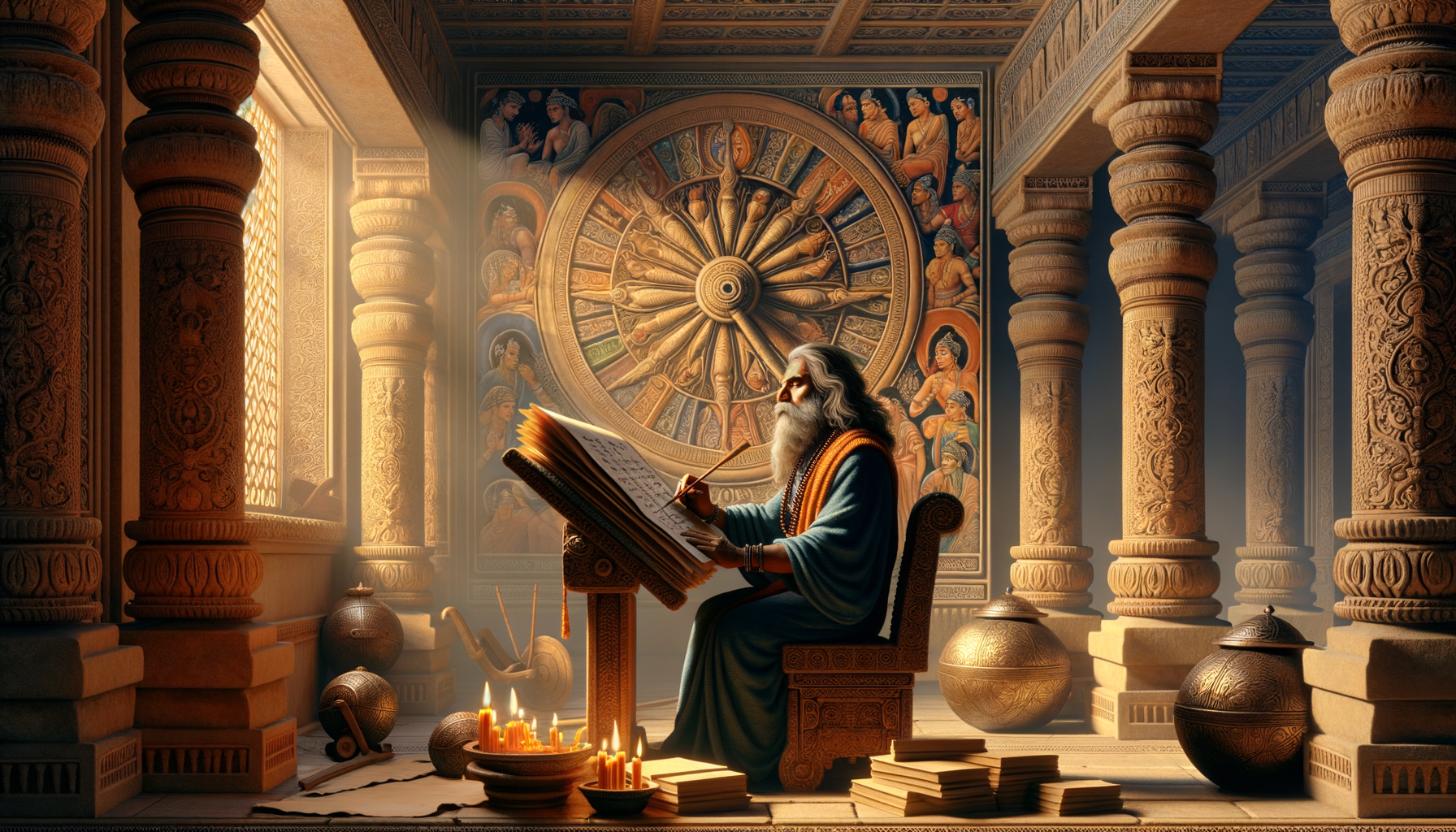
Naranappa, revered by the pen name Kumara Vyasa, stands among the foremost voices in classical Kannada literature and the cultural history of medieval Karnataka. Best known for the Karnata Bharata Kathamanjari—popularly called the Kumara Vyasa Bharata or Gadugina Bharata—he shaped a Kannada Mahabharata that is celebrated for its literary brilliance, spiritual depth, and enduring appeal across generations.
Tradition places Kumara Vyasa in the vibrant milieu of the Vijayanagara Empire, with strong associations to Gadag and the Veeranarayana Temple. The sobriquet “Kumara Vyasa” signals a deep lineage with the epic tradition of Veda Vyasa while affirming a distinctly Kannada voice. His compositions continue to live not only in print but also in oral-performance lineages, particularly in Gamaka recitation and community gatherings dedicated to the Mahabharata.
Karnata Bharata Kathamanjari exemplifies mastery in the Bhamini Shatpadi meter, uniting poetic grace with narrative momentum. The work renders the Mahabharata in idiomatic, image-rich Kannada, balancing grandeur with accessibility. Characters such as Krishna, Arjuna, Karna, and Bhima receive psychologically nuanced portrayals, allowing readers to witness the delicate interplay of dharma and adharma, duty and desire, valor and vulnerability—hallmarks of the epic’s ethical canvas.
Rather than a verbatim translation, the Kannada Mahabharata reframes the epic with strategic compression, selective amplification, and lyrical intensity. This artistic freedom sustains dramatic pacing and heightens emotional resonance, which explains why the text remains a preferred source for performance traditions and classroom readings alike. As “Gadugina Bharata,” it anchors regional pride while speaking to the universal human search for meaning.
Themes central to dharmic thought—ethical discernment, compassion, self-mastery, and courage—form the spine of Kumara Vyasa’s narrative art. These values resonate across Hinduism, Buddhism, Jainism, and Sikhism, offering fertile ground for shared reflection. In this light, the Kannada Mahabharata operates as a bridge across dharmic traditions, inviting unity through common principles of responsibility, non-harm, righteous conduct, and spiritual inquiry.
The legacy of Kumara Vyasa extends far beyond the page. His Bharata has influenced Yakshagana dramaturgy, Gamaka recitation, and vernacular storytelling across Karnataka, while inspiring scholarly commentary and public recitation. Its presence in curricula and cultural festivals ensures the text remains a living classic—experienced, interpreted, and reinterpreted by new audiences.
For contemporary readers, Kumara Vyasa’s voice illuminates perennial questions: How should one act amidst moral ambiguity? What constitutes just leadership? How does devotion inform duty? Such reflections make the work relevant to civic life, personal ethics, and cultural literacy, affirming its place at the heart of Kannada literature and the broader study of Indian epics.
Engagement with the text often deepens through annotated editions, Gamaka performances, and community readings that foreground meter, metaphor, and philosophical nuance. For many, the cultural geography of Gadag and the Veeranarayana Temple offers a contemplative context, reinforcing the intimate bond between sacred space, poetic creation, and collective memory.
Enduring in scholarship and performance, Kumara Vyasa’s Kannada Mahabharata preserves the epic’s ethical core while celebrating the expressive capacities of the Kannada language. It stands as a luminous testament to Vijayanagara-era creativity and a beacon of dharma that continues to guide seekers of wisdom across all dharmic paths.
Inspired by this post on Hindu Blog.