
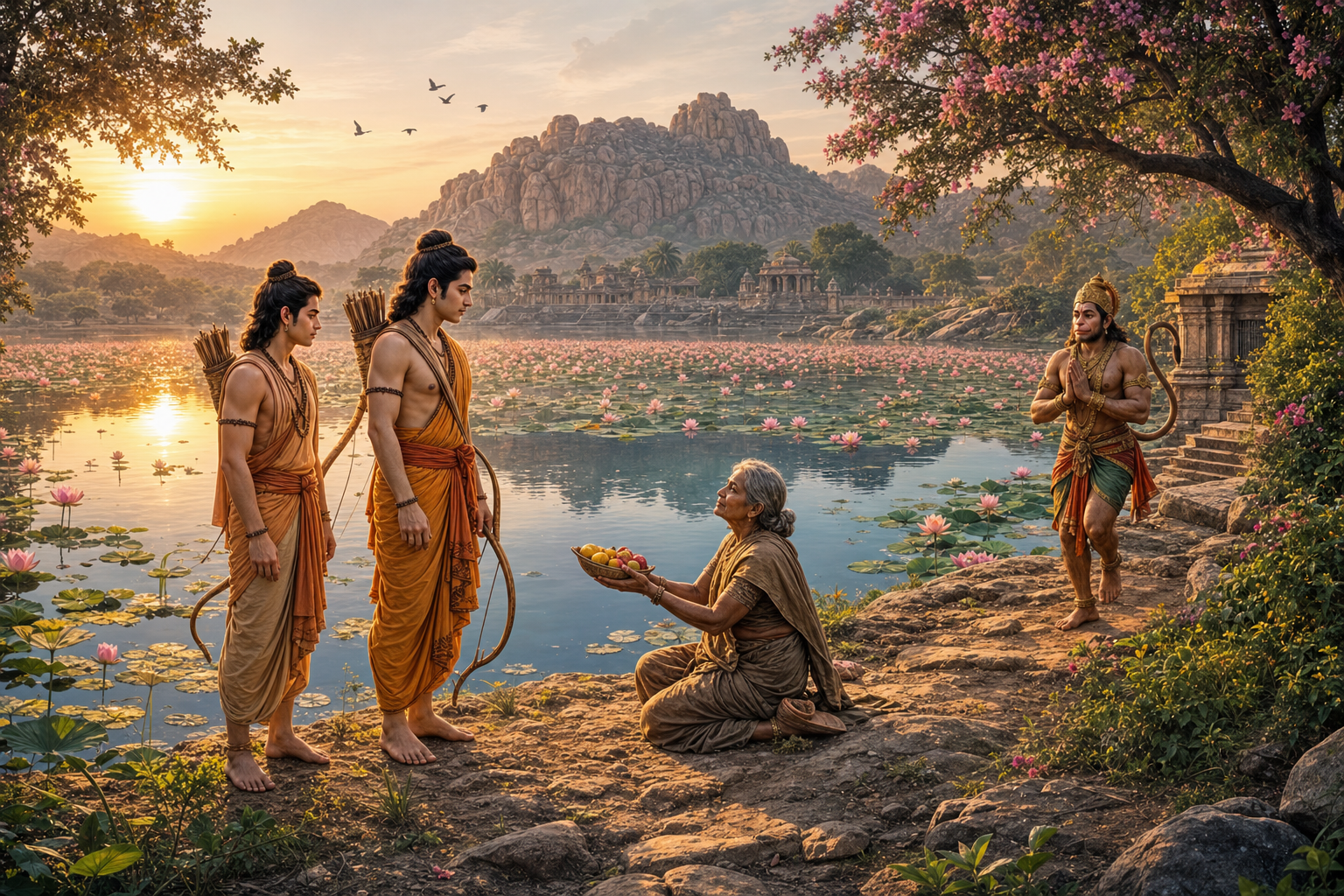
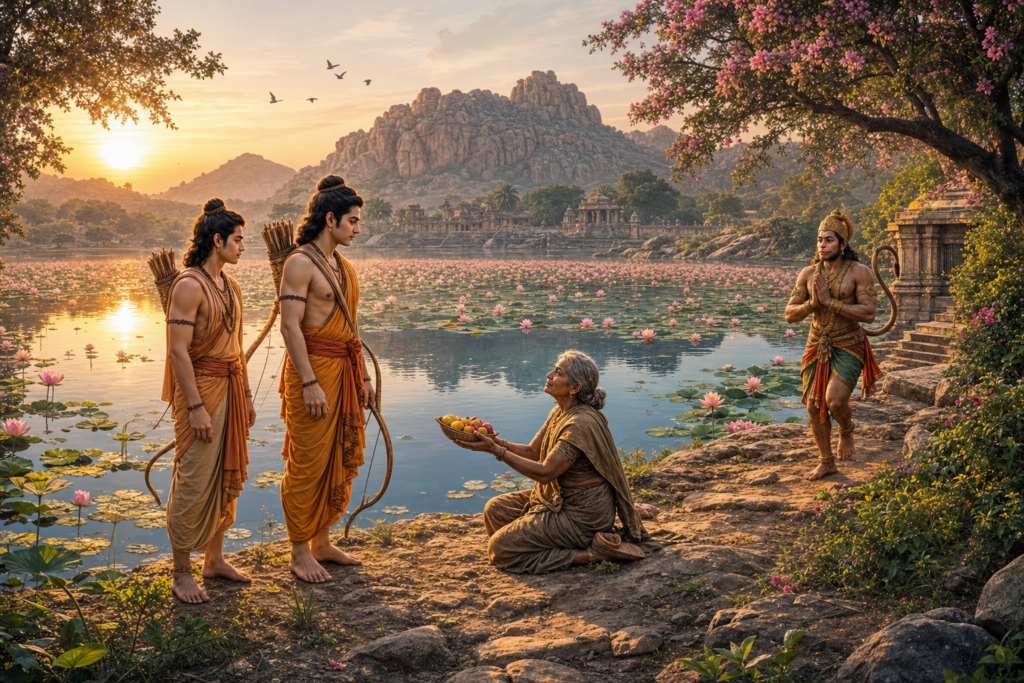
Pampa Lake, often remembered as Pampa Sarovara in the sacred geography of the Ramayana, occupies a deeply evocative place in the Kishkindha Kanda. Situated near Rishyamuka Hill in the region traditionally identified with present-day Anegundi and Hampi in Karnataka, it is not merely a scenic water body in an ancient narrative. It functions as a turning point in the epic, where sorrow, devotion, friendship, and dharma begin to converge around Sri Rama’s search for Sita.
The landscape around Pampa is associated with the broader Kishkindha region, the realm of Sugriva, Vali, Hanuman, and the vanara community. In literary memory and pilgrimage tradition, this region is linked with Rishyamuka Hill, Matanga Rishi’s hermitage, the Tungabhadra riverine world, and the sacred terrain later celebrated through the cultural history of Hampi. The Ramayana presents geography not as a neutral background, but as a living field of moral and spiritual experience. Pampa becomes one such field: a place where grief is felt intensely, but where divine purpose also begins to unfold.
In the Ramayana, Sri Rama reaches the Pampa region after the abduction of Sita by Ravana. The journey to this place follows anguish, uncertainty, and relentless searching. By the time Rama and Lakshmana arrive near Pampa, the emotional weight of separation has become central to the narrative. The lake’s natural beauty, instead of merely soothing Rama, intensifies his remembrance of Sita. Blossoming trees, birds, lotuses, clear waters, and the fragrance of spring awaken memory, longing, and devotion.
This emotional contrast is one of the most remarkable features of the Pampa episode. A beautiful landscape becomes a mirror for inner suffering. In ordinary experience too, places of beauty can sharpen grief when the heart is burdened by absence. The Ramayana gives this human truth a sacred form. Rama, though revered as Maryada Purushottama and an avatara of Vishnu, is shown experiencing the pain of separation with profound tenderness. His sorrow does not diminish his divinity; rather, it reveals the depth of dharma expressed through love, fidelity, and emotional truth.
Pampa is also closely associated with Shabari, one of the most beloved figures in the devotional imagination of the Ramayana. In the Valmiki tradition, Shabari is connected with the hermitage of Matanga Rishi. She waits for Rama with unwavering faith, guided by her guru’s assurance that the Lord would one day come to her dwelling. Her encounter with Rama is among the epic’s most moving demonstrations of bhakti. It teaches that devotion is not measured by social status, scholarship, wealth, or ritual display, but by sincerity, humility, service, and steadiness of heart.
The memory of Shabari near the Pampa region carries special significance for the unity of dharmic traditions. Hinduism, Buddhism, Jainism, and Sikhism all preserve, in their own philosophical languages, a reverence for inner discipline, compassion, ethical conduct, and the transformative power of sincere effort. Shabari’s devotion belongs specifically to the Ramayana’s Hindu sacred world, yet its moral resonance is broader: spiritual worth is not confined to outer identity. The inner disposition of reverence, patience, and service remains central to dharmic life.
The Pampa episode then moves toward another decisive development: the meeting of Rama and Hanuman. Sugriva, living in fear of Vali and taking refuge near Rishyamuka Hill, sees Rama and Lakshmana approaching. Hanuman is sent to learn who they are. This first meeting between Hanuman and Rama becomes one of the most consequential encounters in the entire Ramayana. From this moment, the search for Sita gains direction, and the path toward the eventual defeat of Ravana begins to take form.
Hanuman’s approach to Rama is marked by intelligence, courtesy, restraint, and spiritual insight. He does not rush into judgment. He speaks with dignity, observes carefully, and recognizes the nobility of the brothers before him. This is one reason Hanuman remains an enduring model of bhakti joined with viveka, or discernment. At Pampa and Rishyamuka, devotion is not sentimental weakness; it is disciplined service guided by wisdom, courage, and clarity.
The alliance between Rama and Sugriva, facilitated by Hanuman, also emerges from this sacred geography. It is an alliance born from mutual suffering and mutual obligation. Rama seeks Sita; Sugriva seeks justice and restoration after being driven from his kingdom by Vali. Their relationship is not a casual political arrangement. It is framed by dharma, trust, and reciprocal responsibility. The Pampa region therefore becomes a place where personal grief is transformed into collective action.
For this reason, Pampa Lake should not be viewed only as a devotional site. It is also a literary and philosophical threshold. Before Pampa, Rama’s search is marked by wandering and lamentation. After Pampa, the narrative acquires organized direction through Hanuman, Sugriva, and the vanara forces. The stillness of the lake stands at the edge of movement. The scene teaches that sorrow, when held within dharma, can become the beginning of purposeful action rather than despair.
The relationship between Pampa Lake and the Tungabhadra region also invites attention to the way Indian sacred geography preserves memory. The Ramayana’s events are not remembered only through manuscripts, recitation, and temple worship. They are also remembered through hills, rivers, forests, caves, tanks, and pilgrimage routes. In Karnataka, the Hampi-Anegundi landscape carries layered associations: Ramayana memory, local temple traditions, Shaiva and Vaishnava worship, and later Vijayanagara heritage. This continuity shows how sacred tradition often survives through the combined force of text, place, ritual, and community memory.
Pampa is sometimes described in regional understanding as connected with waters flowing toward the Tungabhadra. Care is needed when speaking historically, because the Ramayana’s sacred geography belongs to a layered tradition of textual, oral, and pilgrimage identifications. What remains important is the role of Pampa as a water-centered sacred site in the Kishkindha landscape. Whether approached through scripture, regional tradition, or pilgrimage, Pampa represents purification, longing, remembrance, and transition.
Water bodies in the Ramayana often carry symbolic force. Rivers and lakes are not passive natural features; they mark transitions in destiny. The Sarayu is associated with Ayodhya and royal dharma. The Ganga evokes sanctity, passage, and purification. The Godavari region marks the forest life of Rama, Sita, and Lakshmana before the crisis of abduction. Pampa, in turn, marks the movement from bereavement to alliance. It is the sacred water beside which Rama’s grief becomes part of a larger divine mission.
The natural beauty of Pampa also deepens the Ramayana’s literary artistry. The description of flowers, trees, birds, and clear waters is not decorative excess. It situates Rama’s emotion within the rhythm of the natural world. Spring, normally a season of joy and union, becomes painful for one separated from the beloved. The poet’s sensitivity lies in this inversion. Nature remains beautiful, but the grieving heart experiences beauty as remembrance. This is why the Pampa passage continues to feel psychologically precise even across centuries.
The Pampa episode also contributes to the Ramayana’s understanding of compassion. Lakshmana witnesses Rama’s anguish and offers strength without dismissing his pain. Hanuman enters the narrative with humility and service. Shabari embodies patient devotion. Sugriva, though fearful and wounded by his own suffering, becomes part of Rama’s mission. Around Pampa, different forms of distress meet different forms of support. The result is not isolation, but relationship. This makes the episode especially relevant for readers seeking ethical models of friendship, service, and resilience.
In theological terms, Pampa reveals the accessibility of the divine. Rama does not remain distant in a palace or confined to formal ritual spaces. He walks through forests, receives hospitality from Shabari, mourns beside a lake, befriends Hanuman, and forms an alliance with Sugriva. The sacred is therefore encountered in lived experience: in hospitality, loyalty, courage, remembrance, and the willingness to act for justice. This understanding has helped make the Ramayana a living text across regions, languages, and communities.
The site also invites reflection on bhakti as disciplined waiting. Shabari’s life is often remembered through the image of long preparation. Her devotion is not dramatic in a worldly sense; it is steady, quiet, and rooted in trust. Such devotion has a powerful place in Hindu spiritual practice. It speaks to the pilgrim, the student, the householder, and the seeker who may not see immediate results from prayer, study, or service. Pampa teaches that sacred encounters often ripen through patience.
At the same time, Hanuman’s arrival near Pampa teaches that devotion must eventually become action. Hanuman does not merely admire Rama. He serves him. He listens, discerns, communicates, organizes, leaps, searches, consoles, and fights when dharma requires it. The Pampa region thus holds two complementary models: Shabari’s patient waiting and Hanuman’s dynamic service. Together they present bhakti as both inward surrender and outward responsibility.
The emotional power of Pampa also lies in its realism. The Ramayana does not deny sorrow. It does not present spiritual life as an escape from loss. Instead, it shows how grief can be honored without being allowed to destroy duty. Rama’s lament near Pampa is genuine, yet he continues the search. This balance is one of the epic’s enduring teachings. Dharma does not require emotional numbness; it requires the courage to carry emotion truthfully while still choosing the right path.
For pilgrims who visit the Hampi-Anegundi region, Pampa Sarovara is often experienced as a place of stillness within a landscape of mythic movement. The surrounding hills and waters evoke the memory of Rama, Lakshmana, Shabari, Hanuman, and Sugriva. Even for those who approach the site academically, the persistence of these associations is significant. It shows how epic literature becomes embedded in geography, and how geography, in turn, keeps literature alive for communities across generations.
Pampa Lake also demonstrates the Ramayana’s ability to connect the intimate and the civilizational. On one level, it is the scene of a husband grieving for his abducted wife. On another level, it becomes the beginning of a vast struggle against adharma. This movement from personal pain to civilizational duty is central to the epic. The recovery of Sita is not only a family matter; it becomes a restoration of moral order. Pampa stands at the moment when private sorrow begins to assume cosmic significance.
The sacred geography of Pampa also helps readers understand why the Ramayana continues to inspire temple traditions, festivals, storytelling, classical arts, folk performances, and regional pilgrimage. The epic is not only read; it is inhabited. Its places become destinations, its characters become ethical companions, and its episodes become mirrors for human life. Pampa remains one such mirror, reflecting longing, loyalty, humility, and the awakening of hope.
In the broader study of Indian civilization, Pampa is important because it shows how ancient texts and living landscapes interact. The Ramayana’s Kishkindha region is not remembered through a single interpretive lens. It is devotional, literary, historical, ecological, and cultural at once. This layered character is typical of many Hindu sacred sites. Their meaning cannot be reduced to archaeology alone, nor can it be separated from the living faith of communities that continue to preserve them.
Pampa Lake and the waters associated with it therefore deserve attention as more than a brief geographical reference. They mark one of the Ramayana’s great transformations: Rama’s grief finds companionship; Shabari’s devotion finds fulfillment; Hanuman’s service finds its Lord; Sugriva’s exile finds a path to restoration. The lake’s stillness gathers these movements into a single sacred memory. In that sense, Pampa remains one of the epic’s most meaningful landscapes, where sorrow, bhakti, friendship, and dharma meet.
The enduring lesson of Pampa is that sacred places are not sacred only because something once happened there. They remain sacred because they continue to teach. Pampa teaches that longing can deepen devotion, that humility can draw divine grace, that friendship can become an instrument of dharma, and that even the most painful phase of life may become the threshold of purposeful action. Within the Ramayana, this lake is quiet, but its meaning is immense.
Inspired by this post on Hindu Blog.






Leave a Reply
You must be logged in to post a comment.