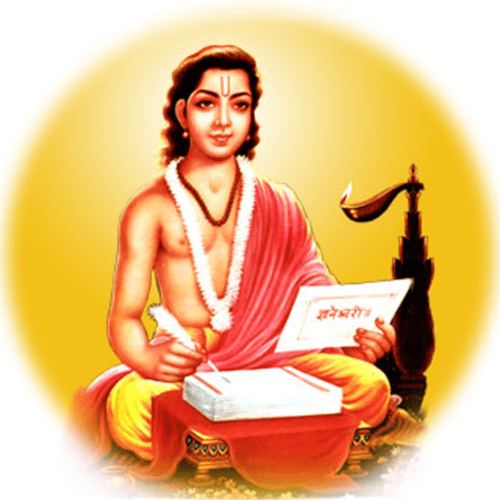
The Nyayamrita of Vyasatirtha (Vyasaraya; 1478–1539 CE) occupies a singular place in the intellectual history of Vedanta. Composed at the cultural zenith of the Vijayanagara Empire, it advances a robust defense of Madhvacharya’s Dvaita Vedanta while engaging Advaita Vedantaassociated with Adi Sankarawith exacting philosophical scrutiny. Far from being a mere polemic, Nyayamrita exemplifies a scholastic culture that treated debate as a sacred duty and a path to clarity, strengthening the pluralist fabric of the broader dharmic world.
Situated within a flourishing ecosystem of temple-learning, courtly debate, and devotional renaissance, Vyasatirtha’s project is both philosophical and civilizational. Tradition credits him as an advisor to Krishnadevaraya and as a pivotal force in the Haridasa movement, guiding figures such as Purandara Dasa and Kanaka Dasa. The same mind that analyzed metaphysical fine points also nurtured an inclusive devotional culture, illustrating how rigorous thought and lived spirituality can reinforce one another.
To appreciate Nyayamrita, it helps to view it alongside the classical triad of Vedanta: Advaita (non-dualism), Vishishtadvaita (qualified non-dualism), and Dvaita (dualism). Each of these schools reads the Upanishads, the Brahma Sutra, and the Bhagavad-Gita through distinctive hermeneutic lenses. Nyayamrita clarifies the Dvaita readingaffirming the reality of plurality and hierarchy (taratamya), the eternality of the individual self (jiva), and the supremacy of Vishnuwhile engaging rival interpretations with philosophical charity and analytical force.
Methodologically, Vyasatirtha draws upon the tools of Nyaya and, in places, the emergent Navya-Nyaya style, to structure arguments with fine-grained precision. The treatise moves across ontology, epistemology, semantics, and soteriology. It evaluates core pramāṇasperception (pratyaksha), inference (anumana), and scripture (shabda)and insists that metaphysical claims must remain accountable to both sound reasoning and a faithful reading of shruti and smriti.
At the heart of Dvaita, as Nyayamrita presents it, is a commitment to robust realism. Difference (bheda) is not an error to be overcome but a structural feature of realitycaptured in Madhvacharya’s well-known “fivefold difference” (panchabheda): between Brahman (Vishnu) and jivas, Brahman and matter (prakriti), jivas among themselves, material entities among themselves, and jivas and matter. This pluralism grounds devotional life, moral responsibility, and cognition itself.
Nyayamrita contends that ordinary and extraordinary experience both testify to real distinctions. Recognition, memory, and successful action presuppose persistent identities and relations among knowers, knowns, and instruments of knowledge. Where non-dual readings risk dissolving worldly diversity into a single undifferentiated substratum, Dvaita insists that such dissolution undermines the very intelligibility of knowledge and conduct. Plurality, on this account, is not a concession to ignorance but a positive datum of experience.
The treatise’s most famous engagements address Advaita’s theory of māyā and the anirvachaniya (indefinable) status of the world. While acknowledging Advaita’s subtlety, Nyayamrita argues that labeling the world as neither real nor unreal is unstable: illusions (like mistaking a rope for a snake) presuppose a real substratum and reliable cognitive powers that later correct the mistake. Extending this to the world at large, Dvaita maintains that globalizing the concept of illusion leads to self-defeatsince the very inference of illusion relies on trustworthy cognition.
Nyayamrita also interrogates the nirguna–saguna distinction. If the ultimate Brahman is strictly nirguna, on what basis do scripture and devotion ascribe auspicious attributes such as omniscience and compassion? Dvaita’s hermeneutic is to read such attributes as intrinsically and eternally real in Brahman, not as provisional projections. The scriptural grammar of names and forms, on this account, testifies to real divine qualities foundational to bhakti.
A classic difficulty in Advaita is the locus of avidyā (ignorance). If avidyā is in Brahman, the purity and perfection of Brahman are compromised; if in the jiva, the difference between the jiva and Brahman becomes inescapably real. Nyayamrita leverages such tensions to argue that Dvaita’s ontologywherein God, souls, and world are distinct yet interrelatedis philosophically cleaner and hermeneutically faithful to texts that teach difference (bheda-shruti).
Beyond metaphysics, Vyasatirtha probes semantics and cognition. If, as non-dualism suggests, all distinctions are ultimately illusory, how should linguistic reference succeed? Successful communication depends on relatively stable referents and category boundaries. Nyayamrita reasons that the “sense of difference” is not merely projected by ignorance but is a constitutive feature without which knowledge (and its correction) would be impossible.
Soteriologically, Nyayamrita safeguards the integrity of devotion (bhakti) and divine grace (anugraha). Liberation (moksha) is God-realization in which the jiva eternally retains its identity while participating in divine bliss. Knowledge is not an abstract identity-claim but is suffused with devotion, ethics, and worship. This has practical resonance: human flourishing involves reverence for a personal God and disciplined cultivation of virtue.
Importantly, Nyayamrita’s criticisms of Advaita are embedded in a shared scriptural universe and a common aspiration for liberation. Advaita, Vishishtadvaita, and Dvaita all honor the Upanishads, Brahma Sutra, and Gita; they diverge on interpretive principles, not on the sacredness of the sources. Nyayamrita therefore exemplifies a dharmic dialogic ethicvigorous in analysis, restrained in tone, and united in seeking moksha.
The intellectual afterlife of Nyayamrita demonstrates this culture of respectful contestation. The Advaita savant Madhusudana Saraswati later authored Advaita-siddhi as a considered reply, prompting further Dvaita rejoinders and sub-commentaries. Rather than fragmenting the tradition, such exchanges clarified concepts across schools, advanced logical technique, and deepened the shared repository of Vedantic reasoning.
Vyasatirtha’s scriptural hermeneutics are meticulous. He privileges direct statements (mukhyartha) where possible, integrates context (vakya-samana), and resists overreliance on metaphor where literal meaning suffices. The net effect is a Vedanta that is experientially grounded, textually anchored, and philosophically transparentan approach that invites readers to trust both pramāṇas and the devotional heart.
Technically, Nyayamrita foreshadows the greater systematization associated with Navya-Nyaya. It refines distinctions concerning qualifier and qualificand, universals and particulars, and the delimitation (avaccheda) relations that underwrite precise ontological claims. The treatise treats logical rigor not as an end in itself but as a service to clarity in metaphysics and soteriology.
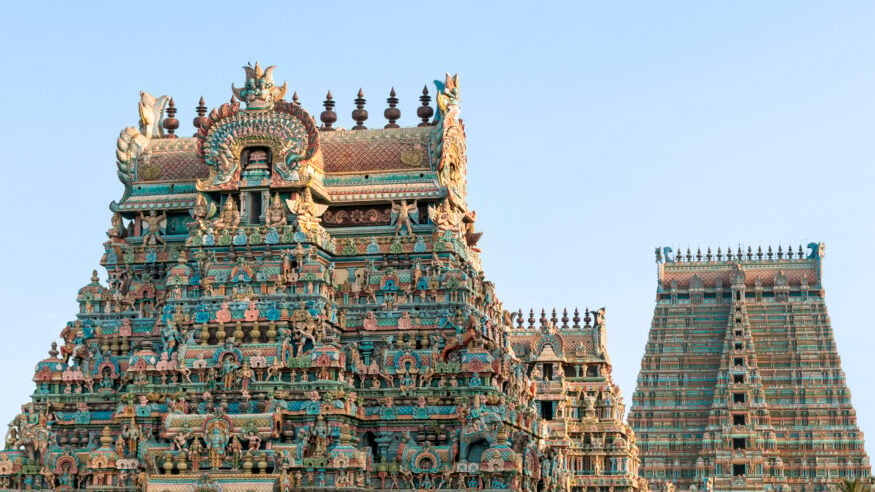
Historically, the Vijayanagara milieu sustained plural forms of learningMīmāṃsā for hermeneutics, Nyaya for logic, Vedanta for metaphysics, and the arts for cultivating devotion and ethical sensibility. Nyayamrita’s presence in that world helped model a way of doing philosophy that welcomes sharp argument and communal piety in the same breath.
The resonances extend beyond intra-Hindu discourse. Buddhism and Jainism, with their own sophisticated logics and ethical disciplines, illuminate similar questions about perception, inference, language, and liberation. Sikh thought too affirms devotion to a supreme reality while honoring ethical action and remembrance of the divine Name. In this sense, Nyayamrita stands as part of a broader dharmic conversationmany voices, one quest.
For contemporary readers navigating questions of identity and pluralism, Nyayamrita offers both content and method. Content, because it lays out a philosophically serious realism open to devotion; method, because it demonstrates how to disagree without hostilityby meeting rival positions at their strongest, testing them with reason, and staying anchored in scriptural fidelity. The result is unity through clarity, not uniformity through coercion.
Engaging Nyayamrita today can feel unexpectedly intimate. The text speaks to perennial concernswhat is ultimately real, how knowledge works, why devotion matters, and how language can bear truth. Its arguments reward slow reading; its spirit encourages humility. For many, that combination is as moving as it is instructive.
In sum, the Nyayamrita of Vyasatirtha is not merely a defense of Dvaita Vedanta against Advaita Vedanta. It is a masterpiece of logic and metaphysics, a model of scriptural hermeneutics, and a testament to the dharmic way of dialogue. By keeping strong differences within a shared sacred horizon, it advances the very unityacross Hinduism, Buddhism, Jainism, and Sikhismthat a living civilization requires.
Inspired by this post on Hindu Blog.