
Mata Sita’s origin is one of the most profound mysteries in the Ramayana tradition. The question, “Who was Mata Sita’s mother?” appears simple at first, yet it opens a deep theological, literary, and cultural inquiry into the nature of birth, motherhood, divinity, and dharma. Across the Ramayanas, Sita is not presented merely as a princess of Mithila or the wife of Sri Rama. She is a sacred presence whose origin links the human world with the cosmic order, the royal household with the soil, and the tenderness of motherhood with the sustaining power of the Earth.
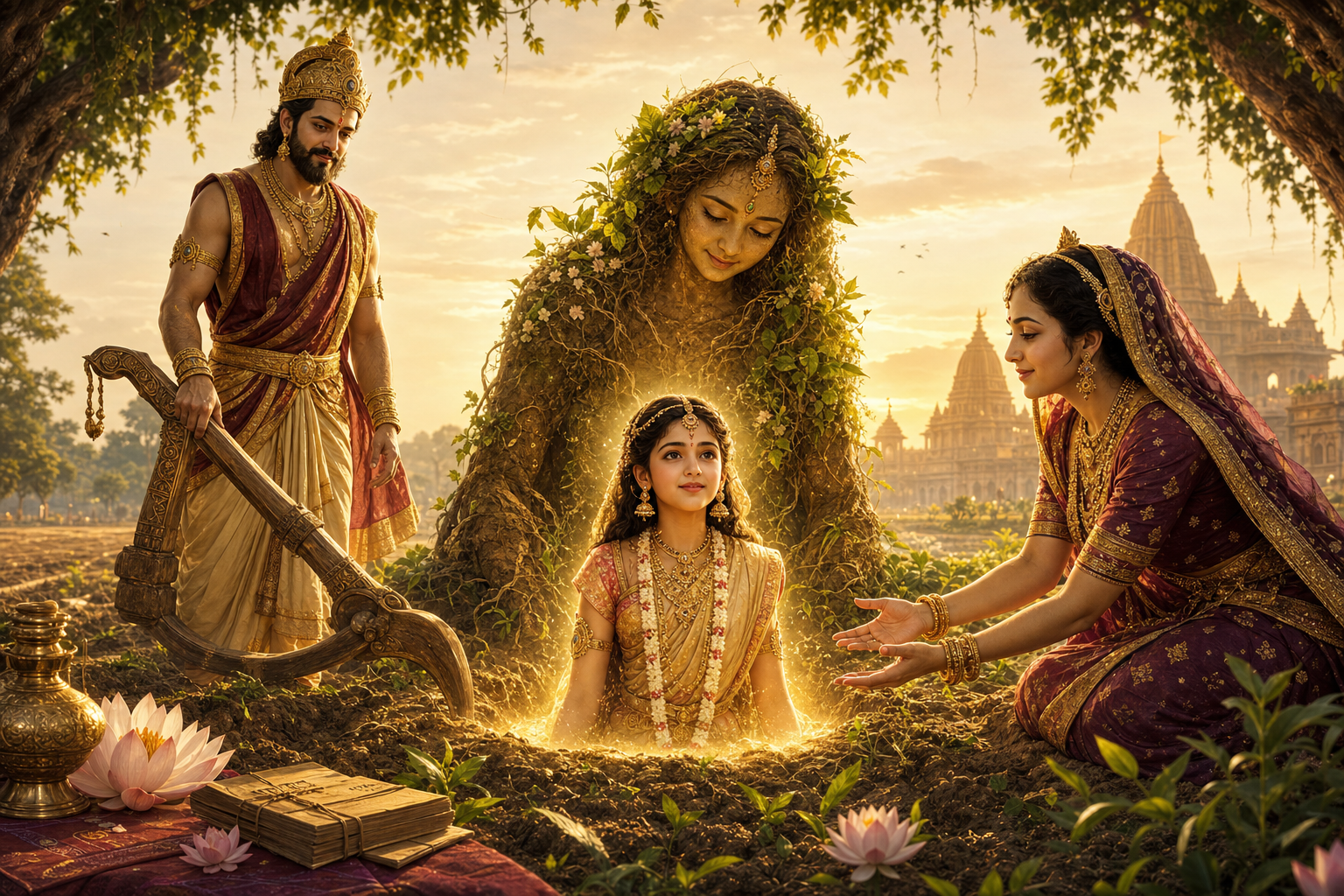
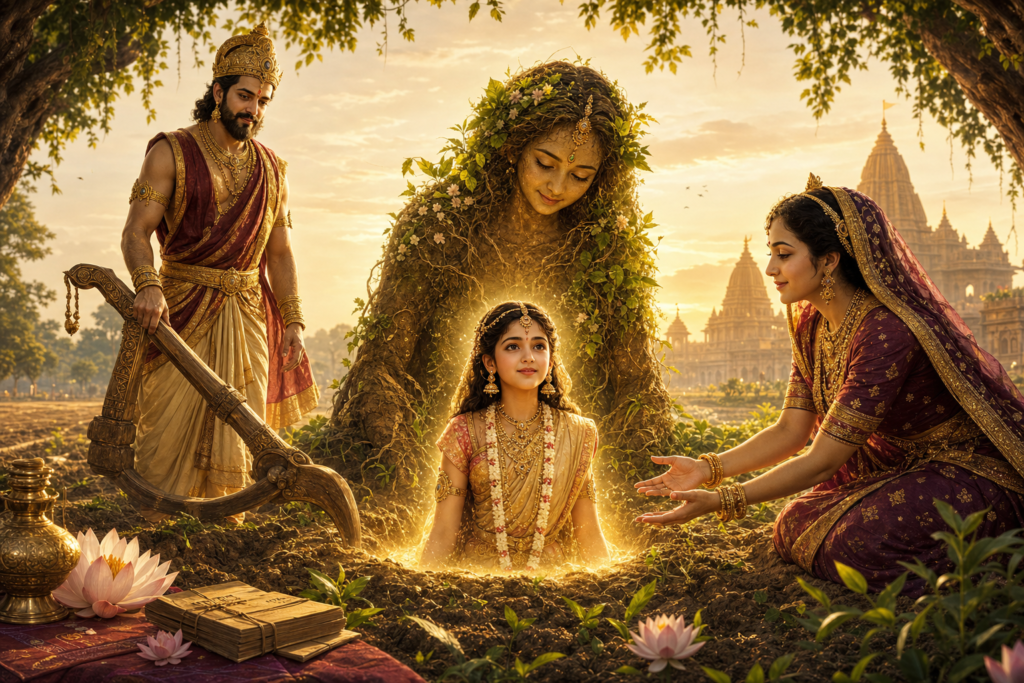
In the Valmiki Ramayana, the earliest and most authoritative Sanskrit telling of Rama’s story, Sita is discovered by King Janaka while he is ploughing a sacrificial field. The text does not name a biological mother. This silence is significant. Sita does not enter the narrative through an ordinary human birth. She emerges from the earth itself, found in a furrow, and is raised by Janaka as his daughter. The name “Sita” is closely connected with the furrow, and this association gives her birth a sacred agricultural and cosmic meaning.
The Valmiki Ramayana therefore presents Bhumi, the Earth, as the deepest maternal source of Sita. This does not mean that later traditions are wrong when they speak of Queen Sunayana or Sunaina as Sita’s mother. Rather, the tradition preserves two complementary forms of motherhood: the cosmic mother who gives Sita to the world, and the human mother who nurtures her within the palace of Mithila. This distinction is essential for understanding why different Ramayana traditions answer the question in different ways.
In the oldest layer of the Ramayana tradition, Sita is the daughter of the Earth. King Janaka is described as finding her while preparing the ground for a yajna. The scene is not incidental agricultural imagery. In Vedic and dharmic thought, the earth is not inert matter; she is a living, sustaining, sacred reality. Bhumi Devi nourishes beings, receives seeds, bears the weight of civilization, and offers abundance without pride. By making Sita arise from the earth, the narrative places her within this sacred symbolism of fertility, purity, patience, and endurance.
This is why Sita’s life cannot be reduced to domestic biography. Her birth from the earth anticipates her entire character. She is gentle but unbreakable, rooted yet radiant, silent at times yet morally decisive. Her connection with Bhumi Devi explains why she embodies kshama, forbearance, and moral strength. It also explains the poetic symmetry of her life: she emerges from the earth in Mithila, walks the hard path of exile in the forest, suffers public suspicion with dignity, and finally returns to the Earth when the human world fails to honour her fully.
The return of Sita to the Earth near the end of the Valmiki Ramayana is crucial. It completes the arc begun at her discovery by Janaka. When Sita calls upon the Earth to receive her if she has remained pure in thought, word, and deed, Bhumi responds. The daughter returns to the mother. This moment is among the most emotionally powerful scenes in Sanskrit epic literature because it is both personal and cosmic. It is the vindication of Sita, but it is also the withdrawal of a divine feminine presence from a society unable to recognize her truth.
Queen Sunayana, also called Sunaina in many regional traditions, represents Sita’s adoptive and royal mother. While Valmiki does not foreground her in the same way that later devotional tellings do, later Ramayana literature, folk memory, temple traditions, and popular retellings often identify Janaka’s queen as Sunayana. In these traditions, Sunayana is the mother who raises Sita, loves her, prepares her for marriage, and experiences the emotional pain of separation when Sita leaves Mithila for Ayodhya.
This maternal role is deeply important. A purely biological reading of motherhood would miss the emotional and dharmic richness of the Ramayana tradition. Sita is found by Janaka, but she is not merely “found.” She is accepted, loved, educated, and honoured as the princess of Mithila. Janaka’s household gives her a social identity, a royal upbringing, and a cultural world shaped by dharma, wisdom, and restraint. Sunayana’s motherhood belongs to this human and relational dimension of Sita’s life.
The distinction between Bhumi Devi and Sunayana does not create contradiction. It creates depth. Bhumi is Sita’s cosmic mother; Sunayana is her human mother. Bhumi gives her origin; Sunayana gives her nurture. Bhumi anchors her in the sacred order of creation; Sunayana anchors her in family, culture, and affection. Together they reveal a dharmic understanding of motherhood that is wider than biology alone. Motherhood can be birth, nourishment, guardianship, moral formation, and sacred belonging.
King Janaka’s role also deserves careful attention. He is often called Videha, a name associated with detachment and spiritual wisdom. In the Ramayana tradition, Janaka is not only a king but also a philosopher-ruler, a figure of rajadharma guided by self-mastery. His discovery of Sita while ploughing the field links kingship with agriculture, sacrifice, and responsibility. A ruler does not merely command land; he must serve and sanctify it. Sita’s arrival during this act gives Mithila a sacred centre.
Janaka’s acceptance of Sita also demonstrates a dharmic principle: the value of a child is not determined by conventional lineage alone. Though Sita is not born from Queen Sunayana’s womb in the Valmiki account, she is fully accepted as Janaka’s daughter. Her dignity is never diminished by her mysterious origin. On the contrary, her origin elevates her. This makes the Ramayana’s treatment of Sita especially powerful for readers reflecting on adoption, belonging, and the spiritual meaning of family.
The word “Sita” itself carries technical and symbolic meaning. In Sanskrit usage, the term is associated with a furrow, especially the line made by a plough. This is not a decorative etymology. The furrow is where seed meets soil, where hidden life becomes visible, and where human labour cooperates with natural abundance. Sita’s name therefore encodes her relationship with agriculture, fertility, prosperity, and sacred land. She is not detached from the world; she is born from the very ground of life.
This agricultural symbolism also explains why Sita has remained so close to the emotional life of ordinary people. Farmers, householders, mothers, daughters, and seekers can all recognize something of their own world in her story. She is royal, yet her birth is from soil. She is divine, yet she suffers human sorrow. She is revered as Goddess Sita, yet she walks through the forest, faces uncertainty, and bears the weight of social judgment. Her origin from the earth makes her universal rather than distant.
Different Ramayanas expand Sita’s maternal background in different ways. The Ramayana is not a single frozen text but a vast civilizational tradition expressed in Sanskrit, Tamil, Awadhi, Bengali, Telugu, Malayalam, Kannada, Marathi, Odia, Assamese, Jain, Buddhist, Southeast Asian, and oral forms. These tellings do not always repeat every detail in the same way. Some emphasize Bhumi Devi; others give greater emotional space to Sunayana; still others explore Sita’s divine identity through theological or devotional lenses.
In many bhakti-oriented tellings, especially those shaped by devotional affection for Sri Rama and Mata Sita, the palace life of Mithila becomes emotionally rich. Sita’s childhood, her relationship with her parents, and the sorrow of departure after marriage receive tender attention. Here Sunayana becomes the recognizable mother of a beloved daughter. Her grief and pride make Sita’s wedding not only a cosmic event but also a human family moment. This is one reason regional Ramayana traditions remain emotionally powerful in homes and temples.
In Tulsidas’s Ramcharitmanas and related North Indian devotional memory, Sita’s identity as Janaka’s daughter is central, and her mother is commonly remembered as Sunayana or Sunaina. The emotional atmosphere of Mithila, the joy of the swayamvara, and the pain of farewell are presented with deep devotional sensitivity. In this world, Sita is not an abstract theological symbol. She is the cherished daughter of Mithila, the jewel of Janaka’s house, and the embodiment of grace, modesty, and strength.
In South Indian Ramayana traditions, including Kamban’s Tamil Ramavataram and temple-based retellings, Sita’s divinity and royal dignity receive profound poetic treatment. The precise handling of her maternal identity may vary, but the larger pattern remains consistent: Sita belongs both to the earth and to the royal house of Mithila. Her sacred origin does not erase her human relationships. Her human relationships do not reduce her cosmic nature. This layered identity is one of the reasons the Ramayana has survived across regions without losing its spiritual force.
Jain and Buddhist tellings of the Rama story also show how widely the narrative travelled within dharmic civilization. These traditions often reshape characters and theology according to their own philosophical frameworks, yet they remain part of a broader civilizational conversation around dharma, restraint, non-violence, renunciation, kingship, and moral responsibility. In this wider context, Sita’s birth and motherhood continue to invite reflection on purity, destiny, and ethical conduct rather than sectarian division.
For this reason, the question of Sita’s mother should not be framed as a rivalry between traditions. A unifying dharmic approach recognizes that Hindu, Buddhist, Jain, and Sikh readers may approach sacred narratives with different theological assumptions, but the ethical and spiritual questions often overlap. Sita’s story speaks to honour, truth, compassion, endurance, and the dignity of the feminine. These values are not diminished by textual variation. They are strengthened by centuries of reflection.
The Valmiki Ramayana’s silence about a named biological mother is therefore not a gap to be hastily filled. It is a deliberate sacred space. Into that space, the tradition places Bhumi Devi. Later devotion places Sunayana beside her. The result is not confusion but a multi-layered theology of motherhood. Sita is daughter of the Earth, daughter of Janaka, daughter of Mithila, and motherly presence for devotees who seek courage in suffering and dignity in difficult circumstances.
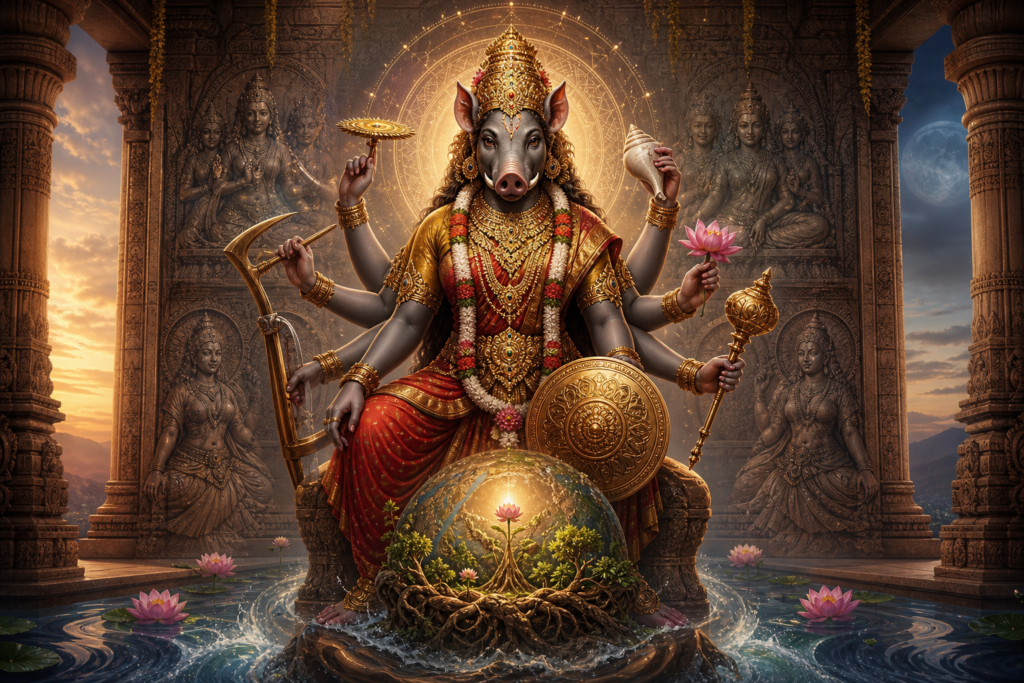
Bhumi Devi as Sita’s mother also carries ecological significance. In contemporary language, one might say that Sita’s story teaches reverence for the Earth. However, the Ramayana’s vision is deeper than modern environmental sentiment alone. The Earth is not merely a resource; she is mother, witness, refuge, and moral presence. When Sita arises from the soil, the narrative reminds society that civilization depends on a sacred relationship with land. When Sita returns to the Earth, the story warns that adharma wounds not only individuals but the moral fabric of the world.
This insight has practical relevance. Communities that revere Sita cannot treat the Earth as disposable. Agricultural life, food, forests, rivers, and the dignity of women are connected within the symbolic universe of the Ramayana. Sita’s suffering is never only personal; it reflects the cost of disorder in society. Her strength is never only private; it reflects the sustaining force of dharma. To ask about her mother is therefore to ask about the foundations of life itself.
Sunayana’s role, meanwhile, carries social and emotional significance. She represents the mother who raises, protects, and releases. In many households, the farewell of Sita from Mithila evokes the emotional reality of daughters leaving their parental home after marriage. The Ramayana transforms that familiar human experience into sacred memory. Sunayana’s love stands for the tenderness of family life, the pain of separation, and the dignity of raising a child who belongs ultimately to a larger destiny.
This is why devotees often feel close to Sita even when discussing complex textual questions. Her story is not merely a matter for philology or comparative literature, though those disciplines are useful. It is also a story carried by songs, rituals, festivals, paintings, temple recitations, village performances, and family conversations. The mother of Sita is remembered not only through manuscripts but through emotion, worship, and cultural continuity.
Theologically, Sita is also understood as an aspect of Lakshmi in many Vaishnava traditions. As the consort of Sri Rama, who is revered as an avatara of Vishnu, Sita is honoured as the divine feminine who accompanies and completes the divine masculine. This does not erase her identity as daughter of Bhumi or daughter of Mithila. Instead, it adds another layer: Sita is earthly and transcendent, humanly tender and cosmically radiant. Her motherhood question therefore cannot be answered only in biological terms.
In this theological framework, Bhumi Devi’s role becomes even more meaningful. The Earth offers Sita to the world as dharma takes human form through Rama’s life and reign. Sita’s presence is essential to Rama Katha. Without her, the Ramayana would lose much of its moral intensity, emotional depth, and spiritual beauty. She is not a secondary character orbiting Rama’s greatness. She is the force through whom the epic tests society’s understanding of righteousness, loyalty, justice, and compassion.
From a literary perspective, Sita’s mysterious birth places her among extraordinary figures whose origins signal destiny. Epic literature often marks great characters through unusual births, divine interventions, vows, boons, or signs. Sita’s emergence from the furrow immediately separates her from ordinary royal genealogy. Yet the narrative does not make her remote. She grows within a family, participates in marriage, walks through exile, and experiences grief. The mystery of her birth intensifies her humanity rather than cancelling it.
This combination of mystery and humanity is one reason Sita remains one of the most studied women in Indian epic literature. Scholars examine her through Sanskrit poetics, dharma shastra, gender studies, comparative mythology, performance traditions, and regional literature. Devotees approach her through bhakti, vrata, kirtan, and temple worship. Both approaches, when handled respectfully, reveal something important. Sita is a sacred figure whose story continues to generate thought, devotion, and ethical debate.
The most accurate answer, then, is layered. In the Valmiki Ramayana, Mata Sita’s biological mother is not named because Sita is discovered in the earth; her sacred mother is Bhumi Devi. In later and popular Ramayana traditions, her adoptive mother is Queen Sunayana or Sunaina, the wife of King Janaka of Mithila. Janaka is her father by acceptance, love, and royal duty. Together, Bhumi, Janaka, and Sunayana form the full maternal and parental context through which Sita enters the world of the Ramayana.
This answer honours both textual accuracy and living tradition. It avoids forcing all Ramayanas into one flat account, while also avoiding the mistake of treating variation as contradiction. The Ramayana tradition has always allowed layered meaning. A sacred story can speak historically, poetically, theologically, ritually, and emotionally at the same time. Sita’s motherhood is one of the clearest examples of this richness.
For readers seeking a simple conclusion, Mata Sita’s mother is Bhumi Devi in the deepest sacred sense and Sunayana in the nurturing human sense. Bhumi gives Sita her divine-earthly origin. Sunayana gives her the warmth of family and the identity of Mithila’s beloved princess. The Ramayana does not ask readers to choose one and reject the other. It invites them to understand motherhood as cosmic, social, emotional, and spiritual.
That layered understanding is perhaps the most beautiful part of the tradition. Sita belongs to the Earth, yet she belongs to a family. She is divine, yet she is deeply human. She is born from a furrow, yet she becomes the moral centre of an epic. To study her origin is to encounter the Ramayana’s vision of dharma: truth rooted in compassion, strength joined with tenderness, and sacred identity expressed through relationship.
In the end, the question “Who was Mata Sita’s mother?” becomes more than a genealogical inquiry. It becomes a meditation on what it means to be born, to belong, to be nurtured, and to return to the source. The Valmiki Ramayana gives the answer in the language of sacred silence and soil. Later Ramayanas give the answer in the language of family love. Together, they preserve Mata Sita as the daughter of Bhumi Devi, the cherished child of Janaka and Sunayana, and one of the most enduring embodiments of dharma in Indian civilization.
Inspired by this post on Hindu Blog.




Leave a Reply
You must be logged in to post a comment.