
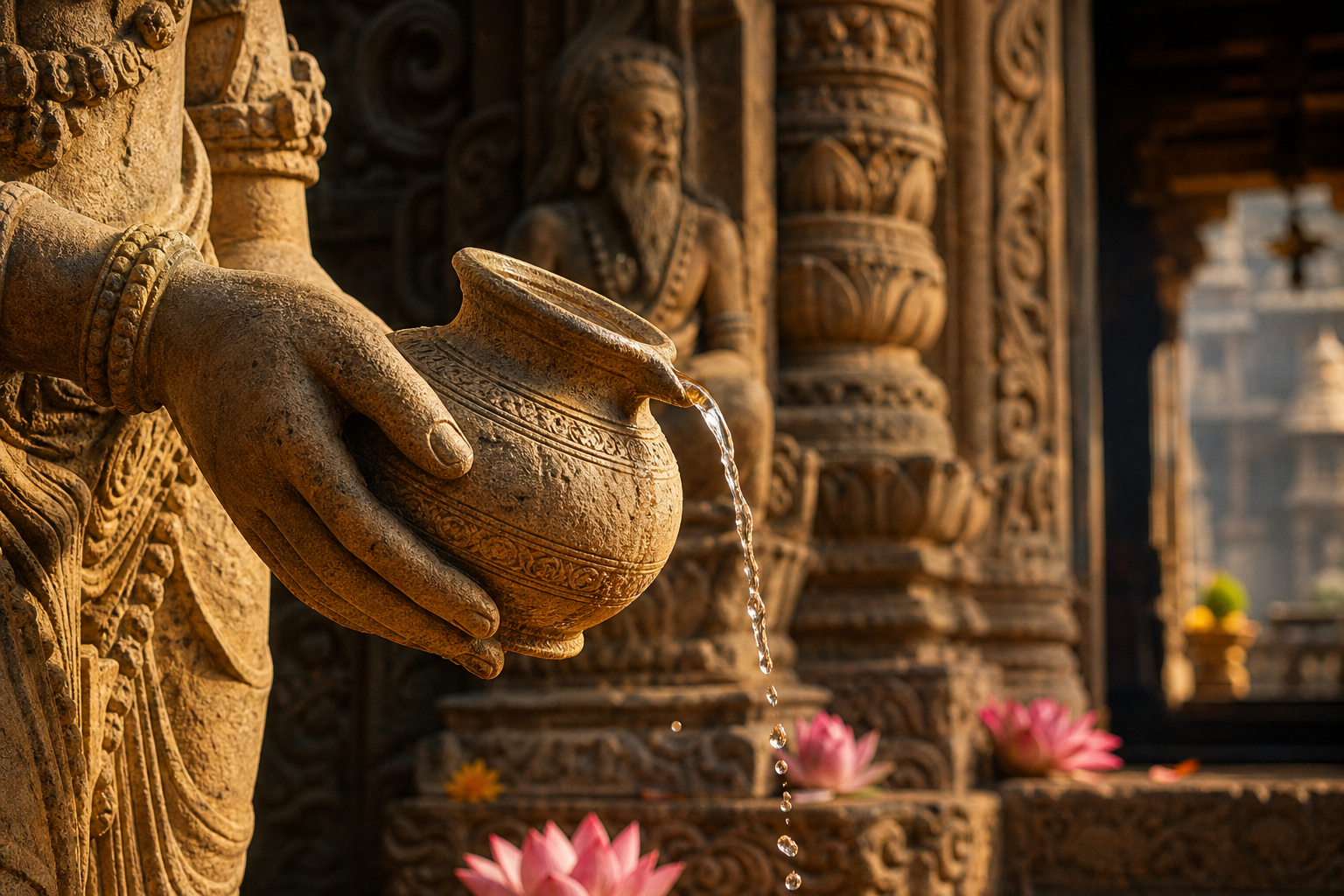
The kundika, a ritual water vessel represented in Hindu sculpture, belongs to that class of sacred objects whose importance is easy to overlook precisely because it appears so modest. It is not a weapon like the chakra, a musical emblem like the vina, or a dramatic symbol like the trishula. Yet in stone, bronze, and painted temple imagery, the kundika quietly carries some of the deepest ideas of Hindu ritual culture: purity, consecration, restraint, abundance, and divine grace.
In Hindu temple art, small objects are rarely accidental. A lotus in the hand of a deity, a serpent coiled around the arm, a rosary held by a sage, or a vessel of water resting against the palm can identify a form, clarify a theological message, and guide the devotee toward a particular mode of reverence. The kundika operates in precisely this way. It is both a functional ritual implement and an iconographic sign, linking the visible body of the deity or sage to the unseen presence of sacred water.
The term kundika generally refers to a small water pot or ritual vessel, often with a spout, neck, or pouring arrangement that distinguishes it from other containers. In ordinary religious life, such vessels are associated with the handling of purified water for achamana, abhishekam, arghya, tarpana, and other acts of sanctification. In sculpture, however, the kundika becomes more than a utensil. It becomes a condensed visual language for disciplined ritual action.
The kundika is often confused with the kamandalu, and the confusion is understandable. Both are water vessels, both are associated with ascetics and sacred rites, and both appear in Hindu iconography. Yet the two are not always identical in form, use, or symbolic emphasis. The kamandalu is commonly imagined as the ascetic’s water pot, often round-bellied and carried by rishis, sannyasis, and deities in tapas-oriented forms. The kundika, by contrast, is frequently understood as a more specifically ritual pouring vessel, often refined in shape and connected to acts of consecration, purification, and offering.
This distinction matters because Hindu sculpture is not merely decorative. It preserves categories of ritual knowledge in visual form. When a sculptor places a kundika in the hand of a deity, attendant, or sage, the object suggests readiness to purify, initiate, bless, or sustain. The vessel becomes a visible extension of the sacred act. It allows the viewer to see water not as a passive element, but as a carrier of divine intention.
Water occupies a central place in Hindu ritual thought. It cleanses, nourishes, cools, carries offerings, marks transitions, and makes consecration tangible. From the waters invoked in Vedic hymns to the sanctity of the Ganga, Yamuna, Saraswati, Godavari, Narmada, Sindhu, and Kaveri, sacred water is understood as both material and metaphysical. It touches the body while also addressing the inner condition of the person who approaches the divine.
The kundika, therefore, should be read through the broader Hindu understanding of tirtha. A tirtha is not only a pilgrimage place; it is a crossing point between the ordinary and the sacred. Water vessels in temple sculpture often evoke this crossing. The water held in a kundika is not random water. It is ritually prepared, sanctified, and directed. It moves from containment to offering, from stillness to blessing, from vessel to world.
In temple worship, water is among the first substances used to honor the deity. The devotee may offer water for washing the feet, hands, and mouth of the deity, followed by bathing, anointing, clothing, adorning, and feeding. These offerings are not theatrical gestures. They express a deeply embodied theology in which the divine presence is treated with hospitality, intimacy, and reverence. The kundika belongs to this world of sacred service.
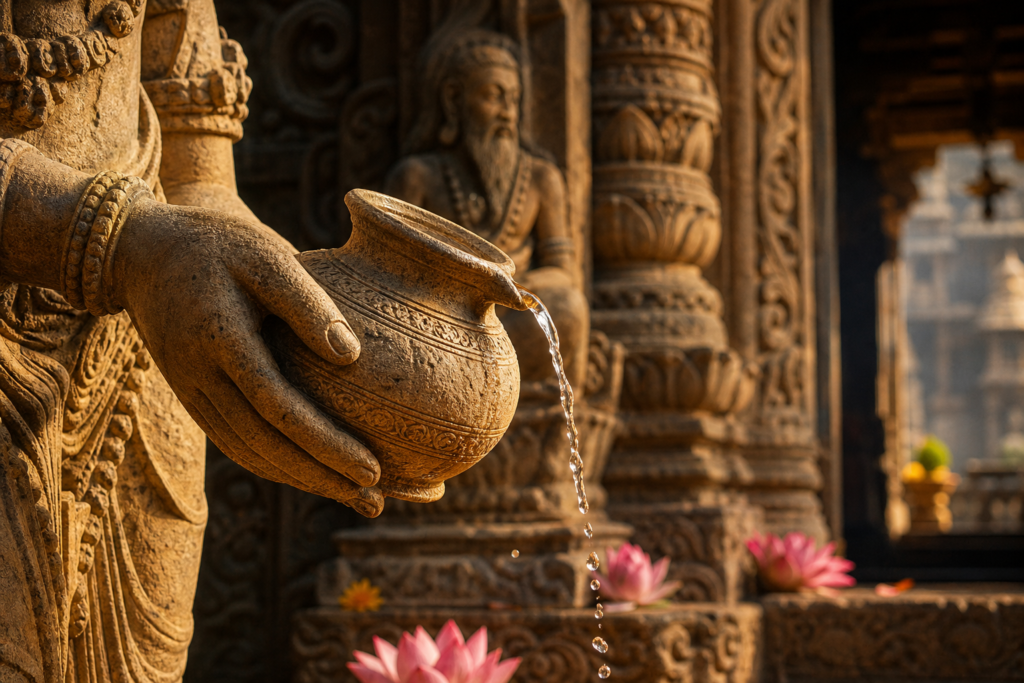
When the vessel appears in stone sculpture, it carries the memory of such rites. A sculpted kundika may not pour water physically, yet it makes the act of pouring permanently present. The hand that holds it becomes a hand of service. The figure who carries it becomes associated with purity, discipline, and ritual competence. The image becomes a still form of ongoing worship.
Art historically, the kundika appears in several settings across Hindu temple architecture and sculpture. It may be held by Brahma, sages, ascetics, temple attendants, river goddesses, ritual specialists, and certain forms of deities connected to creation, austerity, and sacred knowledge. In some images it is rendered with great clarity, while in others it appears as a small pot whose exact identification depends on context, posture, and accompanying attributes.
Brahma’s association with water vessels is especially significant. As the creator within the Hindu sacred imagination, Brahma is linked to emergence, order, and the unfolding of life. A water pot in his hand can suggest the waters from which creation is ritually and cosmically initiated. In this setting, the kundika becomes a vessel of generative order. It holds the potential from which form, speech, time, and sacred law can arise.
In images of sages and rishis, the kundika has a different but related resonance. The sage’s vessel represents restraint, self-sufficiency, and purity of conduct. It is small, portable, and disciplined in purpose. It does not signify luxury or possession. Rather, it suggests a life organized around tapas, study, mantra, and ritual precision. The water held by the sage becomes a marker of inner clarity.
This symbolism is particularly powerful because the vessel is humble. Hindu iconography often communicates greatness through simplicity. The kundika does not overwhelm the figure who holds it. It does not dominate the composition. Its very smallness teaches a subtle lesson: sacred power is not always announced through scale, force, or spectacle. Sometimes it is carried quietly in a vessel meant for service.
In Shaiva contexts, water vessels are deeply connected to abhishekam, the ritual bathing of the Shiva linga and other forms of Shiva. Water, milk, curd, honey, ghee, and other substances may be poured as offerings, each with its own devotional and symbolic meaning. The kundika, when associated with Shaiva figures or ascetic imagery, points toward purification, renunciation, and the cooling of intense spiritual energy.
Shiva’s iconography often holds together opposites: fierce and compassionate, ascetic and householder, cosmic dancer and silent yogi. A vessel of water within this symbolic field tempers intensity with grace. It evokes the flow of the Ganga through Shiva’s matted hair, the purification of the devotee, and the ritual continuity through which the temple becomes a living body of worship.
In Vaishnava temple art, the ritual vessel may appear in scenes of worship, consecration, or divine attendance rather than as a primary attribute of Vishnu in his most familiar iconographic forms. Even then, its role remains important. Vaishnava worship places great emphasis on service, purity, and the loving care of the deity. Water offered with devotion becomes an expression of bhakti, not a mere procedural requirement.
The kundika also has significance in the visual world surrounding temple guardians, attendants, and subsidiary figures. These figures often carry objects that support the ritual atmosphere of the sacred space. A water vessel may indicate that the temple is not an inert monument but a place of continuous ceremonial life. Even the sculpted attendants seem prepared to participate in worship.
River goddesses such as Ganga and Yamuna are frequently placed near temple entrances, especially in classical and medieval Hindu temple architecture. They may carry vessels, stand on aquatic mounts, and embody the sanctifying waters through which the devotee symbolically passes before approaching the deity. In this context, the vessel becomes a threshold symbol. It marks the transition from the ordinary world into sacred presence.
This threshold symbolism is essential to understanding Hindu temples. The temple is approached through purification. The devotee removes footwear, washes, adjusts posture and speech, and enters with a changed awareness. Sculpted water vessels reinforce this process visually. They remind the devotee that darshan is not simply seeing an image; it is entering a relationship that calls for inward preparation.
The kundika also belongs to the wider family of ritual containers in Indian art. Kalasha, purna-ghata, kamandalu, patra, and kundika all participate in the symbolism of containment and abundance, but each has its own nuance. The purna-ghata, or full vessel, often represents auspicious fullness and fertility. The kamandalu emphasizes ascetic possession and spiritual discipline. The kundika frequently highlights ritual handling, measured pouring, and consecrated action.
In sculpture, form helps distinguish meaning. A round pot without a spout may suggest one category, while a vessel with a distinct neck or pouring lip may suggest another. The position of the hand also matters. A vessel held upright indicates containment, readiness, and preservation. A vessel tilted toward the ground or deity suggests offering. A vessel held near the body may signify possession or identity. A vessel placed beside a figure may mark status, role, or ritual function.
The material of the sculpture adds another layer. In stone, the kundika appears permanent, still, and architectural. It is part of the temple’s enduring sacred grammar. In bronze, especially in processional images, the vessel participates in movement. Bronze icons are not only viewed in sanctums; they may be bathed, dressed, carried, and brought into public festivals. A bronze kundika, therefore, can feel closer to living ritual action.
South Indian bronze traditions, particularly those associated with the Chola period and later temple cultures, demonstrate how metal icons could combine theological precision with intimate devotional presence. Small attributes held in the hands of deities and saints are not minor details. They help devotees identify the form and understand its spiritual mood. A vessel in bronze is both an iconographic marker and a reminder that ritual service is central to temple life.
In stone temples, especially across regions such as Tamil Nadu, Karnataka, Odisha, Madhya Pradesh, Rajasthan, and elsewhere, sculptors developed highly sophisticated visual languages for sacred objects. The kundika may appear in niches, friezes, mandapa pillars, doorway compositions, and sculpted panels. Its presence can be modest, but it contributes to the larger theological ecology of the temple.
That ecology includes architecture, mantra, ritual, sculpture, music, light, fragrance, and movement. Hindu temple art does not isolate the visual from the liturgical. The eye sees what the ritual hand does. The sculpted vessel preserves the memory of actual vessels used by priests, devotees, ascetics, and householders. The kundika in art and the kundika in worship illuminate one another.
There is also a philosophical dimension to the vessel. A container gives form to what otherwise flows without boundary. Water by itself moves according to gravity, terrain, and circumstance. In a kundika, water is held, protected, and directed. This makes the vessel a powerful metaphor for disciplined consciousness. Just as water must be contained to be offered precisely, the mind must be steadied to become an instrument of worship.
This metaphor resonates with several streams of Hindu philosophy and spiritual practice. In Yoga, the disciplined mind becomes capable of concentration and insight. In Vedanta, the purified mind becomes fit for knowledge. In bhakti, the heart becomes a vessel for devotion. The kundika quietly mirrors all these ideas. It does not argue; it holds. It does not proclaim; it offers.
The symbolism also extends to purity. In Hindu rituals, purity is not merely a matter of external cleanliness. It includes intention, preparation, mantra, correct sequence, and reverence. Water poured from a kundika may cleanse the hands, sanctify a space, initiate a rite, or complete an offering. The vessel thus represents purity made actionable.
At the same time, it is important to avoid reducing Hindu ritual purity to simplistic modern categories. Ritual purity is a sacred discipline rooted in context, purpose, and relationship. It governs how one approaches the divine, how objects are prepared, how space is honored, and how the body becomes fit for worship. The kundika is part of this refined ritual intelligence.
The kundika also reveals the intimacy between household ritual and temple ritual. Many Hindu homes maintain vessels for puja, achamana, and offering water to deities, ancestors, guests, and sacred plants such as Tulasi. The same basic gesture that occurs in a grand temple can occur in a small home shrine. This continuity between domestic and temple worship is one of the strengths of Hindu tradition.
In this sense, the kundika is not only an object of elite temple art. It belongs to a shared ritual world. A devotee who has watched water poured during abhishekam, offered arghya to the Sun, or seen a priest sprinkle sanctified water after puja can recognize the emotional force behind the vessel. The sculpted object awakens remembered experience.
That emotional recognition is one reason the kundika remains meaningful. A person standing before a temple sculpture may not know every technical term of iconography, but the sight of a water vessel can still evoke cleansing, blessing, and care. The image works at multiple levels. It teaches scholars through form and context, while also speaking to devotees through memory and feeling.
The kundika’s sacred significance is also connected to hospitality. In many traditional settings, water is the first offering to a guest. It refreshes, honors, and welcomes. Hindu worship often treats the deity as the supreme guest, the beloved presence invited into the ritual space. The vessel of water becomes the beginning of relationship. It says, in ritual language, that the divine is received with respect.
This devotional hospitality is central to puja. The deity is invited, seated, bathed, clothed, adorned, fed, praised, and lovingly dismissed or respectfully retained in the shrine. The kundika participates in the earliest and most essential of these gestures. Its water prepares the encounter. It is grace before ornament, purity before offering, welcome before worship reaches fullness.
In the study of Hindu Sculptures, the kundika also helps correct an imbalance in attention. Viewers often focus on large narrative scenes, dramatic postures, and famous divine attributes. Yet the smaller ritual objects preserve the daily life of Hindu dharma with remarkable fidelity. They show how theology is practiced through hands, vessels, substances, and repeated acts of devotion.
This is especially relevant in temple iconography, where every object may serve as a clue. A rosary indicates mantra, discipline, and sacred repetition. A manuscript suggests knowledge and scripture. A lotus evokes purity, beauty, and transcendence. A water vessel points toward purification, offering, creation, and consecration. Together, these objects form a visual vocabulary of Hindu spirituality.
The kundika also encourages a more careful reading of Indian art history. Earlier catalogues and casual descriptions sometimes grouped many ritual vessels under broad labels without distinguishing their forms or meanings. A more attentive approach asks how shape, context, hand gesture, regional style, and accompanying figures affect identification. Such care is not pedantry. It is respect for the intelligence of the tradition.
Regional variation must also be acknowledged. Hindu temple traditions developed across many languages, dynasties, ritual lineages, and artistic schools. A vessel that appears in one region with a specific shape may be rendered differently elsewhere. The distinction between kundika and kamandalu may be clear in one context and more fluid in another. Academic caution is therefore necessary, especially when interpreting damaged or weathered sculptures.
Nevertheless, the recurring association of water vessels with purity, asceticism, creation, blessing, and sacred service remains remarkably stable. Whether the vessel is identified as a kundika, kamandalu, or another ritual pot, its symbolic field is anchored in the sanctity of water. The kundika is valuable because it sharpens this field and allows a more precise understanding of ritual iconography.
There is also a wider Dharmic resonance. Water vessels appear in Hindu, Buddhist, and Jain artistic worlds, often connected with purification, monastic discipline, offering, and spiritual restraint. While each tradition has its own theological framework, the shared reverence for disciplined conduct, sacred spaces, and purified intention points toward a civilizational vocabulary that is deeply interconnected. The kundika can therefore be studied without narrowing it into sectarian isolation.
In Buddhist contexts, kundika-like vessels are sometimes associated with bodhisattvas, monastic discipline, and ritual purity, especially across regions influenced by Indic visual culture. In Jain contexts, water vessels may appear in relation to ascetic practice, purity, and the careful ordering of religious life. These parallels do not erase Hindu meanings. Rather, they show how Dharmic traditions developed distinct yet related ways of honoring restraint, purification, and sacred care.
This shared cultural grammar is important for contemporary readers. The kundika reminds observers that Dharmic traditions often communicate through objects, gestures, and disciplined practices rather than abstract doctrine alone. A vessel, a lamp, a flower, a mantra, or a circumambulation can carry philosophical depth. Such forms are not peripheral to religion; they are the lived body of religion.
The kundika also deepens the understanding of abhishekam. In many temples, the bathing of the deity is among the most moving forms of worship. Water streams over stone or metal, carrying fragrance, mantra, and devotion. The devotee watches as the image is cleansed and revealed again. This ritual is both offering and revelation. The divine form appears renewed, while the devotee’s own inner condition is invited toward renewal.
When a sculpted figure holds a kundika, it evokes this entire ritual world. The vessel is small, but it suggests the sound of water, the touch of coolness, the fragrance of sandalwood, the rhythm of mantra, and the concentration of the priest’s hand. A successful sculpture can make stillness feel active. The kundika is one of the objects through which this happens.
From a technical sculptural perspective, rendering a kundika requires balance. The object must be recognizable but not disproportionate. It must sit naturally in the hand without distracting from the figure’s posture. Its neck, body, rim, and spout must be carved or cast with enough clarity to communicate function. In bronze, the challenge includes durability, especially when small projecting elements are involved.
Such technical decisions reveal the skill of Indian sculptors. Temple art is often praised for its spiritual power, but its craftsmanship deserves equal attention. A small vessel held in a carved hand requires knowledge of anatomy, proportion, ritual objects, and visual hierarchy. The sculptor must know not only how things look, but what they mean.
Iconographic manuals and sculptural traditions often specify attributes, gestures, proportions, ornaments, and vehicles associated with divine forms. Even where the exact textual prescription is not available for every surviving image, the broader principle remains clear: sacred art is governed by knowledge. The kundika is part of that disciplined system. It is placed with intention.
The relationship between text and sculpture, however, should not be imagined as mechanical. Sculptors, patrons, priests, and regional traditions all contributed to the final form of temple imagery. Local practice could shape how a vessel was shown. Sectarian emphasis could affect which figures carried it. Material constraints could influence detail. The kundika therefore stands at the meeting point of shastra, ritual, craftsmanship, and living devotion.
Modern viewers can learn much by slowing down before such objects. Temple visits often encourage attention to the principal deity, and rightly so. Yet the surrounding sculptural field contains layers of meaning that reward patient observation. A kundika in the hand of a sage, a vessel near a river goddess, or a small pot in an attendant’s grasp may open an entire world of interpretation.
This slower way of seeing is especially necessary today, when sacred art is often reduced to photographs, quick captions, or simplified labels. The kundika resists haste. It asks the viewer to notice scale, gesture, placement, and ritual memory. It teaches that sacred meaning can be quiet and still remain profound.
The vessel also offers a valuable lesson in ecological sensitivity. Hindu reverence for sacred rivers and ritual water is not only symbolic. It reflects a worldview in which water is life-bearing, purifying, and worthy of reverence. The kundika, as a vessel of careful use, can speak to contemporary concerns about water ethics, conservation, and responsible stewardship. Sacred symbolism becomes most meaningful when it shapes conduct.
In this respect, the kundika is not a relic of the past. It remains relevant because it encodes an attitude toward resources. Water is not treated as disposable. It is held, sanctified, offered, and shared. The vessel teaches measure. It implies that what sustains life should be handled with gratitude rather than carelessness.
The kundika also speaks to the relationship between outer ritual and inner transformation. Pouring water can be a simple physical act, but in sacred practice it becomes a discipline of attention. The hand steadies, the mantra aligns speech, the mind turns toward the deity, and the offering becomes a means of self-refinement. The vessel trains the body to participate in devotion.
This embodied quality is one reason Hindu rituals remain powerful across generations. They do not ask the devotee to believe only in abstraction. They invite the devotee to stand, bow, pour, touch, smell, taste, sing, and see. The kundika belongs to this embodied religious intelligence. It gives form to devotion through action.
In academic study, the kundika can be approached through art history, religious studies, anthropology, Sanskrit literature, ritual studies, and conservation. Each discipline reveals a different dimension. Art history studies form and style. Ritual studies examines use and sequence. Religious studies interprets symbolism. Conservation preserves the material object. Together, these approaches create a fuller understanding.
For museum interpretation, the kundika presents both a challenge and an opportunity. A label that says merely water pot may be technically understandable but spiritually inadequate. A better interpretation explains that the vessel participates in purification, offering, consecration, ascetic discipline, and sacred hospitality. Such explanation helps viewers encounter Hindu art on its own terms.
For temple communities, the kundika reinforces continuity. The same ritual culture represented in ancient sculpture continues in living worship. Priests still handle water with mantra. Devotees still receive tirtha. Abhishekam still draws crowds into shared reverence. The sculpted vessel is not a dead symbol; it belongs to a continuing tradition.
This continuity is central to Sanatana Dharma. Objects endure because practices endure. Practices endure because they answer human needs for purification, gratitude, order, beauty, and connection with the sacred. The kundika survives in art because it survives in worship, and it survives in worship because water remains one of the most immediate ways to express reverence.
The kundika’s beauty lies in its restraint. It does not demand attention, but it rewards it. It invites careful seeing, careful handling, and careful thought. In a temple filled with divine forms, mythic narratives, ornaments, and architectural splendor, this small vessel gathers the essence of sacred service into a single object.
To study the kundika in Hindu temple art is to recognize how deeply ritual life shapes iconography. The vessel is not a decorative accessory. It is a sign of water made sacred, action made disciplined, and grace made visible. It connects the hand of the sculpted figure with the hand of the priest, the memory of scripture with the experience of the devotee, and the stillness of stone with the flow of living worship.
Ultimately, the kundika teaches that sacredness often resides in the disciplined handling of simple things. Water, when held with reverence, becomes tirtha. A vessel, when placed in divine iconography, becomes theology in form. A small object, when understood within Hindu art and ritual, opens into a vast meditation on purity, creation, service, and grace.
Inspired by this post on Hindu Blog.







Leave a Reply
You must be logged in to post a comment.