
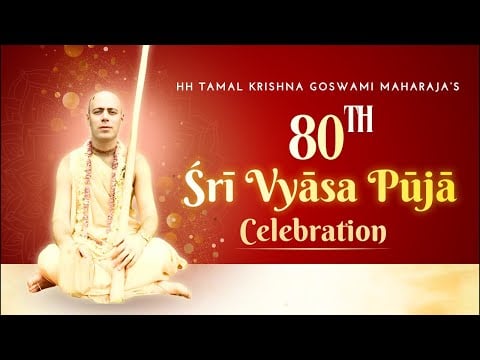
Watch the featured video: Srila Tamal Krishna Goswami Maharaj 80th Vyasa Puja | Live from Mayapur
The 80th Vyasa Puja celebration of Srila Tamal Krishna Goswami Maharaj, presented live from Mayapur, is more than a commemorative broadcast. It is a public meditation on guru-seva, devotional accountability, historical memory, and the continuing life of a spiritual lineage. In the Gaudiya Vaishnava tradition, such an observance is not treated as a mere birthday function. It is a disciplined act of remembrance in which the community reflects on how a teacher received, embodied, preserved, and transmitted sacred knowledge.
Srila Tamal Krishna Goswami Maharaj occupies a distinct place in the modern history of ISKCON. Known as a close disciple of His Divine Grace A.C. Bhaktivedanta Swami Prabhupada, he served in major institutional, pastoral, scholarly, and missionary roles during a formative period of the Hare Krishna movement. His life brought together several demanding dimensions of spiritual leadership: personal discipline, administrative responsibility, scriptural study, public teaching, and the intimate service of a guru whose mission had expanded across continents.
Vyasa Puja itself carries technical theological meaning. The term connects the honoring of the spiritual master with Srila Vyasadeva, the compiler and systematizer of Vedic wisdom. In this understanding, the guru is not worshiped as an isolated personality or charismatic public figure. The guru is honored as a transparent representative of parampara, the disciplic succession through which transcendental knowledge is received, tested through practice, and handed forward with fidelity. This is why offerings, kirtan, remembrance, and community testimony become central to the observance.
Mayapur gives this celebration an especially powerful setting. As the sacred land associated with Sri Chaitanya Mahaprabhu, Mayapur is not merely a geographical backdrop. It is a theological landscape shaped by sankirtana, humility, devotional service, and the aspiration to share Krishna consciousness with the world. A Vyasa Puja from Mayapur therefore places Srila Tamal Krishna Goswami Maharaj’s legacy within the wider Gaudiya Vaishnava mission: the cultivation of devotion through nama-sankirtana, scripture, service, and compassionate outreach.
A careful viewing of this featured video invites attention to the devotional culture surrounding remembrance. The importance lies not only in what is said from the stage, but also in the form of the gathering itself. Devotees assemble, listen, chant, offer respect, and participate in a shared memory. Such practices reveal how Hindu spiritual traditions preserve history through ritualized gratitude. Biography becomes worshipful reflection, and memory becomes a form of education.
Srila Tamal Krishna Goswami Maharaj’s life is often studied through his service to Srila Prabhupada, especially during the later years of Prabhupada’s manifest presence. That service required practical intelligence, emotional steadiness, and deep surrender. The guru-shishya relationship in this context was not sentimental dependence. It was disciplined service under instruction, often in difficult circumstances, with the disciple learning to align personal will with a larger sacred mission.
This aspect of his life remains relevant for contemporary readers because spiritual life is frequently misunderstood as private inspiration alone. The example of Srila Tamal Krishna Goswami Maharaj shows a more demanding model. Devotion involved punctuality, organization, travel, correspondence, management, teaching, correction, sacrifice, and the capacity to keep serving even when the work was heavy. His life demonstrates that bhakti, when matured, does not withdraw from responsibility; it spiritualizes responsibility.
The academic value of such a Vyasa Puja broadcast lies in its ability to show living tradition in motion. Texts, rituals, institutions, memories, and relationships converge in a single event. The gathering becomes a source for understanding how ISKCON maintains continuity across generations. It also shows how a global religious movement negotiates reverence for founding figures while educating newer devotees who may know those figures only through books, recordings, disciples, and institutional memory.
For many devotees, the emotional force of Vyasa Puja comes from the recognition that spiritual inheritance is personal. A teacher’s life is not preserved only in archives or formal biographies. It is preserved in changed habits, refined speech, disciplined worship, steadier faith, and the willingness to serve others. This makes the event relatable even beyond the immediate ISKCON community. Every dharmic tradition understands, in its own language, the importance of gratitude toward those who illuminate the path.
In Sanatana Dharma and the broader family of dharmic traditions, respect for teachers is a civilizational principle. Hindu, Buddhist, Jain, and Sikh traditions all preserve forms of teacher reverence, whether through guru-bhakti, acharya-parampara, monastic discipline, lineage transmission, or the remembrance of saints and enlightened guides. The specific theology differs across traditions, but the ethical structure is deeply resonant: knowledge is received with humility, tested through practice, and honored through transformation.
The 80th Vyasa Puja of Srila Tamal Krishna Goswami Maharaj can therefore be understood as a contribution to dharmic unity. It does not require flattening differences between traditions. Rather, it encourages a mature recognition that reverence, discipline, sacred memory, and service are shared civilizational strengths. Such commemorations remind communities that devotion should deepen humility, not sectarian pride; it should create steadier servants, not louder factions.
Srila Tamal Krishna Goswami Maharaj’s legacy also raises important questions about leadership in spiritual institutions. Religious leadership is not only a matter of eloquent teaching or public recognition. It requires governance, accountability, continuity, and the difficult task of translating ideals into durable practices. ISKCON’s global development placed extraordinary demands on its early leaders, and his service must be understood within that historical setting.
At the same time, an academic and factual approach must avoid turning any spiritual biography into uncritical legend. The value of remembrance increases when it remains honest, textured, and grounded. Great spiritual servants are not honored by removing the complexity of their work. They are better understood when their service is studied in relation to the historical pressures, institutional responsibilities, and personal sacrifices that shaped their lives.
The phrase “Live from Mayapur” also deserves attention in the digital age. A sacred observance once limited by physical distance can now be witnessed by viewers around the world. This changes how devotional memory circulates. A devotee in India, North America, Europe, Africa, or Southeast Asia can participate through listening, watching, chanting, and reflecting. Technology becomes a vehicle for spiritual continuity when used with dignity and purpose.
Yet the digital format also places a responsibility on viewers. A Vyasa Puja should not be consumed as passive religious media. It asks for reflection. What does it mean to honor a guru? How does remembrance become practice? How does hearing about a saintly life change one’s conduct in family, community, work, and worship? These questions move the event from ceremony into sadhana.
Srila Tamal Krishna Goswami Maharaj’s association with Srila Prabhupada remains one of the most significant lenses through which his life is remembered. Srila Prabhupada’s mission emphasized the distribution of sacred literature, the chanting of the holy names, deity worship, prasadam, community building, and philosophical education rooted in Bhagavad Gita and Srimad Bhagavatam. Srila Tamal Krishna Goswami Maharaj’s service reflected these priorities in both practical and contemplative ways.
His example also speaks to the relationship between scholarship and devotion. Modern religious communities often separate intellectual rigor from spiritual practice, as though one must weaken the other. The best of the Gaudiya Vaishnava tradition resists that division. Study is meant to refine devotion, and devotion is meant to purify study. A life of service becomes stronger when scriptural understanding, disciplined reasoning, and humility are held together.
The significance of Mayapur also brings attention to sacred geography. Dharmic traditions have long treated place as a carrier of memory and practice. Pilgrimage sites are not simply historic locations. They discipline the senses, gather communities, preserve stories, and make sacred history tangible. In that sense, a Vyasa Puja from Mayapur unites person, place, and parampara in a single devotional frame.
For contemporary Hindu youth and the wider Hindu diaspora, such commemorations provide a model for rooted modernity. They show that tradition is not preserved by nostalgia alone. It is preserved through organized remembrance, accessible teaching, responsible institutions, and living examples. A young viewer may not know the full biography of Srila Tamal Krishna Goswami Maharaj, but the event can become an entry point into ISKCON history, Gaudiya Vaishnava theology, and the meaning of guru-seva.
The tone of the observance also matters. Authentic guru reverence should cultivate humility, steadiness, compassion, and service. When remembrance becomes competitive or merely performative, it loses its inner force. When it becomes reflective and service-oriented, it strengthens the community. The 80th Vyasa Puja offers an opportunity to renew that higher standard.
This featured video is therefore valuable not only as a record of an event, but as a teaching instrument. It allows viewers to observe how a spiritual community honors lineage, how sacred memory is transmitted, and how devotion is kept alive through shared participation. It also reminds the broader dharmic world that the guru principle is not a relic of the past. It remains central wherever knowledge, character, and liberation are pursued with seriousness.
Ultimately, Srila Tamal Krishna Goswami Maharaj’s 80th Vyasa Puja from Mayapur points toward a simple but demanding conclusion: gratitude must become practice. To honor a spiritual master is to hear more carefully, serve more responsibly, study more deeply, and live with greater integrity. In that sense, the celebration is not finished when the broadcast ends. Its real measure is found in the quiet transformation of those who carry its lessons into daily life.
Inspired by this post on Dandavats.



Leave a Reply
You must be logged in to post a comment.