
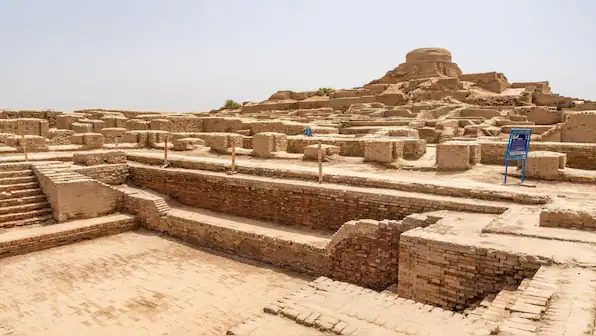
In July 2026, a Firstpost opinion essay titled “My name is Pakistan: I was an Arab yesterday, a Harappan today” drew attention to a striking shift in Pakistan’s public memory: a state long shaped by an explicitly Islamic national narrative now appears increasingly eager to invoke Harappa, Mohenjo-daro, Takshashila, Gandhara, Panini, Porus, and Chanakya as part of its ancestral inheritance.
The issue is not whether the land now called Pakistan possesses an ancient pre-Islamic past. That fact is beyond dispute. The Indus Valley Civilization flourished across large parts of present-day Pakistan and northwestern Bharat. Mohenjo-daro in Sindh and Harappa in Punjab remain among the most important archaeological sites in South Asia, while Taxila and the Gandhara region preserve memories of Buddhist learning, Sanskritic scholarship, trade routes, artistic synthesis, and civilisational exchange.
The deeper question is whether a modern state can selectively claim ancient heritage while continuing to reject the cultural, religious, and philosophical continuities that gave that heritage meaning. A museum label can declare ownership over ruins, but civilisational inheritance demands something more demanding: intellectual honesty, respect for continuity, and protection of the living communities whose traditions still carry that memory.
Pakistan’s relationship with its pre-Islamic past has historically been uneasy. The ideological basis of the state was built around the two-nation theory, which defined Muslims of the subcontinent as a separate political community from Hindus. Over time, this political separation hardened into a civilisational separation. Textbooks, public rhetoric, and state symbolism often placed the beginning of meaningful history around the arrival of Islam in Sindh through Muhammad bin Qasim. Earlier periods were frequently treated as irrelevant, foreign, pagan, or merely archaeological.
This approach produced a fractured national memory. The soil contained Harappan cities, Buddhist monasteries, Hindu temples, Jain traces, Sikh sacred geography, Sanskritic learning, and regional folk traditions; yet the official imagination often preferred to locate emotional ancestry in Arabia, Central Asia, Persia, or the wider Islamic world. The result was a state that lived physically in the Indus region but often narrated itself as though its deepest roots lay elsewhere.
The recent enthusiasm for Harappa and Gandhara therefore cannot be read simply as a liberal awakening. It may also reflect geopolitical need, tourism economics, diplomatic branding, and a response to Bharat’s increasingly confident civilisational discourse. Ancient heritage has become a form of soft power. Nations now use archaeology, museums, language, pilgrimage circuits, heritage restoration, and cultural diplomacy to project depth. Pakistan, facing economic stress and identity fatigue, has reasons to rediscover antiquity as an asset.
Mohenjo-daro illustrates the scale of what is at stake. UNESCO describes it as a major urban settlement of the Indus Civilization, built in the third millennium BCE, with evidence of planned streets, drainage, public architecture, and organized civic life. Such a site is not a minor antiquarian curiosity. It is one of the great windows into early urban life on the Indian subcontinent and one of the strongest reminders that South Asian civilization did not begin with medieval conquest or colonial modernity.
Taxila adds another layer. Its archaeological landscape includes early settlements, Buddhist monasteries, stupas, and later Islamic structures. It was linked with trade routes and became a major centre of Buddhist learning. Its history shows the subcontinent not as a sealed geography but as a meeting ground where Indic, Persian, Hellenistic, Central Asian, Buddhist, Hindu, and later Islamic influences interacted. This complexity should inspire humility rather than political appropriation.
Gandhara is especially important for dharmic traditions. It was one of the great regions through which Buddhist thought, art, and monastic institutions travelled toward Central Asia and East Asia. The Gandharan artistic tradition, with its distinctive representations of the Buddha and bodhisattvas, belongs not only to Pakistan’s territory but to a wider Buddhist and Indic civilisational inheritance. It is a bridge between lands, not a trophy for narrow nationalism.
The same applies to Panini. The great grammarian associated with the northwestern region of the subcontinent cannot be reduced to a modern passport. His work belongs to the Sanskrit intellectual world, to the history of linguistics, and to the shared civilisational memory of South Asia. To celebrate Panini while distancing oneself from Sanskrit, Hindu learning traditions, and the broader Indic knowledge system is intellectually inconsistent.
Chanakya presents a similar difficulty. His association with statecraft, political realism, and the Mauryan world places him within the wider fabric of ancient Bharat. If he is claimed merely because parts of his historical geography intersect with present-day Pakistan, then the claim remains shallow. Civilisational memory is not only territorial; it is textual, ethical, linguistic, ritual, and philosophical.
Porus, too, cannot be detached from the wider history of the Punjab and the resistance to Alexander’s campaign. He belongs to a regional memory that predates modern borders. His story has meaning for Punjabis, for Bharat, for Pakistan, and for students of ancient military history. Yet any honest discussion of Porus must recognize the Indic world in which he stood, rather than placing him inside a modern ideological frame that would have been meaningless to his age.
This is where the Firstpost critique becomes significant. The concern is not that Pakistan is recognizing Harappa or Gandhara. Recognition of ancient heritage is welcome when it is serious, protective, and truthful. The concern is that this recognition may become selective branding: Harappa without the dharmic continuum, Gandhara without living Buddhist reverence, Sanskrit without respect for Hindu knowledge systems, and Taxila without acknowledgment of its Indic intellectual foundations.
For dharmic communities, the question is deeply emotional. Heritage is not only stone, brick, inscription, and excavation. It is memory carried through worship, festivals, philosophy, family stories, pilgrimages, manuscripts, music, and moral imagination. A damaged temple, a neglected gurdwara, a forgotten stupa, or a displaced minority community is not separate from archaeology. These are parts of one civilisational body.
Pakistan’s Hindu, Sikh, Buddhist, and Jain inheritances cannot be treated as extinct museum categories. Hindu temples in Sindh and Punjab, Sikh sacred sites such as Nankana Sahib, Buddhist remains in Gandhara, and Jain mercantile memories all point to a layered past. A state that wishes to claim civilisational depth must protect these traditions in the present, not merely exhibit their ruins for diplomatic prestige.
This does not require hostility between peoples. On the contrary, a mature approach to South Asian history should reduce hostility by restoring truth. Harappa, Mohenjo-daro, Takshashila, Gandhara, and the wider Indus world remind all communities that the subcontinent’s past is older than modern nation-states and richer than ideological slogans. Borders may define citizenship, but they do not erase civilisational continuities.
The dharmic traditions of Hinduism, Buddhism, Jainism, and Sikhism have often differed in theology, practice, and institutions, yet they share a civilisational landscape shaped by karma, dharma, sadhana, liberation, ethical discipline, reverence for knowledge, and respect for multiple paths. The northwestern regions of the subcontinent contributed to this shared world. Any recovery of Pakistan’s ancient past must therefore be understood as part of a broader dharmic and Indic heritage, not as a weapon against it.
There is also a warning for Bharat. Civilisational confidence must not become careless triumphalism. The correct response to Pakistan’s selective rediscovery is not mockery alone, but deeper scholarship, better preservation, stronger public education, and greater unity among dharmic traditions. Ancient India’s history should be studied with rigor, not reduced to political slogans. Archaeology, textual studies, linguistics, genetics, art history, and religious studies all have roles to play.
At the same time, the politics of selective identity cannot be ignored. When a state rejects Indian civilisational continuity for decades and then claims Indus antiquity when convenient, scrutiny is necessary. If Harappa is invoked, then the wider Indus-Sarasvati and Harappan world must be discussed honestly. If Gandhara is celebrated, then the Buddhist and Hindu-Buddhist matrix of the region must be acknowledged. If Panini is honored, then Sanskrit cannot be treated as alien. If Chanakya is admired, then the political thought of ancient Bharat cannot be severed from him.
The larger lesson is that geography gives access to heritage, but continuity gives depth. Pakistan controls many ancient sites, and those sites deserve preservation, funding, research, and global attention. Yet stewardship is not the same as ancestry in the full civilisational sense. Stewardship becomes meaningful when it respects the people, philosophies, languages, and sacred traditions connected with those sites.
A more honest future would allow Pakistan to preserve its ancient sites without denying their Indic and dharmic character. It would allow Bharat to recognize that many sacred and historical landscapes now lie beyond its political borders without surrendering civilisational memory. It would allow Buddhists, Hindus, Jains, and Sikhs to see these places as shared inheritances requiring care rather than rivalry.
The real test, therefore, is not whether Pakistan can call itself Harappan. The test is whether it can accept what Harappa, Gandhara, Takshashila, Panini, Porus, and Chanakya imply: that the land’s deepest memories are plural, Indic, pre-Islamic, dharmic, regional, and interconnected. A civilization cannot be adopted only for prestige while its living heirs are marginalized or its philosophical roots are denied.
Pakistan’s sudden Harappan turn may become either an opportunity or another exercise in narrative management. If it leads to serious conservation, honest textbooks, respect for minorities, and acknowledgment of the subcontinent’s shared civilisational roots, it would be a welcome development. If it remains a diplomatic costume worn over an unchanged ideological structure, it will only deepen the contradiction.
History is patient, but it is not infinitely pliable. Ruins remember what politics tries to forget. The bricks of Mohenjo-daro, the monastic remains of Taxila, the echoes of Gandhara, and the intellectual legacy of Panini all point toward a truth larger than modern propaganda: South Asia’s ancient heritage is interconnected, and its dharmic streams deserve to be studied, protected, and honored with integrity.
Inspired by this post on Hindu Post.



Leave a Reply
You must be logged in to post a comment.