
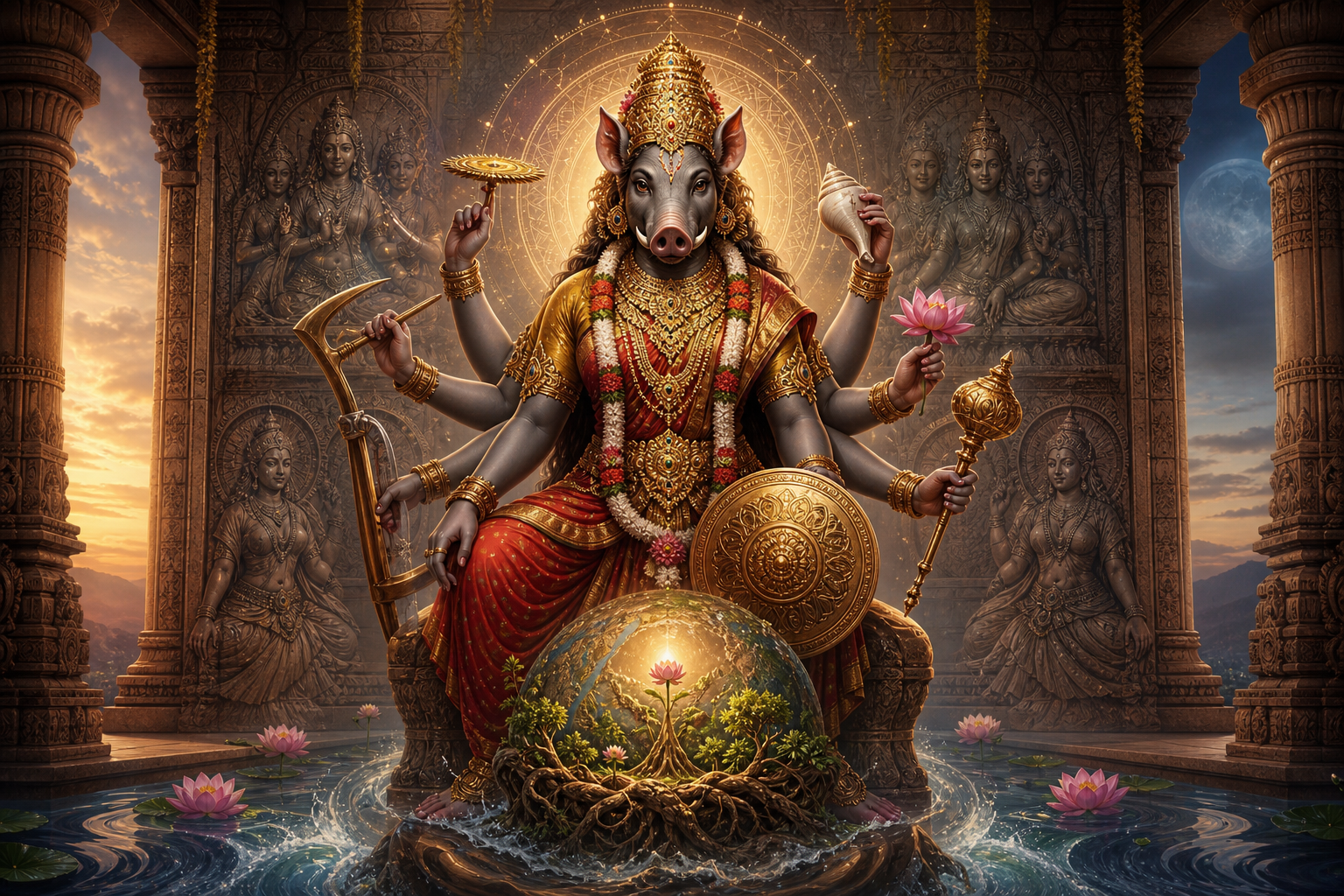
Varahi is often introduced in simplified retellings as merely the female counterpart of Varaha, the boar incarnation of Vishnu. That description is convenient, but it is also incomplete. In the deeper Shakta, Puranic, and Tantric imagination, Varahi is not best understood as a spouse whose identity depends upon a male deity. She is a Matrika, a mother-power, a manifestation of Devi Shakti, and a fierce guardian presence whose boar-faced form encodes protection, sovereignty, fertility, earth-energy, and transformative spiritual force.
The distinction matters because Hindu theology does not reduce divine feminine power to marital relation alone. The word Shakti itself points toward power, capacity, radiance, motion, and manifestation. When a deity acts in the cosmos, that action is intelligible through Shakti. In this sense, Varahi is not an ornamental addition to Varaha. She is the power by which the symbolism of the boar becomes spiritually effective: the power that descends into depth, raises the hidden earth, confronts the forces of disorder, and restores sacred balance.
Within the Matrika tradition, Varahi belongs to the group of divine mothers known as the Sapta Matrikas or Ashta Matrikas, depending on the textual and regional enumeration. These mother-goddesses are not ordinary consorts. They are martial, maternal, protective, and cosmological forms of the Goddess. Their role is especially visible in traditions associated with Devi Mahatmya, Puranic mythology, temple sculpture, folk devotion, and Tantric sadhana. They appear when cosmic order requires forms of power that are immediate, embodied, and uncompromising.
In many lists, the Matrikas are connected with major deities: Brahmani with Brahma, Vaishnavi with Vishnu, Maheshvari with Shiva, Kaumari with Skanda, Indrani with Indra, Varahi with Varaha, and Chamunda or Narasimhi with fierce forms of Devi or Vishnu. This association should not be mistaken for simple wifehood. It is a theological mapping of energies. The Matrikas express the functional powers of the divine, especially in battle against adharma. Their identities are relational in a cosmic sense, not dependent in a domestic sense.
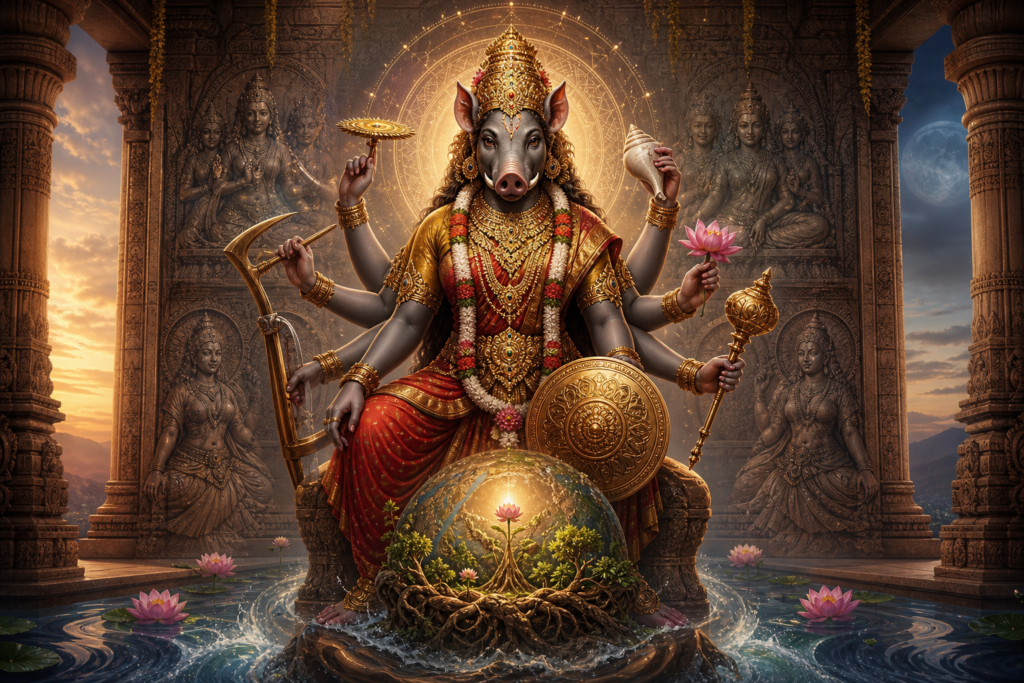
Varahi’s iconography makes this clear. She is usually depicted with the head of a boar and the body of a goddess, often dark, red, or golden in complexion, sometimes pot-bellied, sometimes majestic, and frequently armed. She may hold a plough, mace, discus, sword, shield, noose, goad, conch, or skull-cup, depending on the tradition. Her vehicle is sometimes a buffalo, sometimes a boar, and sometimes another regional form. These symbols do not present her as passive. They present her as a sovereign force who digs into hidden layers of existence, uproots impurity, and protects the devotee from forces that cannot be defeated by polite spirituality alone.
The boar symbolism is especially important. In agrarian and earth-centered cultures, the boar is associated with digging, rooting, force, fertility, and the ability to enter mud without being diminished by it. Varaha raises the Earth from the cosmic waters in Vaishnava mythology; Varahi carries the same earth-rescuing intelligence in feminine form. Her power is not delicate abstraction. It is subterranean, muscular, and practical. She enters what is buried, wounded, or polluted and brings it into the possibility of restoration.
To call Varahi only the consort of Varaha therefore narrows a vast symbolic field. It transforms a mother-goddess into an appendage. It also misses how Matrika theology works. The Matrikas are called mothers because they generate, nourish, protect, and discipline existence. Motherhood here is not limited to biological softness. It includes fierce intervention. In Hindu spiritual vocabulary, the mother can feed the child, but she can also remove poison, restrain danger, and stand between the vulnerable and the destructive.
This wider idea of motherhood is visible throughout Hindu Goddess traditions. Durga is mother and warrior. Kali is mother and time-force. Lakshmi is mother and abundance. Saraswati is mother and wisdom. Bhudevi is mother and earth. Varahi belongs to this same sacred grammar. She represents the form of the mother who does not merely console but also confronts. Her compassion is not sentimental weakness; it is protective intelligence.
Several scriptural traditions support this reading. In Devi-centered theology, all divine powers arise from the supreme Goddess, even when they appear through the forms of male deities. The Devi Mahatmya presents the Goddess as the ultimate ground from which many energies emerge during the battle against demonic forces. Later Puranic and Tantric traditions develop these divine mothers into independent objects of worship, ritual, and meditation. Varahi is therefore not simply explained by Varaha; rather, Varaha symbolism is one doorway into understanding her own Shakti.
In Shakta thought, the feminine divine is not secondary to the masculine divine. Shiva without Shakti is often described as inert, and Shakti without consciousness lacks direction. This is not a hierarchy but a metaphysical complementarity. The same principle helps clarify Varahi. When described as the Shakti of Varaha, the phrase should not be reduced to “wife of Varaha.” It more accurately means the operative power, energetic principle, and manifesting force associated with the Varaha function of cosmic restoration.
The word “consort” can be useful in some mythological contexts, but it becomes misleading when applied carelessly to every goddess associated with a male deity. Hindu traditions contain many kinds of divine relationship: spouse, mother, daughter, sister, emanation, Shakti, aspect, attendant, guardian, guru, sovereign, and independent deity. The richness of Hindu theology depends on preserving these distinctions. When every feminine form is translated into the language of spousehood, the conceptual precision of the tradition is lost.
Varahi’s place in Sri Vidya traditions further reinforces her autonomy. In several Tantric streams, she is revered as Dandanatha or Dandanayika, the commander of the forces of Lalita Tripura Sundari. This title is not decorative. It places Varahi within a highly organized sacred universe where divine power governs, protects, and disciplines. She is associated with command, strategy, and the enforcement of dharmic order. Such a figure cannot be adequately described as a minor companion to another deity.
Varahi worship is also deeply connected with protection. Devotees approach her for courage, removal of fear, victory over hostile forces, protection from unseen disturbances, and inner strength during difficult periods. In many living traditions, she is approached at night or in ritually guarded forms because her energy is considered intense. This does not make her inaccessible. It means that her worship asks for seriousness, discipline, and respect for the sacred boundaries of Tantric practice.
Her fierce appearance should not be misunderstood as negativity. Hindu iconography often uses fierce forms to represent the destruction of ignorance, arrogance, cruelty, and disorder. A serene form of the divine may guide through beauty and wisdom; a fierce form may guide by cutting through delusion. Varahi belongs to the second mode. She reminds the devotee that spiritual life is not only comfort, sweetness, and reassurance. It is also confrontation with fear, ego, confusion, and inner fragmentation.
This is where Varahi becomes emotionally meaningful for modern seekers. Many people encounter periods when life feels buried under pressure, injustice, anxiety, or exhaustion. Gentle inspiration is valuable, but sometimes the human heart also needs a symbol of fierce protection. Varahi’s image offers precisely that: a mother who enters difficult terrain without hesitation, a guardian who does not abandon the devotee in the mud, and a Shakti who knows how to raise what has fallen into darkness.
Academically, this emotional dimension should not be dismissed as merely personal feeling. Religious symbols survive because they organize experience. Varahi’s form organizes the experience of danger, protection, discipline, and recovery. Her boar-face is not an arbitrary mythic exaggeration. It is a sacred language through which the tradition communicates that divine motherhood includes the power to search, uproot, defend, and restore.
Temple sculpture across India also preserves Varahi’s importance. The Matrikas are often carved together in panels, seated in a row, radiating both unity and difference. These panels appear in many Shaiva, Shakta, and broader Hindu temple contexts. Their presence shows that the worship of mother-goddesses was not marginal. It was integrated into sacred architecture, royal protection, village religion, Tantric practice, and the ritual imagination of Hindu society.
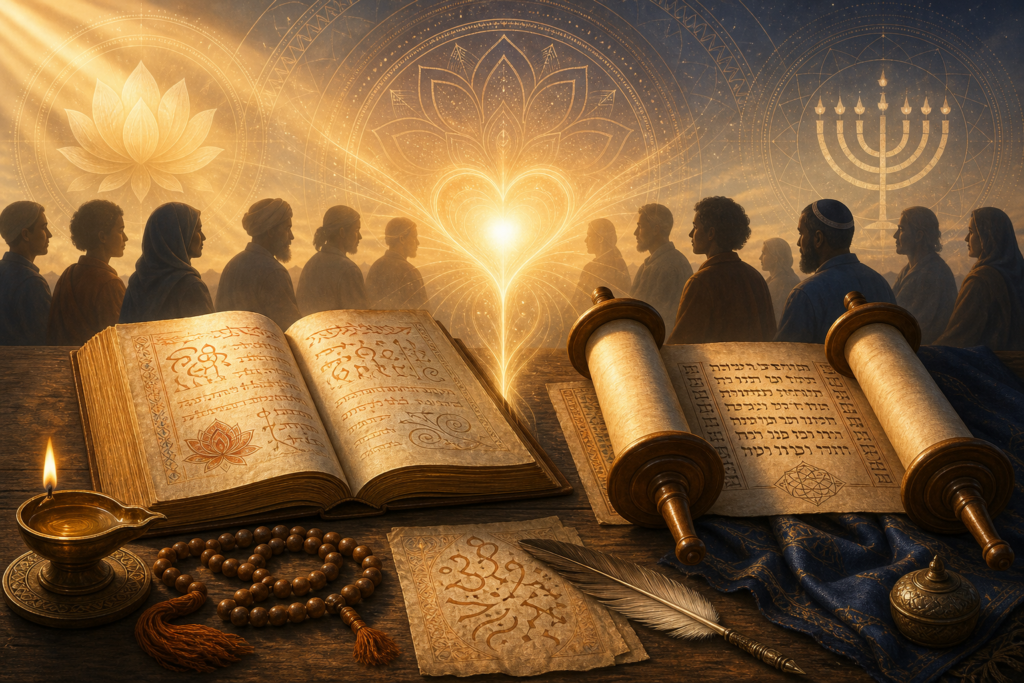
The Matrika panels also reveal a crucial feature of Hindu unity: different streams of worship can coexist without erasing one another. Shaiva, Vaishnava, Shakta, Ganapatya, Saura, and regional traditions have interacted for centuries through shared symbols, pilgrimage spaces, festivals, and theological borrowing. Varahi, as a boar-faced mother connected with both Devi Shakti and Varaha symbolism, stands at such a meeting point. She shows that Hindu traditions often preserve unity through layered meanings rather than uniform doctrines.
This insight is valuable for the wider dharmic world as well. Hinduism, Buddhism, Jainism, and Sikhism each maintain distinct philosophical and devotional identities, yet all have preserved deep respect for discipline, liberation, sacred knowledge, ethical living, and the transformation of the self. A careful reading of Varahi should therefore not become sectarian competition. It can instead become an example of how dharmic traditions honor multiplicity while searching for truth, protection, compassion, and inner freedom.
One common misunderstanding arises from the modern habit of flattening myth into family charts. When Hindu deities are presented only as husbands, wives, sons, and daughters, the metaphysical depth of the tradition is reduced to domestic genealogy. Genealogy exists in the Puranas, but it is never the whole story. A goddess may be described through family relation in one context and as supreme reality in another. Varahi’s association with Varaha belongs to one symbolic layer; her identity as Matrika and Shakti belongs to a deeper theological field.
Another misunderstanding comes from translating Sanskrit and regional categories too quickly into English. Terms such as Shakti, Devi, Matrika, Yogini, Ambika, and Mahavidya do not map neatly onto English categories like wife, goddess, fairy, spirit, or angel. Each term carries philosophical and ritual density. Matrika means mother, but the mother here is cosmic, protective, and energetic. Shakti means power, but this power is conscious, divine, and creative. Varahi must be read through these native categories before being explained through simplified modern labels.
The claim that Varahi is “mother, not spouse” should therefore be understood carefully. It does not deny that some traditions may connect her with Varaha in relational language. Hindu tradition is plural, and local myths may preserve different narrative forms. The stronger point is that her primary theological significance is not exhausted by spousehood. Her core identity in Matrika and Tantric traditions is maternal, protective, fierce, and sovereign.
Varahi also carries an important lesson about feminine agency in Hindu sacred imagination. She is not passive beauty waiting to be interpreted by a male figure. She is armed, alert, and active. She rides into conflict. She commands. She protects. She grants boons. She frightens the hostile and shelters the devoted. In this respect, Varahi challenges shallow assumptions that ancient Hindu goddess traditions confined feminine divinity to softness alone.
Her motherliness is therefore not sentimental. It is juridical, martial, earthy, and compassionate at once. She protects the moral and spiritual order because protection is one of the functions of motherhood. The mother in dharmic imagination is not merely the one who gives birth. She is also the one who sustains the field in which life can grow. Varahi sustains that field by removing what threatens it.
In ritual practice, Varahi is often approached with mantra, yantra, offerings, and disciplined observance under proper guidance. Because many Varahi traditions are Tantric, public summaries should avoid casual instruction in restricted practices. The important point for general understanding is that her worship is not casual folklore alone. It belongs to a sophisticated ritual world in which sound, form, visualization, purity, intention, and lineage all matter.
Her connection with the night, liminality, and hidden power also deserves attention. Night in Hindu symbolism is not merely darkness as ignorance. It can also be the time of inwardness, secrecy, transformation, and contact with subtle forces. Varahi’s nocturnal associations suggest that some forms of wisdom emerge only when superficial daylight categories are suspended. She works in hidden interiors, both cosmic and psychological.
This psychological reading does not replace theology; it complements it. Varahi can be understood as the divine power that enters the buried layers of the mind. Fear, shame, anger, grief, and suppressed strength often remain hidden beneath polite surfaces. A fierce mother-goddess gives symbolic permission to face those layers without collapse. She does not romanticize suffering, but she reveals that restoration may require descent before ascent.
The earth symbolism of Varahi also connects her with ecological and ethical reflection. The Varaha myth is fundamentally about the rescue of the Earth. Varahi, as the Shakti of that symbolism, can be read as a reminder that the Earth is not inert matter. In dharmic thought, the Earth is mother, field, body, and sacred support. To honor Varahi is therefore also to recover reverence for the ground that sustains life.
Such an interpretation remains faithful to Hindu tradition while speaking to contemporary concerns. Environmental neglect, social disorder, and psychological exhaustion all reflect broken relationships with the ground of life. Varahi’s symbolism offers a corrective: return to the Earth, restore balance, confront what degrades life, and protect the vulnerable. Her iconography is ancient, but its ethical force remains immediate.
Varahi’s presence in the Ashtamatrika framework also shows that Hindu sacred power is collective as well as individual. The Matrikas usually appear together. Their collective form matters because cosmic protection is not one-dimensional. Wisdom, strength, discipline, abundance, courage, ferocity, and compassion must act together. Varahi is one mother among many, distinct in form but united in purpose.
This collective model is especially important for understanding dharmic unity. Unity does not require sameness. The Matrikas sit together while retaining their own identities. That image offers a profound cultural lesson: traditions, communities, and paths can share a sacred horizon without erasing their differences. Varahi’s distinctiveness strengthens the whole; it does not fragment it.
From a theological perspective, the phrase “Shakti before the Avatar” can be read as a poetic way of saying that divine action presupposes divine power. An avatar acts in the world, but action itself is Shakti. Restoration, protection, descent, battle, and upliftment are all expressions of power. Varahi represents that power in a specific, concentrated, and maternal form. She is not an afterthought to the avatar; she is the energetic principle that makes the work of restoration intelligible.
Care must still be taken not to turn this into a rigid chronological claim. Hindu theology often speaks in symbolic simultaneities rather than linear sequences. Shakti is “before” not necessarily in clock-time, but in metaphysical priority. Power is required for manifestation. The Goddess is the ground from which divine activity becomes visible. In that sense, Varahi is prior as principle, even when mythology narrates her through association with Varaha.
This layered approach protects both accuracy and devotion. It allows Varaha to remain honored within Vaishnava tradition while allowing Varahi to be understood in her full Shakta and Matrika dignity. There is no need to diminish one form to elevate another. Dharmic theology is spacious enough to recognize masculine and feminine divinity as mutually illuminating expressions of the sacred.
Varahi’s worship also resists the modern tendency to sanitize the divine. Contemporary spirituality often prefers calm symbols, therapeutic language, and agreeable imagery. Varahi does not fit easily into that preference. Her face is animal, her weapons are direct, and her presence is commanding. She insists that the sacred includes wildness, force, danger, and discipline. This is not a rejection of peace; it is the protection of peace through strength.
The devotee who approaches Varahi symbolically encounters a mother who does not flatter weakness but transforms it. Her blessings are associated with courage, clarity, protection, and the capacity to act. She does not merely soothe fear; she helps uproot it. She does not merely cover wounds; she helps expose what must be healed. This is why her fierce motherhood remains spiritually powerful.
In scholarly terms, Varahi should be approached through several lenses at once: Puranic narrative, Shakta theology, Tantric ritual, temple iconography, agrarian symbolism, and lived devotion. Each lens adds depth. Puranic literature explains her mythic environment. Shakta theology clarifies her status as power. Tantra explains her ritual intensity. Iconography reveals her symbolic grammar. Devotion preserves her emotional and practical relevance.
When all these lenses are brought together, the conclusion becomes clear. Varahi is not a minor goddess defined only by Varaha. She is a great mother-power whose boar-faced form expresses the ability of divine Shakti to enter the depths, recover the lost, protect the threatened, and restore the sacred order. Her identity as mother is not a softer alternative to power; it is power expressed as protection.
Understanding Varahi in this way enriches Hindu spiritual study and corrects a common interpretive error. It also deepens respect for the many ways Devi appears across Hindu traditions: gentle, fierce, royal, maternal, erotic, ascetic, philosophical, and cosmic. Varahi stands among these forms as a reminder that the Divine Mother is not bound by human expectations. She may arrive as beauty, wisdom, abundance, or fire. In Varahi, she arrives as the earth-lifting force that protects life from the depths upward.
Inspired by this post on Hindu Blog.



Leave a Reply
You must be logged in to post a comment.